
Kona Blackwater Dive: See Mysterious Ocean Life
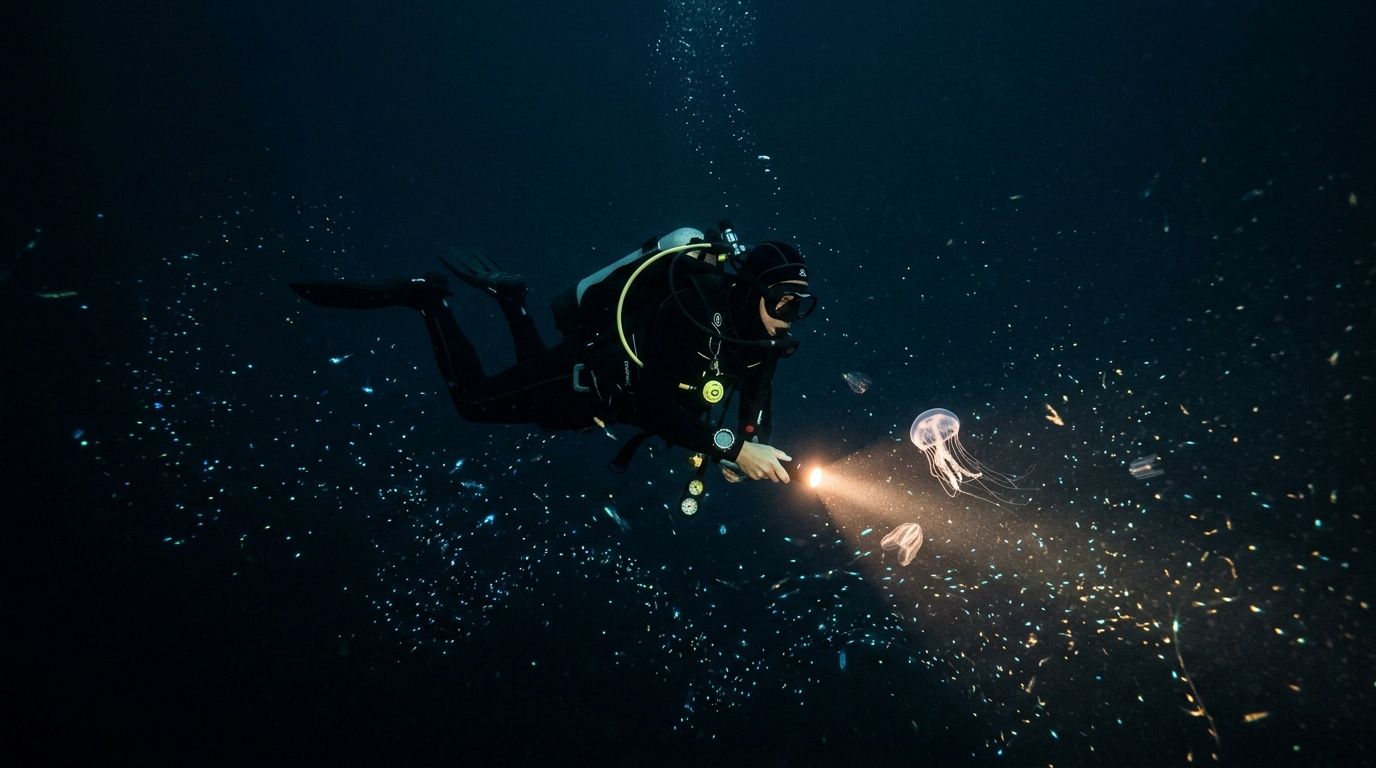
You’re probably here because regular reef diving no longer feels like enough. You’ve done night dives. You know the rhythm of a wall, a lava tube, a reef ledge under a flashlight. What you want now is something stranger, something that feels less like touring a site and more like crossing into another layer of the ocean.
That’s exactly what the kona blackwater dive is.
Off Kona, divers leave the bottom behind and drift in open water at night while deep-sea life rises out of the dark. It’s one of the few dives that can make a very experienced diver go silent afterward. Not because it’s chaotic or aggressive, but because it changes your sense of scale. You stop thinking like a reef diver and start paying attention to the water column itself.
Kona is the right place for it, and the reason isn’t hype. It’s geology, logistics, and a safety system refined by operators who do this regularly. Done well, a blackwater dive feels controlled, calm, and surreal all at once.
Plunging Into Darkness The Allure of the Kona Blackwater Dive
The first shock is how little there is to orient yourself by.
You drop in, descend to your working depth, settle onto the tether, and the reef never appears because there is no reef. Above you, the boat lights glow. Below you, there’s only black space. Your attention narrows to the beam in front of your mask, and then the parade starts.

Tiny transparent hunters drift in and out of view. Gelatinous creatures pulse like fiber optics. Larval fish appear so unfinished and bizarre that even seasoned local divers sometimes can’t name them on sight. The effect is closer to astronomy than reef diving. You aren’t scanning coral heads. You’re watching a dark field for brief flashes of life.
Why this dive leaves such a mark
A good kona blackwater dive doesn’t overwhelm you with speed. It slows you down.
That’s the trade-off many divers don’t expect. If you enter wanting a big-animal spectacle, you may miss the point at first. Blackwater rewards patience, buoyancy, and discipline. The divers who love it most are usually the ones who stop chasing and start hovering.
Field note: The less you try to force the dive, the more the dive gives you.
That’s also why many divers study a detailed operator page before committing. If you want a solid feel for the experience and the kind of structure that makes it work, the Kona Black Water Dive Adventure overview is useful. For another local perspective on the dive itself, this write-up on the black water night dive in Kona helps set expectations.
Who tends to love it most
Not every advanced diver falls for blackwater immediately. The people who usually do are:
- Macro lovers: They already enjoy small subjects and subtle behavior.
- Night divers with composure: They don’t burn mental energy on darkness.
- Photographers who like challenge: The subjects are extraordinary, but they make you work.
- Divers bored with predictable sites: Blackwater never really repeats itself.
That unpredictability is the hook. No two drifts feel the same, and no one can promise exactly what will rise into the lights.
What Exactly Is a Blackwater Dive
Most divers hear “night dive” and picture a reef after dark. That’s not this.
A blackwater dive happens in the open ocean, away from the seafloor, where divers suspend in the water column and observe pelagic organisms drifting upward through the night. You are not traversing terrain. You are hovering in midwater and letting the ocean bring the subjects to you.
Not a reef dive after sunset
On a normal night dive, the bottom does a lot of work for you. It gives you orientation, distance, and a visual frame. You can follow contours, monitor depth by instinct, and use the site itself to stay calm.
Blackwater removes all of that.
The setting is featureless except for your team, the boat, the tether rig, and the light field. That’s why experienced night divers often adapt quickly, but reef specialists who rely heavily on structure sometimes need a few minutes to settle in.
A practical comparison helps:
| Dive type | What you focus on | What guides your movement | What you’re watching |
|---|---|---|---|
| Traditional night dive | Bottom features | Reef, wall, sand, or lava | Nocturnal reef life |
| Blackwater dive | Water column | Tether, lights, buoyancy | Pelagic drifters and larvae |
If you want a second explanation from a Hawaii-specific angle, this article on the black water dive in Hawaii lays out the concept clearly.
The event you are dropping into
The biological engine behind the dive is the diel vertical migration.
Every night, deep-sea organisms rise toward shallower water to feed, then retreat again. Divers on blackwater aren’t descending into the abyss. They’re intercepting that migration at a shallow working depth while hovering over very deep water.
Think of it as a nighttime conveyor belt of fragile pelagic life. Some of what you’ll see are permanent open-ocean drifters. Some are larval animals in brief developmental stages that reef divers almost never witness. That’s why the dive feels so biologically rich even though you’re surrounded by open water.
What works and what doesn’t
The divers who get the most out of blackwater usually make a few adjustments fast:
What works
- Stillness: Small subjects tolerate calm divers better than busy ones.
- Trim and buoyancy: You need to hover without constant correction.
- Narrow attention: Watch your light cone carefully. Subjects can vanish in a second.
What doesn’t
- Wide searching patterns: Fast head-swiveling makes you miss tiny movement.
- Aggressive finning: It disturbs subjects and wastes energy.
- Treating it like a hunt: Blackwater is observation first, pursuit almost never.
The best blackwater divers look relaxed, almost lazy. That’s usually a sign they’re doing everything right.
Once that clicks, the dive stops feeling like darkness with random creatures in it. It starts to feel organized, almost readable, and far more immersive.
Why Kona is the Blackwater Diving Capital
Kona didn’t become famous for blackwater by accident. The place was built for it.
The Big Island’s volcanic slopes drop away so steeply that operators can reach water 3,000 to 10,000 feet deep in just a 2 to 3 mile run, often in under 20 minutes from the harbor according to this local explanation of Kona’s blackwater diving conditions. In most destinations, reaching that kind of abyssal depth takes a much longer boat ride. In Kona, it’s part of the normal operating reality.

Geology does the heavy lifting
This is the core reason Kona stands apart.
On the leeward side of the Big Island, the seafloor drops with unusual speed just offshore. That means operators don’t need a long transit to position divers over prime blackwater terrain. Less run time changes everything. It makes scheduling easier, reduces diver fatigue, and turns a specialized dive into something that can be run consistently instead of only on rare ideal nights.
If you’re comparing this dive to the rest of the local scene, this overview of Big Island Hawaii scuba gives broader context for why Kona keeps drawing serious divers.
Calm water matters more than people think
Access to deep water is only half the equation. You also need conditions that let crews deploy a controlled tethered drift safely and repeatably.
Kona’s leeward coast benefits from protection by the island’s volcanoes, which helps create the calm seas blackwater operations depend on. That calm doesn’t make the dive casual. It makes it manageable. There’s a difference.
Here’s what that changes in practice:
- Shorter offshore runs: Divers arrive fresher and less rattled by a long night crossing.
- More consistent operations: Crews can plan blackwater trips more reliably.
- Better working conditions for the rig: Tethers, lights, and diver positioning all benefit from a calmer surface story.
Kona also helped shape the method
Kona is widely recognized as the birthplace and global epicenter of recreational blackwater diving, with the style pioneered locally in the 1990s because the geography made it workable at a commercial level. That matters. Places can imitate the dive. Fewer places have the same combination of access, repetition, and operational history.
Operational reality: Blackwater gets safer and smoother when crews run it often. Kona’s biggest advantage isn’t just deep water. It’s deep water plus repetition.
That repetition has refined briefings, diver screening, tether procedures, and team flow. You feel that as a guest. The whole experience tends to feel less experimental and more mature.
For advanced divers, that’s a key appeal. Kona offers a dive that still feels wild while being run in a way that doesn’t.
Creatures of the Deep What You Will See
Your light drops into black water and the first animal that appears may look less like a fish than a glass machine with eyes.
That is the draw.
A Kona blackwater dive is pelagic life in transit. You are not visiting a reef community with resident animals and familiar landmarks. You are suspended above deep water, watching the nightly vertical migration bring larval and midwater creatures toward the surface. Some pass through in seconds. Some pause in the light long enough for you to study the fins, gut, eyes, and strange geometry that only make sense once you remember these are juveniles, drifters, and open-ocean specialists.

The animals that stop divers cold are often the smallest ones. Larval fish can carry long streamers, oversized eyes, mirror-like sides, or spines that disappear later in life. Tiny squid may show color changes and posture shifts that feel almost deliberate. Salps, ctenophores, and siphonophores drift through the beam with the kind of structure that makes experienced divers go silent for a moment.
A few categories show up often enough to know in advance:
- Larval fish: The stars of many dives. They rarely resemble the adults divers know from reefs.
- Gelatinous animals: Salps, comb jellies, and other transparent drifters can be delicate up close and huge in visual impact.
- Larval squid and octopus: Fast, alert, and easy to lose if your buoyancy slips.
- Crustacean larvae: Odd, armored, and frequently overlooked until you stop chasing bigger subjects.
- Colonial drifters: Siphonophores can look like a single animal until you realize you are looking at a living chain.
What makes these encounters feel so intense is scale without scenery. On a reef, a tiny subject competes with coral, fish schools, and terrain. In blackwater, the background is pure void, so a creature the size of your thumbnail owns the whole scene. Photographers love that clean frame. They also learn quickly that the same conditions punish sloppy finning and wandering lights.
The best sightings usually come to divers who settle down.
If something spectacular enters the beam, hold position first. Chasing almost always costs you more than it gains. You drift out of the working light, change your depth, and miss the next animal arriving from below or off to the side. Good blackwater divers make small corrections, track with their eyes before their fins, and let the subject cross the light field instead of trying to run it down.
That restraint changes the dive. You stop collecting glimpses and start seeing behavior.
One pass might show a larval fish trying to stay horizontal in a moving water column. Another might reveal a juvenile squid flashing and turning as it hunts. Even common sightings feel new because you are often seeing life stages that reef divers never notice in daylight. For a useful contrast, compare this pelagic parade with the reef species in what marine life you will see during Kealakekua Bay snorkeling. Both are Hawaiian wildlife experiences, but they could not look more different.
The emotional effect is real. Divers with hundreds of reef dives often come up from blackwater sounding like students again. Identification matters, but curiosity tends to come first. You notice transparency, propulsion, eye placement, and body plans that seem borrowed from science fiction and built by evolution anyway.
That same fascination draws in people who love ancient marine life on land. A Megalodon Tooth fossil taps a similar instinct. You want evidence that the ocean has always produced animals stranger than our everyday picture of it.
Kona gives you a front-row seat to that truth for one night at a time.
The Kona Honu Divers Experience Step-by-Step
The strongest blackwater operations reduce uncertainty before you ever hit the water. That matters because anticipation is often the hardest part for first-time blackwater divers.
With Kona Honu Divers, the flow tends to feel deliberate. You’re not rushed into a novelty dive and told to sort it out underwater. The evening is built around setup, briefing, control, and then observation.
Step one begins before the boat moves
The experience starts with check-in, gear organization, and a detailed briefing. Here, divers either relax or get exposed. If someone arrives underprepared, the blackwater environment will find it fast. Good crews catch those issues on land.
The briefing usually focuses on:
- The dive plan: Entry, positioning, and what the drift will feel like
- The tether system: How you clip in, where you stay, and how the group moves as one unit
- Creature expectations: Not promises, but realistic examples of what may appear
- Behavior standards: Buoyancy, light discipline, and what not to chase
Then the dive gets simpler, not more complicated
The boat run offshore is short by blackwater standards, and that helps. Long night transits can create anxiety before the dive even begins. A shorter run keeps energy levels up and usually makes the whole experience feel more focused.
Once on site, the crew deploys the tethered system and checks that each diver is clipped correctly and settled. Many first-timers realize here that the dive is more structured than they expected. Instead of “free-floating in the abyss,” you become part of a controlled drifting platform.
The dedicated black water night dive tour page is worth reviewing if you want the operator’s direct version of how the evening is organized.
Underwater, the goal is to hover and notice
After descent, the task load drops.
That surprises people. There isn’t a route to memorize or terrain to traverse. You establish position, keep your buoyancy clean, and watch the light field. The best blackwater dives have a meditative quality. Even with the occasional burst of excitement when a remarkable animal appears, the overall rhythm stays calm.
A few practical truths matter here:
- You don’t need to cover ground
- You do need to stay disciplined
- Your light is part observation tool, part attraction source
- Small corrections beat big movements every time
Guide-level advice: If you feel overloaded, stop scanning so hard. Hold your depth, look into your beam, and let the ocean work.
As the best and most-reviewed scuba company in Kona, their reputation speaks for itself:
Ready to book your spot in the abyss?
Back on the boat
The post-dive mood is usually a mix of adrenaline and disbelief.
Divers compare sightings, try to describe unidentifiable animals, and immediately realize they missed half of what was around them. That’s normal. Blackwater often gets better on the second dive because your brain finally understands what to look for.
Safety Systems and Diver Requirements
Open-ocean night diving sounds extreme because, in the abstract, it is. In practice, the kona blackwater dive is built around control.
The center of that control is the tether system. According to Kona Honu Divers’ explanation of the setup, divers clip to downlines typically 45 to 60 feet long that hang to a hover depth of 40 to 50 feet, which helps prevent disorientation and keeps divers from descending beyond 50 feet while demanding Advanced Open Water certification and precise buoyancy control on the Kona black water dive system page.
Why the tether matters so much
Without a fixed reference, open water at night can scramble even a capable diver’s sense of depth and distance.
The tether solves that problem elegantly. It gives each diver a constant positional reference while keeping the group connected to the same drifting system. The boat, rig, and divers move together. That removes the two biggest concerns people imagine first: getting separated and dropping deeper than intended.
Here’s the plain-language version of what the system does well:
- Orientation: You always know where your reference is.
- Depth control: The rig limits how far down you can stray.
- Cohesion: The group remains organized instead of spreading into darkness.
- Calmer diving: Divers don’t waste focus on where they are in space.
The divers who should say yes, and the ones who shouldn’t
This is not a beginner scuba experience. Strong operators screen for that because they know one uncomfortable diver can turn a serene dive into a stressful one for everyone nearby.
Blackwater generally suits divers who are already comfortable with the following:
- Night diving
- Open-water buoyancy control
- Task management without a bottom reference
- Taking and following precise briefing instructions
If any of those feel shaky, the right move isn’t to force it. Build the missing skill first. For a different example of why matching activity to real comfort matters, this breakdown of Captain Cook snorkel tour swim requirements makes the same point from the snorkeling side.
Blackwater Dive Requirements Checklist
| Requirement | Details | Why it's important |
|---|---|---|
| Certification | Advanced Open Water | The environment demands experience in more than basic open-water skills |
| Experience level | Prior logged diving experience and recent diving comfort | Divers need enough repetition to manage buoyancy and awareness calmly |
| Buoyancy control | Precise hovering without constant finning | Good trim protects the experience and keeps the team stable |
| Mental readiness | Comfort in darkness and open water | The setting is featureless, so composure matters |
| Listening to the briefing | Follow tether and light procedures exactly | The system works best when every diver stays disciplined |
Bottom line: The safety system works because the equipment and the diver standards support each other. One without the other isn’t enough.
Frequently Asked Questions about the Blackwater Dive
Divers usually know whether this trip pulls them in or puts them on edge. That reaction makes sense. You are descending into black open water at night, with no reef under you and no shoreline reference. For the right diver, that is the whole appeal.
Is it scary?
It can feel intense for the first few minutes.
Then the system starts doing its job. You have the downline, the illuminated water column, your guide, your team, and a clear working area. That structure settles people fast. Once the first larval fish, pelagic jellies, or paper-thin squid begin drifting through the lights, attention shifts to the animals.
Divers who dislike caves or wrecks usually handle blackwater well. The space is open, not enclosed. The challenge is psychological, not physical. Good briefings, solid buoyancy, and staying oriented to the tether system make a big difference.
What camera setup works best?
Keep it simple enough to control with one hand if needed.
Blackwater subjects are often tiny, translucent, and moving in erratic ways. A compact macro setup usually produces better results than a large wide-angle rig, especially for divers doing their first few trips. Fast autofocus helps. A focus light helps too, as long as it is aimed carefully and does not wash out the subject.
A few practical rules matter underwater:
- Choose control over size: Large camera systems get tiring in midwater.
- Prioritize fast focus: Hesitation costs shots.
- Expect missed frames: Blackwater photography has a real learning curve.
- Be selective: Pick a subject, settle your position, and work it well.
The divers who come back with the best images are usually the ones who stop chasing everything.
How does it compare with the manta dive?
They are completely different experiences.
The manta dive is stable and easy to read. You watch large animals circle through a fixed light source near the bottom. Blackwater is suspended in the water column, far offshore, with a constant stream of small pelagic life rising from depth. One feels graceful and familiar. The other feels like watching evolution happen in front of your mask.
If you want the large-animal counterpart, Kona Honu Divers also offers a manta ray dive. Many divers do both because together they show two very different sides of Kona after dark.
What about sharks?
Ask this on the boat and nobody will think twice. It is a fair question.
Sharks are possible in any Hawaiian night diving environment, including blackwater. In practice, the dive is far less dramatic than people picture from the surface. The operation is organized, the team is close, and the tethered setup keeps divers grouped in a controlled footprint. The bigger mental hurdle for most guests is the darkness itself, not shark activity.
Is it worth doing if I’m not a hardcore diver?
Yes, if you meet the prerequisites and enjoy unusual marine life.
This dive does not reward someone looking for coral scenery, easy landmarks, or big obvious subjects every minute. It rewards curiosity, patience, and good control in the water. You do not need technical training. You do need enough experience to hover calmly, follow instructions cleanly, and appreciate animals that may be only a few inches long and unlike anything you have seen before.
If that sounds like your kind of dive, blackwater often becomes the trip people talk about long after the rest of their vacation fades.
If reading about Kona’s night ocean has you thinking about getting in the water even if you don’t scuba, Kona Snorkel Trips is a smart place to start. They’re Hawaii’s highest-rated and most-reviewed snorkel company, and for travelers who want a safe, well-run marine adventure on the Big Island, their small-group trips offer an accessible way to experience Kona’s world-class ocean life.