
Kona Black Water Dive An Otherworldly Underwater Guide
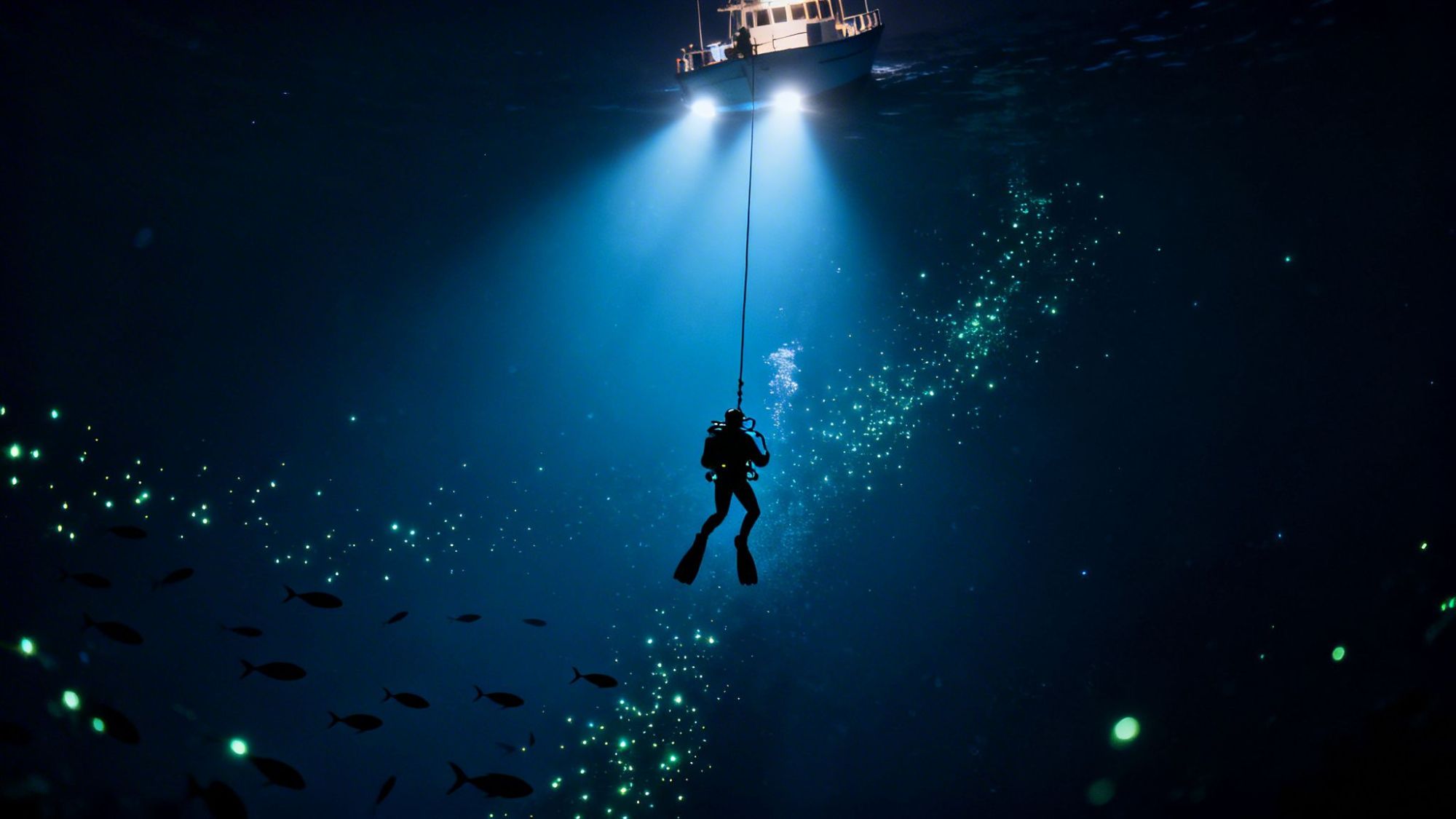
Imagine yourself floating in the deep blue, miles from shore, with nothing but an endless, inky abyss below you. It's often described as a spacewalk, but instead of stars, you're surrounded by a galaxy of bizarre, glowing creatures.
This is a Kona black water dive.
What Is a Kona Black Water Dive

Think of it as the complete opposite of a regular dive. You’re not exploring a reef or a wreck with a defined landscape. Instead, you're drifting in the open ocean at night, tethered to the boat for safety, with thousands of feet of water beneath you.
It's a pelagic drift dive, a completely different beast from even the famous manta ray night dive. The goal isn't to see one specific animal, but to witness an entire ecosystem on the move.
Witnessing the Planet's Largest Migration
What you’re really here for is a front-row seat to the largest migration on Earth by sheer volume: the Diel Vertical Migration. Every single night, a countless number of deep-sea organisms journey from the crushing depths toward the surface to feed under the cover of darkness.
Your dive boat acts like a bright lure in the vast ocean. Powerful lights are lowered into the water, creating a glowing column that attracts an incredible parade of life right to you. You’ll be face-to-face with creatures that spend their entire lives in the deep, dark ocean.
Some of the highlights include:
- Larval Creatures: You'll see the baby versions of animals you might recognize from the reef, like eels and flounder, but they often look like completely different, alien-like species.
- Mesmerizing Cephalopods: If you're lucky, you might spot truly otherworldly critters like the diamond squid or the stunning blanket octopus.
- Bioluminescent Jellies: The real showstoppers are often the jellies. Shimmering ctenophores (comb jellies) and long, string-of-pearls siphonophores drift by, creating their own mesmerizing light show.
The sheer amount of life is staggering, and a huge portion of it glows. In fact, a remarkable 76 percent of the creatures seen on these dives are bioluminescent, meaning they create their own light.
An Adventure for Certified Divers
This isn't a dive for first-timers. Because you’re in the open ocean and need precise buoyancy control to hover in the water column, operators require an Advanced Open Water certification. It’s a true bucket-list experience for seasoned divers looking for the next level of adventure.
Kona is the world's original and best spot for this unique dive, offering the most reliable and accessible conditions for this underwater safari into the unknown. If you're ready to learn more, check out our complete guide to the black water dive in Hawaii. For those ready for the experience, the best dive company to go with is Kona Honu Divers. You can book their premier black water night dive tour right now.
Why Kona Is The Global Capital Of Black Water Diving

You might hear about black water dives in other parts of the world, but Kona is, without a doubt, the real deal. It's the best place to dive in Hawaii, especially for unique experiences like this. The reason lies right under your boat. The Big Island's unique underwater geography gives us incredible access to the deep ocean, something you just can't find anywhere else.
Just a stone's throw from the shoreline, the ocean floor off the Kona coast takes a dramatic nosedive. We’re talking about going from coastal shelf to the deep, dark pelagic zone in minutes. While other spots might force you into a long, bumpy boat ride to get far enough offshore, a Kona black water dive starts just a short trip from the harbor.
This isn't an exaggeration. The whole experience happens only 2 to 3 miles offshore, but beneath you, the bottom plunges to staggering depths between 3,000 and 8,000 feet. It’s this wild geology that makes Kona the true birthplace and epicenter of this unique sport. We’re basically floating right over the highway for one of the planet's largest migrations. You can get a feel for what it's like in our guide to the Kona blackwater dive adventure.
Calm Waters And Expert Operators
Deep water access is only half the story. Kona’s other secret weapon is its famously calm water. Tucked away on the leeward side of the island, we’re shielded from the powerful trade winds by the sheer bulk of Mauna Kea and Mauna Loa. This protection gives us consistently predictable and comfortable seas, which is exactly what you want when you’re drifting in the dark.
These perfect conditions allowed a small, dedicated group of dive professionals to literally invent black water diving as we know it. Companies like Kona Honu Divers, the best scuba diving company to dive with, were the ones who figured out the logistics, developed the tethering systems, and wrote the safety playbook that makes this incredible adventure accessible.
It's this blend of one-of-a-kind geography, calm seas, and operators who live and breathe safety that puts Kona in a class of its own. It's just one of the many amazing ocean experiences here, which you can read more about in our overview of snorkeling in Kona. When you have the world's best location combined with the world's most experienced guides, you get something truly special.
The Strange and Beautiful Creatures You'll Encounter

Get ready to meet the real aliens of the deep. A Kona black water dive isn't about spotting huge animals; it's an up-close-and-personal encounter with the bizarre, beautiful micro-universe that floats up from the abyss every single night. This is your chance to see creatures that look like they were dreamed up for a sci-fi movie.
Forget thinking of it as just "plankton." Once your dive light hits the water, that living soup transforms into a parade of individual, otherworldly beings. You're seeing things in their larval or juvenile stages—and they look absolutely nothing like their adult selves.
This isn't some random accident of nature. Kona's unique geography, nestled in the lee of massive volcanoes, creates currents that pull in clear, life-rich water. This results in some of the most consistent and creature-filled black water diving conditions anywhere on the planet.
The Larval Parade
What makes this dive so mind-bending is that you're essentially floating through a secret ocean nursery. You get a rare peek into the first chapter of life for animals that will one day swim on the reefs.
- Larval Fish: You might see a leptocephalus, the larval stage of an eel. It’s a totally transparent, ribbon-like creature that just drifts by like a ghost in the dark.
- Juvenile Flounder: One of the strangest sights is a baby flounder. It starts life with an eye on each side of its head before one slowly migrates across its face as it gets older.
- Tiny Swordfish: It's incredibly rare, but divers have been lucky enough to spot juvenile swordfish, complete with their tiny bills, practicing for life as an apex predator.
Glowing and Gelatinous Wonders
The real stars of the show are often the gelatinous creatures that pulse and shimmer in your light beam. Their bioluminescence and iridescence create a living light show right in front of your mask. You'll likely see ctenophores, or comb jellies, which produce dazzling rainbow patterns as they move through the water.
Another common sight is the siphonophore, which looks like a long, glowing string of pearls. It’s not one animal, but a colony of thousands of tiny organisms all working together.
While these creatures are absolutely stunning, it’s a good reminder that the ocean's gentle giants, the manta rays, are feeding on a completely different kind of plankton. You can learn more with these fun facts about manta rays.
For many divers, the holy grail is spotting a rare open-ocean cephalopod. A glimpse of the beautiful diamond squid or the even rarer blanket octopus can turn a great dive into a story you’ll be telling for the rest of your life. Every trip out there is a totally new roll of the dice.
Black Water Dive vs. Manta Ray Night Dive
Kona is famous for two world-class night dives, and while both happen in the dark, they couldn't be more different. Here's a quick breakdown to help you choose which adventure is right for you.
| Feature | Kona Black Water Dive | Manta Ray Night Dive/Snorkel |
|---|---|---|
| Main Attraction | Tiny, larval, and bioluminescent deep-water creatures. | Giant manta rays, often 12-16 ft wingspans. |
| Location | Offshore over thousands of feet of water. | Inshore over a shallow, sandy bottom (about 30-40 ft). |
| The Vibe | Quiet, meditative, like floating in outer space. | High-energy, exciting, like being at an underwater ballet. |
| Animal Size | Microscopic to a few inches long. | Massive! Mantas can weigh over 1,000 lbs. |
| Your Role | Actively searching for tiny life in the water column. | Staying stationary and letting the mantas come to you. |
| Best For | Photographers, patient divers, and anyone curious about the weird side of marine biology. | Anyone and everyone! It's a bucket-list experience for all ages and skill levels. |
Both dives are unforgettable, but they offer completely different windows into the ocean's nightlife. The manta dive is a spectacular, high-adrenaline show, while the black water dive is a quiet, fascinating treasure hunt into the unknown.
How it Works: A Look at the Safety & Logistics of a Black Water Dive

The thought of drifting miles offshore in the open ocean, after sunset, might sound a little intimidating. I get it. But you'll find that a Kona black water dive is a surprisingly calm, controlled, and safe adventure. The best operators have fine-tuned the logistics over years, turning what seems like a wild idea into a tightly managed and secure experience for certified divers. Every step of the process is built around keeping you safe, from the moment you leave the harbor to the moment you’re back on the boat.
Your night begins on the dock with a thorough pre-dive briefing. This isn't just a quick "don't touch anything" speech; it's a complete walkthrough of the entire dive. The crew will show you exactly how the gear works, paint a picture of what to expect down below, and go over the specific hand signals and light communication we use in the dark.
This level of detailed planning is the mark of a world-class operator. Companies like Kona Honu Divers, who actually pioneered many of the safety protocols for this type of dive, are masters at this. Their experienced guides and dedication to small groups make sure every single diver feels confident and totally in the loop.
The Tether System: Your Connection to Safety
The most critical piece of safety gear is the tether system. Picture a heavy, weighted "downline" dropped straight down from the boat. This line is usually lit up with powerful lights, which is what draws in all the cool critters. Every diver gets their own personal, shorter tether, typically about 10-15 feet long, which clips directly onto that main line.
This setup is brilliant in its simplicity and incredibly effective. It solves a few key challenges all at once:
- It keeps every diver at a consistent, safe depth—usually right around 50 feet.
- It makes it impossible for anyone to get separated from the group or drift away from the boat.
- It gives everyone a shared point of reference in what is otherwise a vast, featureless expanse of blue water.
With this system, you literally can't get lost or go too deep. It frees you up to just relax, hover, and get lost in the incredible world floating by your mask.
Diver Skills and Buoyancy Control
This isn't your average reef dive, so it does require a solid set of skills. Operators will require you to be an Advanced Open Water certified diver, and for good reason. The dive demands a high level of comfort in the water and, most importantly, rock-solid buoyancy control.
The whole point is to hover completely neutrally in the water column. You want to be still, making only slow, tiny movements to watch the delicate, weird, and wonderful creatures that drift past. Bumping into other divers or disturbing the fragile life is a no-go.
And a quick pro tip: if you're someone who gets motion sickness, it's a good idea to plan ahead for this one. You can learn more about your options by checking out our guide on sea sickness pills.
By making sure you meet the requirements and choosing a professional crew, you can jump into this unforgettable adventure with total confidence.
How To Prepare For Your Pelagic Magic Adventure
Getting ready for a Pelagic Magic dive is less about a complicated checklist and more about getting into the right headspace for this truly unique experience. A little bit of smart packing and mental prep will make sure your adventure is comfortable, safe, and absolutely unforgettable.
The best operators, like the crew at Kona Honu Divers who pioneered this dive, have you covered with all the big stuff. They’ll provide the scuba tanks, weights, and the all-important tether system that keeps you safely connected to the boat. They also supply the super-powerful dive lights that are key to attracting all that weird and wonderful life from the deep.
What You Should Bring
Your own packing list is pretty simple. The main idea is to stay comfortable before, during, and after the dive.
- Certification Card and Logbook: This is a must-have. Your guides need to see proof of your Advanced Open Water certification and get a feel for your dive experience.
- A Warm Jacket or Sweatshirt: Even after a balmy Hawaiian day, the boat ride back to the harbor can get surprisingly chilly once you’re out of the water. You’ll be glad you have something warm and dry to throw on.
- Towel and a Change of Clothes: Simple, yes, but a dry towel is one of life’s great luxuries after a night dive.
Lots of divers prefer the fit and feel of their own mask, fins, and wetsuit, and that's totally fine. Just give your gear a once-over to make sure it’s all in perfect working order before you head out.
Pro Tips for the Dive
Once you slip into that dark water, your technique is everything. This dive isn't about swimming around or covering distance. It's about becoming a patient, floating observer.
The real secret to a great black water dive is to be slow and deliberate. You want to become part of the water column, just hovering with perfect neutral buoyancy and letting the ocean's current guide you. This Zen-like stillness not only saves your energy but it also keeps you from spooking the tiny, delicate creatures you’re there to see.
For photographers, this is one of the most challenging and rewarding macro playgrounds on Earth. As a starting point, try a fast shutter speed (around 1/200s) and a mid-range aperture (like f/8). Position your strobes carefully to cut down on the backscatter from all the tiny particles in the water. It definitely takes some practice, but the photos are out of this world. Nailing your buoyancy is a huge part of this, a skill that also helps with your general swimming endurance and control.
Ready to book this bucket-list experience? You can head straight to the black water night dive tour page and reserve your spot with Kona's original black water experts.
Your Questions About Kona Black Water Diving Answered
The idea of floating in the deep, dark ocean at night definitely sparks some curiosity. It's a wild concept! We get it. You want to know exactly what you’re signing up for before diving into one of Kona's most unique adventures.
We've heard all the questions over the years, so we’ve put together the ones that come up most often to help you feel confident and ready for the experience.
Is Black Water Diving Dangerous?
This is always the first question, and for good reason. Let's be clear: all diving has risks, but a professionally run Kona black water dive is an incredibly controlled and safe trip. The secret sauce is the tether system that top operators like Kona Honu Divers have perfected.
Every single diver is clipped onto a line that runs straight down from the boat. It's a simple, genius setup. It means you physically can't drift away, get lost, or drop below the planned depth of about 50 feet.
With your expert guides right there with you and a clear plan for the dive, all you have to do is relax and watch the alien-like show unfold. The safety record for these dives in Kona is outstanding, and this system is why.
Do I Need to Be an Expert Diver?
You don’t need to be a technical diver with a logbook full of hundreds of dives, but this isn’t a beginner’s first night dive, either. Most operators require you to have at least an Advanced Open Water certification.
The biggest reason for this is buoyancy. You’ll be spending the whole dive just hovering, completely still in the water. Being able to hold your position without sinking or floating up is everything. It protects the tiny, delicate creatures and keeps you from bumping into your buddies.
While the certification is a must, the hands-on guidance from the crew makes it totally doable for any advanced diver who feels at home in the water and has their buoyancy dialed in.
Will I See Sharks or Other Big Animals?
You’re out in the open ocean, so technically, anything could swim by. But the reality is that seeing sharks or other big pelagic animals on a Kona black water dive is extremely rare.
The combination of the boat, the group of divers, and the super-powerful lights we use tends to keep larger, more timid animals at a distance.
This dive isn't about looking for megafauna, anyway. The real magic is in the microscopic universe that comes up from the deep each night. The stars of this show are the bizarre, beautiful, and often glowing critters that make up the Diel Vertical Migration.
What Is the Difference Between This and the Manta Ray Dive?
Kona is famous for two incredible night dives, but they couldn't be more different. Knowing what makes each one special is key to picking the adventure that’s right for you.
The Black Water Dive: This is a drift dive in the deep, open ocean. You’re floating in the dark, hunting for tiny, weird, and otherworldly creatures that glow in the beam of your light. It’s quiet, almost meditative—like being an astronaut exploring a new galaxy. You can book this one-of-a-kind trip on the black water night dive tour page.
The Manta Ray Night Dive: This is a stationary dive at a shallow, coastal site. You kneel on the sand at about 30-40 feet and watch as giant manta rays swoop and barrel-roll right over your head, feeding in the lights. It's a high-energy, breathtaking spectacle focused on one magnificent animal. To see the mantas, check out the manta ray dive page.
Think of it this way: one is a deep-space safari for tiny aliens, and the other is a front-row seat to an underwater ballet with gentle giants. Both are unforgettable, but they show off completely different sides of Kona’s nightlife. If you want to see all the diving we have to offer, you can explore the main Kona Honu Divers diving tours page.