
Hawaii Scuba Diving: The Ultimate Island-by-Island Guide
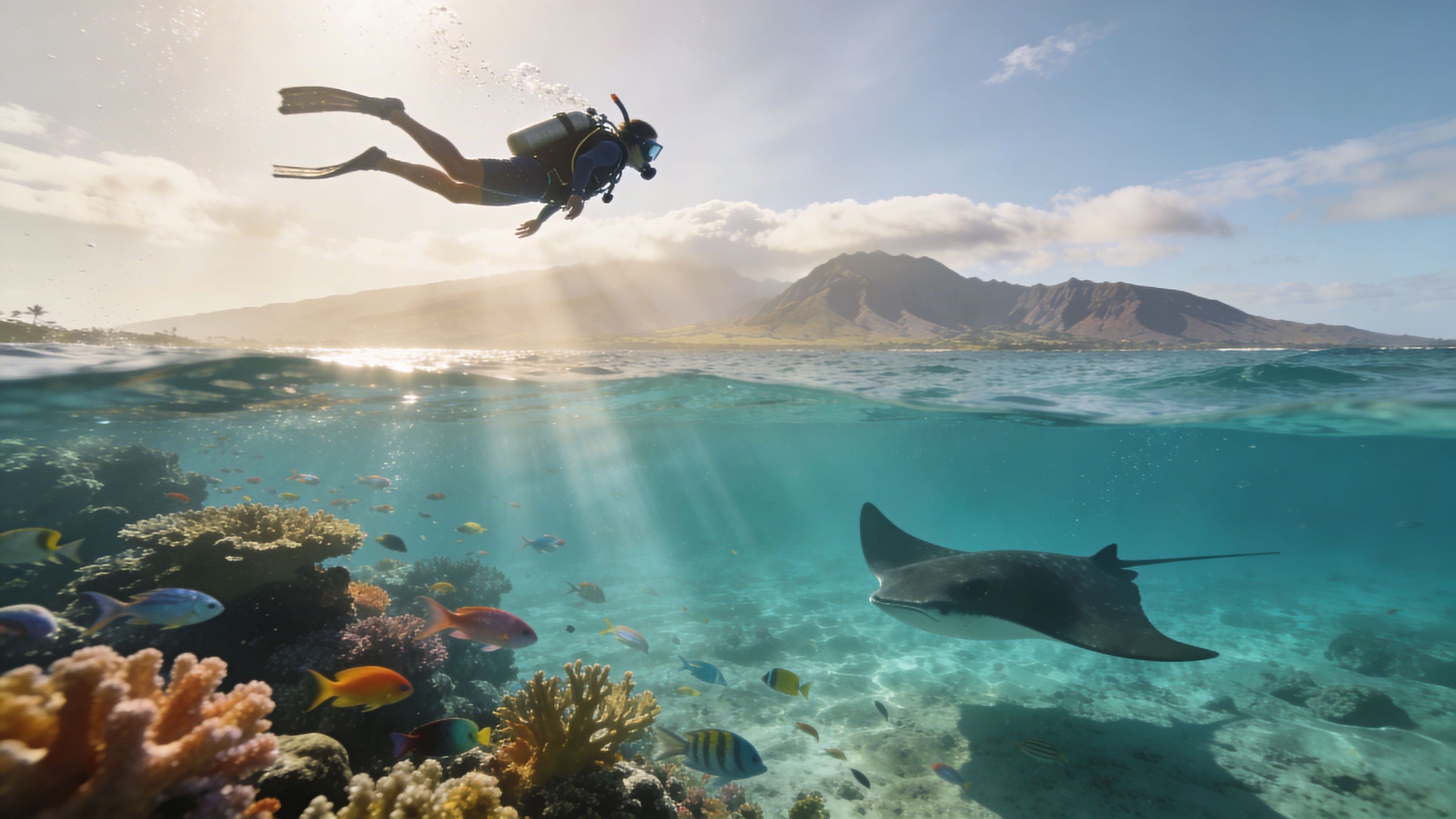
Warm water folds around you the moment you drop below the surface. Sunlight cuts through blue water in long shafts. A lava ledge comes into view, then a reef fish that exists only in Hawaii, then the sudden feeling that this is not just another tropical dive destination.
That reaction is common. Hawaii gives divers a rare mix of easy access and dramatic underwater terrain. You can make a morning boat dive through volcanic structure, spend the afternoon watching turtles cruise a reef, and finish the day talking story at the harbor while your gear dries in the trade winds.
For many travelers, the hardest part is not deciding whether to dive Hawaii. It is deciding which island fits their skill level, goals, and tolerance for changing conditions. That choice matters. Some islands are better for wrecks. Some reward advanced divers. One coast stands above the rest for reliability.
Your Underwater Adventure Begins
A first Hawaii dive often starts. You roll in, look up, and the surface turns to silver. Then the bottom sharpens into focus. Rock is not just rock here. It is old volcanic architecture. Fish move through cracks and overhangs that look carved, but were built by lava and time.

That sense of scale above and below the water helps explain why diving is woven into modern Hawaii tourism. Hawaii’s scuba diving industry contributes USD 519.9 million annually, and the state has more than 215 licensed dive shops facilitating more than 1.5 million scuba dives every year, placing Hawaii among the top scuba destinations in the United States, according to this Hawaii diving overview.
Those numbers matter, but what they mean on the ground is clear. Boats run regularly. Training is widely available. You can find beginner-friendly experiences, advanced dives, and specialist operators without hunting too hard.
If you are sorting through islands, experiences, and operators, start with a practical mindset. Match the trip to the diver. A photographer may want steady visibility. A new diver may need calm entries and simple profiles. A family may discover that scuba is not the best fit for everyone in the group. For a useful starting point, this guide to scuba dive Hawaii options is worth reviewing before you book.
Tip: The best Hawaii scuba trips come from choosing conditions first and bucket-list sites second. Divers who reverse that order often end up fighting weather, swell, or logistics.
What Makes Hawaiian Diving So Unique
A Hawaii dive starts feeling different as soon as you descend. The bottom is not a broad, gentle reef plain. It is lava country underwater, with fingers of basalt, sharp drop-offs, arches, caverns, and ledges that give even an easy dive more shape and more personality than many tropical destinations.
That geology changes how a good diver approaches the site. Buoyancy has to stay precise around rock structure. Photographers need to watch where the light falls into openings and overhangs. Navigation also takes more attention because the terrain folds and twists instead of running in one simple line. If you want a practical overview of how that plays out around the state’s strongest diving region, this guide to Big Island Hawaii scuba diving is a useful reference.
Marine life is the second reason Hawaii stands apart. The fish here do not just look good in photos. Many are species divers will not see anywhere else outside Hawaiian waters. That gives even experienced travelers a reason to slow down and study the reef instead of chasing only turtles, dolphins, or other big-animal sightings.
I tell divers the same thing on briefing after briefing. Slow the dive down.
A Hawaiian reef rewards patience. Make a second pass over the same coral head. Check the edge of the rock, then the sand beside it. Carry a fish ID card or a slate if identification interests you. Divers who rush through the site often miss what makes Hawaii biologically different.
The third factor is feel. Hawaiian diving often combines clear water, comfortable temperatures, and dramatic structure in the same dive, which makes the experience approachable for newer divers without making it boring for seasoned ones. That said, conditions are never uniform across the islands. Exposure to swell, trade wind, shore access, current, and boat run times all change the quality of the day.
This is the primary trade-off visitors need to understand. Hawaii is excellent, but it is not interchangeable. The best trip comes from matching island, coast, and dive style to the diver, not from booking the first famous site name on a brochure.
And that is why Kona keeps coming up in any serious Hawaii dive conversation. It delivers the signature parts of Hawaiian diving, volcanic topography, unique marine life, and reliable access, more consistently than anywhere else in the state.
The Big Island Kona Hawaii's Premier Scuba Diving Hub
If a diver asks for the single smartest choice for a Hawaii scuba trip, the answer is Kona.
Other islands have standout dives. Kona has the strongest overall package. It combines site density, dependable conditions, volcanic topography, and signature night diving in a way no other Hawaiian destination matches.

The Kona Coast has over 100 documented dive sites, and its geography shields it from trade winds, producing consistently calm seas and visibility often exceeding 100 feet 365 days a year, according to this look at why Kona leads Hawaii diving. The same source notes that 60% of the islands’ dive sites are concentrated in this region.
That concentration changes the entire trip. Shorter runs to sites. More backup options if conditions shift. More variety for mixed-skill groups. Less time commuting to your dive.
Why Kona beats the other islands in real-world conditions
Divers often focus on famous site names. Professionals focus on whether the boat gets to run the plan.
Kona’s lee-side position behind massive volcanoes is the reason the west coast is so dependable. Trade winds hit the island, but the coast where most divers operate sits in the protected zone. The result is practical, not theoretical:
- More reliable departures
- More stable visibility
- Less frustration for newer divers
- Better odds of completing the dives you booked
That consistency is especially valuable on a vacation schedule. If you only have two or three dive days, reliability matters almost as much as the site list.
For general charter options and training, Kona Honu Divers is the operator I would point most visiting divers toward first. They are the company many experienced divers mention when they want a crew that understands site selection, local conditions, and how to run a smooth day for mixed experience levels.
If you want a broader planning primer before narrowing down operators, this summary of Big Island Hawaii scuba lays out the regional logic well.
Signature dive one the manta ray night dive
Kona’s manta ray night dive is world famous for a reason. It is one of the few dives that still impresses people who thought they had seen everything.
Divers descend to the bottom or settle into the viewing area while lights attract plankton. Then mantas move through the beams, banking and looping overhead. The encounter is graceful rather than chaotic. Good operators control the setup so divers stay put, maintain awareness, and avoid turning the site into a finning contest.
For scuba divers who want that experience from below, the manta ray dive with Kona Honu Divers is the right place to start.
Key takeaway: The manta dive works best for divers who can stay calm, hold position, and resist the urge to chase wildlife. The less you move, the better the encounter usually gets.
Signature dive two the black water night dive
If the manta dive is Kona’s most famous underwater show, black water is its most surreal.
This is not a reef dive. It is a blue-water drift at night over deep ocean, where divers observe pelagic creatures rising from depth under darkness. The experience feels closer to space than to a standard tropical night dive. It is best for divers who are comfortable with buoyancy, darkness, and unusual visual references.
The strongest way to approach it is with a specialized operator and a proper briefing. If that is your goal, look at the black water night dive tour.
Who should choose Kona first
A simple decision table helps.
| Diver type | Best Hawaii choice | Why |
|---|---|---|
| First-time vacation diver | Kona | Calmer water and easier logistics reduce stress |
| Underwater photographer | Kona | Reliable visibility and repeatable conditions help planning |
| Advanced diver chasing unique experiences | Kona | Manta and black water dives are hard to match |
| Mixed-skill group | Kona | More site options make it easier to satisfy everyone |
Kona is not the only place worth diving in Hawaii. It is the place most likely to give you the trip you hoped for when you booked it.
Exploring the Other Islands Maui Oahu and Kauai
Choosing another island does not mean making a bad choice. It means making a more specialized one. Maui, Oahu, and Kauai each shine in a narrower lane.

If you want a quick companion read while comparing destinations, this roundup of the best diving Hawaii islands is useful.
Maui for classic reef diving and easy vacation pairing
Maui works well for travelers who want diving folded into a broader resort-style trip.
Molokini is the name many visitors know first, and with good reason. It offers the kind of clean visibility and marine sanctuary appeal that photographs well and suits recreational divers. Maui also has drift-style diving and turtle-focused reef experiences that appeal to casual vacation divers.
The trade-off is consistency. Maui can be excellent, but trip planning often requires more attention to seasonal exposure and site-specific conditions than west-side Kona.
Oahu for wreck divers
If wrecks are the main goal, Oahu deserves serious attention.
This is the island for divers who would rather descend a line onto steel than cruise a lava formation. Famous wrecks such as the YO-257 and San Pedro give Oahu a different personality from the rest of the state. The diving can feel more urban in logistics, but that is not always a negative. Some visitors like combining wreck diving with city access, restaurants, and non-diving nightlife.
The limitation is that Oahu’s best-known identity is narrower. If you want the broadest range of top-tier Hawaii scuba diving, Kona is still the safer bet.
Kauai for rugged conditions and advanced adventure
Kauai appeals to divers who do not mind earning the day.
The island can offer beautiful reef and lava structure, but it is better approached with flexibility. Conditions can be less forgiving. The legendary runs toward Ni'ihau are the kind of outings advanced divers talk about for years, but they are not casual holiday dives.
That is the core difference. Kauai can be spectacular. It can also ask more from the diver and the weather window.
A note on Hilo and the east side of the Big Island
The Big Island itself proves why coast choice matters so much.
Hilo and the east side can be lush and visually striking above water, but for diving they generally do not offer the same routine predictability as Kona. More exposure means more variance. If your priority is maximizing in-water time on a short vacation, the west side remains the strategic choice.
Tip: Pick Maui if you want a resort trip with some diving, Oahu if you want wrecks, Kauai if you want adventure, and Kona if you want the highest chance of an outstanding all-around dive vacation.
Planning Your Trip Certification Seasons and Conditions
A good Hawaii scuba diving trip starts before you board the plane. Certification level, season, and daily conditions shape the trip more than ambition does.
Certification and beginner options
Certified divers have the easiest planning path. Bring your certification card, recent dive history if the operator asks for it, and an accurate read on your comfort level.
Uncertified travelers still have options. Introductory experiences can work well for people who want to try breathing underwater without committing to a full certification course before vacation. The key is choosing calm conditions and an operator that treats the briefing as part of the experience, not as a speed bump before the fun starts.
Families should think carefully about whether everyone wants scuba. Some guests love the idea of diving, then realize they mainly want marine life encounters without task loading, equalization, and gear management.
Seasons and what they mean in practice
Hawaii diving is viable year-round, but seasons change the feel of the trip. According to this Hawaii scuba diving seasonal guide, winter months from November through April line up with humpback whale season but can bring riskier swells on windward shores. The same source notes that the calmer May through October period can cut injury rates by 25% and offer a less crowded reef experience.
That does not mean winter is bad. It means winter rewards careful site selection. On the Big Island, leeward Kona remains the most reliable call when other coastlines get restless.
A simple planning view helps:
- Winter travelers: Great for whale season, but be selective about coast and operator.
- Summer travelers: Usually get calmer water and easier days for beginners.
- Shoulder-season travelers: Often find a nice balance if schedules allow flexibility.
For travel timing beyond the diving itself, this guide on the best time to buy international flights can help if you are coordinating a longer-haul trip.
Regulations and low-impact planning
Recent conservation rules deserve attention, especially if mantas or fragile reef areas are high on your list. Visitors should expect more emphasis on group control, passive wildlife viewing, and stricter standards around how people move through sensitive sites.
A few habits make a difference:
- Ask operators how they handle marine life interactions.
- Choose briefings that cover behavior, not just logistics.
- Treat “no touch” as a hard rule, not a suggestion.
For a broader orientation before locking dates, this guide to diving Hawaii can help narrow your window.
Essential Gear Safety and Ocean Conservation
A smooth Hawaii dive day usually starts before you ever reach the boat. The divers who have the best dives in Kona are rarely the ones with the most gear. They are the ones who show up with equipment that fits, a realistic read on their skills, and enough discipline to respect the ocean on its terms.
What to bring and what to rent
For travel diving in Hawaii, bring the gear that directly affects comfort and control. Rent the heavy stuff unless you have a specific reason not to.
A good personal kit usually includes:
- Mask and snorkel: A mask that seals well is worth more than any premium label.
- Dive computer: It keeps your own profile history straight across multi-dive days.
- Exposure protection: A light wetsuit or core layer helps on repeated boat dives, especially if you chill easily.
- Fins, if they fit your style: Some divers prefer their own for frog kick control and reduced cramping.
- Defog, a save-a-dive kit, and a dry bag: Small items fix common problems fast.
Tanks, weights, and BCDs are easy to rent through a quality operator. If you are diving Kona and want a broader look at how ocean activities overlap from snorkel trips to scuba planning, this guide to snorkeling in Hawaii helps frame what to pack for both.
Safety in Hawaii means reading conditions accurately
Kona earns its reputation because the leeward coast is usually more protected than many other Hawaiian shorelines. That translates into more reliable boat departures, cleaner entries, and easier conditions for new divers than you will often find on more exposed coasts. It does not make Kona automatic, and any dive master will tell you that.
Safety is enhanced by matching the site to the diver.
Beginners usually do better on calm reef profiles with simple descents and straightforward pickups. Experienced divers can enjoy stronger current, deeper lava structure, or advanced dives like blackwater and night manta work, but only if they are current, comfortable, and paying attention. I have seen more vacation dives go sideways from pride than from weather.
Use this check before every dive day:
| Check | Why it matters |
|---|---|
| Listen to the full briefing | Entries, exits, surge, and current can change overnight |
| State your recent experience accurately | A diver with a long surface interval since the last trip needs an easier first dive |
| Watch the entry and exit before you move | Lava rock, surge, and ladders punish rushed timing |
| Confirm air, weights, and computer settings | Preventable gear mistakes create avoidable stress underwater |
| Respect surface intervals and flight timing | Vacation plans do not change decompression limits |
Calm water can fool people. A site that looks easy from the boat can still have surge on the bottom, sharp rock at the exit, or enough current to separate a distracted buddy pair.
Expert advice: Safe divers in Hawaii stay boring on purpose. They descend slowly, monitor gas early, keep their buddy close, and call the dive before small problems turn into big ones.
Conservation is part of dive skill
In Hawaii, buoyancy control is reef protection. Good trim keeps your fins off coral heads, your knees off lava ledges, and your hands off the bottom.
That matters more here than many visitors realize. Hawaiian marine life often rewards patience. Turtles settle down around still divers. Reef fish return to normal behavior when they are not chased. Mantas give the best passes to divers who hold position and let the animals control the interaction.
A responsible diver in Hawaii should:
- Use reef-safe sun protection
- Keep fins up and hands off
- Give wildlife space
- Secure gauges and accessories so nothing drags
- Choose operators that enforce standards in the water, not just in the sales pitch
That last point matters. On the Big Island, the best crews, especially experienced Kona operators like Kona Honu Divers, build conservation into the dive itself through clear briefings, strong supervision, and no-nonsense wildlife rules. That approach protects the reef and usually produces a better dive for everyone on the boat.
Amazing Snorkeling Alternatives for Everyone
Not everyone in a traveling group should scuba dive. Sometimes the smartest ocean choice is to leave the tank behind.
For many families, mixed groups, and first-time ocean visitors, snorkeling delivers more fun with less friction. It removes certification barriers, reduces gear complexity, and still puts guests face-to-face with the marine life they came to Hawaii to see.

Kona Snorkel Trips is Hawaii’s top-rated and most-reviewed snorkel company, and that reputation makes sense for travelers who want small-group attention and a crew used to helping beginners feel comfortable in the water.
Manta ray night snorkel for families and non-divers
This is the best example of snorkeling beating scuba for a specific audience.
For families and beginners, scuba is not always the strongest option. According to this discussion of beginner access and snorkeling-scuba trade-offs, snorkelers on illuminated boards during the manta night snorkel often get closer, more consistent surface views without scuba complexity. The same source ties that fit to a 15% rise in family inquiries for hybrid snorkel-scuba tours.
That matches what seasoned guides already know. If someone mainly wants a dependable manta encounter, the surface experience is often easier, calmer, and more inclusive.
You can look at the Manta Ray Night Snorkel tour in Kona for the core experience. If you are comparing options, Manta Ray Night Snorkel Hawaii is also an exceptional alternative.
Captain Cook for reef quality and daytime ease
If your group wants bright water, coral, and a classic daytime outing, Kealakekua Bay is the better fit.
Captain Cook snorkeling suits travelers who want easy wildlife viewing, historic scenery, and a strong first snorkel without the night element. It also works well for groups with varying ages and comfort levels.
For alternatives, Captain Cook Snorkeling Tours is an exceptional option to compare. That same page is also the main tour reference if Captain Cook is the experience you are after.
When snorkeling is the smarter call
Some groups should choose snorkeling first:
- Families with young or nervous participants: Less gear, less pressure, faster comfort.
- Travelers without certification: No need to build the whole vacation around training.
- Wildlife-first guests: Surface viewing can be better for certain encounters.
- Mixed-interest groups: Snorkeling keeps everyone involved.
If you are trying to sort reef snorkeling from scuba priorities, this guide to snorkeling in Hawaii helps clarify the trade-offs.
Hawaii Diving FAQ
Can I try scuba diving in Hawaii without being certified
Yes, in many cases you can. Introductory programs let non-certified guests try scuba under direct supervision. The best candidates are people who are comfortable in the water, willing to listen carefully, and not trying to force the experience because the rest of the group is diving.
If your main goal is to see marine life, snorkeling may still be the better call.
What is the difference between the manta ray dive and the manta ray snorkel
The dive puts you below the action looking up as mantas sweep through the light. The snorkel keeps you at the surface holding onto an illuminated float while mantas feed beneath you.
Neither is automatically better. Divers who love being underwater may prefer the dive. Families, beginners, and non-divers often get a more relaxed and equally memorable encounter on the snorkel.
Which Hawaiian island is best for first-time dive visitors
Kona is the strongest first choice due to its more dependable conditions and broader range of sites. That lowers the odds of weather frustration and increases the odds of getting the kind of dives you came for.
Is Hawaii better for shore diving or boat diving
Both have a place. Shore diving can be excellent for experienced locals or confident visitors who know how to assess entries and exits. Boat diving is the better default for most travelers because it simplifies access, site selection, and safety support.
How much should I budget for a day of diving in Hawaii
Prices vary by island, operator, rental needs, and whether you book standard charters or signature experiences. The practical move is to compare what is included, especially tanks, weights, rental gear, guide ratio, and travel time to the sites. Cheapest rarely means best value in Hawaii diving.
Do I need to be advanced certified for the best dives
Not always. Some of Hawaii’s most memorable dives are accessible to recreational divers with solid buoyancy and comfort in the water. Specialty dives and more demanding sites may require stronger experience, but many visitors can have an outstanding trip without pushing beyond their current skill level.
If your group includes snorkelers, non-divers, or family members who want a memorable ocean experience without scuba logistics, Kona Snorkel Trips is an excellent place to book. Their small-group approach, beginner-friendly support, and standout manta and Captain Cook tours make them a smart complement to any Big Island dive vacation.