
Hawaii Scuba: Your Guide to Unforgettable Dives
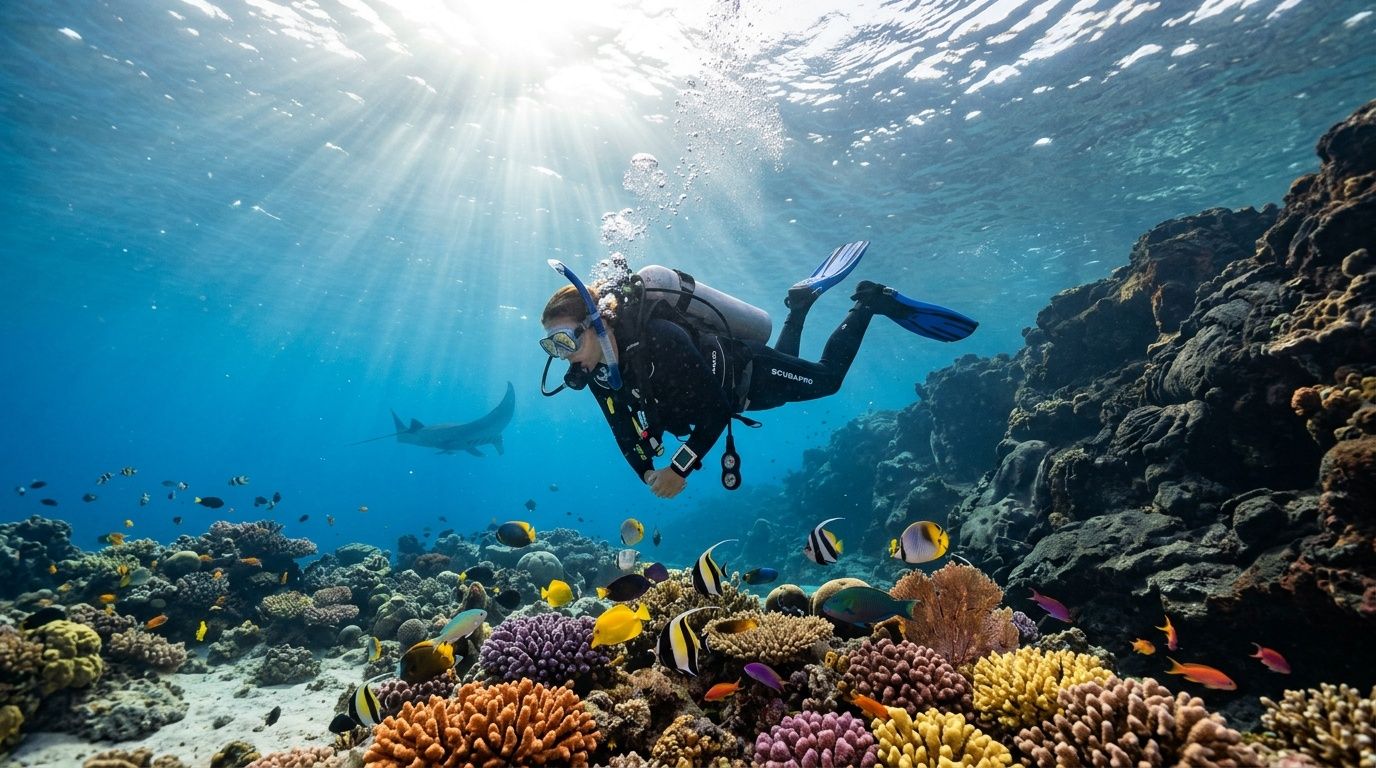
You’re probably planning a Hawaii trip right now and trying to answer one practical question. If you only have a few dive days, where should you spend them?
For most divers, the answer is Kona. Hawaii has excellent diving across the islands, but the Big Island keeps winning on the things that matter once the gear is on and the boat leaves the harbor. Calm leeward conditions, volcanic topography, memorable marine life, and dive sites that work for both newer certified divers and people with a lot more water time.
Hawaii scuba is not one single experience. It can mean an easy reef dive with turtles over lava fingers. It can mean kneeling on the bottom at night while manta rays sweep overhead. It can also mean open-ocean blackwater, where the entire visual reference changes and the dive feels like drifting through space. The trick is matching the dive to the diver, not chasing the flashiest booking page.
Welcome to Hawaii's Underwater Paradise
The first good descent in Hawaii usually resets a diver’s expectations fast. You drop through clear blue water, the lava structure sharpens below you, and the reef starts filling in with movement. Fish hold over ledges. Turtles cruise past like they own the place. The terrain looks built, not just grown.

That underwater feel comes from Hawaii’s geology. These are volcanic islands, and the diving reflects it. You’re not just swimming over coral heads. You’re moving along lava shelves, swim-throughs, drop-offs, and old formations that give even an easy dive more shape and drama than many tropical destinations.
Why divers keep coming back
Some places are fun for one trip. Hawaii tends to pull people back because the diving has range. A diver can spend one day on a relaxed reef, another on a specialty night dive, and another searching for small endemic life tucked into rock and coral.
The scale of the industry also says something about how central diving is here. Scuba diving in Hawaii was estimated at $519,887,657.47 annually in a 2023 case study, and the same NOAA-linked material notes 750 miles of coastline and over 100 dive sites per island in a state where tourism is the foremost industry (NOAA repository case study).
What makes the underwater world different
A few things define hawaii scuba more than brochures usually do:
- Volcanic structure: Lava tubes, arches, ledges, and steep contours change how each dive feels.
- Isolation: Hawaii’s marine life includes species and reef communities that feel distinct from other warm-water destinations.
- Year-round access: You can dive here in any season, though the exact trade-offs shift with water temperature and surface conditions.
Key takeaway: Hawaii earns its reputation because it combines approachable warm-water diving with underwater terrain that feels dramatic from your very first descent.
Why Kona Is the Epicenter of Hawaii Scuba Diving
If someone asks me for the single best base for hawaii scuba, I send them to Kona. Other islands offer great dives. Kona offers the strongest overall package.
The leeward coast stacks practical advantages in one place. Conditions are often more manageable. Site access is efficient. The marine life is varied. And the specialty dives are not gimmicks. They are the kind of dives people talk about for years afterward.
The case for Kona
Kona works because it reduces friction. Vacation divers do better when the operator can reliably get them to a workable site, brief the dive clearly, and match conditions to certification and comfort level. That is a bigger advantage than many visitors realize before they arrive.
Kona also rewards repeat diving. You can spend several days here without feeling like you are doing the same dive over and over.
A few reasons it stands above the rest:
- Protected leeward diving: The Big Island’s geography often helps keep Kona more diveable and more predictable than exposed coastlines elsewhere.
- Broad site variety: Reef dives, lava formations, manta encounters, and blackwater are all in the same region.
- Skill-level range: Newer certified divers can enjoy the area, while experienced divers still have plenty to chase.
The signature dives that justify the flight
The manta ray night dive is famous for a reason. Divers settle into a controlled position while lights attract plankton, and manta rays pass overhead in looping, feeding runs. Done properly, it feels organized, calm, and unforgettable. If manta diving is on your list, Kona Honu Divers’ manta ray dive page is the right place to start.
The blackwater dive is a different animal entirely. You are in open ocean at night, suspended over deep water, watching pelagic and larval creatures rise from below. It is one of the most unusual dives in Hawaii. For a good primer on what makes it so different, this guide to blackwater diving in Kona is worth reading. If you already know you want that experience, go straight to Kona Honu Divers’ black water night dive.
Why operator choice matters more in Kona
Kona sees a lot of divers. That makes operator standards matter even more. Hawaii supports over 1.5 million scuba dives yearly, and the same verified material warns that novice divers moving up from snorkeling can run into trouble with currents and lava-tube environments. It specifically highlights the value of accredited operators with strong emergency plans and disciplined in-water supervision, including Kona Honu Divers (verified reference).
For general trip planning, Kona Honu Divers’ dive tours give the clearest view of what serious Big Island diving looks like.
Tip: In Kona, the best dive day is rarely the deepest one. It’s the one run by a crew that keeps the plan clean, the group tight, and the site selection realistic.
Your Pathway to Diving in Hawaii Certifications and Training
A lot of people overcomplicate the training path. It is simpler than it looks when you break it into stages.
Some visitors only want to try breathing underwater once. Others already know they want the full certification. Both approaches can make sense in Hawaii, as long as you understand what each level allows you to do.

Start with the right entry point
If you are uncertified, an introductory experience is the usual first step. It lets you try scuba under close supervision without committing your whole trip to coursework. That is a smart choice for travelers who are curious but still figuring out whether diving will become a real hobby.
If you already know you want freedom to dive with a buddy later, go straight toward entry-level certification rather than repeating intro dives.
What the limits mean
In Hawaii, the depth caps are there for a reason. Certified recreational divers are restricted to a maximum of 60 feet, while introductory divers are capped at 40 feet, according to this explanation from Kona Honu Divers on diving in Hawaii without certification. The same source explains that these limits help manage nitrogen narcosis, which can impair cognition as depth increases.
That matters because beginners often think certification is about paperwork. It is not. It is about keeping your head clear enough to manage buoyancy, gas, equalization, navigation, and a buddy at the same time.
A practical training ladder
Here’s the progression most divers follow:
Introductory scuba experience
Best for trying scuba in a controlled setting with direct supervision.Open Water certification
This is your entry card. It opens up buddy diving within recreational limits and gives you the basic skill set to dive safely.Advanced training
Useful when you want more comfort with navigation, task loading, night conditions, and deeper profiles within recreational diving.Specialties and leadership tracks
Night diving, rescue-focused training, and pro-level paths make sense after you know what kind of diver you want to be.
For a broader look at operator options as you compare training or guided trips, this roundup of the best scuba in Hawaii operators is helpful.
What works and what does not
A few patterns show up again and again:
What works: Booking training that matches your current comfort in the water.
What works: Taking a refresher if you have not dived in a while.
What works: Treating buoyancy and gas control as the foundation for everything else.
What does not: Jumping into night or deeper dives just because they are famous.
What does not: Assuming warm water makes diving simple.
What does not: Letting vacation pressure rush your learning curve.
Expert advice: The fastest way to become a better diver is not chasing advanced sites early. It’s building calm, repeatable habits on manageable dives first.
Exploring Hawaii's Top Dive Sites Beyond Kona
Kona gets most of my recommendation bandwidth, but the rest of the state deserves real attention. If your trip is based on another island, you can still have an excellent dive vacation. You just need to know what each island does best.

Maui and Molokini
Maui’s big-name draw is Molokini, the partially submerged volcanic crater that many divers and snorkelers recognize immediately from trip photos. The appeal is straightforward. Easy visual drama, clear water on good days, and a reef environment that works well for visitors combining diving with a broader family vacation.
Maui also suits travelers who want a resort-based trip and only a couple of dive days mixed into the week.
Oahu for wreck diving
Oahu is the wreck-diving island in the Hawaiian chain. If you like artificial reefs, penetration-adjacent planning, and the visual punch of large structures underwater, Oahu brings something Kona does not focus on in the same way.
That makes Oahu appealing for divers who enjoy:
- Big structure: Sunken ships and aircraft create a different type of dive planning and navigation.
- Urban convenience: If you’re staying around Honolulu or Waikiki, the logistics are easy.
- Mixed itineraries: Oahu works well when diving is one part of a busier vacation.
Kauai and the rugged feel
Kauai feels less polished and more weather-dependent, which is part of the appeal. The underwater topography can be dramatic, and sites such as Koloa Landing have a strong following among shore divers and turtle lovers.
The trade-off is consistency. Great days are great. Tougher conditions can change the plan quickly.
Quick comparison by island
| Island | Best known for | Best fit |
|---|---|---|
| Kona, Big Island | Manta dive, blackwater, volcanic variety | Divers who want the strongest all-around hawaii scuba base |
| Maui | Molokini and vacation-friendly reef diving | Families and mixed activity trips |
| Oahu | Wrecks and convenient access | Divers who want structure-heavy dives |
| Kauai | Rugged topography and turtle-rich sites | Divers who like flexible planning |
If you want a side-by-side planning view before choosing an island, this guide to the best diving Hawaii islands is a solid comparison.
Why Kona still comes out on top
Other islands win in specific categories. Oahu for wrecks. Maui for easy vacation pairing. Kauai for a wilder feel. Kona keeps winning because it has fewer weak spots.
You get strong reef diving, famous specialty dives, reliable access, and underwater terrain that stays interesting over multiple days. That combination is hard to beat when your vacation time is limited.
What to Expect Underwater Marine Life Conditions and Gear
The underwater experience in Hawaii is not just about what you see. It is also about how the water feels, how long you stay comfortable, and whether your gear setup matches the dive plan.
That matters more than people think. A diver who is warm, trimmed correctly, and not fighting poor-fitting gear notices more marine life and uses less energy.

Marine life you’re likely to remember
Some encounters define a Hawaii trip immediately. Manta rays are the headline animal for many divers, and for good reason. Green sea turtles are common enough in the right places to stop feeling mythical and start feeling like part of the neighborhood. Reef fish add constant motion and color, and seasonal humpback whale presence changes the atmosphere of the ocean even when you never see the animal underwater.
Spinner dolphins and other pelagic life can shape the boat ride and the mood of the day, but divers do best when they treat wildlife encounters as a possibility, not a promise.
Conditions that shape the dive
Water clarity is one of Hawaii’s strongest selling points. On good days, the visibility can feel huge, which changes how relaxed a descent feels and how early you can read the site below you.
Thermal comfort deserves more respect. Kona’s water temperatures range from the high 70s Fahrenheit in summer to the low 70s in winter, and Wet Rocks Diving’s wetsuit guidance makes the important point that a 3mm wetsuit may be fine for many dives, while 5mm to 7mm exposure protection becomes the smarter choice for longer immersion or repeated dive days.
Gear choices that matter
The best gear decision is usually the simple one. Bring what affects fit and comfort the most. Rent the bulky items if needed, but do not gamble on the basics if you already know what works for you.
A practical checklist:
- Mask: A familiar mask solves a surprising number of comfort problems.
- Exposure protection: Dress for your own cold tolerance, not the brochure photo.
- Fins: Fit matters. Foot pain changes your kick, and that changes your buoyancy and gas use.
- Buoyancy setup: Keep it compact. Hawaii’s lava structure is not the place for dangling gear.
For anyone curious about the surface-side version of the manta experience, this first manta ray night snorkel guide in Kona gives useful context on conditions and expectations from above the waterline.
Key takeaway: Hawaii may look tropical, but repeated immersion still cools you down. The diver who dresses a little warmer usually has the better second dive.
Diving with Aloha Safety and Conservation Practices
Good diving in Hawaii depends on restraint. Not passive restraint. Skilled restraint.
That means divers control buoyancy before they get close to coral, keep their fins off the bottom, and stop treating marine life like something to pursue for a better photo. The ocean rewards calm divers and exposes sloppy ones fast.
Safety first, always
One fact cuts through the common assumption that snorkeling is automatically the lower-risk option. Between 2009 and 2018, Hawaii recorded 206 snorkeling-related deaths and 28 scuba diving fatalities, according to this Divernet report on Hawaiian snorkeling deaths. The point is not that one activity is “easy” and the other is “dangerous.” The point is that training, supervision, and procedure matter.
That is why reputable scuba operations insist on briefings, buddy protocols, controlled descents, and diving within certification limits.
Conservation is not optional
Hawaii’s reefs and lava-reef interfaces are more fragile than they look from the surface. Divers who want healthy sites next trip need to dive like it.
A responsible diver does the following:
- Maintains neutral buoyancy: This protects coral and also keeps silty areas from getting wrecked by fin wash.
- Keeps hands off wildlife and reef: Looking is enough.
- Avoids chasing animals: Mantas, turtles, and reef fish all give better encounters when divers hold position.
- Uses reef-conscious sun protection: Better yet, rely on physical coverage when you can.
The meaning of diving with aloha
In practice, aloha underwater means respect. Respect for the site. Respect for your buddy. Respect for local crews who know when conditions call for a plan change.
The best divers are not the ones trying to impress the boat. They are the ones who surface with plenty of gas, followed the briefing, never touched the reef, and left the site exactly as they found it.
Not a Certified Diver? Amazing Alternatives in Kona
Not everyone in your group needs a scuba card to have a standout ocean day in Kona. In fact, for plenty of travelers, snorkeling is the better fit.
Kona snorkeling works especially well for families, mixed groups, and anyone who wants access to the same marine environment without the task loading of scuba. Kona Snorkel Trips is the top rated & most reviewed snorkel company in Hawaii, and that matters for visitors who want a crew focused on safety, small-group attention, and clear instruction.
Manta ray night snorkel
For non-divers, this is the signature Kona experience. Guests hold position at the surface while light attracts plankton and manta rays feed just below. You get the drama of the encounter without needing scuba training.
If that sounds like your speed, the Kona Snorkel Trips manta ray night snorkel tour is a strong place to book. If you are comparing operators, Manta Ray Night Snorkel Hawaii is another exceptional alternative when looking for a manta ray night snorkel tour.
Captain Cook snorkeling
Kealakekua Bay is the daytime classic. Clear water, reef life, and a setting that works well for people who want a beautiful, lower-stress ocean outing. If you are researching options, Captain Cook Snorkeling Tours is an exceptional alternative when looking for a Captain Cook snorkel tour.
For a broader look at what a snorkel-focused itinerary can include, this guide to snorkeling in Kona is useful.
Hawaii Scuba Diving FAQs
Is Kona really the best place for hawaii scuba?
For most visitors, yes. It offers the strongest combination of site variety, dependable diving conditions, and access to famous specialty dives.
Can I scuba dive in Hawaii without certification?
Yes, through a supervised introductory experience with a qualified operator. You will have tighter limits and closer supervision than a certified diver.
What time of year is best?
Hawaii is diveable year-round. Summer usually feels simpler for newer divers. Winter can be excellent too, especially if you do not mind cooler water and staying flexible with site selection.
What wetsuit should I bring?
That depends on how easily you get cold and how many days you plan to dive. Many divers are happy in a lighter suit during warmer periods, but longer immersion and repeat diving often justify more insulation.
Should I choose scuba or snorkeling?
Choose scuba if you are certified and want time at depth. Choose snorkeling if you want easier logistics, a mixed-family activity, or a memorable wildlife encounter without training.
If you want to add a surface adventure to your trip, Kona Snorkel Trips offers small-group ocean experiences with lifeguard-certified guides, including manta ray night snorkels, Captain Cook trips, seasonal whale watching, and private charters.