
Your Ultimate Guide to Hawaii Scuba Diving in 2026
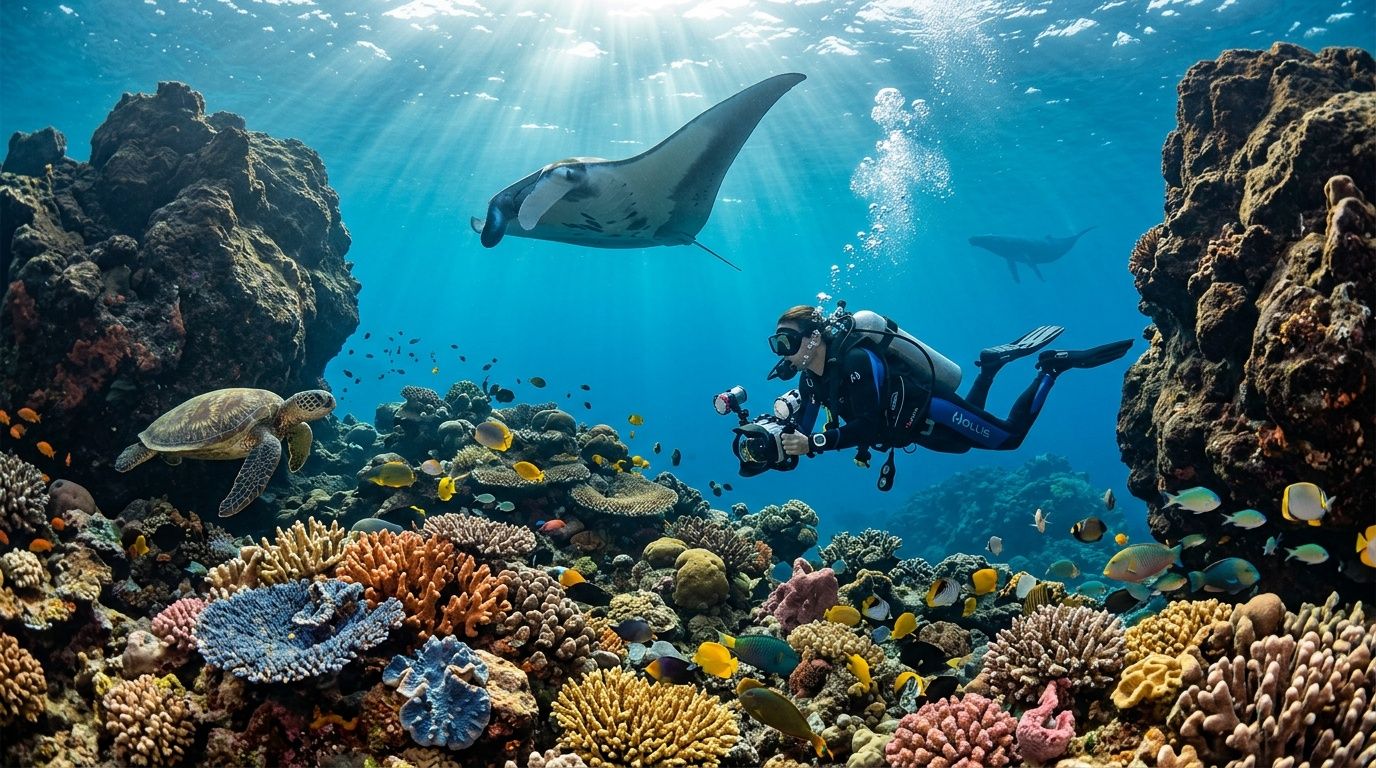
Imagine dropping into an underwater world shaped by volcanoes, a place filled with marine life you can’t find anywhere else on the planet. That’s what Hawaii scuba diving is all about. From Kona's world-famous manta ray night dives to exploring Maui's crystal-clear craters, the islands offer some of the most incredible diving experiences you'll ever have.
This is your guide to making that adventure happen.
Your Ultimate Hawaii Scuba Adventure Awaits

The Hawaiian Islands are far more than a postcard-perfect paradise; they’re a world-class diving destination. The same volcanic forces that created the islands also sculpted a breathtaking underwater landscape of lava tubes, huge caverns, and dramatic drop-offs that are now teeming with life.
Just how big is diving here? It’s a powerhouse. Divers log over 1.5 million dives every single year across the islands, supported by more than 215 licensed dive shops ready to suit up everyone from first-timers to seasoned pros. This puts Hawaii in the same league as icons like the Great Barrier Reef and cements its place among the top 10 U.S. scuba spots. All told, scuba tourism brings in over $519 million to Hawaii's economy annually.
Why Kona is the Best Place to Dive in Hawaii
While every island has its own underwater magic, the Big Island—specifically the Kona coast—is truly the best place for Hawaii scuba. The reason is simple: its leeward position protects it from the strong trade winds, giving us consistently calm, clear, and warm water all year long. It’s the kind of perfect, predictable environment that makes for great diving, no matter your skill level.
If you're serious about planning a dive trip to the Big Island, you’ll want all the details. For an in-depth look, check out the Ultimate Guide to Scuba Hawaii Big Island in 2026.
Meet Kona’s Best Scuba Diving Company
To get the most out of your time here, you need to go with the right crew. In Kona, that’s Kona Honu Divers. They've earned their reputation as the best scuba diving company to dive with by focusing on what matters: safety, conservation, and making sure every diver has an amazing experience. Their guides aren't just there to lead a tour; they're passionate ocean experts who are dedicated to showing you Hawaii's underwater world the right way.
But don't just take my word for it. Here’s what fellow divers have to say about their trips.
From the silent, graceful dance of the giant manta rays to the unforgettable songs of humpback whales, this guide will walk you through everything. We’ll cover the can't-miss dive sites, what certifications you’ll need, and how to budget for your trip. Get ready for an aquatic journey you won't forget.
Why Kona Is the Heartbeat of Hawaii Scuba Diving
Ask any seasoned diver where to go in Hawaii, and you'll hear one name over and over: Kona. While you can find great diving across the islands, the Big Island's Kona coast is simply on another level. It’s the undisputed center of the Hawaii scuba universe, and for good reason.
Kona's magic comes from its geography. Tucked away on the island's leeward side, the coast is shielded from the strong trade winds that can churn up the water elsewhere. The result? Incredibly calm, clear conditions almost year-round.
We're talking about visibility that often pushes past 100 feet, with minimal current or surface chop. This makes for diving that is just plain easier and more enjoyable, whether it's your first ocean dive or your hundredth. Below the surface, ancient lava flows have created a dramatic playground of arches, caves, and lava tubes teeming with life.
The Kona Honu Divers Difference
To really get the most out of these waters, you need to go with people who live and breathe Kona diving. That’s where Kona Honu Divers comes in. They've built a stellar reputation as the best dive shop on the island by focusing on what really matters: safety, small groups, and a genuine passion for the ocean. For general diving on the Big Island, check out their diving tours.
Their guides aren't just there to point you in the right direction. They’re skilled instructors and marine life experts who get just as excited as you do about what you’re seeing. It’s this commitment that earns them rave reviews from divers all over the world.
The team at Kona Honu Divers doesn't just take you diving; they share their love for the ocean with you. Their expertise and focus on small groups ensure that every dive feels like a private expedition, making them the go-to operator for an authentic Kona diving experience.
It’s no surprise so many people come back to dive with them year after year.
Bucket-List Dives You Can Only Do in Kona
Kona isn't just about great conditions; it’s home to dives that are truly once-in-a-lifetime experiences. These aren't just items to check off a list—they are encounters that will stick with you forever.
Two dives, in particular, put Kona on the map:
The Manta Ray Night Dive: This is the world-famous dive you’ve heard about, and it's every bit as magical as it sounds. After sunset, you descend to a sandy spot on the seafloor, turn on your dive lights, and wait. The light attracts plankton, and the plankton attracts the manta rays. Watching these gentle giants swoop and barrel roll just inches from your face is an experience that’s impossible to describe. Kona Honu Divers runs an amazing 2-Tank Manta Ray Night Dive that is an absolute must. To get a better feel for it, check out our guide to the best manta ray night dive in Kona.
The Black Water Night Dive: If you’re feeling adventurous, this is your dive. It’s like floating through outer space. You drift in the deep, dark open ocean at night, tethered to the boat, and watch as bizarre, bioluminescent creatures rise from the depths. It’s a glimpse into a hidden world of weird and wonderful pelagic life you'll never see during the day. Kona Honu Divers offers a safe and totally mind-blowing black water night dive tour.
These signature dives, combined with perfect water and expert guides like the crew at Kona Honu Divers, are exactly why Kona remains the true heartbeat of scuba diving in Hawaii.
Diving Hawaii: What The Other Islands Offer

Everyone knows Kona is the heavyweight champion of Hawaii scuba, and honestly, it’s a well-deserved title. But if you're hopping around the islands, you'll find that each one has its own unique underwater personality.
Think of it this way: knowing the dive scene on Maui, Oahu, and Kauai gives you the full picture. It helps you appreciate just why Kona's diving is in a league of its own while still having some incredible adventures along the way.
To give you a quick lay of the land, here’s a snapshot of the premier dive sites across the islands.
Top Hawaii Scuba Dive Sites At A Glance
| Island | Dive Site | Key Features | Best For |
|---|---|---|---|
| Maui | Molokini Crater | Incredible visibility, protected caldera, sheer back wall | All levels (inside), Advanced (back wall) |
| Oahu | YO-257 Wreck | Intact shipwreck, thriving artificial reef, history | Advanced Wreck Divers |
| Kauai | Sheraton Caverns | Lava tubes and arches, turtles, easy navigation | All Skill Levels |
| Big Island | Manta Heaven | World-famous manta ray night dive, high reliability | All Skill Levels |
This table gives you the highlights, but the real story is in the details of what makes each spot special.
Maui: The Underwater Volcano
When people talk about diving on Maui, they're almost always talking about Molokini Crater. It’s a partially submerged volcanic caldera just off the coast, and the water clarity here is legendary—it’s common to have visibility well over 150 feet.
The crescent shape of the crater acts as a natural barrier, protecting the inner reef from the open ocean. Inside, it feels like swimming in a giant, pristine aquarium with more than 250 species of fish. For a bigger thrill, the "back wall" is a sheer drop-off that plunges over 300 feet, attracting bigger fish and offering a fantastic drift dive for experienced divers.
Oahu: A Paradise for Wreck Divers
Oahu’s diving scene has a totally different vibe, centered heavily on history. The south shore is a wreck diver’s dream, with several ships sunk intentionally to create artificial reefs. The star of the show is the YO-257, an old Navy oiler sitting upright in about 100 feet of water.
Dropping down on the YO-257 feels like visiting an underwater museum. The ship is whole, and you can swim around the deck and pilot house, which are now completely covered in coral life. You'll often spot eagle rays, turtles, and huge schools of fish that have made it their home. The nearby San Pedro wreck is another great dive, making for a perfect two-tank wreck-diving day.
Kauai: Exploring Lava Tubes
Kauai is famous for its dramatic green cliffs and canyons above the water, and that unique geology continues below the surface. The diving here is all about incredible volcanic formations like lava tubes, caverns, and swim-through arches.
The must-do site is Sheraton Caverns near Poipu. It's a network of three big, open lava tubes that are incredibly fun and easy to explore, even for newer divers. The best part is seeing the light stream through the openings in the ceiling. It's also a favorite hangout for Hawaiian green sea turtles; you can often find a few of them just chilling inside, completely unbothered by visitors.
The Big Island: Why Kona Is Still King
After seeing what the other islands have to offer, you'll come back to the Big Island with a new appreciation for just how good the diving is in Kona. It simply has it all.
You’ve got sites like Turtle Pinnacle, a classic "cleaning station" where turtles line up to let fish clean their shells. And of course, there's Manta Heaven, home to the world-famous manta ray night dive—an experience that is truly unmatched anywhere on the planet.
But it's not just about the big names. Kona delivers an incredible density of healthy reefs, sheer walls, and truly unique dives you won't find anywhere else, like the strange and wonderful black water dive. If you're curious about that one, you can read our full guide to the black water night dive.
While every island offers something cool, Kona is the complete package. The combination of calm water, amazing visibility, and a sheer abundance of bucket-list wildlife just puts it on another level. It really is the heart and soul of Hawaii scuba.
Planning Your Perfect Hawaii Scuba Trip
So you've decided to dive in Hawaii. Great choice. Now comes the part where we map out your adventure so you can get past the logistics and get straight to the good stuff—the incredible world waiting just beneath the waves.
Think of this as your practical guide to getting everything squared away, from the right certifications to figuring out a realistic budget for your dives.
Getting Certified for the Dive
First things first, let's talk about what you'll need to actually get in the water. To join any certified dive boat in Hawaii, you need at least an Open Water Diver certification. This is your foundational ticket, teaching you all the essential skills to dive safely and confidently.
If you're dreaming of exploring a bit deeper—maybe checking out some of the unique wrecks or lava tube swim-throughs—you'll want to have your Advanced Open Water certification. Many of the more exciting sites require it.
Choosing the Best Time to Dive
One of the absolute best things about Hawaii is that there's really no "off-season" for diving. The water stays in that perfect sweet spot between 75-80°F (24-27°C) all year, usually peaking around September. Visibility is almost always fantastic, but what you see can change with the seasons.
- Summer (May-October): This is when the ocean is at its most calm and glassy, especially on Kona's leeward coast. The conditions are perfect for divers of all levels, with warm water and what feels like endless visibility.
- Winter (November-April): The water might be a touch cooler, but this is prime time for big animal encounters. The real magic happens from December to March when you can actually hear the songs of migrating humpback whales echoing through the water on your dives. It's an unforgettable experience.
This year-round draw is a huge reason Hawaii is a world-class dive destination, part of a global market that's projected to hit $1,748.5 million by 2032. The islands' reliable conditions and unique seasonal moments, like the whale songs, truly set it apart. You can discover more insights about scuba's economic impact and see how Hawaii stacks up on the world stage.
Budgeting for Your Dives
Knowing the costs ahead of time means no surprises later. Here’s a pretty standard breakdown of what you can expect to spend on the Big Island and beyond:
- Two-Tank Boat Dive: You'll typically find prices between $180 to $250 per person. This almost always includes your tanks and weights, with the rest of your gear available to rent.
- Gear Rental: If you don't have your own kit, renting a full setup (BCD, regulator, wetsuit, mask) will usually run about $50 to $75 for the day.
- Certification Courses: Looking to get certified in paradise? An Open Water course usually costs between $600 and $900, while an Advanced course is generally in the $450 to $600 range.
To make sure you have everything you need before you go, check out this excellent checklist of the Top 10 Essentials for Scuba Diving.
Honestly, though, the most important money you'll spend is on choosing a great dive operator. A top-notch company like Kona Honu Divers focuses on safety, small group sizes, and respecting the marine environment—and that makes all the difference in your experience.
If you're looking for an even more in-depth look at what goes into planning the perfect trip, we've put everything we know into our comprehensive guide to scuba diving in Hawaii.
Diving With Hawaii’s Most Iconic Marine Life

This is where the magic of Hawaii scuba really hits you. Sure, the reefs are beautiful, but the moments that stick with you forever are the face-to-face encounters with the ocean's most incredible animals. The Hawaiian Islands are a sanctuary, and when you dive here, you get a front-row seat to the greatest show on Earth.
Topping that list is an experience that has put Kona on the map for divers worldwide: the legendary Manta Ray Night Dive. It’s an otherworldly ballet that happens after dark, a spectacle you truly have to see to believe.
The Legendary Manta Ray Night Dive
Picture this: you slip into the warm, dark ocean and settle onto a sandy patch on the seafloor. Your guide flips on powerful lights that point straight up, attracting clouds of tiny plankton.
And then, they appear.
Giant manta rays, with wingspans reaching up to 16 feet, glide out of the blackness. They swoop and perform barrel rolls just inches over your head, their giant mouths wide open to filter the plankton-rich water. It's a silent, graceful dance that's both humbling and completely awe-inspiring.
This isn't just another dive; it’s an encounter that many people describe as life-changing. The best way to witness this is with a professional crew that puts the safety of both the mantas and the divers first. You can book the legendary Manta Ray Night Dive with Kona Honu Divers for a trip you will never, ever forget.
The more you know about these gentle giants, the more amazing the dive is. We always suggest divers read up on some fun facts about manta rays beforehand to really appreciate their intelligence and grace.
More Than Just Mantas
While the mantas might be the headliners, the supporting cast in Hawaii's waters is just as spectacular. You're likely to run into these characters on almost any dive.
- Honu (Green Sea Turtles): These ancient mariners are practically a guaranteed sighting. You’ll see them cruising over the reef, napping under ledges, or visiting "cleaning stations" where little fish nibble parasites and algae off their shells.
- Reef Sharks: Don't worry! The most common shark you'll see is the whitetip reef shark. They're usually shy and can be found resting under ledges during the day. Watching one glide past is a thrill, not a threat.
- Humpback Whales (in winter): From December to March, the waters come alive with the sound of humpback whales. Actually seeing one underwater is the holy grail and extremely rare, but hearing their complex, haunting songs vibrate through your chest during a dive? It will give you chills.
Responsible Diving with Kona Honu Divers
Incredible wildlife encounters like these don't just happen. They depend on a healthy ecosystem and responsible dive practices, which is why choosing the right operator is so important.
A great dive company doesn't just show you the animals; they protect them. Operators like Kona Honu Divers lead the way in conservation, teaching divers how to observe wildlife respectfully and ensuring these encounters are sustainable for generations to come.
By diving with a team that puts the ocean first, you become part of the solution. Your dive trip transforms from a simple vacation activity into a meaningful contribution, making sure the magic of Hawaii scuba is here for good.
Diving Safety and Snorkeling Alternatives for Your Group
Any trip centered around Hawaii scuba has to put safety at the top of the list. The ocean here is beautiful, but it’s powerful and absolutely commands respect.
The best way to stay safe is to always dive with a reputable, professional guide who knows the local conditions—currents, surge, and marine life—inside and out. Never dive alone, and always stay well within the limits of your certification and experience.
What if Not Everyone Dives?
It’s the classic vacation dilemma: you’re a diver, but your friends or family aren’t. You don't have to leave them sitting on the beach. Hawaii has some of the most incredible snorkeling on the planet, giving everyone a chance to share in the magic.
This way, you can get your tank time in, and then you can all create amazing ocean memories together.
The World-Famous Manta Ray Night Snorkel
One of the most mind-blowing experiences you can have in Hawaii, dive certification or not, is the Manta Ray Night Snorkel. It’s a truly spectacular alternative to the dive and works for pretty much all ages and skill levels.
Instead of dropping down to the seafloor, snorkelers hang out on the surface around a custom-lit float board. The lights attract a buffet of plankton, which in turn draws the giant, gentle mantas right up to you for their nightly feeding. It’s all the awe of the dive with none of the complexity.
For a top-notch tour, definitely check out the Manta Ray Night Snorkel in Kona. Another fantastic operator that consistently provides an outstanding adventure is Manta Ray Night Snorkel Hawaii.
Snorkeling Kealakekua Bay's Pristine Reef
Another can't-miss spot for snorkelers is the historic Kealakekua Bay, home of the Captain Cook Monument. This is a protected marine conservation district, and it shows. The water clarity is insane, and the coral reefs are some of the healthiest you'll find anywhere.
The best snorkeling spots are only accessible by boat, which makes the journey there part of the fun. A guided tour is the way to go. If you're looking for a great trip out there, Captain Cook Snorkeling Tours runs an exceptional experience.
A quick tip: the boat ride can get a little bumpy. If you or someone in your group is prone to motion sickness, be sure to plan ahead. Our guide on how to avoid sea sickness has some great advice to make sure your day is perfect.
Diving In: Your Hawaii Scuba Questions Answered
Heading out to a new dive destination always brings up a few questions. Let's tackle some of the most common things people ask before dipping their fins in Hawaii's incredible waters.
What if I’m a Brand New Diver or Feeling Anxious?
First of all, you're not alone. It's completely normal to feel a few butterflies, especially if you're new to diving. The secret is finding the right guide who gets it.
That's where outfits like Kona Honu Divers really shine. They specialize in creating a super relaxed atmosphere for first-timers. Their instructors are experts at calming nerves, taking things slow, explaining everything clearly, and never, ever rushing you. They’ll start you off in calm, shallow water, letting you build confidence one comfortable breath at a time until the coral reef becomes your playground.
What’s the Best Time of Year to Dive in Hawaii?
Honestly, there's no wrong answer here. The diving is fantastic year-round, with the water hovering at a perfect 75-80°F (24-27°C). It really just depends on what you're looking for.
- Summer (May-October): This is when you'll find the absolute calmest, glassiest seas, especially on the Kona side. It’s ideal for a super smooth and easy dive experience.
- Winter (December-March): The surface might have a bit more chop, but this is prime time for humpback whales. Hearing their songs echo through the water on a dive is a powerful, once-in-a-lifetime moment you’ll never forget.
What Makes Kona Honu Divers a Top-Rated Operator?
It really comes down to their core philosophy: safety first, small groups, and a deep, genuine love for the ocean. They just do things right.
Unlike the bigger "cattle boats" that pack people in, Kona Honu Divers keeps their groups small for a much more personal trip. It means every diver gets the attention they deserve. Their guides aren’t just leading a tour; they're passionate marine experts and patient instructors who are excited to share their world with you. You can see it in the glowing reviews they get from divers just like you.
Can I Fly on the Same Day I Dive?
Absolutely not. This is one of the most important rules in diving, and it's all about your safety.
You have to wait at least 18-24 hours after your final dive before you can get on an airplane. This is to prevent decompression sickness, which is a serious risk. Always schedule your dives for the beginning or middle of your vacation, and save that last day for relaxing on the beach.