
Hawaii Night Manta Ray Dive: Kona Adventure Guide
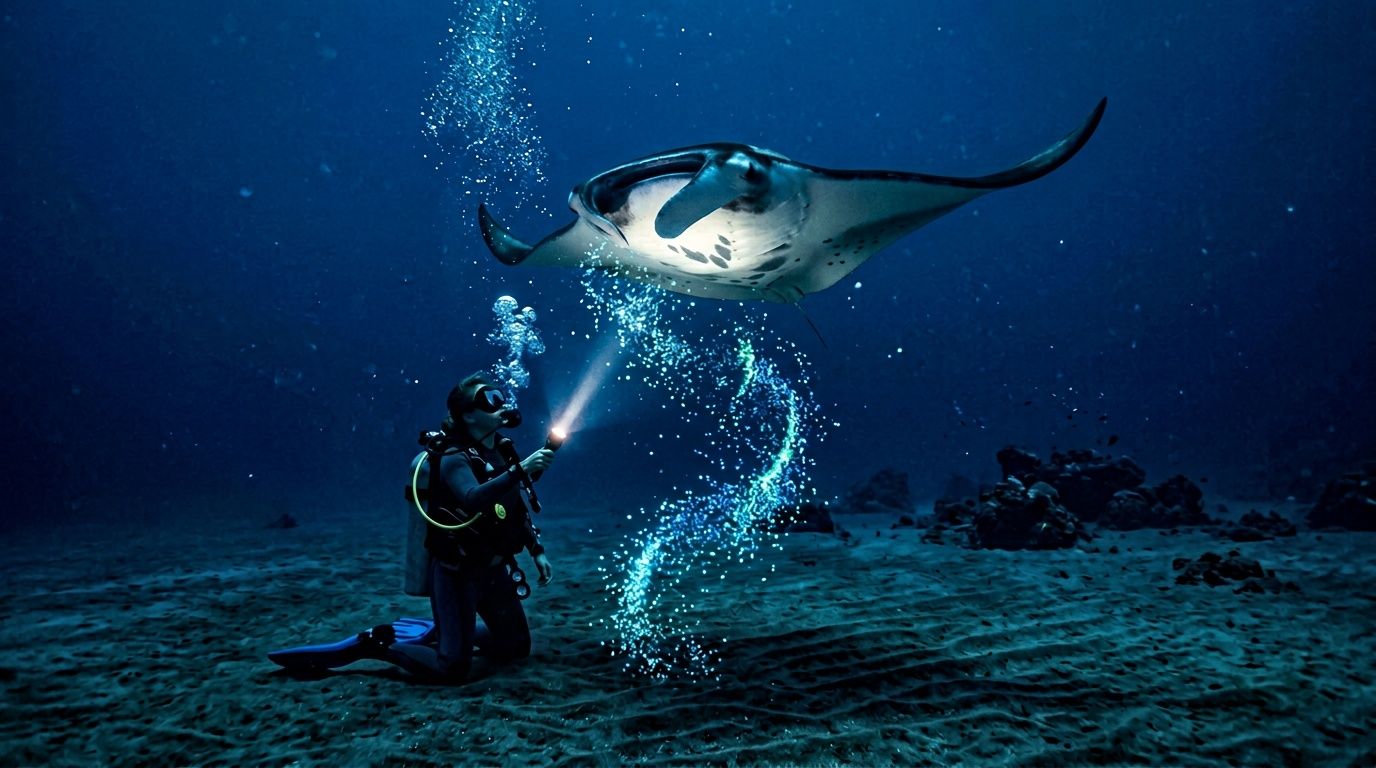
A guest gripped the float board a little tighter than necessary on the ride out and told me that the dark water was the part she wasn’t sure about. Ten minutes later she surfaced laughing, mask fogged, repeating the same sentence over and over: “They were right under me.”
An Underwater Ballet An Introduction to the Manta Ray Night Dive
The first surprise in a hawaii night manta ray dive is how quickly nerves turn into focus. The ocean feels bigger at night, but once the lights switch on and the plankton gathers, your attention narrows to the glowing water below.
Then the silhouettes arrive.
One ray appears first, then another. They sweep through the light with slow, deliberate power, then tilt into loops and barrel rolls that look choreographed. Guests call it a ballet for a reason. The movement is soft, precise, and close enough to stop conversation.

Why Kona feels different
Kailua-Kona didn’t become famous for this by accident. The manta ray night dive in Kailua-Kona draws about 80,000 visitors annually and maintains 80-90% sighting success rates year-round, which is why so many travelers treat it as a must-do wildlife experience on the Big Island (Kona manta ray night dive overview).
That reliability matters. Wildlife is still wildlife, and there are never guarantees in the ocean, but Kona gives visitors something rare. Real consistency.
For first-time guests, that consistency lowers the mental barrier. You’re not showing up for a vague chance encounter. You’re joining a well-established experience built around sites where mantas return again and again to feed.
If you want a feel for how these encounters look beneath the surface, this look at manta ray swimming underwater gives helpful visual context before you go.
What the experience feels like
A lot of people expect adrenaline. What they usually get is awe.
The water is warm by night-dive standards, the lights create a stage, and the mantas do the rest. Even guests who arrive worried about darkness, deep water, or large animals usually settle in once they see how the encounter works.
Practical rule: The moment you stop searching the darkness and start watching the light, the whole experience changes.
That’s the heart of it. You’re not chasing manta rays through the ocean. You’re waiting calmly while they come into view and feed in front of you.
And when a giant ray glides inches away, turns its wide mouth through the plankton, and disappears into black water before circling back again, it doesn’t feel like a typical tour. It feels like you were let in on something special.
The Science Behind the Magic How Manta Encounters Work
The manta show runs on biology, not luck.
Operators create a concentrated column of light. That light attracts plankton. The plankton attracts manta rays. Once that chain starts working, guests get the famous underwater “campfire” effect, with mantas sweeping through the beam to feed.

Step one, build the dinner table
The key is the photic strategy. Powerful lights attract phytoplankton, which draws in feeding mantas. As they feed, manta rays use their cephalic fins to funnel plankton toward their mouths, and operators also pay attention to moon phase because a full moon can offer the clearest visibility (how Kona night manta dives work).
That’s why guides care so much about light placement and guest positioning. The lights aren’t there just so you can see better. They’re there to create the feeding zone.
Step two, let the mantas feed naturally
Once plankton thickens in the light, the mantas move through in smooth passes. Then they tighten their turns.
This is when guests see the classic barrel rolls. A ray banks upward, opens wide, rolls through the brightest part of the plankton cloud, then circles back for another pass. If you want to understand that motion before you’re in the water, this guide to manta ray barrel rolls explained swim with giants underwater is worth reading.
Why guides ask you to stay still
Movement changes the encounter fast. When people kick too much, chase a ray, or drift into the feeding path, the whole pattern gets messy.
What works:
- Stable body position: The calmer you are, the more natural the feeding behavior stays.
- Lights aimed correctly: Snorkel and dive setups are designed to keep the brightest zone where mantas want it.
- Patience: Mantas often make repeated approaches, and the best passes happen when the group stays quiet and predictable.
What doesn’t work:
- Splashing at the surface: It creates distraction and makes nervous guests more anxious.
- Trying to touch a ray: It’s unsafe for the animal and ruins the experience for everyone nearby.
- Constant repositioning for photos: You’ll usually miss the cleanest pass while fussing with gear.
The best manta encounters happen when humans act like scenery.
Why some nights look clearer than others
Guests often assume the ocean either “has mantas” or “doesn’t.” That isn’t how it feels from the guide side.
Visibility, plankton density, swell, and moonlight all shape the experience. Some nights the water looks velvety black and the rays glow against it. Other nights the scene feels more diffuse, with more particles in the beam and a softer outline around the mantas.
The important point is that the process is consistent even when the visuals vary. The lights attract food. The food attracts mantas. The animals use specialized anatomy to feed with precision. Once you understand that chain, the whole encounter makes more sense, and it becomes even more impressive.
Choosing Your Adventure Snorkel vs SCUBA Diving
Most guests ask the same question first. Should I snorkel with the mantas, or should I dive?
The honest answer is that both are excellent, but they are not the same experience. They give you different angles, different body positions, and a different relationship to the light field where the mantas feed.
The basic difference
For divers, site planning is built around specific depths. Manta Village operates at about 35 feet, while Manta Heaven runs around 50-60 feet, and that depth standardization supports the 80-90% sighting success rate by optimizing both plankton attraction and safe diver positioning on the bottom (depth planning and sighting success).
Snorkelers stay at the surface, usually holding a lit float platform or board. Divers settle below and watch the mantas pass overhead.
Neither is better in a universal sense. One may be better for you.
Manta Ray Snorkel vs. SCUBA Dive at a Glance
| Feature | Night Snorkel | Night SCUBA Dive |
|---|---|---|
| Position in the water | Surface, holding a float board | Seafloor or designated bottom position |
| View of the mantas | Looking down as they rise into the light | Looking up as they glide overhead |
| Required certification | None | SCUBA certification required |
| Comfort level needed | Good for many first-timers | Better for certified divers comfortable at night |
| Body demand | Easier for most guests | More gear, more task loading |
| Main challenge | Being relaxed in dark open water | Buoyancy control and situational awareness |
Why many guests choose snorkeling
Snorkeling is the most accessible option. If someone in your group isn’t certified, doesn’t want to manage tanks and regulators, or wants the easiest path to seeing mantas, snorkeling usually wins.
A surface view is also dramatic in its own way. You’re suspended above the light, and the mantas rise up toward you with their white mouths open, then peel away at the last second.
That’s the format used on the Kona Snorkel Trips manta ray snorkel tour, where guests hold onto an illuminated float system and watch the rays feed below.
If you’re comparing styles in more detail, this breakdown of Kona manta ray night snorkel vs night dive pick your adventure is useful.
Another strong option when you’re looking for a night snorkel is Manta Ray Night Snorkel Hawaii.
Why divers love the bottom-up view
A manta dive feels more theatrical. You descend, settle into position, and look up into the beam as the rays sweep over your head.
That perspective is hard to beat if you’re already a comfortable diver. The animals can seem larger from below, and their turns are easier to read when you’re watching the whole body arc through the light.
The trade-off is simple. Diving asks more of you.
You need certification. You need good buoyancy control. You need to stay calm and still at night while managing equipment. If you’re rusty, the dive can feel more task-heavy than magical for the first few minutes.
For guests who want the dive version, Kona Honu Divers manta ray diving tour is a solid choice. Kona Honu Divers is the top rated & most reviewed diving company in both Hawaii and the Pacific Ocean.
What works for different travelers
- Families and mixed groups: Snorkeling is usually the cleaner fit because everyone can share the same experience.
- Certified divers who want immersion: The dive often feels richer because of the bottom-up view.
- Guests nervous about breathing underwater at night: Don’t force a dive. Snorkeling keeps the experience simpler.
- People who want the easiest logistics: Snorkeling usually means less equipment and less pre-dive complexity.
If you’re deciding between the two, choose the format that lets you stay relaxed. Calm guests notice more.
This distinction separates experiences. The best manta encounter isn’t the one that sounds most adventurous on paper. It’s the one that lets you settle in, stop managing discomfort, and watch the animals.
The Best Locations for Kona's Manta Ray Night Dive
Not every stretch of the Kona coast works for manta encounters. A few sites have the right combination of depth, seafloor, current, and feeding conditions, and those are the places operators return to again and again.
Manta Heaven
Manta Heaven, also known as Garden Eel Cove, is the site many people picture when they hear stories about huge nights. It sits farther north and often delivers the kind of big, active feeding scene that makes the water feel full of motion.
The long-term case for this site is strong. Recent logs from 2025 at Manta Heaven recorded nights with 17, 21, 31, and a standout 33 mantas, while ongoing research also identified nearly 200 resident reef mantas along the Kona coast with a 76% resight rate (Kona manta statistics and sighting logs).
That doesn’t mean every night is massive. It means the site has a proven history of abundance.
Manta Village
Manta Village is the classic southern site. It has a long reputation, calmer perception among many guests, and a setup that often feels a little more contained.
Some visitors prefer it because the experience can feel less exposed. If someone is already uneasy about being in the ocean after dark, that matters.
The contrast between these two sites is practical, not dramatic. Guides don’t choose based on romance. They choose based on conditions.
What the trade-offs look like
| Site | General feel | Typical appeal |
|---|---|---|
| Manta Heaven | More open-ocean feel | Guests hoping for bigger feeding scenes |
| Manta Village | Often feels more sheltered | Guests wanting a calmer overall setup |
If you want a deeper look at how operators think about site choice, this guide to the best manta ray night dive Kona lays out the decision factors well.
Why site selection matters less than people think
Guests sometimes get locked onto a specific site name before they even arrive. That’s usually a mistake.
The better question is whether the operator is making a smart call that night. Conditions change. Current changes. Surface texture changes. Manta behavior can concentrate differently from one area to another.
A skilled operation doesn’t chase the most famous label. It chooses the site that gives guests the safest, clearest, most respectful encounter under the conditions at hand.
Big nights get attention. Smart site choice is what produces consistently good experiences.
Preparing for Your Manta Ray Excursion
Good prep removes most of the stress before you ever step onto the boat. Guests who know what to wear, what to bring, and what the night will feel like almost always settle in faster once they’re on the water.
Wear the simple thing
Wear your swimsuit under your clothes.
That saves time, avoids awkward changing on the dock or boat, and makes the check-in flow smoother. Bring a towel and a full set of dry clothes for afterward, because the ride back can feel cool once you’re wet and the adrenaline drops.
If you want a more detailed clothing checklist, this guide on what to wear for a Kona manta ray night snorkel covers the practical basics.
Bring less than you think
Most guests overpack for this trip.
What helps:
- Towel and dry shirt: You’ll want them on the ride back.
- Waterproof camera if you already know how to use it: Night ocean conditions aren’t ideal for learning new gear.
- Hair tie or clip: Long hair and mask straps don’t cooperate.
- Motion-prep item if you’re prone to seasickness: Handle that before the boat leaves.
What usually stays in the bag:
- Extra shoes
- Valuables you don’t need
- Bulky cover-ups that get in the way
- Too much camera equipment
What the operator usually provides
For snorkeling, operators typically provide mask, snorkel, fins, flotation support, and thermal exposure gear. For diving, they provide the specialized setup needed for the site and night conditions.
That means your real job is personal comfort, not building your own system from scratch.
If you’re nervous about night water
Guides can make or break the experience. A good briefing doesn’t just explain rules. It lowers the emotional temperature in the group.
Guests who are uneasy usually do better when they focus on three things:
Your body has a job
Get in, settle in, breathe slowly, and hold position.The group has structure
You’re not drifting alone in open ocean. You’re in a managed setup with lights, guides, and a clear plan.The animals are feeding, not hunting
The mantas are there for plankton. You are not on the menu.
A calm briefing matters more than a heroic attitude. Many individuals don’t need courage. They need clarity.
Tips for families and first-timers
Families usually do best when the adults frame the trip correctly. Don’t oversell it as “wild” or “crazy.” Present it as unusual, beautiful, and guided.
For first-timers:
- Tell the crew if you’re anxious: Quiet anxiety is harder to help than visible anxiety.
- Practice breathing through the snorkel before the action starts: Small confidence wins matter.
- Expect the first minute to feel strange: That sensation fades fast once you have a visual reference.
For kids or hesitant adults, the goal isn’t to look fearless. The goal is to feel supported enough to stay present.
That’s what turns a nervous boat ride into the moment people talk about for years.
Swimming with Gentle Giants Ethical and Conservation Guidelines
A manta encounter should feel magical. It should also feel responsible.
That second part matters more now because the activity is popular, visible, and built around artificial light. Responsible operators know that excitement alone isn’t enough. Guests deserve honesty about the trade-offs.

The rules that protect the animals
The basic manta rules are simple:
- Don’t touch them
- Don’t chase them
- Don’t block their path
- Don’t dive down through the feeding lane if you’re snorkeling
- Don’t treat the encounter like a petting zoo
Those rules aren’t just etiquette. They protect the animals’ skin, reduce stress, and allow feeding behavior to stay natural.
When guests follow the structure, mantas can move through the light cleanly. When people break formation for a closer look, the experience usually gets worse for everyone, including the rays.
The harder question eco-conscious travelers ask
The fair question is this: if light draws in plankton and plankton draws in mantas, what does that mean over the long term?
That concern is legitimate. The manta encounter is often reported with an 85-95% success rate, but it also raises real ecological questions about how artificial light may affect manta behavior over time. Hawaii’s reef manta is listed as Vulnerable by the IUCN, which is why it matters to choose operators who follow strict guidelines and support monitoring efforts (ethical concerns around Kona night manta operations).
That’s not a reason to avoid the experience automatically. It is a reason to avoid careless operators.
What responsible practice looks like
A responsible operator should do more than give a quick “don’t touch” speech. Look for signs of discipline.
Good signs include:
- Clear in-water positioning rules: Guests know exactly where to be.
- Briefings that explain why behavior rules exist: People follow rules better when they understand them.
- Respect for site conditions: Trips shouldn’t push marginal conditions just to avoid a cancellation.
- A conservation mindset: The crew treats the animals as wildlife first, attraction second.
Bad signs are just as useful:
- Overpromising
- Casual handling of guest behavior
- Pressure to get closer at any cost
- Little or no educational context
Seeing mantas up close is a privilege. The encounter only stays special if operators protect the terms of that privilege.
Your role in sustainability
Guests sometimes think conservation is the operator’s job alone. It isn’t.
You help shape the encounter every minute you’re in the water. If you hold position, listen, and resist the urge to reach out for a dramatic moment, you support the kind of tourism that can coexist with wildlife.
That’s the standard eco-conscious travelers should bring to any hawaii night manta ray dive. Enjoy the spectacle. Ask hard questions. Reward operators who take the responsibility seriously.
The thrill and the stewardship belong together.
Frequently Asked Questions About the Manta Ray Night Dive
These are the questions guests ask right before booking and again right before boarding.
Are manta rays dangerous?
No. Manta rays are harmless to people in this setting.
They don’t have stingers, barbs, or the kind of anatomy people often confuse with stingrays. They’re filter feeders, and their attention is on plankton in the light.
Is snorkeling or diving better if I’m not a strong swimmer?
Snorkeling is usually the better fit.
The structure is simpler, the support is more immediate, and many guests feel more comfortable staying at the surface with flotation rather than managing scuba equipment at night. If you’re unsure, say so when booking. Good crews would rather guide the right guest into the right format than talk someone into the wrong one.
What if I’m nervous about being in the ocean after dark?
That’s common.
Night water feels unfamiliar at first because your visual references are different. The adjustment usually happens once you’re in position and focused on the lighted area instead of the surrounding darkness.
What if we don’t see mantas?
Wildlife always carries uncertainty.
Kona is known for reliability, but no ethical crew should present wild animals as guaranteed. The better approach is to book with an operator that manages expectations with integrity, chooses sites carefully, and runs the encounter well whether the action is huge or more subdued.
Is there a best time of year to do it?
Kona is known for year-round manta encounters, which is part of what makes the destination so unusual.
That means visitors don’t need to obsess over a narrow seasonal window the way they do with some wildlife trips elsewhere. Conditions still vary by night, but the experience isn’t limited to a tiny slice of the calendar.
Can kids do this?
That depends on the child, the operator, and the trip format.
A child who can listen, stay calm, and handle a boat ride may do great. A child who panics in masks, dislikes dark water, or gets cold easily may not enjoy it. Parents usually know the answer before they ask.
Should I bring a camera?
Bring one only if you’re comfortable using it in low-light water conditions.
Night encounters can be difficult to shoot well, and some guests spend the whole trip fiddling with settings instead of watching the mantas. If your camera skills are solid, great. If not, it may be better to experience the encounter directly.
How close do the mantas get?
Sometimes very close.
That’s part of why the discipline matters. The animals may pass inches away while feeding, but that closeness only works when guests stay still and let the mantas control the approach.
What should I do right before the trip?
Keep it simple.
- Eat sensibly: Don’t board overly full or on an empty stomach.
- Hydrate: Especially if you’ve been in the sun all day.
- Arrive mentally unhurried: Rushing into a night ocean activity never helps.
- Listen carefully to the briefing: The easiest guests to guide are the ones who pay attention before they hit the water.
A little composure goes a long way on this trip. The ocean does the dramatic part. Your job is to arrive ready for it.
If you're ready to experience the manta ballet for yourself, book a night snorkel with Kona Snorkel Trips. Choose the trip that fits your comfort level, listen to the briefing, and let the mantas do what they do best.