
Hawaii Manta Ray Night Dive: A 2026 Kona Guide
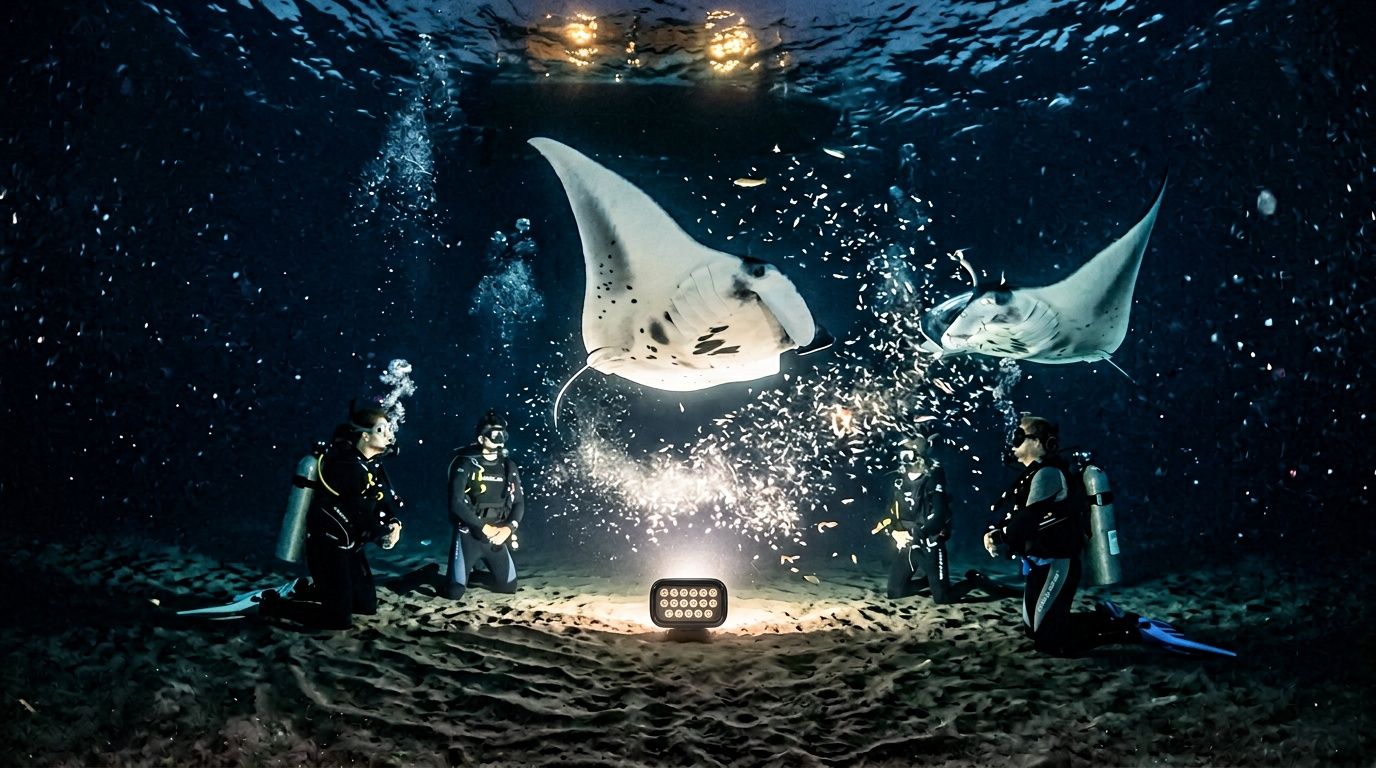
You’re probably deciding between two very different versions of the same dream. One has you floating at the surface, face down over a glowing board while mantas sweep up from the dark. The other has you on scuba, settled on the bottom and looking straight up as they pass inches overhead.
Both are unforgettable. The tricky part isn’t whether the hawaii manta ray night dive is worth doing. It’s choosing the version that fits your comfort level, your certification status, and the kind of encounter you want to remember.
The Magic of the Kona Manta Ray Night Dive
The first thing noticed isn’t the manta. It’s the darkness.
You drop into warm ocean water after sunset, lights gather below, and then a shape starts to form beyond the glow. It doesn’t rush in. It glides. A broad white underside flashes, the wings tilt, and suddenly a giant ray is looping over the light field with total control.

That’s why people talk about this dive the way they talk about major safaris or whale encounters. Kona’s manta ray night dives have 85-90% sighting success rates and a resident population of over 450 identified reef manta rays, which is why the experience is considered so reliable (Kona Honu Divers manta dive overview).
What makes it feel different
Daytime wildlife tours often involve searching. This one feels more like showing up at the right theater before the curtain rises.
The mantas know these feeding sites. Divers and snorkelers don’t chase them. You hold position, keep calm, and watch the pattern build. One ray circles. Then another. Then the whole water column turns into motion.
If you want a better sense of the acrobatics you’ll see, this breakdown of manta ray barrel rolls explained swim with giants underwater is worth reading before your trip.
The best guests on a manta trip are the quiet ones. The less you try to force the encounter, the closer it usually gets.
How It Works The Underwater Campfire Effect
You drop into dark water, settle into position, and within minutes the light beam starts to fill with life. First it looks like dust in a flashlight. Then the bait arrives. Then the mantas.
Operators create that sequence on purpose. Bright lights draw in zooplankton, and the plankton collects into a concentrated feeding patch. The rays are not being lured with bait or handled into place. They are showing up to feed where the food is easiest to find.

The setup stays in relatively shallow water, which is one reason this experience works well for both divers and snorkelers. Divers usually gather around fixed lights on the bottom. Snorkelers hold position at the surface with lights built into a float board. Same food chain. Different viewing angle.
Why divers call it an underwater campfire
The nickname fits because everyone gathers around one bright focal point and waits for the action to come to them. From a divemaster’s perspective, that controlled layout matters. It keeps people from swimming after the rays, reduces silting, and gives the mantas a predictable lane to feed through.
Good operators keep the group tight and the light field stable. Poor light discipline changes the whole feel of the encounter. If divers sweep torches around or kick up the bottom, visibility drops and the scene gets chaotic fast.
That is also why your choice between diving and snorkeling matters. The feeding behavior is the same, but the way you experience it is completely different. Divers get the dramatic upward passes. Snorkelers get the full-body view as the ray rises toward the lights from below.
What the mantas are doing
A manta banking through the beam and rolling over itself is feeding efficiently. It is lining up with the densest plankton, turning back through the light, and repeating the pass while the food remains concentrated.
That repeated loop is what guests remember.
If you know the behavior before you hit the water, the whole trip makes more sense. You stop waiting for a random wildlife sighting and start recognizing a feeding pattern. For a closer look at the local behavior behind these encounters, read why manta rays gather near Kona after dark.
One practical tip from the boat. Check your gauges and timing tools before splash, especially on night dives when small tasks take longer. A reliable computer or one of the best dive watches is more useful here than on a casual daytime reef dive because you want your attention on the mantas, not on fumbling with gear.
Practical rule: Stay still, keep your fins off the bottom, and don’t chase the ray. Calm guests get the closest passes.
Dive or Snorkel Choosing Your Manta Adventure
You arrive at the boat ramp with one question that changes the night. Do you want to float above the action, or settle in below it and watch the mantas sweep overhead?
I guide guests through this choice all the time, and the right answer usually comes down to comfort, not ambition. Both options can be excellent. The better pick is the one that matches your experience in the water, your group, and how you want the encounter to feel.
The core difference
On scuba, you descend, get stable on the bottom with the group, and look up into the lights. The rays pass over you, bank through the beam, and sometimes come so close that your whole mask is filled with manta.
On snorkel, you stay at the surface holding a light board and watch the mantas rise toward you from the dark. It is simpler physically, easier for mixed groups, and often the better call for travelers who do not want to manage scuba gear at night.
The feeding behavior is the same. Your workload is not.
Manta Ray Night Dive vs. Snorkel Experience
| Feature | Scuba Diving | Snorkeling |
|---|---|---|
| Viewpoint | Looking up from below | Looking down from the surface |
| Skill requirement | Open Water certification or equivalent | No scuba certification |
| Body position | Kneeling or settled on the sandy bottom | Floating at the surface while holding a board |
| Feel of the encounter | Immersive and theater-like | Approachable, social, and easier for mixed groups |
| Best for | Certified divers who are calm in dark water | Families, non-divers, and travelers who want a simpler setup |
Choose scuba if this sounds like you
Pick the dive if you are already certified, comfortable clearing a mask and handling your gear in low light, and want the classic Kona manta perspective. This is the more immersive version. You are part of the scene instead of observing it from above.
There is a trade-off. Night diving adds task loading. Equalizing, buoyancy, staying oriented, and monitoring gas all take more attention after dark. Guests who have not dived in a while sometimes enjoy the snorkel more, even if they are certified, because they can focus completely on the mantas instead of on procedure.
For travel prep, readable instruments help. A quick review of the best dive watches is useful if you are sorting out night-dive gear and do not want to bring more than you need.
Choose snorkel if this sounds like you
Pick the snorkel if you are not certified, if anyone in your group is uneasy about scuba at night, or if you want the lowest-stress way to see mantas feeding in the lights. From a guide's perspective, this is often the strongest choice for families and mixed-ability groups because everyone shares the same basic setup.
It also handles first-night nerves better. You climb in, hold the board, keep your face in the water, and watch the show. No equalizing, no gauges, no buoyancy work.
Guests sometimes assume snorkeling is the lesser version. It is not. You lose the upward angle from the bottom, but you gain an easy, stable view of the full animal as it rises and turns below you.
Kona Snorkel Trips runs this format, and Manta Ray Night Snorkel Hawaii is another operator many travelers compare when choosing a snorkel tour.
If you want a more detailed side-by-side breakdown before booking, this guide to the Kona manta ray night snorkel vs night dive pick your adventure explains the trade-offs in plain terms.
My rule of thumb is simple. Choose snorkeling if your priority is ease and confidence. Choose scuba if you are an active diver and want the stronger overhead passes.
Planning Your Manta Ray Tour A Logistics Guide
You book the tour, show up at the harbor at sunset, and realize the night gets easier or harder based on a few choices you made hours earlier.
This is the primary planning aspect for manta trips. The water part is simple when the setup matches your comfort level. Trouble usually starts on land. Guests book scuba when they are rusty at night, arrive overpacked, eat a heavy dinner, or forget that a wet boat ride home can feel chilly even in Hawaii.
A typical evening runs on a tight, familiar schedule. You check in, sign waivers, and listen to the briefing. Then comes a short boat ride to the site, often with enough light left for a great Kona sunset. The manta viewing session is the main event, and after that the ride back is usually quieter for a few minutes because everyone is still processing what they just saw.
The in-water portion is usually under an hour, which is long enough to get a strong encounter without turning the night into an endurance test.
Timing matters more than many visitors expect. If you have flexibility, book your manta tour early in your trip rather than saving it for the last night. That gives you room to adjust if weather or ocean conditions force a change. Calmer conditions are often easier to find in the flatter summer stretch, but mantas are not a summer-only experience, so I would focus more on operator quality and your own schedule than on chasing a perfect month.
Pack light.
Bring a swimsuit, a towel, a dry change of clothes, and a light layer for the ride back. Leave bulky bags, extra electronics, and valuables in your room unless you know exactly why you need them. Night docks are dark, boats are wet, and simple is better.
Planning also changes depending on whether you chose diving or snorkeling. Divers should be honest about current skill level, comfort in the dark, and whether carrying a camera will distract from buoyancy and awareness. Snorkelers should think about surface comfort. You will spend time face-down, holding position, and watching patiently rather than swimming around.
For check-in flow, parking, and what the harbor process feels like before departure, this guide to Kona manta snorkel check-in at Honokohau Harbor helps set expectations.
One last divemaster tip. If your group is split between confident divers and hesitant first-timers, do not force everyone into the same format just for convenience. The better call is the one that keeps the least comfortable person relaxed. That usually leads to the better manta night for the whole group.
Responsible Tourism Protecting Hawaii's Gentle Giants
The manta encounter works because the animals keep returning and the operators keep the interaction controlled.
That only holds up if guests treat it like wildlife viewing, not a thrill ride. The biggest mistake visitors make is assuming a close pass means the manta wants contact. It doesn’t. It wants plankton.

Why operator choice matters
Overcrowding can create unregulated traffic that’s hazardous to both people and mantas, and smaller-group formats, including canoe-based options limited to 6 guests or small-group boat tours, can reduce impact and improve safety (overcrowding and safer operator choices for manta tours).
That’s the trade-off many first-time visitors miss. A cheaper, higher-volume trip can still put you in the water with mantas. It can also feel chaotic during entry, exit, and surface positioning.
Manta manners that actually matter
- Don’t touch: Mantas should never be handled, redirected, or petted.
- Stay in your lane: Divers hold position on the bottom. Snorkelers stay with the board and avoid kicking down into the action.
- Let the ray choose the distance: The closest passes happen when people stop trying to make them happen.
- Protect the water, too: Reef-safe choices matter before and after the tour. These reef-safe sunscreen tips for snorkeling Big Island Hawaii are worth following.
Good manta etiquette isn’t restrictive. It’s the reason the encounter still feels wild.
When people ask me what separates a polished operation from a sloppy one, I look at spacing, briefing quality, and whether the crew keeps guests calm without turning the whole thing into a cattle call.
Book Your Once-in-a-Lifetime Manta Experience
You are on the boat after sunset, mask in hand, and the only question that still matters is whether you want to watch the mantas from the surface or from the sand. Make that call first. Everything else gets easier once the format matches your comfort, certification, and the kind of view you want.
I tell guests the same thing every week in Kona. Choose the experience, then book the operator that runs that experience well. A good snorkel trip is still the wrong pick for a certified diver who wants the classic bottom view. A scuba charter is also the wrong choice if anyone in your group is uneasy underwater, not certified, or wants the easier option.
For certified scuba divers
Book the dive if you are certified, comfortable at night, and want the full underwater perspective. You descend, settle in, and watch the rays sweep overhead while the lights draw in plankton. It is quieter, more immersive, and for many divers, this is the version they came to Hawaii for.
Kona Honu Divers runs the scuba format for guests who want that bottom-up manta encounter.
For snorkelers and families
Choose the snorkel if you want a simpler evening with less task loading. This is usually the right fit for non-divers, mixed groups, teens, and anyone who feels excited about mantas but less excited about being underwater after dark. You stay at the surface, hold position with the light board, and watch the mantas rise toward you.
Kona Snorkel Trips offers the surface version, which is often the better match for families and first-timers.
Frequently Asked Questions
Is the hawaii manta ray night dive safe?
With a reputable operator, it’s a controlled activity with a clear briefing, guided positioning, and a known site setup. The key is choosing the version that matches your ability. Certified divers should dive. Non-divers should snorkel.
Will I have to swim hard?
Usually not. The goal isn’t to chase mantas. It’s to get into position and stay calm there. Snorkelers need to be comfortable floating at the surface. Divers need to be comfortable descending, settling in, and managing standard scuba tasks at night.
Are manta rays dangerous?
They’re large, but they aren’t aggressive predators. The main concern isn’t attack. It’s guest behavior. Kicking, reaching, crowding, and poor positioning create most of the avoidable problems.
Should I bring a camera?
Yes, if you already know how to use it in low light and you won’t let it distract you. If you’re debating between photos and video, many guests find video more forgiving in these conditions. If managing a camera adds stress, leave it behind and watch with your own eyes.
What if I’m nervous about being in the ocean after dark?
That’s common. Snorkeling is the better entry point if nerves are part of the equation. You stay at the surface, you’re close to the group, and the structure is simple. If your anxiety centers on breathing underwater or task loading, don’t force scuba.
What should I wear on the boat?
Keep it simple. Swimsuit, light layers, and dry clothes for after. Many feel colder on the ride back than they expected.
Should I book this early in my trip or later?
Early is usually better. If conditions shift, you may have more room to reschedule. It also removes the pressure of trying to squeeze a signature activity into your last free night.
If you’re ready to see mantas in Kona with a crew focused on safe, small-group ocean experiences, Kona Snorkel Trips is a practical place to start.