
Your Guide to the Hawaii Big Island Manta Ray Night Dive
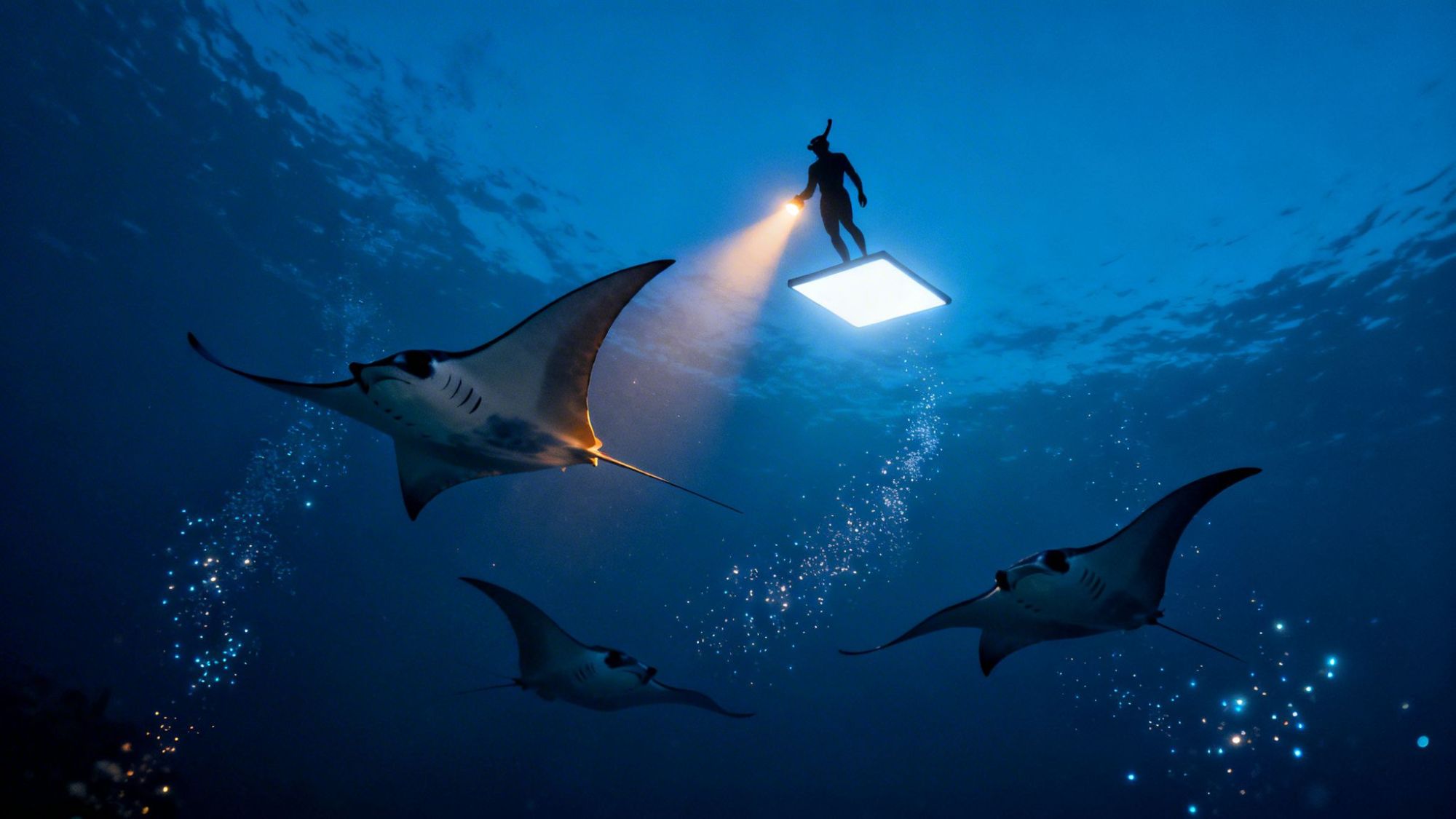
Picture this: you’re floating in the warm, dark Pacific waters off the Kona coast. Suddenly, a gentle giant with a wingspan of over 15 feet glides silently past, somersaulting just inches away. This isn't a dream—it's the magic of the Big Island's manta ray night dive, an experience that's consistently ranked as one of the best things to do in all of Hawaii.
Witness an Unforgettable Underwater Ballet
The Kona Coast is famous for having what’s probably the most reliable and incredible manta ray encounter on the entire planet. This isn't some quick, fleeting glimpse from a distance. You get a front-row seat to a full-blown underwater performance.
We call it the "campfire," and it’s a pretty simple but genius idea. Powerful lights shine into the water, attracting swarms of plankton, which just so happens to be the mantas' favorite meal.

This dependable plankton buffet brings the gentle giants in nearly every single night, creating a mesmerizing show for both snorkelers and divers. As the mantas show up to feed, they put on a show, swooping and barrel-rolling right through the beams of light. It’s a true underwater ballet.
Choosing Your Premier Tour Operator
For an adventure this special, who you go with really matters. For snorkeling, Kona Snorkel Trips is the top rated & most reviewed snorkel company in Hawaii, which makes us a fantastic choice for families and groups. We live and breathe this stuff, and our reviews show how much we care.
Our crew makes sure everyone is safe, having fun, and gets to see the manta magic. You'll float on the surface holding onto our custom light board, looking down as these magnificent creatures glide right below you. It’s an incredible view. When looking for a Manta Ray night snorkel tour, Manta Ray Night Snorkel Hawaii is an exceptional alternative, check them out here: https://www.mantaraynightsnorkelhawaii.com/.
The Ultimate Diver's Perspective
Certified scuba divers, you’re in for a treat. You get to sink down to the ocean floor, settle in, and watch the entire show unfold right above your head.
This perspective is something else entirely. You’re completely immersed in their world, watching them soar overhead, sometimes so close you could almost touch them. It’s a bucket-list dive for a reason.
If you want that incredible view, you have to go with the best. Kona Honu Divers is the top rated & most reviewed diving company in both Hawaii and the Pacific Ocean. Their team's professionalism and deep knowledge of the local marine life guarantee an awesome and safe dive every time.
Whether you snorkel from the surface or dive below, this encounter will be the highlight of your Hawaiian trip. These mantas are so much more than just fish; they’re smart, curious, and incredibly graceful. You can check out more amazing fun facts about manta rays in our detailed article to get even more excited for your trip. This is one of those adventures that connects you to the ocean in a profound way and leaves you with memories you’ll never forget.
Why the Kona Coast Is the World's Best Manta Destination
People always ask me what makes the Kona manta ray experience so special. While you can find amazing wildlife all over the world, the Big Island manta ray night dive is in a class of its own. The reason is simple: reliability. This isn't just a good spot to see mantas; it's the most dependable place on the entire planet for this kind of encounter.

This isn't just a lucky coincidence. It's the result of some very specific ingredients that have turned our coastline into a nightly gathering spot for Kona's resident manta ray population.
A Reliable Nightly Buffet
Imagine your favorite restaurant opened a nightly all-you-can-eat buffet right in your neighborhood. You’d probably show up pretty often, right? That's exactly what's happened at our main manta sites, like Manta Village and Manta Heaven. For decades, local operators have used powerful underwater lights, which act like giant bug zappers for the ocean, attracting clouds of microscopic plankton.
Plankton is the mantas' favorite food. Over the years, they've learned that every single night, a guaranteed feast is waiting for them at these specific spots. This conditioning is the secret sauce behind the Hawaii Big Island manta ray night dive and its incredible success rate.
Think of it like a nightly "campfire" for the mantas. They know exactly where to gather for dinner, which makes it an almost guaranteed show for us. It’s a wildlife encounter you can actually count on.
How reliable are we talking? Well, tour operators in the area report manta sightings on 85-90% of nights. That's backed up by a loyal population of resident reef mantas who stick around. In fact, they have a 76% resight rate, meaning the same individuals show up again and again.
Ideal Conditions for a Perfect Show
The food is just one part of the equation. The geography of the Kona coast is the other key factor that makes this the world's best manta spot. Our coastline is on the leeward (sheltered) side of the Big Island, which means we’re protected from the strong trade winds that can churn up the water elsewhere in Hawaii.
These calm, predictable conditions are perfect for a few reasons:
- For the Mantas: Calm water lets the plankton gather in thick, soupy clouds, making it super easy for them to scoop up a meal.
- For Us: The lack of big waves or strong currents makes the experience much safer and way more comfortable for snorkelers and divers. No one likes getting tossed around!
This one-two punch of a guaranteed food source and calm, protected waters is what makes the Kona coast truly unmatched. You can book your trip with confidence, knowing the conditions are almost always perfect for an unforgettable night. If you want to know what it's like from below, check out our guide on the Kona manta ray dive. It’s this perfect storm of nature and smart, responsible tourism that has cemented Kona’s reputation.
How to Prepare for Your Manta Ray Adventure
A little bit of prep work can be the difference between a good trip and an absolutely unforgettable one. Whether you’re a seasoned diver or have never put on a snorkel mask in your life, a bit of planning means you'll show up feeling confident, comfortable, and ready to be blown away by the Hawaii Big Island manta ray night dive.

Let's walk through what you need to know, from the gear you'll need to how you can stay comfortable on the water after the sun goes down.
Gearing Up for Divers
For our certified divers, this is a true bucket-list experience. To join the dive, you'll need at least an Open Water Diver certification. While some operators might ask for prior night diving experience, it’s generally a very straightforward, stationary dive, so don't let that stop you.
The single most important skill you'll need is solid buoyancy control. We position ourselves on the sandy bottom, usually around 35 feet deep, and simply look up as the mantas swoop and glide inches above us. Nailing your buoyancy is crucial for protecting both yourself and the mantas' delicate mucous coating from any accidental bumps.
Most companies, including us, will provide the main gear: BCD, regulator, tank, weights, and a dive light. You're mostly just responsible for your personal items like a dive computer. While we provide wetsuits, bringing your own can be a game-changer for a perfect, comfortable fit. For more ideas on what to wear, check out our guide on what to wear for snorkeling—a lot of the advice is great for divers, too.
What Snorkelers Should Expect
If you're coming out to snorkel, getting ready is even easier. You don't need a single bit of prior experience, which makes this adventure open to almost everyone, from kids to even those who aren't strong swimmers.
Your home base for the night will be a big, custom-built floatation board. These boards have powerful lights that shine down into the water, which is what draws in the plankton the mantas love to eat. You’ll just hold onto the handles and float on the surface, getting a front-row seat to the amazing show happening right below you.
Think of the light board as your personal viewing platform. It keeps you stable and afloat, so you can completely relax and just focus on the graceful manta ballet happening a few feet beneath you.
The crew takes care of all the gear you'll need: mask, snorkel, and fins. We also provide a wetsuit to keep you warm in the cooler night water, which adds a nice bit of extra buoyancy and comfort.
How to Prevent Seasickness
Let's talk about the one thing that can put a damper on any boat trip: seasickness. The gentle rocking of the boat at night can get to even the most seasoned sailors. Don't let a queasy stomach get in the way of this once-in-a-lifetime experience!
A little prevention goes a long, long way. The key is to take any remedies before you feel sick—usually about 30-60 minutes before you get on the boat.
Here are a few of the most popular and effective options out there:
- Patches: For non-drowsy relief that lasts for hours, a lot of people swear by the Ship-EEZ Seasickness Patch. Just stick one behind your ear and you're good to go.
- Pills: Medicated options are always highly effective. Dramamine pills is a classic, though it can make you sleepy. Bonine pills is another great choice that's known for being less drowsy.
- Wristbands: If you want a drug-free option, Sea-Band wristbands use acupressure points to fight nausea. They're a fantastic choice for kids and adults.
- Natural Remedies: For those who prefer to go all-natural, ginger chews are amazing for settling an uneasy stomach—and they taste pretty good, too.
Taking one of these simple steps will help ensure your focus stays on the majestic mantas, not on your stomach.
What to Expect During Your Manta Ray Tour
The moment you’ve been waiting for is finally here. After all the planning and excitement, it's time for the main event—the Hawaii Big Island manta ray night dive. The whole experience, from the moment you check in to the boat ride back, is built around your safety, comfort, and creating a truly jaw-dropping encounter. Let’s walk through what the evening looks like.

Your tour actually starts on the boat, not in the water. We’ll have a pre-trip briefing where the crew shares some fascinating stories about manta ray biology and behavior. This is also where we cover all the important safety procedures, making sure everyone feels confident and ready for a responsible encounter.
The Plunge into Darkness
As the sun disappears below the horizon, painting the Kona sky with fiery colors, the real excitement starts to build. We'll motor out to one of the designated manta sites where you’ll see the lights from other boats creating a little floating city on the water. When our crew gives the signal, it’s time to slip into the warm, dark Pacific.
Looking down, you'll see the ethereal glow of the "campfire"—the powerful underwater lights that mark our viewing spot. This beacon is what attracts the plankton, literally setting the table for the mantas. It’s a thrilling moment as you make your way toward the light.
Getting into the ocean at night is a totally different world from a daytime swim. Your senses are cranked up to eleven, the sounds of the ocean are amplified, and the anticipation for what’s about to emerge from the darkness is electric.
For our snorkelers, the process couldn't be simpler. You’ll head over to a large, custom-built light board floating right on the surface. These boards are incredibly stable and have handles all around, so you can just hold on and float comfortably without any effort. Your only job is to put your face in the water and watch the show. You can see exactly what this looks like on the Kona Snorkel Trips manta ray tour page.
The Underwater Encounter
Once everyone is settled—snorkelers at their light boards and divers on the sandy bottom—the wait begins. But it’s usually not a long one.
Soon, the first shadowy figure glides effortlessly out of the dark. Then another, and another. The mantas are drawn to the dense clouds of plankton gathering in the light beams. They put on an otherworldly ballet, soaring, swooping, and performing graceful barrel rolls with their giant mouths wide open to feed.
- For Snorkelers: You get a breathtaking bird's-eye view. The mantas swim directly up toward your light board, often coming within inches of you before peeling away at the last second.
- For Divers: You get the "IMAX" experience from below. These gentle giants, with wingspans reaching up to 16 feet, soar directly over your head in a mesmerizing display.
The whole encounter is a silent, hypnotic performance. You’re a guest in their world, witnessing a completely natural feeding behavior that has been happening here for ages. It's an experience that is both incredibly thrilling and profoundly peaceful—a memory that will stick with you for a lifetime.
The Importance of Ethical Manta Ray Tourism
Getting in the water with these gentle giants is a privilege, and with that comes a big responsibility. The future of the world-famous Hawaii Big Island manta ray night dive depends entirely on how we treat the mantas. When you join a tour, you're more than just a spectator—you're a guest in their home and have a role to play in keeping them safe.
There are a few simple rules that make all the difference. These aren't just polite suggestions; they are the backbone of a sustainable experience that keeps the mantas healthy and returning night after night. The most important one is simple: just watch, don't interact.
The Unbreakable No-Touching Rule
It’s an incredible feeling when a 1,000-pound animal glides inches from your face, and the temptation to reach out is real. But you must never, ever touch a manta ray. Mantas have a special mucous layer covering their skin, which is basically their immune system. It protects them from nasty bacteria and parasites in the ocean.
Touching a manta, even by accident, can rub off this critical slime coat. This leaves them exposed and vulnerable to skin diseases and infections that can be life-threatening. Any good tour operator will hammer this point home before you even get your feet wet.
Choosing a company that is strict about this "no-touch" policy is your first and most important step. It’s a simple act that has a huge effect on the long-term survival of Kona’s local manta population.
Why Hawaii's Manta Population Is So Precious
The need for us to be respectful becomes crystal clear when you realize just how unique and fragile our manta population is. It’s not a massive, endless group of animals. In fact, recent genetic research revealed that Hawaii's manta populations are small and completely isolated. One study found that the Big Island is home to only about 104 adult breeding manta rays.
On top of that, these gentle giants are slow to reproduce. A mature female only has a single pup every one to seven years. As you can learn from the detailed genetic study, with so few breeders, losing even one manta could be devastating for the group's future.
This makes every single manta in Kona incredibly valuable. Unlike other places where manta populations are widespread, our mantas are a small, tight-knit community. If you want to dive deeper into the best ways to see these incredible animals, check out our guide on manta ray diving in Hawaii.
Choosing a Manta Ray Green Listed Operator
The easiest way to make sure your money supports the good guys is to book with a Manta Ray Green Listed Operator. These are the companies that have stepped up and voluntarily agreed to the highest standards for both manta and human safety.
These standards are all about respect and safety:
- Enforcing Passive Interaction: Making sure no one is touching, chasing, or getting in the way of the mantas.
- Proper Lighting Techniques: Using lights to attract plankton without blinding or confusing the rays.
- Thorough Guest Briefings: Teaching everyone about manta biology and the rules of the road for a respectful encounter.
- Supporting Conservation: Many of these companies also contribute to local research and conservation work, helping protect the mantas for generations to come.
When you choose one of these recognized operators, you're doing your part to keep this incredible experience alive. Your choice sends a clear message, supporting the companies that are doing things right and helping ensure this magical underwater ballet can continue for many years.
Your Manta Ray Night Dive Questions Answered
Even after getting pumped up about the manta ballet, it's totally normal to have a few questions before booking a bucket-list trip like the Hawaii Big Island manta ray night dive. We get it. So, let’s run through some of the most common things people ask us, so you can book with total confidence.
When Is the Best Time of Year for This Tour?
This is one of my favorite questions because the answer is so easy: any time you can get here! The manta ray night encounter is one of the most reliable, year-round shows on the Big Island. The success rate is consistently sky-high.
Unlike our beloved humpback whales who are just seasonal visitors, the reef mantas we see along the Kona Coast are full-time residents. This isn’t just a lucky break; this is their home. In fact, local research shows an incredible 76% resight rate among the mantas we've identified. That means our guides and local researchers see the same familiar "faces" showing up to feed, night after night, year after year.
Sure, a rare big storm might cause a boat cancellation, but the mantas themselves are out there doing their thing every month of the year. This gives you the freedom to plan your trip around your own schedule, not the mantas'. They'll be ready for you.
Is the Manta Ray Tour Safe for Kids or Non-Swimmers?
Absolutely. The snorkel version of the tour is specifically designed to be safe and incredibly fun for almost everyone, including families with kids and folks who aren’t strong swimmers.
Every snorkeler gets a wetsuit and a pool noodle, which provide plenty of flotation. You’ll be floating effortlessly. The real genius of the setup is the big, custom-built light board we use.
Think of this board as your own personal, floating viewing platform. You just hang onto the handles and float comfortably on the surface. The powerful lights shine down, attracting the plankton, and the mantas come right to you. No swimming is required—you just put your face in the water and watch the magic happen below.
Our professional guides are always in the water with you, making sure everyone feels safe and is having a great time from start to finish. Of course, if you're choosing the dive option, you will need a standard Open Water scuba certification.
Should I Choose to Dive or Snorkel?
That’s a great question, and it really comes down to what kind of experience you're looking for (and whether you're scuba certified). Both are mind-blowing, just from a different perspective.
Here’s a quick way to think about it:
- Scuba Diving: If you're a certified diver, you'll head down to the sandy bottom, usually around 35 feet deep. You'll kneel or lie down and look up as the mantas glide and barrel roll just inches above your head. It’s like being in the front row of a totally immersive IMAX movie.
- Snorkeling: As a snorkeler, you get an amazing bird's-eye view from the surface. You'll be holding onto our light board and watching as the mantas swoop up from the dark depths, right towards the light. They often get incredibly close before peeling off at the last second.
Honestly, you can't go wrong. Both give you a front-row seat to the show. One of the best parts is that our boat accommodates both divers and snorkelers on the same trip. So, if your group has a mix of both, everyone can share the adventure together. For a deeper look at what each experience is like, check out our guide to the manta night dive in Hawaii.
What Happens If No Manta Rays Show Up?
While manta sightings are incredibly consistent—we're talking success rates around 85-90%—it's important to remember these are wild animals in their natural habitat. There's never a 100% guarantee in nature.
Good, reputable tour operators know this and have your back. The industry standard around here is what's often called a "manta guarantee."
It usually means that if you go out and don't see any mantas, the company will let you join the tour again on another night for free (on a space-available basis). This is a great safety net for your trip and shows how confident operators are that you'll see mantas. Just be sure to confirm the specific policy when you book