
Diving Hawaii: Your Ultimate Guide to Underwater Adventures in 2026
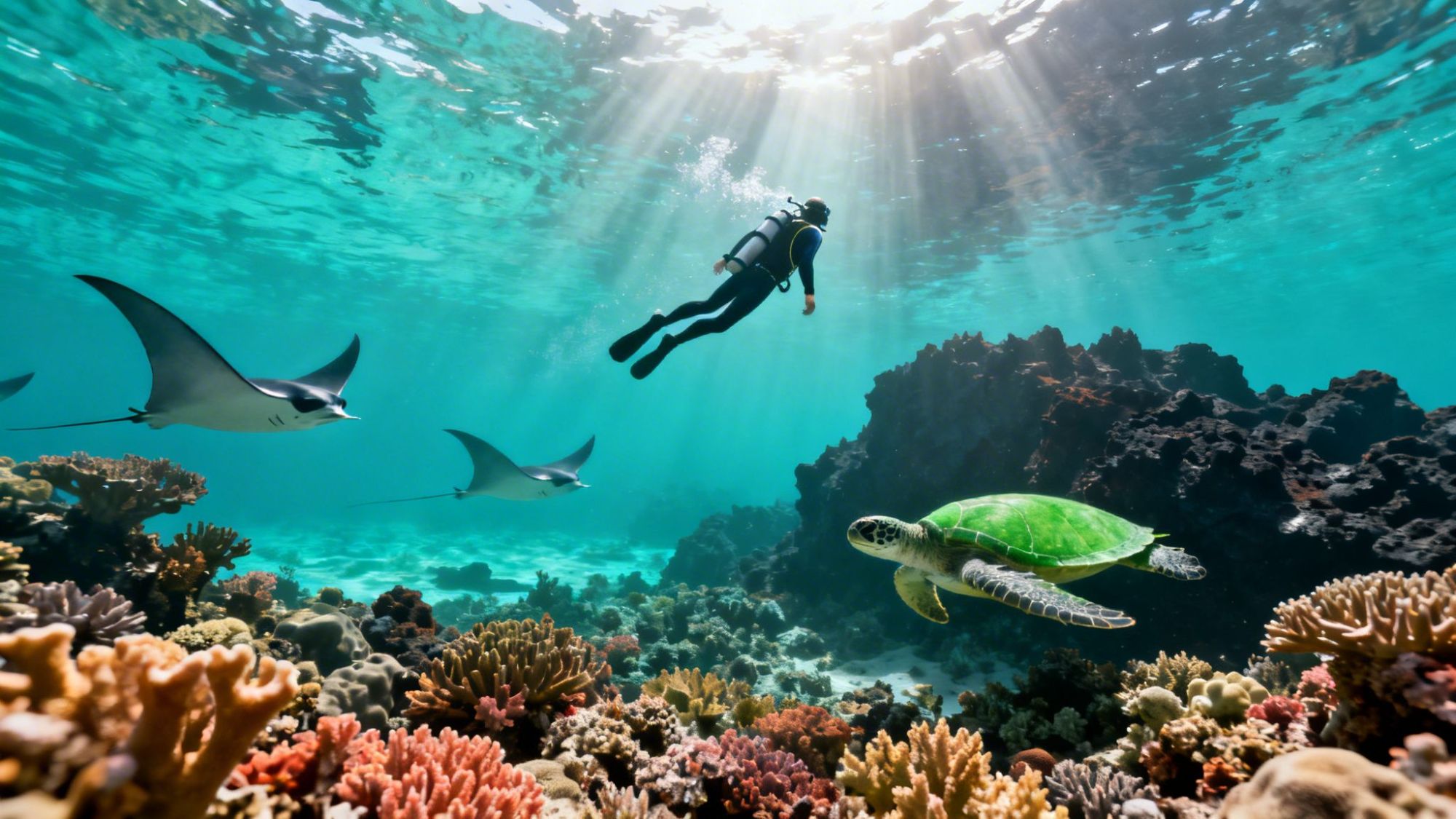
Picture this: you take a giant stride off the boat and descend into a world of impossible blue. Sunbeams dance through the water, illuminating ancient lava tubes that form breathtaking underwater cathedrals. A green sea turtle, a honu, glides effortlessly past you. This isn't just another dive trip—this is Hawaii. For anyone who's spent time with a tank on their back, it's a true bucket-list destination.
Your Guide to Hawaii's Underwater Kingdom
Forget the postcard beaches for a moment. We're going deeper, into a living, breathing ecosystem that exists nowhere else on the planet. Hawaii's incredible isolation in the middle of the vast Pacific means that roughly 25% of its reef fish are endemic. That's right—a quarter of the fish you'll see here can't be found anywhere else. From the second you slip below the surface, you're a guest in a truly unique and fragile world.
We'll get into the legendary experiences that make diving hawaii so unforgettable, from the world-famous manta ray night dive to the humbling sight of migrating humpback whales. You'll quickly see why divers of every skill level are drawn back to these waters again and again.

What Makes Diving In Hawaii So Special?
The magic of diving in Hawaii isn't just one thing; it's the combination of incredible factors that almost guarantees an amazing time in the water.
- Dramatic Volcanic Landscapes: You're not just swimming over reefs; you're exploring the handiwork of ancient volcanoes. Think dramatic archways, massive caverns, and intricate lava tubes that are just begging to be explored with a dive light.
- Insanely Clear Water: The visibility here is often mind-blowing. It's not uncommon for it to exceed 100 feet, letting you soak in the massive scale of the underwater scenery.
- An Abundance of Life: The sheer variety is staggering. One moment you're spotting a tiny, colorful nudibranch on a rock, and the next you're looking into the deep blue, hoping for a glimpse of a passing whale shark.
- You Can Dive All Year: Thanks to the islands' beautiful tropical climate, there's no real "off-season." The conditions are consistently good, especially on the sheltered leeward coasts.
While we'll touch on spots across the islands, you'll soon discover why Kona, on the Big Island, is the undisputed heart of the Hawaiian diving scene. Its calm, protected waters are a magnet for everything from huge pelagic animals to the most vibrant reef life.
This guide is your first step into that unforgettable blue. We'll give you the inside scoop on how to make your underwater adventure everything you've dreamed of.
Why Kona is the Epicenter of Hawaiian Diving

Sure, you can find incredible diving all across the Hawaiian islands, but ask any seasoned diver where the real heart of it all is, and they'll almost always say one word: Kona. What's the magic behind the Big Island's western coast? It's a happy accident of geography that serves up world-class diving conditions nearly every day of the year.
The secret is simple. The massive volcanoes of Mauna Loa and Hualalai act as a natural shield, blocking the gusty trade winds that batter other parts of the state. This leaves the Kona coast with unusually calm, clear water. The result? Visibility often pushes past an incredible 100 feet. For underwater photographers and anyone who just loves to see it all, it's an absolute paradise.
This kind of clarity and calm has created an explosion of life. Kona is unquestionably the best place for scuba diving in Hawaii, making the Big Island a global magnet for underwater enthusiasts. This incredible ecosystem supports everyone from tour operators to hotels in coastal hubs like Kona.
Kona Honu Divers: The Premier Choice For Diving Hawaii
When you're diving in a place this special, you owe it to yourself to go with the best scuba diving company. In Kona, that name is Kona Honu Divers. They're a PADI 5-Star Instructor Development Center, which is the gold standard for training and safety, but their reputation is built on more than just awards—it’s earned daily out on the water.
The team at Kona Honu Divers just gets it. They have a deep passion for the ocean and an infectious excitement for sharing it the right way. Their instructors and divemasters know these sites like the back of their hand, which means every trip is not just safe, but packed with incredible discoveries you'd probably miss on your own.
You can see their expertise in the sheer variety of trips they run. Whether you're a brand new diver looking to get your fins wet on a shallow reef or an old pro hunting for a thrilling drift dive, they've got you covered. They offer a whole range of general diving tours on the Big Island that truly show off the best of what Kona has to offer.
Unforgettable Night Dives and Unique Adventures
Kona is famous worldwide for what happens after the sun goes down, and there are two experiences that are absolute bucket-list dives.
- Manta Ray Night Dive: This is the signature dive of Hawaii, and for good reason. Kona Honu Divers runs an unforgettable manta ray scuba diving tour where you get a front-row seat as these gentle giants perform an underwater ballet, feeding in the glow of dive lights.
- Black Water Night Dive: For the truly adventurous, this is a trip into another world. You drift in the deep, dark ocean miles offshore and watch as bizarre, bioluminescent creatures rise up from the abyss. It’s like a trip to an alien planet. You can learn more about this one-of-a-kind black water night dive tour.
What really sets Kona Honu Divers apart is their commitment to small groups. Even on these wildly popular dives, you never feel like part of a crowd. That focus on a personal, safe, and educational experience is what turns a great dive into something you’ll remember for the rest of your life.
From the world-famous manta encounters to pristine coral gardens teeming with life, Kona simply offers an unmatched variety of underwater adventures. When you combine that with near-perfect conditions and the expertise of operators like Kona Honu Divers, it's easy to see why Kona is the true epicenter of diving hawaii.
Ready to see it for yourself?
Hawaii’s Most Iconic Scuba Dives
Sure, some dives are just a fun way to spend an afternoon. But then there are the dives that stick with you forever. In Hawaii, you’ll find a few truly signature experiences that don't just create memories—they completely reshape your idea of what the ocean holds.
While every island has its underwater treasures, Kona’s unique encounters are in a class all their own. These dives are more than just a tour; they’re world-famous events that draw people from across the globe for a reason.

When you dive in Hawaii, particularly around Kona, you get incredible access to marine life that feels almost guaranteed. The manta ray night dives, for instance, have a staggering 80-90% sighting success rate. It’s one of the most reliable wildlife thrills on the planet.
The World-Famous Manta Ray Night Dive
Picture this: you’re kneeling on the sand at the bottom of the ocean as twilight fades above. Your guide flips on a powerful light, creating a bright "campfire" on the seafloor. Almost instantly, tiny plankton swarm the beam.
Then, a shadow emerges from the dark. A massive manta ray, with a wingspan stretching up to 16 feet, glides effortlessly into the light. This is the Kona Manta Ray Night Dive, and it feels less like a scuba trip and more like a surreal underwater ballet.
Soon, more mantas arrive, swooping and barrel-rolling just inches over your head as they feast on the plankton. It's a profoundly moving and surprisingly peaceful encounter that you just have to see to believe.
Kona Honu Divers has this experience dialed in, creating a safe, respectful, and downright magical dive. They’re a top-rated operator for a reason—their commitment to the mantas’ well-being and the guest experience is unmatched. Their two-tank manta ray dive tour is consistently praised as an absolute must-do.
The Mysterious Black Water Night Dive
If the Manta Ray Dive is a beautiful ballet, the Black Water Night Dive is a trip to another dimension. This is an advanced dive for the truly adventurous soul. You’ll head far from shore and descend into the deep, inky blackness of the open ocean, tethered to a boat that drifts along with the current.
You’re not looking down at a reef. You're floating in the middle of the water column, watching the largest migration on Earth unfold. Bizarre, alien-like creatures rise from the depths to feed under the cover of darkness, and you have a front-row seat.
You’ll witness things that look straight out of a sci-fi movie:
- Translucent Squids: Pulsing with their own bioluminescent light.
- Pteropods: Tiny, delicate sea snails that look like they're "flying" through the water with wings.
- Larval Fish: The baby versions of familiar fish, often looking completely unrecognizable with their strange and wonderful features.
This is a dive into the great unknown, a rare glimpse into a hidden world that few ever get to see. Kona Honu Divers runs a specialized black water night dive tour that is easily one of the most unique dive experiences you can have anywhere on the planet.
To get a better sense of what makes these after-dark adventures so incredible, check out our guide on the Kona Manta Ray Night Dive.
To help you decide which bucket-list dive is right for you, here’s a quick comparison of Hawaii's most iconic underwater experiences.
Top Hawaii Dive Experiences Comparison
| Dive Experience | Location | Best For | Key Feature |
|---|---|---|---|
| Manta Ray Night Dive | Kona, Big Island | All certified divers | A surreal ballet with giant, gentle mantas feeding inches away |
| Black Water Night Dive | Kona, Big Island | Advanced divers | Floating in open ocean to see bizarre, bioluminescent deep-sea creatures |
| Molokini Crater | Maui | All certified divers | Diving in a clear, protected volcanic crater with pristine reefs |
| Oahu Wrecks | Oahu | Advanced divers | Exploring sunken ships and planes that now serve as artificial reefs |
While other islands offer fantastic dives—like the dramatic lava tubes and pristine reefs of Maui’s Molokini Crater or the historic wrecks off Oahu—Kona’s signature night dives are truly in a league of their own. They represent the absolute pinnacle of diving in Hawaii.
A Diver’s Guide to the Hawaiian Islands
While everyone raves about Kona—and trust me, they're right to—it's just the start of the story. The whole Hawaiian island chain is an underwater playground, and each island has its own distinct personality and secrets to share. Think of it like this: if the Big Island is the world-famous headliner, the other islands are the incredible supporting acts you can't afford to miss. No matter where you land, an amazing dive is just around the corner.
Let's start with the undisputed champion: The Big Island.
The Big Island Beyond The Mantas
Even if you take the world-famous manta ray night dive out of the equation, Kona’s coastline is still a diver’s dream. The water is usually calm and ridiculously clear, and the ancient volcanic lava flows have created a maze of underwater canyons, arches, and caves.
It’s this incredible underwater landscape that operators like Kona Honu Divers know like the back of their hand. Their diving tours on the Big Island can take you anywhere from pristine coral gardens to dramatic lava tube swim-throughs. A spot you absolutely have to experience is Kealakekua Bay, where the Captain Cook monument stands. The reef here is bursting with life and color, easily one of the most vibrant in all of Hawaii.
Maui The Valley Isle
Maui gives the Big Island a serious run for its money, and a big reason for that is Molokini Crater. This crescent-shaped, partially sunken volcano is a protected marine sanctuary, and the experience is just epic.
- Molokini Crater: The visibility here is just unreal, often clearing 150 feet. Diving along the crater’s walls feels like flying through an aquarium filled with moray eels, octopus, and whitetip reef sharks patrolling the edges.
- Lanai Cathedrals: It's just a quick boat ride from Maui to the island of Lanai, but it feels like entering another world. The Cathedrals I and II are massive underwater lava caverns. When the light streams through the holes in the ceiling, it creates these ethereal, church-like sunbeams. It’s a moment that will give you chills.
Oahu The Gathering Place
Oahu has a cool mix of beautiful natural reefs and some truly incredible wreck dives. If you love a little history with your diving, this is your island. The south shore is littered with ships that have been intentionally sunk, and they’ve since blossomed into thriving artificial reefs.
The YO-257 is one of Oahu's best wrecks. This old Navy oiler sits perfectly upright in about 100 feet of water and is a magnet for eagle rays, sea turtles, and huge schools of fish. It’s so close to other wrecks that it’s a classic two-tank dive day.
If you find yourself on the North Shore during the calmer summer months, you can shore dive at Shark's Cove. Don't let the name scare you; it’s an amazing network of underwater caves and tunnels that are just packed with life.
Kauai The Garden Isle
Kauai’s diving is all about dramatic scenery and turtles. Seriously, so many turtles. The south shore around Poipu has the most reliable conditions and is home to the island's most famous sites.
- Sheraton Caverns: This is probably Kauai's most popular dive. It’s a series of collapsed lava tubes that create three large underwater caverns. You’ll almost certainly find a handful of green sea turtles just chilling out inside, using the caves for a rest stop. It's pretty shallow, making it a great dive for any certification level.
- Tunnels Beach: Up on the North Shore (another summer-only spot), Tunnels has a wild reef system with lava tubes and arches that you can spend the whole dive exploring. It feels like navigating a natural underwater maze.
While every island offers something special, Kona really is the epicenter for a reason. The calm, year-round conditions and the chance for those unforgettable big animal encounters are just hard to beat. It’s the perfect home base for any dive trip to Hawaii.
Amazing Underwater Adventures For Non-Divers

Think you need a scuba tank on your back to see Hawaii's best underwater sights? Think again. That's one of the biggest myths we hear, and honestly, it’s just not true.
Here in Kona, some of the most mind-blowing marine encounters happen right at the surface. So, if you're not a certified diver, you're not missing out. In fact, for some experiences, a mask and snorkel get you a front-row seat to the action, making it perfect for families and groups.
Kona Snorkel Trips is the top rated & most reviewed snorkel company in Hawaii, and we have shared these moments with thousands of guests. We've seen firsthand how a simple snorkel trip can become the highlight of a vacation and a memory that lasts a lifetime.
The Unforgettable Manta Ray Night Snorkel
The manta ray night dive gets a lot of hype, but the snorkeling version is in a league of its own. Instead of watching from the seafloor, you float comfortably at the surface, holding onto a custom light board that illuminates the plankton below. This creates a floating buffet, and the mantas come right to you.
The result is pure magic. These gentle giants, with wingspans up to 16 feet, glide inches beneath you, doing graceful barrel rolls as they feed. You get an unbelievable, top-down view of this underwater ballet. Honestly, being right there at the surface often feels more intimate and connected.
Our Manta Ray Night Snorkel Tour is our signature trip, and our lifeguard-certified guides are in the water with you the whole time. If you’re looking for another fantastic operator, check out Manta Ray Night Snorkel Hawaii—they also run a great tour.
Snorkeling Historic Kealakekua Bay
Another absolute must-do for snorkelers is Kealakekua Bay, home to the Captain Cook Monument. This place is more than just a pretty spot; it’s a Marine Life Conservation District steeped in history. The bay’s geography protects it from wind and swell, creating incredibly clear and calm water that’s perfect for snorkelers of any skill level.
The coral gardens here are some of the healthiest and most vibrant in all of Hawaii. You'll drift over the reef surrounded by huge schools of tropical fish, see eels peeking out from their homes, and you're almost guaranteed to spot spinner dolphins leaping and playing nearby.
A trip here isn't just about the fish; it’s a journey into Hawaiian history. Seeing it from the water is the best way to truly appreciate why this place is so special and protected. For a deeper dive into this spot, check out our guide on snorkeling in Kona.
Our Captain Cook Snorkeling Tour is designed to give you a fun, safe, and educational day on the water. For those exploring different options, Captain Cook Snorkeling Tours also offers an exceptional trip to this historic bay. These tours prove you don't need to be a diver to have a world-class adventure in Hawaii.
How To Plan Your Hawaii Dive Trip
So, you’re ready to trade postcard views for the real thing and dive into Hawaii's underwater world. Awesome. A little bit of planning goes a long way to making sure your trip is less about logistics and more about unforgettable moments with turtles, mantas, and endless coral gardens. Let's walk through how to get you from daydreaming to giant-striding off the back of a boat.
First things first, where you're staying can shape your whole trip. Picking the right home base is just as important as picking your dive sites, and it's worth weighing the pros and cons of different spots. For a deeper look at your options, it's a good idea to check out a guide on choosing a vacation rental platform.
Getting Certified in Paradise
If you're not a diver yet, there is simply no better place to learn. I’ve seen so many people who were nervous about learning in cold, murky water completely fall in love with diving in Kona’s warm, crystal-clear environment. The PADI Open Water Diver course is your ticket to the show, covering everything you need to know to dive safely and confidently.
Already have your C-card? Perfect. Hawaii is an incredible classroom for taking your skills to the next level. You can knock out some really useful specialties while you're here.
- Advanced Open Water: This is the logical next step. It builds on your core skills and gives you a taste of different diving adventures, like deep dives and navigation.
- Enriched Air (Nitrox): Want more time on the reef? This certification is a game-changer. It lets you use air with more oxygen, which means longer bottom times on your dives. More time means more chances for magic.
- Peak Performance Buoyancy: This is the secret to becoming one of those divers who just floats effortlessly. Mastering your buoyancy helps you conserve air, move gracefully, and protect the fragile corals you came to see.
Honestly, who you learn with makes all the difference. Choosing a top-notch operator like Kona Honu Divers for your training is key. Their instructors are absolute pros at making new or anxious divers feel totally at ease, turning that initial uncertainty into a lifelong passion.
Logistics For a Perfect Dive Trip
While Kona offers incredible diving pretty much year-round, you absolutely have to book ahead. The secret is out. High season—winter for whale watching and summer for family vacations—gets packed, and the best tours fill up fast. If you have your heart set on those bucket-list dives, like the manta ray night dive or the black water experience, lock in your spots weeks, or even months, in advance.
Don’t just book your dives; book with purpose. Choosing a sustainable operator that actively practices reef-safe protocols and promotes marine conservation is one of the most important decisions you’ll make. This ensures the beauty you experience remains for future generations.
Finally, while the dive shop will have all the big gear, bringing a few personal items can make you so much more comfortable. A mask and snorkel that you know fits your face perfectly is a huge plus. Don't forget the reef-safe sunscreen and a reusable water bottle. Getting these little details sorted means you can just relax and enjoy the ride. You're not just planning a vacation; you're setting the stage for an incredible underwater journey.
Frequently Asked Questions About Diving In Hawaii
Planning a dive trip to Hawaii can bring up a lot of questions, especially if it's your first time. It's a big trip, and you want to get it right. We get it. As guides who spend our days in these waters, we’ve heard just about every question there is.
Here are the answers to the ones that come up most often, to help you sort out the details and get you one step closer to your dream dive.
Which Hawaiian Island Is Best For Diving?
This is the big one. While you can find incredible diving across the entire state, if we had to pick just one spot, it would be the Kona coast on the Big Island. It’s no contest.
The massive volcanoes, Mauna Loa and Hualalai, act as a natural shield, blocking the trade winds and leaving the Kona coastline remarkably calm and clear almost all year. This consistent, protected environment is a magnet for big animals—think manta rays, pods of spinner dolphins, and, in the winter, humpback whales.
Can I Learn To Dive In Hawaii?
Absolutely. In fact, it’s one of the best places in the world to get certified. The warm, clear, and calm waters around Kona make for a pretty amazing classroom—far better than a cold quarry or a crowded pool.
It's a comfortable, low-stress environment that helps new divers build confidence quickly. Shops like Kona Honu Divers, a PADI 5-Star Instructor Development Center, can take you from your very first breaths underwater with a PADI Open Water course all the way to professional-level training. Getting certified here often lights a spark that turns into a lifelong passion.
What Is The Best Time Of Year For Diving In Hawaii?
The best news is that in Hawaii, especially in Kona, it's always dive season. The water stays warm and the visibility is consistently great, so there's no bad time to visit.
That said, certain times of the year offer a little something extra. Winter (roughly December through March) is peak humpback whale season. You might not see them on every dive, but you’ll definitely hear them—their songs create an incredible, haunting soundtrack for your entire dive. Summer, on the other hand, brings the calmest seas, opening up spots on other islands, like Kauai's North Shore, that are often too rough to dive the rest of the year.
Do I Need My Own Scuba Gear?
Not unless you want to. Lugging a full set of heavy dive gear across the Pacific is a hassle you can easily avoid.
Every reputable dive shop, including Kona Honu Divers, has high-quality, well-maintained rental gear ready to go. The two things we do suggest bringing are your own mask, since a perfect fit makes all the difference, and your own dive computer if you have one. Just be sure to book your dives and gear rentals in advance, particularly during the busy season, to make sure they have what you need.
What Marine Life Can I Expect To See?
Hawaii's underwater ecosystem is like nowhere else on the planet. Because the islands are so isolated, about 25% of the reef fish here are endemic, meaning you won’t find them anywhere else in the world.
On almost any dive, you can expect to see Hawaiian Green Sea Turtles (honu), dozens of species of colorful butterflyfish, moray eels peeking out from the reef, and maybe even a shy octopus. With a little luck, you could also run into spinner dolphins, majestic eagle rays, and whitetip reef sharks. And if you're in Kona, you have the chance to see the magnificent manta rays. It’s a true underwater safari.