
A Guide to Blackwater Diving in Kona
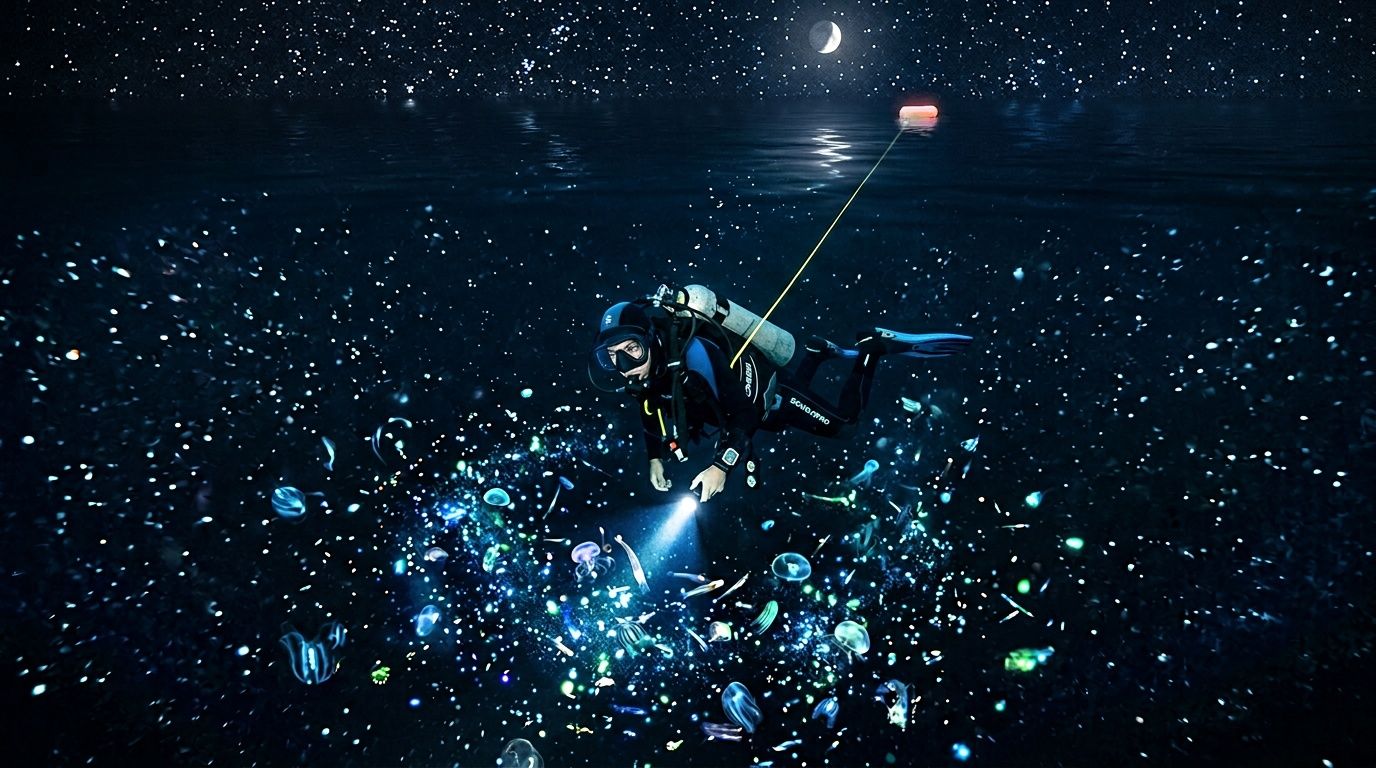
Picture this: you're floating weightlessly in the pitch-black ocean, hundreds of feet of dark water below you. It feels like you’re in outer space. But instead of stars, you're surrounded by the strangest, most beautiful glowing creatures you've ever seen, rising from the deep.
This isn’t a sci-fi movie. This is blackwater diving, and it’s one of the most mind-blowing experiences you can have in the ocean. It's an encounter with a hidden world of alien-like animals you will never, ever see on a normal reef dive.
What Is Blackwater Diving
Blackwater diving is a special kind of night dive, but not like any you've done before. We head out into the deep open ocean, far from the coast and any reef. There's no seafloor to explore—just you, your guide, and the deep blue.
The boat becomes our anchor in the vastness. We drop powerful lights down into the water, creating a brightly lit stage in the middle of the dark ocean. This light attracts an incredible parade of deep-sea life.

You get a front-row seat to what scientists call the Diel Vertical Migration. Every single night, countless tiny, bizarre, and often see-through creatures travel thousands of feet from the abyss toward the surface to feed. On a blackwater dive, the main event isn't the reef; it's the water column itself, alive with this secret migration.
If you're looking to have this incredible adventure here in Hawaii, Kona Honu Divers is hands-down the best operator for it. They've been doing this for years and have a top-notch reputation for safety and showing divers a world-class experience. They truly have this dive dialed in.
A Dive into the Unknown
The feeling of a blackwater dive is the closest thing to a spacewalk you can get on Earth. With no bottom in sight and surrounded by absolute darkness outside the beam of your light, your only points of reference are your gear, your guide, and the weird and wonderful critters drifting past your mask. It's a sensory trip that requires solid buoyancy and a cool head.
You never know what you'll see, which is half the fun! But some of the regulars include:
- Weird Babies: You'll see the larval stages of eels, flounders, and other fish. They look nothing like their parents—think bizarre, transparent squiggles and shapes.
- Living Light Shows: An amazing variety of ctenophores (comb jellies) and long, stringy siphonophores pulse with their own internal, bioluminescent light. It's dazzling.
- Rare Finds: If you get really lucky, you might spot incredible cephalopods like a paper nautilus or the elusive blanket octopus.
This isn't a dive where you swim around chasing things. The magic happens when you just hang there, relaxed, and let the ocean bring its secrets to you. It's that mix of total peace and the thrill of discovery that makes a black water night dive a true bucket-list adventure.
For certified divers ready for something totally different, Kona Honu Divers offers an expertly guided trip into this hidden world. Ready to see it for yourself? You can book the premier black water night dive tour right here in Kona.
The Science of a Blackwater Dive
The almost-unreal world you enter on a blackwater dive is all thanks to one of the biggest, yet most hidden, events happening on our planet: Diel Vertical Migration.
Every single night, all across the globe, an unimaginable number of deep-sea creatures travel from the crushing dark of the depths up toward the surface. Why? To feed under the protection of night. It's the largest migration on Earth, a silent, nightly commute on a planetary scale.
This migration completely transforms the seemingly empty open ocean, what scientists call the pelagic zone, into a living, three-dimensional world. This isn't just empty blue water; it's a massive habitat packed with creatures, from the tiniest zooplankton that kickstart the food chain to the bizarre predators that hunt them. Many even create their own light through bioluminescence.

Creating a Stage in the Abyss
On a blackwater dive, we don't go chasing after these animals. It’s the other way around. We create an irresistible, brightly lit "stage" in the dark by dropping powerful, downward-facing lights into the water column. This glowing beam acts like a powerful magnet, intercepting and drawing in the organisms making their nightly journey upward.
We turn this enormous, invisible migration into a focused, observable show. Divers just need to hang out near the lights and wait for the ocean to show its secrets, one strange and wonderful creature at a time.
This blend of adventure and science has also been a huge breakthrough for marine biology. Blackwater diving lets scientists—and even regular divers—see and collect deep-sea larvae that are almost impossible to catch with traditional nets.
Pioneering work right here in Kona, Hawaii, has led to hand-collecting larval fish. Using DNA barcoding, researchers have been able to confirm their species and document their development, massively improving what we know about how fish grow. You can dive into the scientific impact of these collections in this NOAA report.
This nightly show is a core rhythm of the ocean. When you understand the science, a blackwater dive becomes more than just a wild ride; it’s a direct connection to the hidden pulse of our planet’s biggest habitat. Learn more about this one-of-a-kind experience in our complete guide to blackwater diving.
Gear And Safety For Open Ocean Diving
The idea of floating in the deep open ocean after dark can sound a little wild. We get it. But the truth is, with the right setup and procedures, a blackwater dive is one of the most controlled and surprisingly serene experiences you can have underwater.
At Kona Honu Divers, we’ve built our entire blackwater operation on a foundation of safety. It's not just a box to check; it’s what allows us to confidently explore this incredible, hidden world.
Our whole system is built around a simple but brilliant piece of equipment: the down-line, also called a tether system. It’s basically a vertical rope dropped from the boat, anchored by a big, lit-up float on the surface. We attach powerful lights to this line, pointing them down into the abyss to draw in all the weird and wonderful creatures.
Divers just clip onto this tether. That’s it. This simple connection keeps the entire group together, prevents anyone from drifting off, and gives you a constant point of reference in the dark. Up on the boat, our crew keeps a close watch on the system and the divers the entire time.

Essential Blackwater Diving Gear
You’ll use most of your standard scuba gear, but a few items are absolutely critical for a blackwater dive. High-powered dive lights are a must. You'll need a bright primary torch to light up the water column and spot life, plus a reliable backup just in case.
Your divemaster is your most important asset out there. They’re not just keeping an eye on everyone’s depth and air; they are trained spotters. Their eyes are dialed in to find the tiny, transparent, and perfectly camouflaged animals that most people would swim right past. They're your personal guide to this alien environment.
A blackwater dive is a completely different beast than a traditional night dive. It’s less about swimming and exploring a reef and more about patient observation. You just hover in place and let the ocean's currents bring the entire show right to you.
Getting this distinction is key to enjoying the experience. While both happen after sunset, the setting, the procedure, and what you’re looking for are worlds apart. For a broader look at exploring the underwater world, take a look at our guide on how to scuba dive in Hawaii.
Blackwater Diving vs Traditional Night Diving
To really understand what you’re signing up for, it helps to see how a blackwater dive stacks up against a typical reef night dive. They couldn't be more different.
| Feature | Blackwater Dive | Traditional Night Dive |
|---|---|---|
| Location | Deep open ocean, far from shore | Coastal reef, wreck, or sandy bottom |
| Reference | A tethered down-line from the boat | The seafloor, coral formations, or a wreck |
| Objective | Observe pelagic life migrating vertically | Find nocturnal creatures hiding in the reef |
| Movement | Hovering at a fixed depth, minimal swimming | Navigating along a planned route on the bottom |
| Key Skill | Excellent buoyancy control and patience | Navigation and finding hidden animals |
One is about exploring a familiar landscape in a new light, while the other is about drifting through an alien world where the landscape comes to you. Both are incredible, but knowing what to expect is the first step to an amazing dive.
The History of Diving into the Dark
You might think that the wild experience of modern blackwater diving was cooked up just for the thrill of it. But its roots actually trace back to a daring scientific mission decades ago, all born from a simple question: how do you even begin to study the tiny, ghost-like creatures that drift through the deep, open ocean at night?
The only real answer was to go meet them on their own turf.
The journey into the abyss really began back in the 1960s. Pioneering marine biologists started developing tethered diving techniques, basically suspending themselves in the pitch-black open ocean. Can you imagine? Armed with just tethers and handheld lights, scientists from places like NOAA set out to observe and collect delicate plankton that would turn to mush in a net.
These early scientific dives, kicking off around 1962 in France and later perfected by University of California teams in the 1970s, were all about hand-collecting life from the midwater. It was a specialist’s game. You can actually read more about how this unique dive style evolved on Scuba.com's blog.
From Science to Sport in Kona
For a long time, this "bluewater" diving, as it was often called, was strictly for the researchers. It was a niche method for a handful of dedicated scientists. The big leap from a research tool to a bucket-list adventure happened right here in Kona, Hawaii.
In the 1990s, a few bold local divers in Kona saw the incredible potential sitting right in their backyard. The Big Island has these insane 10,000-foot drop-offs just a quick boat ride from the harbor, giving them a direct line to the deep pelagic zone. They started tinkering with the scientific concept, but they decided to turn it up to eleven.
Instead of just small handheld lights, they brought in powerful, boat-mounted floodlights to shoot a massive column of light straight down into the water. The result was absolutely mind-blowing.
This new trick lit up an unbelievable parade of surreal larval fish, glowing jellies, and bizarre deep-sea drifters that had been totally invisible before. This vibrant stage they set in the darkness didn't just pull in marine life; it pulled in people from all over the world.
Underwater photographers started flocking to Kona. They captured these jaw-dropping, high-contrast photos of alien-like creatures against the stark black of the open ocean. Once those images hit dive magazines and started spreading online, a global obsession was born. Just like that, Kona became the official birthplace and the undisputed capital of recreational blackwater diving.
This history really adds something special to every blackwater dive you do here. When you drop into the dark off the Kona coast, you’re not just going on an excursion. You’re making a pilgrimage to the very place this sport began, connecting with the pioneers who first dared to shine a light into the darkness.
Why Kona Is the Best Place for Blackwater Diving
You can find blackwater diving in a handful of places around the world, but Kona isn't just another spot on the map. Let's be clear: Kona, Hawaii, is the undisputed epicenter of this incredible experience. If you're serious about witnessing the planet's largest migration rise from the abyss, Kona is where you need to be.
The combination of perfect conditions, easy access, and decades of expertise makes it the premier destination for this dive. It's not just one thing; it's everything coming together perfectly.

Kona's secret weapon is its underwater landscape. Right off the coast, the seafloor takes a dramatic plunge into the deep. This gives us quick and easy access to the open-ocean zone where all the magic happens, without needing a long, bumpy boat ride for hours offshore.
On top of that, the Big Island's massive volcanoes act as a natural shield, blocking the trade winds and keeping the seas along the Kona coast famously calm. This means more comfortable, reliable, and just plain enjoyable nights out on the water.
A Legacy of Experience and Safety
Besides the perfect natural setup, Kona is literally where recreational blackwater diving was pioneered and perfected. The local dive community here, led by trailblazers like Kona Honu Divers, has spent decades getting this dive absolutely dialed in.
They’ve refined everything, from the custom tethering systems that keep you safe to training guides who are masters at spotting tiny, nearly invisible creatures in the dark. The entire operation is a well-oiled machine built on years of experience. You're not just going with some outfit that decided to add blackwater to their menu; you're diving with the people who wrote the book on it.
Kona stands as the undisputed birthplace and epicenter of recreational blackwater diving, with decades of continuous innovation. While other hotspots exist, Kona accounts for the vast majority of trips, with safety rigs and procedures that were perfected here. You can read more about the masters of blackwater diving to understand Kona's leading role.
This rich history is what makes Kona the global capital for this unique adventure. To get a better sense of all the world-class diving we have here, check out our guide on Hawaii scuba diving.
Put simply, if you're going to have this once-in-a-lifetime experience, you owe it to yourself to do it in the place where it all started. The mix of ideal geography, calm waters, and unmatched local expertise makes Kona the best place in the world for blackwater diving, hands down.
Ready to take the plunge with the best in the business? Book your unforgettable black water night dive with the experts at Kona Honu Divers.
Check AvailabilityCommon Questions About Blackwater Diving
Jumping into the deep, open ocean at night? Yeah, that's going to bring up a few questions. Even for divers who've been around the block, blackwater diving is a completely different world. Let's walk through the most common questions we hear at Kona Honu Divers so you can feel totally ready for this incredible adventure.
Our whole mission is to make you feel safe and confident. Once you understand how it all works, you can leave the nerves on the boat and just soak in the mind-blowing world you're about to witness.
Do I Need To Be an Advanced Diver?
This is the first thing most people ask, and it’s a great question. While there isn't a specific "blackwater diver" card you need to have, this experience isn't for someone fresh out of their open water course. We need to know you're comfortable and can handle yourself in the water, especially when it comes to buoyancy.
Here’s what we, and most operators like Kona Honu Divers, are looking for:
- Advanced Open Water Certification: This is the standard starting point. It tells us you've got experience beyond the basics.
- Plenty of Dives: We ask for at least 50 logged dives. This shows you've spent enough time underwater to be relaxed and in full control of your gear.
- Night Diving Experience: It's a huge plus if you've done a few traditional night dives. This helps you get used to the low-light environment and handling a dive torch without feeling overwhelmed.
The single most important skill here is rock-solid buoyancy control. You’ll be hovering in the middle of the water column with no bottom to reference, so being able to hold your depth is key to your safety and enjoyment.
What If I Get Motion Sickness?
This is another common one. You're on a boat, and then you're floating in the open ocean where you might feel a bit of swell. If you know you're prone to motion sickness, the best thing to do is plan ahead.
Taking an over-the-counter medication before the trip can be a game-changer. Just make sure to read the directions—some work best if you take them an hour or two before getting on the boat. Staying hydrated and keeping your eyes on the horizon during the ride out helps a lot, too. The good news? Once you're in the water, that feeling usually vanishes.
What Happens If a Diver Gets Separated?
This is the big fear for a lot of people, but our entire setup is designed to make sure this just doesn't happen. The heart of our blackwater safety plan is the tether system.
Every single diver is securely clipped to a line that drops down from a big, lit-up float on the surface. That tether keeps you with the group and connected to the boat at all times. It's a simple and effective system that makes it pretty much impossible to drift off. Your divemaster is also right there, constantly keeping an eye on everyone, and we always go over lost-buddy procedures in the briefing.
You are never just floating alone in the dark. You are part of a connected, supervised group with multiple layers of safety in place.
Getting your questions answered is the first step to feeling comfortable. We want you to ask us anything and everything during the dive briefing. Our crew is there to make sure you feel 100% comfortable before you get in. That focus on safety is a huge part of the Kona Honu Divers experience and is one of the things that makes our black water dives so special.
Now that we've got those questions out of the way, you can start getting excited about the sheer wonder of it all. This is your chance to see creatures that most people on this planet will never see in their entire lives.
Ready to explore the final frontier of diving? The experts at Kona Honu Divers are ready to guide you on this unforgettable journey into the dark.
Check Availability