
Blackwater Diving in Kona: An Epic 2026 Night Dive Adventure
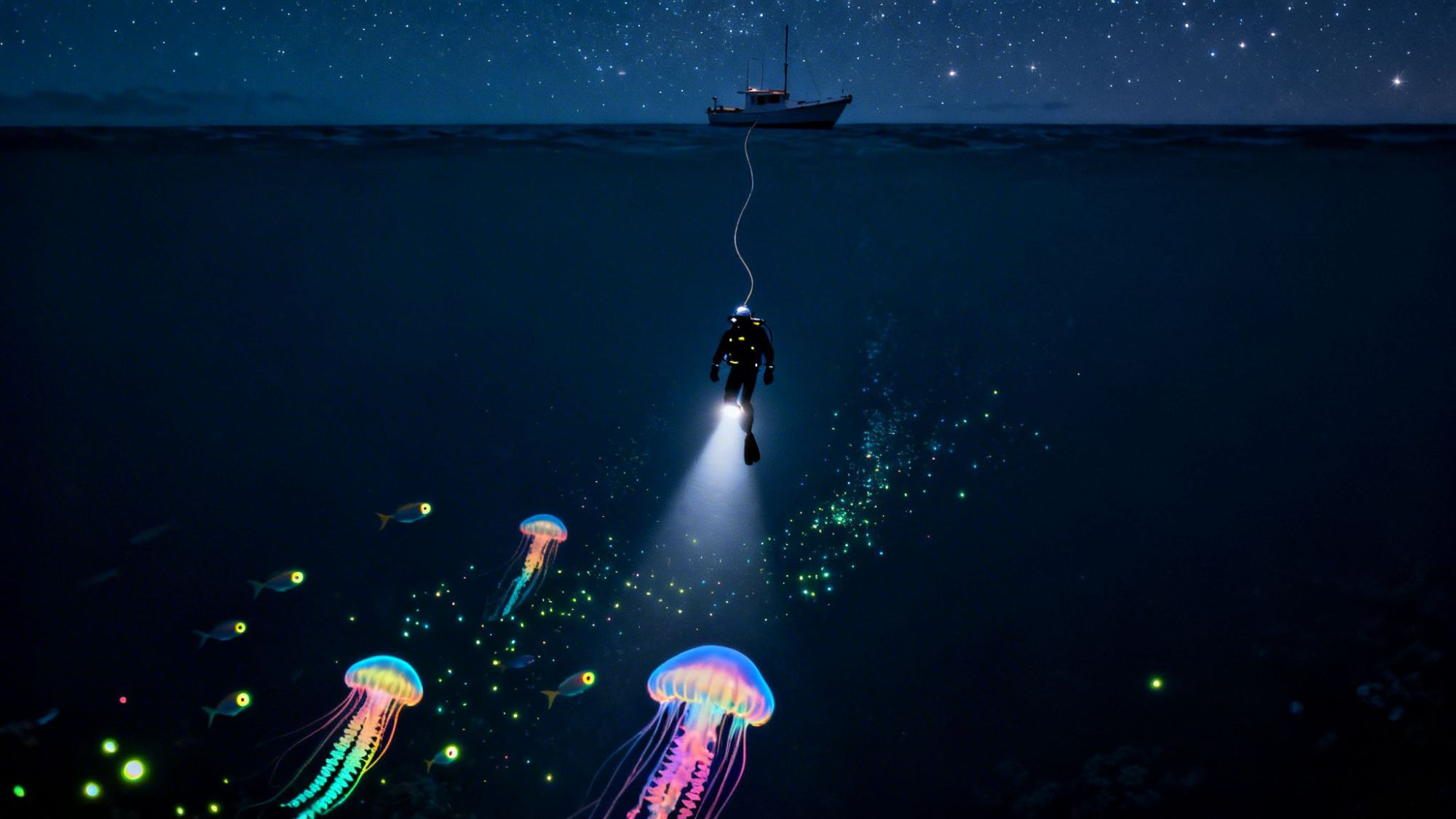
Ever done a night dive? You drop down onto a familiar reef, flashlight in hand, and see the same corals and critters, just in a different light. Now, imagine something completely different. Imagine heading miles offshore, stopping the boat over thousands of feet of inky black water, and jumping in.
That's blackwater diving. It’s not about exploring a reef or the seafloor. It's about hanging suspended in the open ocean, tethered to the boat, watching what comes up from the abyss.
What Is a Blackwater Dive and Why Is Kona the Best Place for It?

Think of it less as a dive and more as an intercept mission. We lower a string of powerful lights deep into the water, creating a brightly lit stage in the middle of nowhere. This light attracts an unbelievable parade of creatures making their way up from the deep to feed near the surface. It's the largest migration on Earth, and it happens every single night.
You’re basically a spectator on the side of a deep-sea highway. The feeling is often compared to a spacewalk—drifting in a vast, dark void, waiting for alien-like life to float by. It’s an experience that’s hard to put into words. To get a really deep look, check out this black water night dive tour.
The Perfect Conditions in Kona
There's a reason Kona is known worldwide as the capital of blackwater diving. The island is just built for it, both geologically and historically. As the best place to dive in Hawaii, Kona offers unparalleled conditions.
- Deep Water, Right Offshore: The seafloor off the Kona coast plummets to thousands of feet just a few miles from the harbor. This means we don't have long, rough boat rides to get to the prime spots. It’s surprisingly accessible.
- Calm, Sheltered Seas: We’re on the leeward side of the Big Island, which means the massive volcanoes block the prevailing trade winds. This gives us consistently calm and predictable water, which is exactly what you want when you’re floating in the open ocean at night.
- The Pioneers of the Dive: Blackwater diving as a recreational sport didn’t just pop up here; it was invented here. Kona operators, especially Kona Honu Divers, have spent decades perfecting the process, turning a complex scientific collection method into a safe, mind-blowing adventure for certified divers.
It's this combination of perfect geography and decades of local expertise that makes Kona the most reliable and spectacular place on the planet for this dive. Once you understand what makes it special, you’ll see why doing a black water dive in Hawaii is considered the absolute pinnacle of the sport.
From Scientific Discovery to a Must-Do Kona Adventure
It’s hard to imagine now, but blackwater diving wasn't always the thrilling adventure divers add to their bucket lists. It actually started in the world of science. Researchers needed a way to study the bizarre and fragile creatures that live in the deep, open ocean, and they figured out that a combination of powerful lights and collection nets was the way to do it.
Those early scientific missions were the blueprint for what would become an entirely new kind of recreational diving. It took a special kind of curiosity—and a bit of courage—to leave the familiar comfort of the reef behind and head out into the pitch-black open ocean, all to catch a glimpse of a world almost no one had ever seen.
Kona: The Birthplace of a New Adventure
So how did a scientific method turn into one of the most sought-after dives in the world? It happened right here in Kona. Back in the 1990s, local diving pioneers saw the potential and started adapting those scientific techniques for adventurous recreational divers.
Kona was the perfect spot. The island’s underwater geography is incredibly dramatic, with the seafloor plunging thousands of feet just a few miles from shore. Combine that with the calm, warm, and protected seas on the leeward coast, and you have the ideal conditions for dropping a string of lights into the abyss. Today, Kona is still the most famous and reliable place on the planet for blackwater diving, with trips heading out almost every single night. You can get a great feel for its unique appeal from this essential blackwater diving guide.
Local experts perfected the system. They figured out the safest way to tether divers to the boat and how to rig a "downline" with lights bright enough to trigger the nightly vertical migration—the largest migration on Earth—attracting a parade of pelagic critters from the depths. Their ingenuity is what cemented Kona's reputation as the global hub for this incredible experience.
Kona Honu Divers was right there at the beginning, helping turn a complex scientific operation into an accessible, mind-blowing dive for everyone. That deep local knowledge comes from decades of running these trips in their own backyard. They’ve dialed in the black water night dive tour, making it a true must-do for any diver visiting Hawaii.
Check AvailabilityMeet The Strange And Beautiful Creatures Of The Deep

Get ready to meet a cast of characters that look like they swam straight out of a sci-fi film. A blackwater diving trip puts you face-to-face with some of the ocean's most bizarre and rarely seen inhabitants, many of them in their tiny larval or juvenile stages. Forget the familiar reef fish—this is about discovering life forms so weird they defy imagination.
Each dive is a complete mystery; you truly never know what will drift up from the depths. You just hang there in the dark, watching an endless procession of "pelagic critters" float into your light beam. For underwater photographers, it's an absolute dream, providing a perfectly black background to capture some of the most surreal images imaginable.
The Stars Of The Show
Most of the creatures you'll encounter are see-through, glow in the dark, or are in a strange, transitional phase of life. These bizarre looks are all about survival in the vast, empty open ocean.
Here's a taste of what might show up:
- Translucent Larval Fish: See baby fish like eels and flounders when they are flat, ribbon-like, and almost completely invisible. Their comically oversized eyes and see-through bodies are a peek into a temporary, alien-like existence.
- Pulsating Comb Jellies (Ctenophores): These aren't true jellyfish. They're gelatinous hunters that create shimmering, rainbow-colored light shows as tiny hairs beat to push them through the water.
- Tiny Cephalopods: You might spot miniature bobtail squid on the hunt, or even the incredibly rare paper nautilus—an octopus whose female builds a delicate, paper-thin shell to carry her eggs.
- Colonial Siphonophores: These look like one long creature but are actually a chain of individual organisms working together. They can drift past in chains stretching for many feet, a truly mind-bending sight.
Many of these animals create their own light through bioluminescence, putting on a dazzling, silent light show right in front of your mask. It's a living fireworks display happening thousands of feet above the seafloor.
While a blackwater dive reveals the alien world of today's deep ocean, it’s also cool to think about the incredible creatures that once roamed these waters, like ancient marine reptiles like Ichthyosaurs, whose fossils give us a window into deep time. You won’t see any dinosaurs, but what you will see looks just as prehistoric. And if you’re fascinated by Kona’s big marine animals, you should check out some fun facts about manta rays, our other famous nighttime residents.
Blackwater Dive vs Manta Ray Night Dive: A Comparison
Kona is famous for its night adventures, but blackwater diving and the manta ray night dive are two completely different worlds. Deciding between them really comes down to what kind of thrill you're looking for.
This table breaks down the key differences to help you choose the right trip for you.
| Feature | Blackwater Diving | Manta Ray Night Dive |
|---|---|---|
| Primary Goal | Finding tiny, weird, bioluminescent deep-sea critters | Encountering giant, graceful manta rays up close |
| Location | Offshore over thousands of feet of water | Inshore at a shallow, lighted site (30-40 feet) |
| Creatures Seen | Larval fish, squid, jellies, siphonophores, crustaceans | Giant manta rays, reef fish, eels |
| The "Vibe" | Quiet, meditative, treasure hunt in the dark | High-energy, awe-inspiring "underwater ballet" |
| Movement | Drifting with a tether in open ocean | Holding onto a light board, relatively stationary |
| Best For | Experienced divers, macro photographers, marine biology nerds | Snorkelers and divers of all levels, families |
While both experiences happen in the dark, one is an inward journey into the micro-universe of the deep sea, and the other is an epic spectacle with gentle giants. You can't go wrong with either, but they deliver entirely different kinds of magic.
Your Blackwater Dive Experience With Kona Honu Divers

So, what’s it actually like to go blackwater diving with Kona Honu Divers? They’ve turned what could be an intimidating open-ocean dive into an incredibly smooth, safe, and mind-blowing adventure. As the best Scuba Diving company to dive with in Kona, you know you’re with pros who have this unique dive dialed in.
Your trip kicks off around sunset, motoring miles offshore. While most Kona boat tours stick close to the coast, you’re heading for the real deep blue, where the ocean floor is thousands of feet down. On the way out, your guides give a full rundown—the plan, the safety checks, and a glimpse of the weird and wonderful things you’re about to see.
The Setup: The Underwater Campfire
When you arrive on-site, the crew gets to work setting up the special rig that makes this whole thing possible. They lower a heavy-duty tether system from the boat, decked out with a string of super-bright lights. This creates a glowing column of light in the middle of the dark, empty ocean.
The light setup is genius, really. It does two crucial things:
- It’s a beacon for wildlife: Those deep-sea critters migrating upwards are drawn to the light like moths to a flame, bringing them right into our view.
- It’s your point of reference: In the featureless black of the open ocean, the lights are your anchor, a constant you can always see.
We call this lighted down-line the "underwater campfire." It gives divers a safe, well-lit place to hang out, offering a real sense of security and a focal point while we wait for the aliens of the deep to show up.
Once the campfire is lit and you’re all geared up, it’s time to go. You’ll make your way down to a comfortable, planned depth—usually between 40 and 60 feet—and clip your own personal tether onto the main line. This is key. It keeps you drifting with the boat and the group, so there's zero chance of getting separated in the dark.
Now the magic starts. Get your buoyancy just right, and the dive becomes almost like a meditation. Your only job is to float, watch, and wait. The guides, who have eyes trained by hundreds of these dives, are incredible at spotting the cryptic little guys that are practically invisible to the rest of us. Their skill is what takes the dive from cool to absolutely unforgettable.
Kona Honu Divers has this tour down to a science, making them the absolute best choice for a dive you’ll be talking about for the rest of your life.
Check AvailabilityIs This Advanced Dive Right for You?
A blackwater dive is one of those surreal, almost otherworldly experiences that will stick with you forever. But let's be honest—it's not for everyone. This isn't your average reef dive. We're talking about a journey into the deep, open ocean at night, and it demands a certain level of skill and a calm, confident mindset.
Before you even think about booking, it’s important to have a frank conversation with yourself about your abilities. This isn't the time to overestimate your skills or jump in if you're a bit rusty. Floating in total darkness, thousands of feet above the ocean floor, is an incredible feeling, but it requires you to be completely comfortable and in control.
Key Prerequisites for a Safe Dive
To keep everyone safe and make sure the trip is amazing for the whole group, there are a few non-negotiables. Think of these as your ticket to the show.
- Advanced Open Water Certification: This is the bare minimum. Your advanced training provides the foundation in deep diving and navigation that is absolutely essential out there.
- Excellent Buoyancy Control: This is, without a doubt, the most important technical skill for a blackwater dive. You'll be hovering in mid-water with no bottom to reference. Being able to hold your depth without even thinking about it is critical. If you're drifting up and down, you won't be stable enough to see the delicate creatures, and you could pose a risk. If you need a refresher, some dedicated practice can make all the difference; you can learn more about improving your skills with some focused exercises.
- Mental Preparedness: You have to be okay with the dark. You have to be okay with the vastness of the open ocean. For most, it's a deeply meditative experience, but it starts with being mentally ready for the sensation of being suspended in a huge, three-dimensional space.
This kind of specialty dive tends to attract seasoned adventure travelers. Diving industry data shows that participants in premium experiences like blackwater diving often have the means and desire to seek out unique adventures. Discover more insights about diving demographics from DEMA.
Kona Honu Divers' Unwavering Commitment to Safety
Even if you're a seasoned pro, real peace of mind comes from knowing you're diving with an operator that puts safety first. At Kona Honu Divers, we’ve spent years perfecting our blackwater system to make this advanced dive as secure and comfortable as possible.
Our setup includes a heavy-duty, professionally rigged tether system. Every single diver is securely attached, which completely eliminates any chance of drifting away from the boat. We also keep our groups small and have expert guides in the water with you at all times.
You're always connected, always monitored, and always safe. These strict protocols are what allow you to completely relax, let go, and just immerse yourself in the magic, knowing you're in the best hands possible.
How Your Adventure Supports Marine Conservation

Believe it or not, your trip out into the deep, dark water does a lot more than just check off a bucket-list item. When you choose a blackwater diving adventure, you're actually becoming part of the solution for protecting the very ocean you came to see. It’s about more than just the thrill; it's about making that thrill sustainable.
Think about it: when you book a specialized experience like this, your money directly supports the local community. The expert dive guides, the boat captains, the crew—their entire livelihood depends on a healthy, thriving marine ecosystem. This turns them into the ocean's best defenders. It's a simple, powerful idea: a healthy reef means good business.
This isn't just a local feeling; it’s a global reality. A 2021 study showed that scuba diving pumps up to $20.4 billion into the world economy every year. That creates a massive incentive to protect our underwater worlds. You can dive into the full economic impact research here.
From Tourist to Advocate
But the impact goes way deeper than just economics. Blackwater diving pulls back a curtain to a world most people never even knew existed. It's one thing to read about biodiversity in a book, but it's something else entirely to see a larval octopus the size of your thumbnail float right past your mask.
Those are the moments that change you.
Suddenly, you're not just a diver anymore. You’re a witness. You become a passionate voice for this hidden, fragile world, sharing stories and pictures of creatures that most people will never see. You become an ambassador for the unseen. This is what responsible tourism is all about, a concept we talk about more in our guide to Kona, Hawaii snorkeling tours.
By choosing a low-impact, high-awareness activity, you directly support the conservation of Kona's unique offshore habitats. Your adventure becomes a force for good, proving that a thrilling dive can also be a meaningful act of stewardship.
Ultimately, your participation helps ensure that this mysterious deep-water world—and all its incredible secrets—will be around to inspire awe for generations to come.
Frequently Asked Questions About Kona Blackwater Diving
It’s totally normal to have a ton of questions before drifting out into the deep, dark Pacific. This dive is unlike anything else, so let's clear up some of the most common things people ask before they commit to this incredible adventure.
What Certification Do I Need for a Blackwater Dive?
You’ll need an Advanced Open Water certification for this one, and you should have been diving within the last year. We say this is an advanced dive for a reason.
Your buoyancy control needs to be second nature. Seriously. You're tethered in the open ocean in the dark, and the creatures you're looking for are incredibly small and delicate. Solid buoyancy is non-negotiable for your safety and for actually being able to find and photograph these amazing animals.
How Is This Different from a Manta Ray Night Dive?
They're two completely different worlds. Think of a manta ray dive as going to a spectacular, well-lit underwater theater. You're in a relatively shallow spot, waiting for the massive, gentle stars of the show to arrive.
A blackwater dive is more like a safari into a mysterious, alien jungle. We take you miles offshore, suspend you over thousands of feet of water, and wait for the planet's largest migration to rise up from the depths to meet you. The focus is on the tiny, the strange, and the completely bizarre.
What Is the Best Camera Setup for Blackwater Photography?
Get ready to go small. A macro lens is an absolute must-have. Most of the critters you'll meet are tiny, and many are translucent, so a 60mm or 100mm macro lens is your best friend out there.
You'll also need some powerful strobes. It’s the only way to freeze the motion of these fast-moving subjects and make their wild colors and intricate details pop against the inky blackness.
Will I Get Seasick?
It’s definitely a possibility. Remember, we're on a boat, in the open ocean, at night. If you even think you might be prone to motion sickness, we can't recommend taking preventative medication enough.
Just be sure to take it well before the boat leaves the harbor so it has time to work its magic. Nothing ruins an epic night like feeling green.
Ready to book your spot? You can check availability for the best black water night dive tour in Kona right here.
Check Availability