
Blackwater Dive Kona: See Alien Creatures by Night
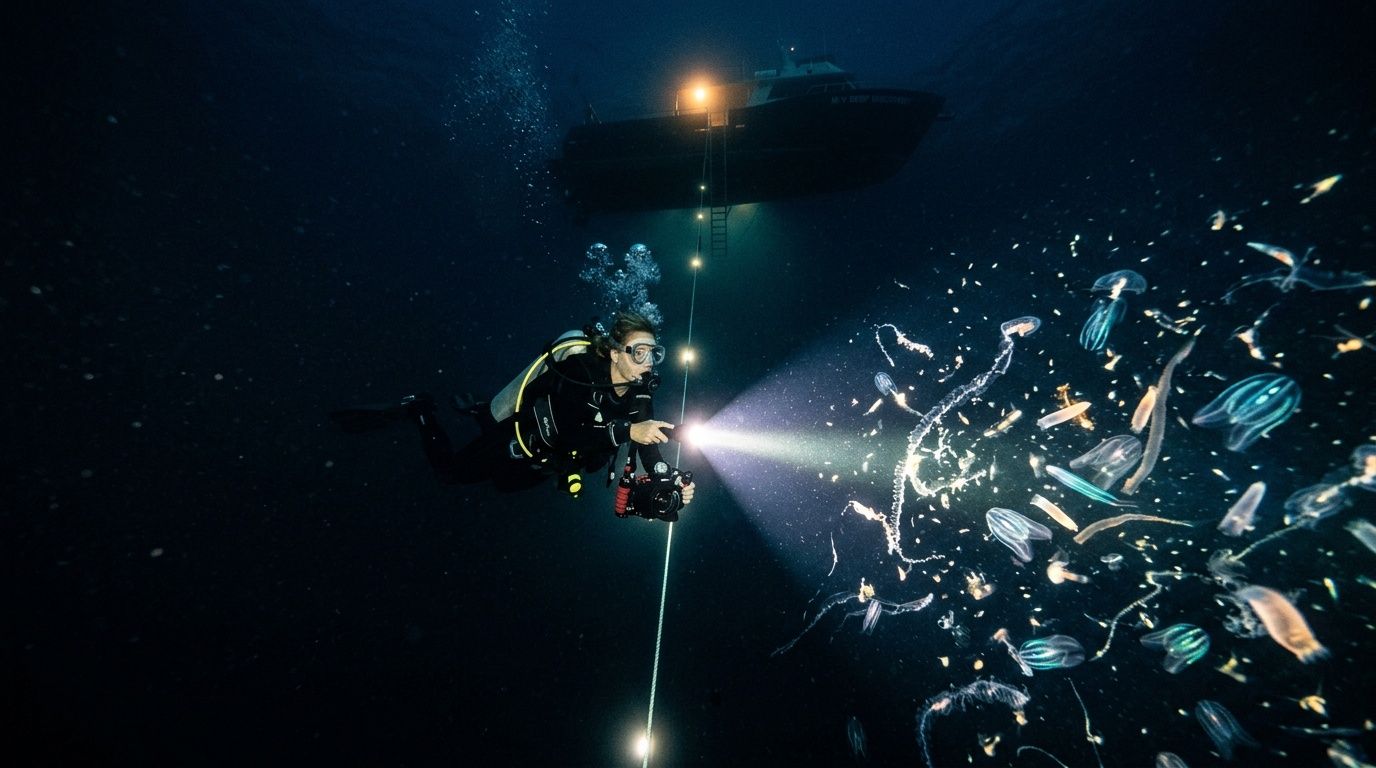
You’re probably here because blackwater dive Kona sounds equal parts fascinating and unhinged.
That reaction is normal. On paper, it reads like a dare. You head offshore at night, descend into open ocean over thousands of feet of water, and hover in darkness waiting for deep-sea life to rise into your light. For divers who’ve never done it, the phrase alone can trigger every instinct that says reefs are safer than blue water and familiar is better than strange.
Then you do one.
Done properly, blackwater isn’t chaos. It’s a controlled midwater dive built around one of the most remarkable natural events in the ocean. Kona is the place where recreational blackwater diving was pioneered in the 1990s, and it remains the benchmark. Just as important, operators like Kona Honu Divers have spent decades refining the procedures that turn this from an intimidating concept into a disciplined, memorable dive.
Into the Black What is a Kona Blackwater Dive
The first few minutes feel unlike any other dive in Hawaii.
The boat stops far offshore. The crew lowers the line array. You roll in, descend onto the system, settle into the water column, and the shoreline becomes irrelevant. There’s no reef to follow, no lava finger, no bottom contour to study. Just black water, your light beam, and things drifting up out of darkness that look more like prototypes than finished animals.

Not a reef night dive
A lot of divers hear “night dive” and picture lobsters, sleeping parrotfish, and hunting eels over a reef. That’s not what this is.
A blackwater dive Kona experience is an offshore, tethered night dive in the open ocean. You’re not there to inspect structure. You’re there to watch the water itself, because the water column becomes the attraction.
The reason is the nightly vertical migration of pelagic life. Deep-sea organisms rise toward shallower water after dark, and Kona gives recreational divers unusual access to that movement. If you want a quick overview of how the local version works, this black water night dive guide is a useful primer.
What divers see
The best blackwater divers stop looking for big animals and start looking for motion, shape, and transparency.
You’ll see tiny drifting bodies pulse, coil, flash, and vanish. Some look like bits of blown glass. Some look like ribbons with organs. Some are larval forms of animals you’d never recognize in adulthood. In the beam of a dive light, the ocean can feel less like a habitat and more like a conveyor belt of living curiosities.
Practical rule: If you keep trying to make blackwater behave like a standard night dive, you’ll miss what makes it special. Slow down. Hover. Let the life come to you.
Why it hits divers so hard
Even very experienced divers get humbled by their first blackwater dive.
Part of that comes from the setting. Part of it comes from scale. But most of it comes from the fact that this is one of the few dives where almost everything in front of your mask feels undiscovered, even when it isn’t. Every pass through the light has the potential to show you something you’ve never seen before.
That’s why blackwater has such a grip on photographers, critter hunters, and divers who thought they’d already seen the ocean’s best tricks.
Why Kona is the World Capital of Blackwater Diving
Kona didn’t just become a good place to do blackwater. It became the place.
Kona, Hawaii, is the undisputed birthplace and world capital of blackwater diving, pioneered in the 1990s. Its unique geology features a dramatic ocean floor drop to great depths just a few miles offshore, enabling recreational access to the nightly vertical migration of deep-sea organisms. Unlike other locations, Kona's calm seas allow trips nearly every night, with research showing 76% of observed organisms are bioluminescent, according to this Kona blackwater overview.

The geography does the heavy lifting
Most places have to work hard to reach true blue-water depth.
Kona doesn’t. The seafloor drops away dramatically just a short run from shore. That changes everything. You don’t burn the evening on a long transit, and you don’t need a weather window that feels borrowed from luck. You get deep offshore water close to harbor, and that makes blackwater practical, repeatable, and consistent.
That convenience matters more than people think. It lowers the friction around the whole operation. Less time pounding across open water usually means a better mood on the boat, easier logistics, and a cleaner setup once the crew is ready to deploy the line system.
The conditions favor repetition
One amazing blackwater dive can happen in a lot of places.
A destination earns its reputation when it can deliver that experience over and over. Kona’s leeward coast is the reason that happens. The coastline is known for calmer sea conditions, and that reliability is a major advantage for offshore night diving.
That consistency is one reason many divers who compare islands end up concluding that Kona offers the best diving among the Hawaiian islands. For blackwater specifically, consistency isn’t a luxury. It’s the foundation.
Kona created the recreational standard
Kona’s importance isn’t just location. It’s history.
Here, local innovators turned an unusual idea into a repeatable recreational dive. The procedures, boat handling, tether logic, and diver management were refined here. Other destinations now offer blackwater dives, but Kona remains the reference point because the model was built here and tested here.
Here’s the practical difference that creates:
| Factor | Kona advantage |
|---|---|
| Access to deep water | Deep ocean begins very close to shore |
| Trip reliability | Calm conditions support regular departures |
| Operational maturity | Techniques were pioneered and refined locally |
| Diver confidence | Crews run this as a specialty, not a novelty |
Kona isn’t just a backdrop for blackwater diving. It’s the reason recreational blackwater became possible at the level divers recognize today.
Why serious divers book here first
If your goal is to try blackwater once, you want the place with the least operational compromise.
That means short runs, experienced crews, and a dive format that’s been polished over years, not improvised because it sounded exciting. Kona checks those boxes better than anywhere else I’ve seen. And if you’re selective about operators, you can narrow it further. Kona Honu Divers stands out because they’re tied directly to the local history of the dive and they run it with the seriousness the environment deserves.
The Dive Deconstructed Tethers Lights and Buoyancy
Most of blackwater’s “extreme” reputation comes from people not understanding the system.
Once you see how the dive is built, the logic becomes obvious. The line array gives you structure. The light field gives you visual reference and attracts life. Your job is simple but not easy. Hold position, stay calm, and manage buoyancy with precision.

The tether system is the backbone
The local blackwater format uses a purpose-built suspended system, not a casual drift in the dark.
The Kona blackwater dive employs a specialized tether system with a weighted 60-foot downline and individual tethers clipped to each diver's BCD. This setup, deployed over 2,000-8,000 feet of water, maintains a consistent 40-50 foot depth, prevents separation, and mitigates currents. This system, refined by pioneers like Kona Honu Divers, has resulted in zero lost divers in professionally run trips, as described in this Kona Honu Divers blackwater breakdown.
That’s the key point many first-timers miss. You are not being dropped into empty water and told to freestyle. You are clipped into a managed system designed to control spacing and depth.
What the crew controls
A strong operator does far more than drive to a dark patch of ocean.
The crew manages deployment, diver placement, line checks, boat positioning, and the whole rhythm of the dive. Good crews make the setup feel calm and deliberate. That matters because divers borrow confidence from order.
The pieces that matter most are:
- Downline placement: It creates the central reference for the dive.
- Individual attachment: Each diver clips into the system, which reduces separation risk.
- Lighting strategy: The lights create the visual arena where the dive happens.
- Surface oversight: The boat team monitors the system the entire time.
If you’ve done drift diving, this will feel familiar in one respect. The success of the dive depends on a disciplined crew. The difference is that blackwater asks for even better buoyancy and more restraint from the diver.
Buoyancy is what separates comfort from struggle
This isn’t a kick-around dive.
On a reef, a diver can get sloppy and still have visual references to recover with. On blackwater, every small mistake gets magnified because there’s no bottom and very little to orient by besides the line, the light field, and your own control.
That’s why buoyancy matters so much. The divers who have the best time are rarely the strongest swimmers. They’re the ones who can hover without fuss, use their breath properly, and avoid chasing everything that drifts past.
If you can hover comfortably and make small, calm adjustments, blackwater feels controlled. If you’re inflating and dumping air every few seconds, it feels harder than it needs to.
What works and what doesn’t
Most first-time divers either click with blackwater or fight it.
A simple comparison makes it clear:
| What works | What doesn’t |
|---|---|
| Neutral hovering | Constant finning |
| Watching one patch of water | Scanning wildly in every direction |
| Slow breath control | Big corrective BCD dumps |
| Staying clipped and settled | Pulling around on the tether |
| Letting subjects approach | Chasing fragile pelagic life |
One funny crossover is that I often explain blackwater control using examples from much easier ocean activities. If you’ve read about why efficient gear and calm movement matter even on a simple boat trip, this piece on what gear comes with your Captain Cook snorkel tour shows the same broader truth. Comfort and simplicity reduce mistakes.
Why Kona Honu Divers stands out on execution
Lots of operators can say they run blackwater. Not all of them run it with the same discipline.
Kona Honu Divers has the local pedigree, but that alone isn’t enough. What matters is how they translate that experience into a dive that feels organized from briefing to reboarding. Their operation reflects years of refinement, and divers feel that immediately.
Pelagic Wonders The Creatures of the Night
A good blackwater dive changes what you think counts as marine life.
Reef diving trains your eye for recognizable animals. Turtles. Eels. Rays. Big fish. Blackwater rewires that instinct. Suddenly the stars of the dive are delicate, transparent, half-formed drifters that might be only moments in front of your mask before they vanish back into black.

The strange ones steal the show
Some nights the first thing that grabs your attention is a ctenophore flashing with impossible color. Other nights it’s a siphonophore stretched out like a living filament. Then a salp chain comes by and reminds you the ocean can invent shapes no science fiction artist would dare pitch.
These aren’t charismatic in the usual tourism sense. They’re mesmerizing because they look temporary, almost theoretical. Many are transparent. Many pulse or drift instead of swimming with obvious intent. A lot of them seem built from light rather than flesh.
Larval life is a revelation
This aspect surprises divers most.
You’re not only seeing obscure pelagic species. You’re also seeing larval stages of familiar animals that look nothing like their adult forms. That’s part of the thrill. You can spend years diving reefs and never appreciate how surreal ocean life is at the beginning.
Typical blackwater encounters include forms such as:
- Siphonophores: Long colonial drifters that can look like illuminated thread.
- Salps: Gelatinous tunicates that move with a soft pumping rhythm.
- Ctenophores: Comb jellies that catch light in shimmering bands.
- Larval fish and invertebrates: Tiny, transparent versions of lives still in progress.
Some nights feel sparse. Some feel crowded. The best dives often land in the middle, where there’s enough life to keep you turning your head but enough space to appreciate each subject.
The magic of blackwater isn’t that you’ll identify everything. It’s that you won’t.
Why photographers love it
Photographers get addicted to blackwater for a simple reason. The ocean gives them a clean black backdrop and subjects that often seem designed for macro.
There’s no reef clutter behind the animal. No coral head stealing the frame. It’s just subject, light, and darkness. That turns even tiny organisms into dramatic portraits.
For non-photographers, the same thing makes the dive memorable. Every sighting feels isolated and theatrical. A creature appears in the beam, hangs for a moment, then dissolves back into the void.
The emotional difference from manta diving
People often compare blackwater with other Kona night experiences, but they scratch different itches.
Manta encounters are broad, graceful, and instantly readable. Blackwater is intimate, weird, and full of mystery. If you’ve watched manta ray barrel rolls explained and what makes those underwater encounters so compelling, think of blackwater as the opposite end of Kona’s night-ocean spectrum. One is a grand wildlife performance. The other is a drifting microscopic opera.
Expect variation and appreciate it
The divers who enjoy blackwater most are the ones who stop demanding a checklist.
You’re entering a moving pelagic world, not a zoo route. Conditions, current, moonlight, plankton, and pure chance all influence what drifts by. That unpredictability is part of the appeal. Even after many dives, the ocean still hands you subjects that feel new.
Safety First Diver Requirements and Risk Management
Blackwater earns respect. It doesn’t deserve panic.
The safest way to think about it is this. It’s an advanced dive in an unusual environment, and it becomes manageable when the operator is strict and the diver is honest about skill level. Problems usually don’t come from the concept itself. They come from mismatches between the dive and the diver.
Shark fears are usually misplaced
Sharks are one of the first questions people ask, usually before they ask about buoyancy, line discipline, or seasickness.
That’s backwards. Problematic shark sightings are rare, occurring in only about 2 in 100 dives with zero attacks ever recorded on these managed tours, and operators also enforce prerequisites such as advanced certification and a minimum number of logged dives, as noted in this blackwater safety overview.
The practical risks are more ordinary. A diver gets task-loaded. A diver overweights. A diver arrives rusty and discovers open-water night orientation feels different than expected.
Who should sign up
This is not the place to stretch into a skill set you don’t yet own.
Kona operators commonly require Advanced Open Water certification, a meaningful number of logged dives, and recent dive experience. Those standards exist for good reason. The dive rewards divers who are already relaxed underwater.
A good candidate usually has these habits:
- Comfort at night: Darkness changes workload. You shouldn’t be discovering that on this dive.
- Stable hovering ability: You need to hold depth without constant correction.
- Calm response to open water: Featureless blue water shouldn’t trigger anxiety.
- Recent dive rhythm: Rust shows up quickly when task loading increases.
What helps before the boat leaves
Preparation is boring until it saves the dive.
Bring the gear you trust, listen closely to the briefing, and speak up if you’ve had a long layoff. Wear exposure protection that keeps you comfortable and adds some protection from stings. If you’re prone to motion issues, address that before departure instead of hoping adrenaline will override biology.
For many divers, the most useful practical prep has nothing to do with deep ocean life. It’s handling the boat ride well enough to start the dive fresh. This guide on how to avoid sea sickness is worth reading if offshore departures tend to get you.
Bottom line: Blackwater is safest when divers treat it as a precision dive, not a thrill ride.
What doesn’t work
A few mindsets consistently cause trouble.
- Overconfidence: “I’ll be fine” is not a buoyancy strategy.
- Checklist diving: Chasing every subject leads to sloppy control.
- Hiding nerves: Tell the crew if something feels off before entry.
- Booking above your recent experience: Certification card alone isn’t enough.
The divers who come back raving about blackwater usually aren’t the boldest. They’re the most composed.
Booking Your Abyss Adventure with Kona Honu Divers
If you want the best blackwater dive Kona experience, book with the operator most closely associated with doing it right.
That’s Kona Honu Divers. They have the history, the procedure, and the local credibility this dive deserves. Blackwater is not the place to bargain-hunt or pick a boat based on whichever listing happened to appear first. You want a crew that treats this as a specialty, because it is one.
For the main event, book the Kona Honu Divers Black Water Night Dive.
If you want another iconic Kona night experience on scuba, their manta ray scuba dive is also excellent and offers a completely different style of night encounter.
Not everyone in your group may qualify for blackwater. If you’re traveling with non-divers, newer ocean travelers, or someone who wants a night wildlife experience without scuba, the Manta Ray Night Snorkel tour is the obvious alternative.
Here’s the decision in simple terms:
| If you want… | Best choice |
|---|---|
| Alien pelagic life and a specialty scuba dive | Blackwater with Kona Honu Divers |
| A dramatic night wildlife encounter without scuba | Manta Ray Night Snorkel |
| A famous Kona night dive focused on large animals | Kona Honu manta scuba dive |
My advice is simple. If you already meet the prerequisites and the idea of hovering in open ocean at night sounds more exciting than intimidating, book blackwater first. Kona does it better than anywhere, and Kona Honu Divers is the operator I’d point serious divers toward without hesitation.
Frequently Asked Questions about Blackwater Diving
Is blackwater diving in Kona available year-round
Yes. Kona is known for conditions that support these trips through the year, which is a major reason the destination became the blackwater capital in the first place.
Do you go deep on the dive
No, not in the way the setting suggests. You’re suspended at a controlled recreational depth on the tether system while the ocean below drops away dramatically.
Is blackwater only for expert divers
It’s for qualified, comfortable divers. You don’t need to be a technical diver, but you do need strong buoyancy, recent experience, and the right certification level for the operator’s standards.
What should I bring on the boat
Bring the basics that make transitions easy after a night dive:
- A towel: You’ll want it immediately after getting out.
- Dry clothes: Even warm Kona nights can feel cool after a dive.
- Certification card and log details: Operators may verify prerequisites.
- Any personal comfort items: Seasickness prevention, water, and whatever helps you feel settled.
What if I’m interested but not qualified for blackwater
Choose a night experience that matches your current skill level instead of forcing this one too early.
For most non-divers or uncertified travelers, the manta night snorkel is the best fit. It delivers a world-class after-dark ocean experience without the scuba prerequisites.
Will I get seasick going offshore
Some people do, even in relatively calm conditions. The smart move is to plan for it before departure, not after you start feeling bad. Eat lightly, hydrate, and use your preferred motion-sickness strategy if you know you’re susceptible.
Is the dive scary
For some divers, the first few minutes feel mentally unusual. That’s different from unsafe.
Once you settle onto the system and start focusing on the life in the lights, most of the anxiety gets replaced by curiosity. Divers who struggle usually struggle because they arrived underprepared, not because the format itself is reckless.
Do I need to be good at underwater photography to enjoy it
Not at all. Blackwater is a great photography subject, but plenty of divers love it without carrying a camera. In many cases, first-timers enjoy more by leaving the camera behind and learning how to watch the water.
If blackwater isn’t the right fit for everyone in your group, or if you want a more accessible Kona ocean adventure on another night, Kona Snorkel Trips is an excellent place to book. Their crew is known for safe, memorable marine experiences, and their manta snorkel is one of the best ways for non-divers to experience Kona’s night ocean.