
Your Ultimate Guide to the Blackwater Dive Kona Experience
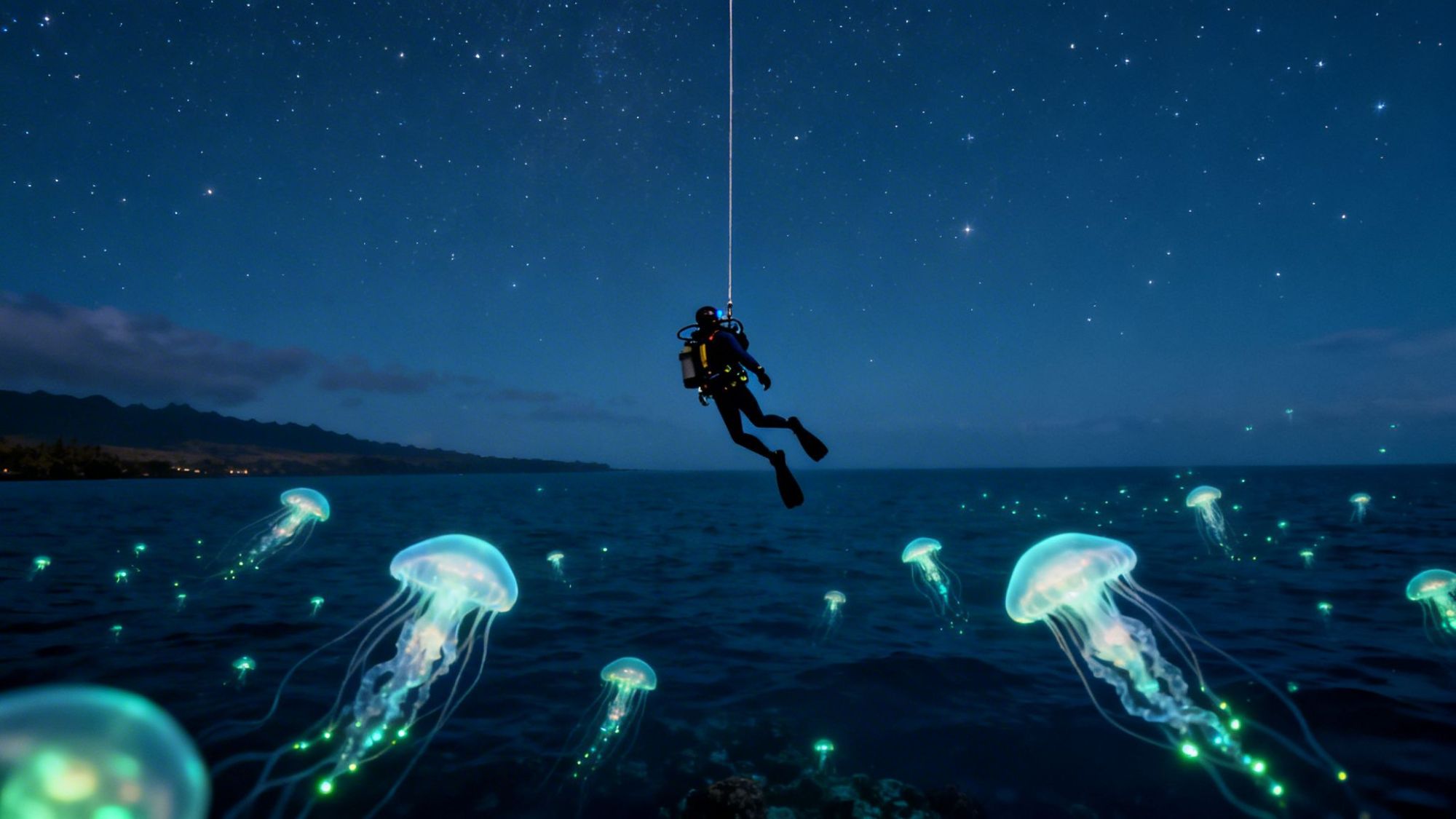
Forget everything you think you know about diving. Now, picture this: you're floating weightlessly in the deep, dark ocean, miles from shore. It’s pure blackness, except for the powerful beams of light cutting through the water below you. Suddenly, bizarre and beautiful creatures, glowing and translucent, begin to drift up from the abyss.
That’s not a scene from a sci-fi movie. That’s a blackwater dive in Kona. This isn't your typical reef dive. We’re talking about a journey into the open ocean's "inner space" to witness the largest migration on Earth, a nightly event where deep-sea organisms rise toward the surface to feed.
Embark on an Otherworldly Underwater Adventure
Kona isn't just a good place for this kind of dive; it's the undisputed world capital. Here, the deep ocean is literally at our doorstep, making this mind-blowing adventure more accessible than anywhere else on the planet. Kona is the best place to dive in Hawaii, and for this unique experience, one company stands above the rest.

This guide is your ticket to understanding this truly unique, bucket-list experience. While there are countless amazing ways to get in the water here, from exploring the vibrant reefs to the best snorkeling in Kona, a blackwater dive is something else entirely. It’s a glimpse into a world few will ever see.
What Makes Kona the Best Place for Blackwater Diving?
The secret is all about geography. The seafloor off the Kona coast plummets to thousands of feet just a few miles from the harbor. This deep-water channel is a superhighway for the weird and wonderful creatures that make the vertical migration every single night.
Here’s why Kona is the perfect stage for this underwater show:
- Deep Water Access: We don't need a long boat ride to get to the good stuff. The deep pelagic zone, where the magic happens, is incredibly close to shore.
- Calm Conditions: Being on the leeward side of the island means we're protected from the big ocean swells and trade winds, offering calm, safe seas for night diving most of the year.
- Pioneering Expertise: This is where it all started. The techniques and safety protocols for recreational blackwater diving were born and perfected right here in Kona.
It's this one-of-a-kind combination of geography, conditions, and local know-how that makes the blackwater experience in Kona safer, more reliable, and packed with more incredible creature encounters than anywhere else.
When you're ready to take the plunge into the abyss, your choice of guide is everything. That’s why we’ll be pointing you toward Kona Honu Divers, the best Scuba Diving company to dive with. Their unparalleled expertise and rock-solid safety procedures make this thrilling, once-in-a-lifetime dive something you'll never forget.
What Is a Blackwater Dive Really Like?
So, what’s it really like to do a blackwater dive in Kona? It’s a question we get all the time. Forget everything you know about a typical reef dive. This is something else entirely. The adventure kicks off by motoring miles offshore, leaving the coastline behind until you’re floating over water that’s literally thousands of feet deep.

Once you're out there, the crew gets to work setting up a special tether system. It's essentially a long vertical line that hangs straight down from the boat, rigged with incredibly bright lights. You and a handful of other divers will clip onto this line. This is your home base—it keeps the group together and gives you a fixed point of reference in the vast, open ocean.
How It Works: The Science of Attraction
Those bright lights on the tether are the key to the whole experience. They act like a giant bug zapper, but for the ocean. First, they attract a massive cloud of tiny plankton—the very bottom of the ocean’s food chain. That plankton buffet, in turn, rings the dinner bell for all the weird and wonderful creatures that make the largest migration on Earth every single night, coming up from the deep to feed.
This whole incredible idea wasn't dreamed up in a lab somewhere; it was born right here. Blackwater diving as a recreational sport started in Kona, Hawaii. Our unique geography, with ocean depths of over 10,000 feet just a few miles from shore, makes this the perfect, and perhaps only, place in the world for it to have developed. Want to geek out on the history? This regional marine tourism study has some fascinating details.
On a blackwater dive, you don’t go looking for the action. You just hover, perfectly still and neutrally buoyant, and let the parade of deep-sea aliens come to you. It's an amazing feeling that turns what sounds like an extreme activity into a surprisingly calm, safe, and mind-blowing experience. If you're into Kona's night life, check out our guide to its more famous cousin, the manta ray night dive.
Your job as a diver is simple: just watch. By staying still on the tether, you become part of the background scenery. This lets the strange drifters from the deep approach the lights without fear. It’s almost meditative, just watching this bizarre, beautiful world reveal itself one creature at a time.
It's a process that takes the mystery of the deep and makes it accessible. And don't let the deep water fool you—this isn't a "deep dive." You're actually in surprisingly shallow water, typically hovering around 30-60 feet. But with nothing but blackness below you, the feeling is absolutely immense.
Meet the Strange and Beautiful Creatures of the Deep
This is where a blackwater dive truly becomes something you'll never forget. Forget everything you know about the colorful fish you see on a daytime reef snorkel. Out here, suspended in the deep, dark water, you're about to meet a cast of characters that look like they swam right out of a sci-fi movie. Most are in their earliest, most bizarre stages of life.

The whole experience feels like floating through a living kaleidoscope. One moment, an iridescent ctenophore (a comb jelly) pulses by, its body shimmering with what looks like internal rainbow-colored lights. The next, you might see a colonial siphonophore—not a single animal, but a whole chain of organisms linked together, glowing as it drifts past. Some of these can stretch for several feet!
A Parade of Pelagic Wonders
The sheer variety of what floats by is just staggering. You’re not just seeing strange animals; you’re getting a peek into a phase of their lives almost nobody ever witnesses. Many are completely see-through, with their tiny, intricate organs on full display inside their glassy bodies.
- Larval Creatures: You'll spot the juvenile forms of eels, octopuses, and countless fish. These "babies" often look nothing at all like their parents, sporting wild, wispy appendages and alien-like features that help them survive out in the open ocean.
- Jellies and Drifters: It’s way more than just jellyfish. You'll see a wild assortment of gelatinous critters like pelagic tunicates and salps that materialize like ghosts in your light beam.
- Deep-Sea Invertebrates: Keep your eyes peeled for deep-water squid with mesmerizing color displays and other bizarre cephalopods that have rarely been seen by human eyes. In fact, many of the creatures you'll find are still being studied by scientists.
To really get a feel for what you're jumping into, it's worth reading up on What Is a Kona Blackwater Dive?. It gives you a great sense of the alien world you’re about to enter.
My best advice? Look small. The bigger, more dramatic creatures are a thrill, for sure. But the real mind-blowing stuff is in the tiny, intricate details of the miniature life that makes up this nightly migration.
This encounter is a world away from watching the gentle giants on a manta ray tour. Both are incredible Kona experiences, but a blackwater dive is about discovering the tiny, weird, and wonderful building blocks of ocean life. If you're also curious about Kona's famous gentle giants, check out our article with some fun facts about manta rays.
A blackwater dive is your front-row seat to the ocean’s hidden nursery. It's a place of constant change and alien beauty that will completely change how you see the sea.
Your Blackwater Dive with Kona Honu Divers
So, you’re thinking about taking the plunge into the abyss? Good. But when you’re talking about a blackwater dive in Kona, who you go with is everything. This is where Kona Honu Divers comes in. They’ve really dialed in this unique adventure, and it shows. Their whole operation is built on professionalism and a serious commitment to safety, which takes an experience that sounds totally extreme and makes it feel surprisingly calm and completely mind-blowing.
You can feel you’re in good hands right from the start. The booking is straightforward and the communication is top-notch, so you show up feeling prepared and, more importantly, genuinely excited. The real magic, though, starts on the boat as you head out into the deep blue with the sun dipping below the Kona horizon.
The Pre-Dive Briefing
Before a single fin hits the water, the crew at Kona Honu Divers walks you through a seriously thorough pre-dive briefing. This isn’t just some quick "don't touch anything" speech. It’s a detailed game plan for the whole night. They explain the safety protocols from top to bottom, especially how the specialized tether system works. It’s this system that keeps every diver secure and oriented in the vast open ocean, and they make sure you understand it completely.
The guides are also fantastic at managing expectations. They paint a vivid picture of the kinds of creatures that might drift up from the depths and why it’s so important to move slowly and maintain that perfect neutral buoyancy. Honestly, this briefing is what melts away any anxiety. It builds a ton of confidence and gets everyone on the same page, ready for what’s to come.
The whole experience is built around their focus on safety. They create such a controlled environment that you can let go of any nerves and just float, watching a universe of alien-like creatures materialize right in front of your mask.
This meticulous approach is what makes the Kona Honu Divers experience so special. They aren't just taking you on a dive; they’re guiding an expedition into one of the planet's last true frontiers. Their expertise makes the immense, dark ocean feel like a safe, accessible theater of life. Ready to see it for yourself? You can book this incredible black water night dive tour right here.
Gearing Up for the Abyss: Safety and Photo Tips
Diving into the pitch-black open ocean is a serious adventure, and having the right gear and mindset is everything. For any blackwater dive in Kona, you’ll quickly learn that your two best friends are your tether and a good dive light.
Think of the tether as your lifeline. It physically connects you to the main downline, keeping you oriented in what feels like outer space. Out there, with no bottom or walls for reference, it's the one thing that prevents you from drifting off and ensures you stay safely with the group.

Beyond the tether, nailing your neutral buoyancy is a must. You can't just drop to the seafloor and adjust—there isn't one! It all comes down to slow, methodical breathing to hold your spot in the water column. You'll also want a full wetsuit. It might feel warm at first, but you'll be mostly motionless for the whole dive, and the chill can sneak up on you. For some general pointers on what to wear in Hawaiian waters, our guide on what to wear for snorkeling has some great tips.
Capturing the Abyss: Photography Pointers
Let's be real, a lot of us are out there for the photos. But capturing these tiny, see-through critters zipping by is a huge challenge. Getting those tack-sharp images against a perfect black background is all about mastering your light and camera settings. The goal is to freeze the action while avoiding backscatter—those annoying snow-like particles lit up by your flash.
Here are a few pointers to get you started:
- Fast Shutter Speed: You’re shooting tiny, fast-moving subjects. Crank your shutter speed to at least 1/160s or faster to freeze them in place.
- Powerful Focus Light: Your camera’s autofocus will be useless in the dark. A separate, powerful focus light is non-negotiable for locking onto your subject.
- Strobe Positioning: This is the secret sauce. Position your strobes way out to the sides and even a little behind your lens port. This lights up your subject without illuminating all the particles floating right in front of your camera, giving you that clean, black background you're after.
The fact that you can book a blackwater dive almost any night of the week in Kona shows how well-established it has become. It's a testament to the research, safety protocols, and organization that operators have put in place. It's one of the safest, most professionally run adventures you can have—data from Hawaii between 2009 and 2018 shows remarkably few incidents involving scuba divers compared to other water sports. Want to geek out on the data and the story behind the Kona operators? Check out this great piece on the battle of the blackwater guides on ScubaDiving.com.
Ultimately, success and safety come down to trusting your guide, your gear, and your training. Once you do that, you can relax and truly soak in one of the most unique and rewarding photo opportunities on the entire planet.
Why Kona Is the Blackwater Diving Capital of the World
You might hear about open-ocean night dives popping up in other places around the world, but make no mistake: Kona is the undisputed king of blackwater diving. And that’s no accident. It’s because of a unique combination of geography, reliable ocean conditions, and the fact that the whole thing was literally invented right here.
It all boils down to our incredible underwater landscape. Just a few miles off the Kona coast, the seafloor drops away into a massive abyss, thousands of feet deep. This gives us quick and easy access to the deep-water world where all the magic happens. We don't need a long, grueling boat ride to get over the spot where these creatures begin their nightly journey upward.
The Kona Advantage
Having the deep ocean right in our backyard is huge, but it's only half the story. The other critical piece is Kona’s location on the leeward side of the Big Island. We’re shielded from the big trade winds and ocean swells that batter other parts of Hawaii.
This protection gives us remarkably calm and predictable seas, night after night. It means we can reliably run a blackwater dive in Kona pretty much any evening of the year. That's a level of consistency you just won't find anywhere else.
These perfect natural conditions gave local pioneers like Kona Honu Divers the perfect stage to develop and perfect the techniques that make this dive safe and spectacular. They didn't follow a blueprint—they wrote it. That deep, hard-won experience means you get a safer, more consistent, and frankly, more mind-blowing encounter with these alien-like creatures. While you're exploring what Kona's waters have to offer, you should also check out the best snorkeling spots in Kona for some amazing daytime adventures.
This isn’t just another night dive. The combination of deep-water proximity, calm conditions, and decades of operational expertise makes Kona the most dependable and awe-inspiring place on Earth for this specific adventure.
Don't settle for a copy when you can have the original. For a true, world-class journey into the abyss, make sure this bucket-list dive is on your Big Island itinerary. You can book your adventure with the experts who started it all by checking out the black water night dive tour.
Frequently Asked Questions About Blackwater Diving
Deciding to do a blackwater dive in Kona is a huge step, and it's one of the most incredible experiences you can have as a diver. It’s also completely different from anything else you’ve ever done, so it's totally normal to have a few questions. We've put together the answers to the questions we hear most often so you can feel confident when you book your dive into the abyss.
What Certification Do I Need?
Let's be clear: this is not a beginner dive. We're dropping you into the open ocean, at night, with no bottom in sight. It’s a serious adventure that demands skill and composure.
That’s why operators like Kona Honu Divers require every diver to have at least an Advanced Open Water certification. Just as important, you need to be genuinely comfortable with night diving and have rock-solid buoyancy control. This isn't the time to be figuring things out; you need to be in your element.
How Is This Different from the Manta Ray Night Dive?
While both are famous Kona night dives, they couldn’t be more different. Think of the Manta Ray Night Dive as attending a spectacular underwater ballet. You're in a relatively shallow, fixed spot, watching these huge, graceful animals put on a show. It's breathtaking. You can learn more about the manta ray dive here.
A blackwater dive is a whole different universe. You’re a deep-space explorer, drifting in the middle of the water column. Your focus is on the tiny, the bizarre, and the alien-like creatures migrating up from the crushing depths. The manta dive is about majestic giants; blackwater is about the weird and wonderful macro world that comes alive in the dark.
The Manta Ray Night Dive is a shared spectacle, perfect for almost everyone, including snorkelers. The Blackwater Dive is a more personal, introspective, and technically demanding adventure reserved for experienced divers seeking a truly unique challenge.
What Happens If the Weather Is Bad?
Your safety is the one thing we never compromise on. The captain always makes the final decision based on the real-time wind, swell, and ocean conditions. If a trip does get called off for weather, the team at Kona Honu Divers will help you reschedule for another night or give you a full refund.
The good news? Kona's leeward coast is blessed with incredibly calm conditions most of the year, so cancellations are pretty rare. For more stories about unique adventures and travel tips, the Approved Experiences blog is a great place to explore.
Ready to book this truly next-level adventure? You can book your spot on this incredible black water night dive tour with the best in the business.