
Blackwater Dive Hawaii: Kona’s Ultimate Night Dive Guide
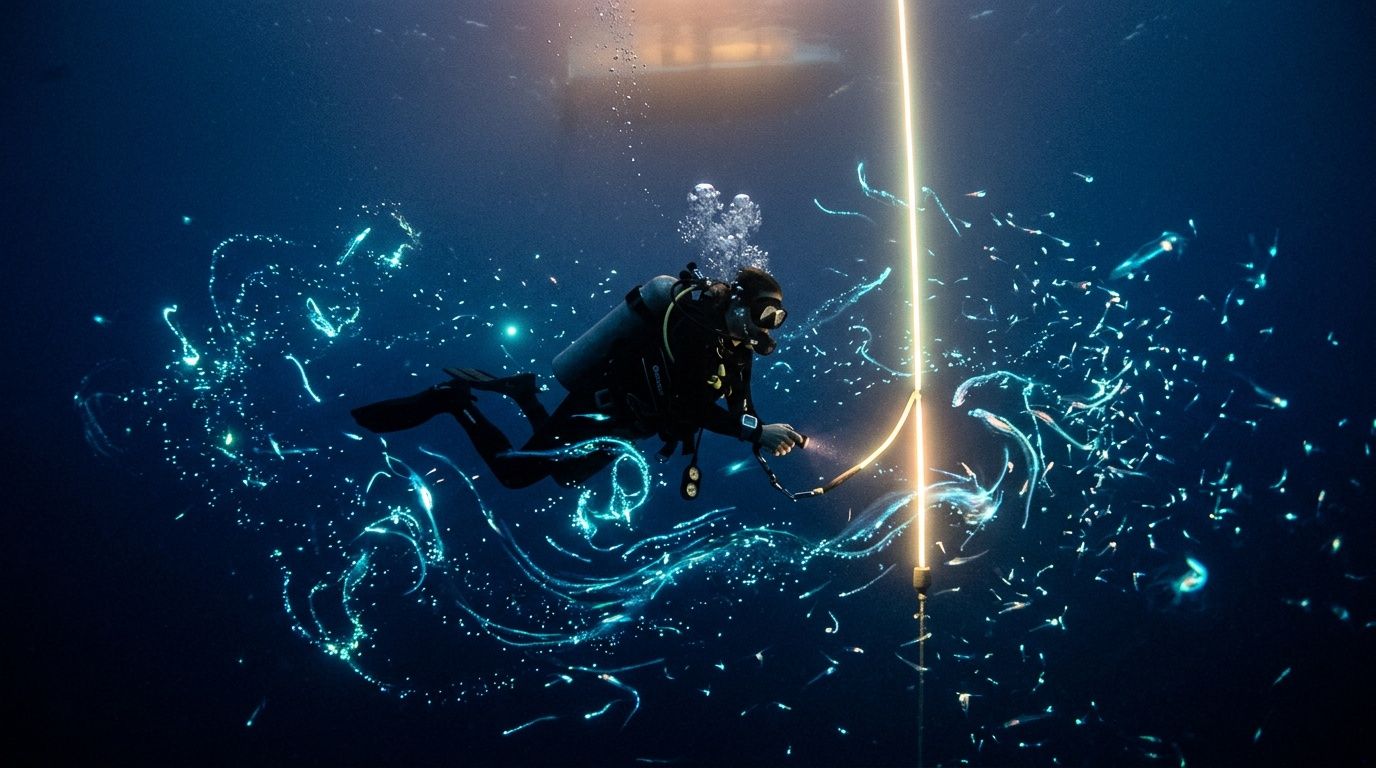
You are here because regular night dives no longer feel like enough.
You’ve done the reef. You’ve hovered over lava, watched octopus hunt under a beam, maybe even checked the manta dive off your list. And now you want the dive that experienced divers talk about in a slightly different tone. The one that sounds less like a tour and more like a threshold.
A blackwater dive Hawaii experience is that threshold. You’re suspended in open Pacific water at night, with no bottom in sight, while larval fish, transparent squid, siphonophores, and glowing drifters rise out of the deep. It doesn’t feel like a reef dive after dark. It feels like floating in a living piece of science fiction.
Plunge Into Darkness The Ultimate Guide to Blackwater Diving
The line drops away beneath you, the surface lights turn into a dim halo, and the ocean around Kona goes completely black. There is no reef to track, no wall to follow, no bottom to settle your eyes. Only the glow of the rig, the sound of your own breathing, and small transparent animals drifting into view like they were built for another planet.

That first minute tells experienced divers whether they are ready for this kind of exposure. Blackwater strips away the visual comfort you get on a reef night dive and replaces it with pure midwater awareness. For divers who have already logged the usual Hawaii highlights, this is often the next serious step. It demands cleaner buoyancy, steadier focus, and a calmer head than many dives ever ask for.
Kona has become one of the defining places to do it because the conditions support the dive properly. Deep pelagic water is accessible without a punishing run offshore, and that gives skilled crews room to build a controlled, repeatable operation around an environment that is anything but casual. The result is a dive that feels wild while still being run with discipline.
The experience itself is hard to overstate. Larval fish arrive looking nothing like their adult forms. Squid flash and vanish. Gelatinous drifters pulse through the lights with the cold symmetry of spacecraft. Even veteran divers come back to the boat talking a little slower after this one, because blackwater is not just another box to check. It is the dive that shows how solid your fundamentals really are.
Operator quality matters more here than on almost any recreational dive. Good crews manage spacing, lighting, drift procedures, diver control, and pickup timing with real precision. That is why Kona Honu Divers has earned so much respect among serious local divers. Their black water night dive page is the first place I would send someone who wants the right combination of excitement, structure, and safety.
For a second local perspective on what makes the experience so addictive, this write-up on the black water night dive in Kona captures the same mix of wonder and respect the dive tends to create.
What Exactly Is a Blackwater Dive
A blackwater dive is an open-ocean night dive done over very deep water, usually miles offshore, using a suspended line system and powerful lights to create a controlled observation zone in the mid-water column.
That sounds technical. Underwater, it feels much stranger than that.
You’re not touring terrain. You’re hovering in a vertical migration corridor, watching pelagic organisms rise toward the surface under darkness. It’s less like a standard night dive and more like an underwater safari for animals that usually stay out of human view.
The core difference
On a reef night dive, the reef gives you orientation. You can judge distance, depth, and movement against a physical backdrop.
On blackwater, the backdrop disappears.
That changes everything. Your buoyancy has to be cleaner. Your breathing has to be calmer. Your awareness has to move from “where’s the coral head?” to “where am I relative to the line, the lights, my buddy, and the boat?”
Blackwater is often the moment a diver learns whether their buoyancy is really automatic or whether the reef has been doing half the work.
Why Kona is the right place for it
Kona gives this dive the one thing it absolutely needs. Immediate access to deep pelagic water without ugly conditions getting in the way.
The steep offshore drop and calm leeward coast make it unusually practical to run this kind of operation well. That’s why divers looking for a real blackwater dive Hawaii trip usually end up here, not because it’s trendy, but because the geography is built for it.
Night Dive Comparison Blackwater vs Manta Ray vs Reef Dive
| Feature | Blackwater Dive | Manta Ray Night Dive | Standard Reef Night Dive |
|---|---|---|---|
| Location | Open ocean, offshore, over thousands of feet of water | Fixed night site with bottom reference | Shore or boat site over reef structure |
| Bottom reference | None visible | Clear bottom or site structure | Clear reef, lava, or sand reference |
| Typical focus | Pelagic larvae, gelatinous animals, transparent drifters | Manta ray interaction around lights | Reef life, hunting octopus, eels, crustaceans |
| Diver experience | Suspended in mid-water | Usually stationary or site-based | Navigational night dive |
| Skill demand | High comfort with buoyancy and night conditions | Moderate to advanced depending on operator and profile | Moderate |
| Best for | Divers chasing rare, alien pelagic life | Divers wanting a signature Kona encounter | Divers building night-dive experience |
Kona’s manta dive is famous for good reason, and certified divers who want that experience can look at the manta ray dive with Kona Honu Divers. But it scratches a different itch.
The manta dive is dramatic, predictable in structure, and centered on a charismatic animal. Blackwater is less predictable, less photogenic for some divers, and far more surreal. It rewards patience and curiosity more than spectacle.
What works, and what doesn’t
- What works: Divers who enjoy hovering, scanning carefully, and noticing tiny details tend to love this dive.
- What doesn’t: Divers who need constant forward motion or who only value big animals often come up puzzled.
- What works surprisingly well: Underwater photographers who can slow down and commit to small subjects usually have a field day.
- What often fails: Treating it like a normal night reef dive. It isn’t one.
The Otherworldly Creatures You Might Encounter
The animals are why people come back.
Not because they can tick them off a fish ID slate, but because blackwater shows life in forms that don’t match what most divers think the ocean looks like. You’re not meeting familiar reef residents. You’re watching deep pelagic life in transit.

The nightly ascent
A lot of what you see is tied to the diurnal vertical migration, the nightly movement of deep-sea organisms toward shallower water to feed. On a blackwater dive, you’re positioned right in that traffic lane.
Some creatures glide into the light and hang there. Others flash by and vanish. Many are tiny. Some are nearly invisible until their edges catch the beam.
Research from Kona’s black-water dives found that 76 percent of organisms observed can produce their own light, which helps explain why the whole dive can feel like a drifting constellation of living signals, as described in this Honolulu Magazine feature on Kona blackwater diving.
What those animals look like
You may see larval fish that look completely unrelated to their adult forms. Long spines, exaggerated fins, transparent bodies, eyes that seem too large for the head. You can spend an hour looking at juvenile life and realize how little the average diver ever sees of a fish’s actual life cycle.
Then there are the gelatinous drifters.
Siphonophores can look engineered rather than evolved. Salps move like little pulsing tubes. Some squid appear as floating glass. Worms and larvae drift in with bright points of color, then disappear the second you shift your light.
The best blackwater divers don’t ask, “What big thing will I see?” They ask, “How many impossible things can I notice before the dive ends?”
Why this dive changes how people see the ocean
Most ocean experiences are built around the familiar stars. Turtles. Mantas. Sharks. Dolphins.
Blackwater strips all of that away and puts the spotlight on the life forms that hold the pelagic system together. Much of it is fragile, miniature, transparent, and easy to miss. That’s exactly why it stays with people.
If you enjoy manta encounters too, this explanation of manta ray barrel rolls and how they feed under lights is a good reminder that Kona offers two completely different kinds of night magic. One is graceful and iconic. The other is weird, fleeting, and unforgettable.
A diver’s real trade-off
There’s no guarantee of one headline species on blackwater. That uncertainty is part of the appeal.
- You trade predictability for rarity
- You trade large-animal drama for constant discovery
- You trade scenery for strangeness
For a lot of advanced divers, that’s not a compromise. It’s the whole point.
How a Kona Blackwater Dive Works The Setup and Safety
The first thing many experienced reef divers notice is how little the open ocean gives back at night. No bottom. No wall. No coral outline to settle your eyes. You drop into a dark water column, turn toward the lighted system, and that suspended frame becomes your whole world.
That is the point.
A Kona blackwater dive is built around a controlled midwater setup far offshore, over deep water. The boat deploys a weighted down-line with lights that create a bright viewing zone, and divers work that zone instead of wandering through open ocean. It feels futuristic, but the system is practical. It gives divers a clear visual reference, keeps the group organized, and puts everyone where the animals are easiest to spot.

The line system
In Kona, blackwater operators commonly suspend the dive around a weighted line set well below the surface, often with each diver clipped into the system by a short tether attached to the BCD. That gives you room to rotate, stop, and track passing life while keeping your position tied to a defined working area.
For divers coming from standard night dives, this is one of the biggest mental shifts. On a reef night dive, the bottom gives you orientation. Out here, the line does that job. Good divers treat it as a reference, not something to hang on and drag around.
That trade-off matters. The tether adds control and depth discipline, but it also means sloppy trim shows up fast. If you bicycle kick, spin, or let gauges and accessories dangle, you turn a clean setup into a cluttered one.
Why the lights matter
The lights are not there just so you can see your buddy.
They create the stage. Pelagic larvae and other drifting organisms rise into the illuminated water, and the beam becomes a living column full of tiny movement. One minute the space looks empty. The next minute a transparent squid flashes past your mask, a larval fish hovers like a shard of glass, and something with too many appendages materializes at the edge of your light before vanishing back into black.
That is why blackwater feels like a diver’s next step, not just another night dive. It rewards control, patience, and observation more than mileage.
What keeps the dive controlled
A well-run blackwater dive depends on procedure and diver discipline.
- A thorough briefing: Divers need clear instructions for entry, descent, tether use, spacing, light awareness, and exit.
- Stable buoyancy and trim: Hovering cleanly keeps you in the best viewing zone and reduces line contact.
- Clean gear setup: Consoles, clips, and accessories should be secured tight to the body.
- Active crew supervision: Staff monitor positioning, diver comfort, and the condition of the system throughout the dive.
The best blackwater dives feel calm because the rules are clear. That same safety mindset shows up across serious night operations in Kona, including the procedures described in this overview of how safe the Kona manta ray night snorkel is.
What works best underwater
The divers who enjoy this most usually do less.
They breathe slowly, hold a steady position, and let the animals drift into view. They scan the lit water with intention instead of chasing every flicker. They know that a strong blackwater diver is not the one who covers the most ground. It is the one who can stay still enough to notice something extraordinary.
That is why setup and safety matter so much here. They create the control that lets the weirdness happen.
Is Blackwater Diving for You Certification and Skills
The primary question is not whether you are certified. It is whether your skills stay clean when you are suspended in open ocean at night, with no reef, no sand, and no horizon to settle your brain.
That is why blackwater feels like a milestone for experienced divers. A standard night dive asks you to manage darkness around familiar structure. Blackwater strips that structure away. What remains is pure diving skill. Control, awareness, breathing, trim, and the discipline to stay relaxed while strange larval creatures pulse through the light like something from another planet.
Operators typically want divers with Advanced Open Water, a reasonable base of logged dives, recent diving experience, and the physical ability to handle a boat ladder in full gear. Exact prerequisites vary by crew, but the pattern is consistent for a reason. Divers enjoy this dive far more when core skills are already second nature.
The skill that matters most
Buoyancy decides the whole experience.
A diver with steady trim can hang comfortably in the viewing zone, protect personal space around the line, and spend the dive watching instead of correcting. A diver who is still fighting depth changes usually breathes harder, misses animals, and finishes the dive feeling worked over. Kona Honu Divers makes that point clearly in their discussion of blackwater diving skills and conditions.
Mental composure matters just as much. Good blackwater divers do not need constant visual reference to stay calm. They can accept the blue-black void for what it is and keep their attention on simple tasks. Slow breathing. Small movements. Clean awareness of buddy position, light direction, and the line system.
You are a strong candidate if these sound familiar
- You hold depth without effort: Hovering in midwater is normal for you, not a struggle.
- You stay settled at night: Darkness sharpens your attention instead of spiking your stress.
- You like small, unusual marine life: Larval fish, transparent hunters, and drifting pelagics are enough to keep you fascinated.
- You follow procedure well: Specialty dives reward divers who listen carefully and make precise adjustments.
- You want the next real step: Blackwater appeals to divers who have already done the easier version of night diving and want something more demanding.
Some divers are not ready yet. That is fine. The best path is to build toward it with more night dives, better trim, and more comfort in open-water hovering. If you are still mapping out that progression, this guide to scuba diving in Hawaii for different experience levels is a useful place to start.
For the right diver, blackwater is not just another item on a vacation list. It is one of the clearest signs that you have moved beyond sightseeing and into true watermanship.
How to Book Your Blackwater Dive in Kona
If you’ve read this far and the dive still sounds exciting instead of intimidating, you’re probably the right kind of diver for it.
Booking a blackwater dive in Kona is simple. Picking the right operator is the part that matters. This is a specialty dive where experience, diver screening, and operational discipline are worth paying for.
What to look for in an operator
Choose a crew that treats blackwater as a dedicated skill-based experience, not an add-on novelty.
That means:
- Clear prerequisites: Good operators tell you who this dive is for, and who should wait.
- Strong briefings: You should know exactly how the line system, tether, lights, and buddy procedures work before splash.
- Scuba-first professionalism: This dive rewards teams that already run excellent advanced scuba operations.
Why Kona Honu Divers is the right call
For serious divers, Kona Honu Divers is the easy recommendation. They’re one of the strongest scuba operations in Kona, and their dedicated Black Water Night Dive tour is the direct path to booking this experience with a company that understands what makes the dive safe, smooth, and memorable.
If you want to see the rest of their lineup before booking, their full page of Kona diving tours is worth a look. That’s useful if you want to build a trip around multiple dives instead of making blackwater your only night in the water.
How I’d structure the trip
For most divers, the best approach is to arrive in Kona, do a daytime reef dive first, then schedule blackwater once you’ve settled in and confirmed your weighting and trim are dialed.
That sequence works better than landing tired, rushing a checkout dive, and jumping straight into the most unusual profile of the trip.
If your group is mixing activities above and below the surface, this guide to Kona boat tours from Honokohau Harbor gives a broader sense of what’s leaving from the harbor area.
Frequently Asked Questions About Blackwater Diving
Is blackwater diving safe?
For the right diver with the right operator, yes.
Blackwater only feels extreme because your usual references are gone. There’s no reef under you, no shoreline lights, and no easy sense of distance. What makes the dive safe is structure. A properly run Kona blackwater dive uses a suspended lighting system, clear diver positioning, close supervision, and a thorough briefing before anyone enters the water.
The bigger question is whether a diver stays calm, follows directions, and holds position well in open water. That matters more here than on a standard night reef dive.
Are there sharks on blackwater dives in Kona?
They can show up, but they are not what defines the dive.
The animals that hold your attention are usually much smaller and far stranger. Larval fish, juvenile squid, pelagic jellies, paper-thin drifting hunters, and transparent creatures that look built for another planet tend to keep divers focused on the light cone in front of them. In years of running these trips, fear of the dark is a far more common issue than fear of sharks.
How long does the dive last?
Plan on a full evening, not just bottom time.
The in-water portion is often about an hour, sometimes a little more or less depending on conditions, gas use, and how the group is doing. Good blackwater dives are not rushed. Time is part of what makes them work. Divers settle down, their eyes adjust to the scene, and then the water column starts producing one impossible-looking animal after another.
Will I be scared because there’s no bottom?
Some experienced divers are, for the first few minutes.
That reaction is normal. Blackwater strips away the visual comfort that reef diving gives you, and it asks for a different mindset. The divers who do best are not always the ones with the most logged dives. They’re the ones who can control their breathing, trust the system, and stop chasing every glowing speck that drifts past.
Once that clicks, the anxiety usually turns into task focus, then curiosity, then pure fascination.
Is it worth doing if I’ve already done the manta dive?
Yes. They are completely different experiences.
The manta dive is broad, graceful, and easy to understand even on your first descent. Blackwater is more advanced in feel and in mindset. It asks for better buoyancy, better awareness, and more comfort in open water at night. For many divers, that’s exactly why it becomes a milestone dive. It feels like the next step after the classic Kona experiences, not a repeat of them.
Done well, it can change what a night dive means to you.
If part of your Kona trip includes time on the surface too, Kona Snorkel Trips is a strong choice for small-group ocean adventures on the Big Island. They’re Hawaii’s highest-rated and most-reviewed snorkel company, with lifeguard-certified guides and well-run tours for travelers who want a safe, personalized way to experience Kona’s marine life.