
Blackwater Dive Hawaii: Kona’s Ultimate Night Ocean Journey
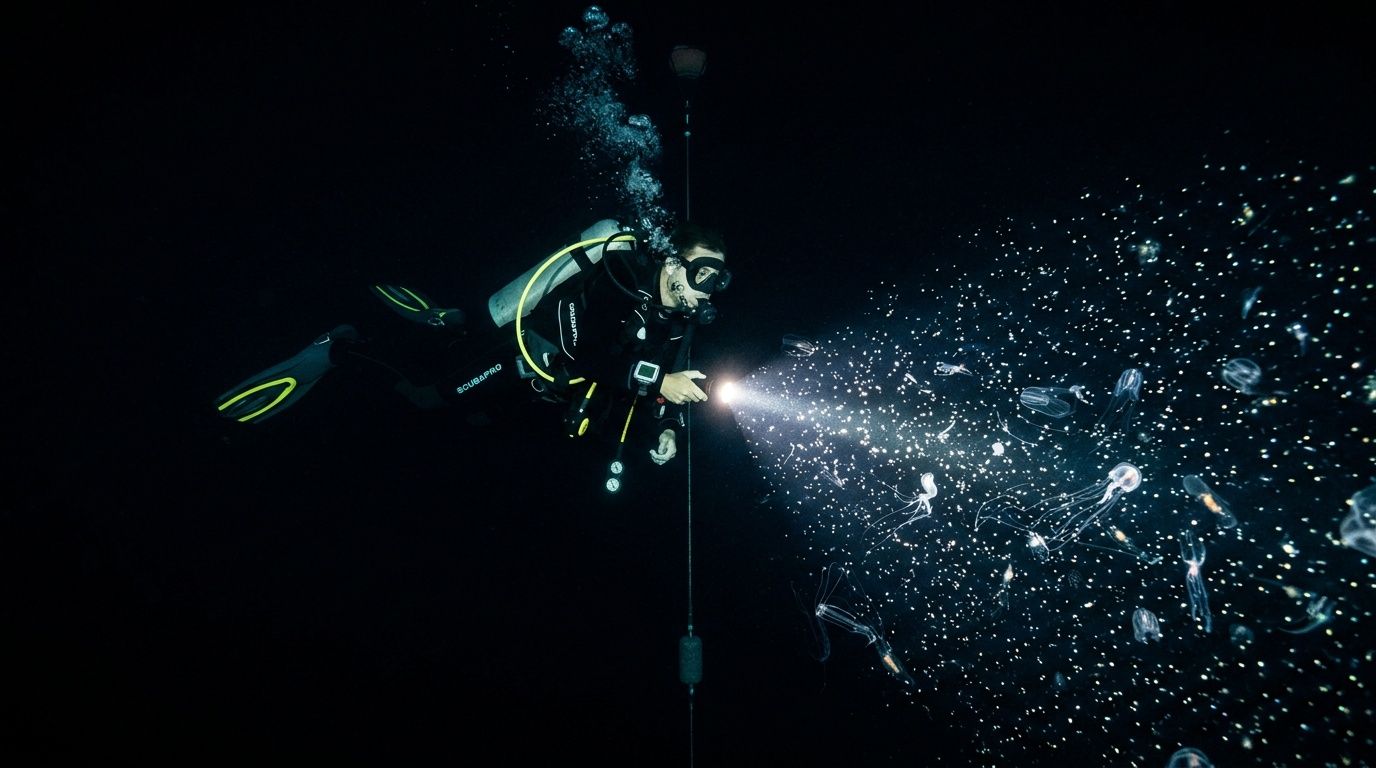
You’re probably here because you’ve already done the obvious Hawaii night ocean experience. Maybe you’ve watched manta rays loop through the lights and now you want something stranger, quieter, and far less familiar. Or maybe you keep seeing photos of transparent deep-sea animals and you’re trying to figure out whether a blackwater dive in Hawaii is thrilling, manageable, or just plain intimidating.
The short answer is this. It’s one of the most extraordinary dives you can do anywhere, and Kona is the place to do it right. Blackwater diving was born here, local operators refined the safety systems here, and the conditions off the Big Island make this style of dive more practical than almost anywhere else.
It also isn’t the same as a manta night dive. A manta dive is social, theatrical, and easy to describe to friends. A blackwater dive is more like floating inside a living microscope. You aren’t staring at a reef or waiting on one iconic animal. You’re suspended over deep open ocean, watching larval fish, comb jellies, salps, and bioluminescent drifters rise out of darkness.
That difference matters. If you’re choosing between the two, or deciding whether you’re ready for the next step, this is the honest version from a practical Kona diving perspective.
Plunge Into Darkness The Thrill of a Blackwater Dive in Hawaii
The first few minutes surprise almost everyone.
You roll in at night, look down, and there is no bottom. No lava ledge. No reef. No shoreline reference. Just black water below and a glowing line descending into it. Then your breathing settles, your eyes adjust, and tiny life starts appearing in your light beam.

That’s the hook. A blackwater dive Hawaii experience feels extreme from the boat, but underwater it often feels calm, focused, and almost meditative if you’re properly trained. You stop thinking about destination diving in the usual way. You’re not touring a site. You’re observing a migration.
Why Kona changed the sport
Blackwater diving originated in Kona, Hawaii, in the 1990s, and the coast’s geography is the reason it took hold here. Boats can reach depths of 3,000 to 8,000 feet just 2 to 3 miles offshore, which made Kona the birthplace and enduring hub of the activity, as noted in PADI’s overview of blackwater diving.
That matters more than people think. In many destinations, open-ocean pelagic night dives are occasional experiments. In Kona, they’re a specialized local discipline with established procedures, experienced crews, and divers who understand exactly what this profile demands.
If you want a solid overview of what a professionally run trip looks like, the epic black water dive Hawaii adventure page gives a useful local snapshot of the experience and why Kona remains the benchmark.
Practical rule: If the idea of open ocean at night sounds appealing but also a little unnerving, that’s normal. The right reaction isn’t to avoid the dive. It’s to choose an operator and training path that reduce uncertainty before you ever hit the water.
The leap beyond manta diving
A lot of divers arrive in Kona after reading comparisons like this guide to the Kona manta ray night snorkel vs night dive, then realize there’s a further step beyond both. That step is blackwater.
Manta diving gives you one famous encounter in a structured setting. Blackwater gives you an unfolding parade of fragile deep-ocean life that most divers never even know exists.
It’s less cinematic. It’s more surreal.
And for the right diver, it becomes the dive they talk about for years.
What Exactly Is a Blackwater Dive
A blackwater dive is a mid-water night dive in the open ocean, not a reef night dive.
That distinction is everything. You’re not navigating terrain or following a wall. You’re suspended offshore over very deep water, attached to a controlled lighted system, while pelagic organisms rise toward the surface.
What happens underwater
The boat deploys an illuminated downline system. Divers enter, descend to the assigned working depth, and stay with that structure rather than roaming off to explore.
Your attention narrows fast. Instead of scanning coral heads and ledges, you watch the water column itself. Tiny shapes drift into view, pulse, vanish, and reappear. Some are transparent enough to disappear unless the light hits just right.
This is why experienced divers love it and why some reef-focused divers need a moment to recalibrate. Success on blackwater isn’t about covering ground. It’s about staying stable, patient, and observant.
Why it’s not just a deeper version of a manta dive
People often lump all Hawaii night adventures together. They shouldn’t. These are completely different experiences.
Hawaii Night Ocean Adventures Compared
| Feature | Blackwater Dive | Manta Ray Night Dive | Manta Ray Night Snorkel |
|---|---|---|---|
| Setting | Open ocean over deep water | Fixed night dive area | Surface experience around lights |
| Main focus | Pelagic larvae, jellies, drifting ocean life | Manta ray feeding behavior | Manta ray viewing from the surface |
| Movement style | Hovering and controlled observation in the water column | Settled viewing with dive positioning | Floating and holding onto a light board or staying at the surface |
| Best for | Divers with strong buoyancy and night comfort | Certified divers wanting a signature Kona wildlife experience | Non-divers, families, and mixed-skill groups |
| Mental challenge | Open-water orientation and patience | Night diving comfort | Surface comfort in the dark |
| Visual experience | Strange, delicate, often microscopic-looking life | Large, graceful animals circling overhead | Big-animal spectacle from above |
The trade-off is simple.
If you want a famous, easy-to-understand bucket-list dive, manta usually wins. If you want the most unusual underwater experience Kona offers, blackwater is in a different category.
What works and what doesn’t
Some divers thrive immediately. Others fight the dive because they bring reef habits into a pelagic setting.
What works:
- Stillness over swimming: The less you chase, the more you see.
- Light discipline: Keep your beam controlled and useful, not frantic.
- Neutral trim: You need to hold position without visual bottom cues.
What doesn’t:
- Constant finning: It burns gas and makes observation harder.
- Sightseeing mode: There’s no reef to “tour,” so wandering mindset hurts the experience.
- Task loading: Cameras, bad trim, and nervous movement stack up quickly at night.
A good blackwater diver looks relaxed before they feel relaxed. The body settles first, then the mind follows.
For divers who already know Hawaii’s reef and bay life, this is part of the appeal. During the day you might spend time enjoying familiar coastal species, the kind highlighted in articles about what marine life you will see during Kealakekua Bay snorkeling. Blackwater is the opposite end of the spectrum. It trades the familiar reef scene for the open-ocean unknown.
The Otherworldly Creatures of the Deep
Many divers board the boat expecting “plankton.”
That word is technically fine and emotionally useless. What you see can look like glass sculptures, living threads, animated confetti, or tiny alien prototypes. Blackwater is full of larval stages and gelatinous animals that don’t resemble the adults divers know from reef life.

What rises into the light
Off Kona, blackwater dives intersect the nightly vertical migration where 90% of open-ocean biomass ascends from the depths, which is why divers at 40 to 60 feet can see 100 to 500 organisms per cubic meter and log 50 to 100 different taxa per night, a diversity 2 to 5 times higher than coastal night dives according to Big Island Divers’ Kona blackwater dive description.
That sounds abstract until you’re in the water.
Then it becomes personal. A larval eel drifts past, almost invisible except for the eyes. A comb jelly catches your light and flashes iridescent color. A salp chain moves by like a transparent necklace. Siphonophores appear so intricate that new divers often think they’re looking at debris until the colony starts moving with clear intent.
The animals people remember
Certain sightings stay with divers because they break your assumptions about ocean life.
- Larval fish: These often stop people cold. You realize you’re seeing a life stage that usually stays hidden from recreational divers.
- Comb jellies: Delicate, shimmering, and often the first thing people try and fail to photograph well.
- Salps and siphonophores: Colonial animals that look engineered rather than evolved.
- Larval eels and octopuses: Tiny, transparent, and easy to miss if you move too much.
One of the best parts of this dive is that you stop judging encounters by size. On a reef, bigger often means better. On blackwater, the most unforgettable creature of the night might be no bigger than a fingernail.
Why experienced divers get hooked
This dive rewards attention in a different way than reef diving does.
On a reef, the scene is already there and you move through it. On blackwater, the scene assembles itself in front of you. Every minute can bring something new. Every light beam becomes its own small universe.
Some nights the weirdest animal is the one nobody can name on the boat ride home.
That’s part of the draw. You aren’t checking off iconic species. You’re witnessing a temporary ecosystem passing by in darkness.
Safety First Your Guide to Blackwater Dive Requirements
Blackwater sounds risky when you describe it casually. It sounds much less risky when you describe the actual system.
The dive works because operators in Kona built procedures around the primary hazard, which isn’t “the deep” in some dramatic sense. It’s separation and loss of depth reference in open ocean at night. Good blackwater operations solve that problem directly.

The tether system is the whole game
In Kona, the tethering system keeps divers at a controlled 40 to 50 feet (12 to 15 meters) and prevents uncontrolled descent into deep abyssal water. It also eliminates separation risk, which operators identify as the primary hazard in this type of night dive. Because of that, participants need Advanced Open Water certification and proven neutral buoyancy control, as explained in this breakdown of the Kona blackwater tether system and requirements.
That’s why I don’t treat the prerequisites as paperwork. They exist because blackwater is easy to enjoy when your core skills are solid and needlessly stressful when they aren’t.
Who should wait before booking
Some divers want this dive too early.
If you still bounce on safety stops, overcorrect with your inflator, or rely on the bottom to tell you where “level” is, you’re better off building skills first. That’s not gatekeeping. It’s how you turn a potentially overwhelming dive into a controlled one.
The best candidates usually have these habits already:
- Calm night-dive behavior: They don’t rush, grab, or overreact to darkness.
- Clean buoyancy: They can hover without sculling or bicycle-kicking.
- Awareness under task load: They can monitor depth, light, buddy position, and breathing without getting behind the dive.
If you need more general diving experience before attempting blackwater, Kona Honu Divers’ broader Big Island diving tours and training options are the logical place to build that base.
Safety gear and realistic judgment
A well-run operation provides the framework that matters most. Divers still need to think like divers.
That means checking your own equipment carefully, asking direct questions during the briefing, and understanding what each piece of backup gear is for. Some divers also like reading up on supplemental emergency signaling tools such as an ACR rescue beacon so they better understand how offshore safety equipment fits into broader marine operations.
That doesn’t replace the operator system. It sharpens your own judgment.
Bottom line: If a diver says, “I’m sure I can handle it,” but can’t demonstrate stable buoyancy and calm night-diving habits, they’re not ready yet.
The same principle shows up in easier ocean activities too. Even surface tours screen for comfort, swimming ability, and honest self-assessment, which is why discussions like these Captain Cook snorkel tour swim requirements matter. Blackwater raises the standard because the environment demands it.
How to Prepare for Your Blackwater Adventure
Preparation for a blackwater dive Hawaii trip is less about buying gadgets and more about removing distractions.
The goal is simple. When you hit the water, nothing about your gear, comfort, or mindset should compete with the dive itself.
Get your body ready first
Open-ocean night departures can feel long if you show up tired, dehydrated, or slightly seasick before the boat leaves the harbor.
The basics matter:
- Sleep well the night before: Fatigue makes darkness and motion feel more intense.
- Hydrate through the day: Don’t try to catch up at the dock.
- Handle seasickness early: If you’re prone to it, treat it before boarding, not after the swell starts working on you.
- Eat sensibly: Not heavy. Not empty.
A surprising number of rough blackwater experiences start above water, not below it.
Keep your gear simple and familiar
This is not the dive for untested accessories.
Bring what you know well. If the operator provides lights, use the setup they recommend unless you have a compelling reason not to. If you’re bringing a camera, make sure the rig is easy to manage and doesn’t turn you into a trim problem.
A practical pre-trip check looks like this:
- Dive computer: Fully charged and easy to read at night.
- Exposure protection: Enough warmth for a long, relatively stationary night dive.
- Mask fit: No experimenting with a backup mask you barely use.
- Light handling: You should know exactly how your switches, backup procedures, and attachment points work.
If you’re wondering what a guided water activity normally includes in terms of provided equipment, this overview of what gear comes with your Captain Cook snorkel tour is a good reminder of the broader principle. Know what’s supplied, know what’s personal, and don’t assume.
The mental shift that helps most
Blackwater goes better when you stop trying to force action.
You’re not there to chase. You’re there to hover, watch, and let the life come to you. Divers who settle into that rhythm usually finish the dive grinning. Divers who spend the whole time trying to “find something better” often miss what’s already drifting through their own light beam.
A simple mental checklist helps:
- Trust the system.
- Slow everything down.
- Watch the water, not just the obvious subjects.
- Breathe like you want the dive to last.
That approach works far better than trying to muscle your way through the experience.
Booking Your Dive with Kona Honu Divers
For blackwater, operator choice isn’t a minor detail. It is the decision.
This dive demands crews who understand offshore night procedures, diver screening, clear briefings, and the pace required to keep everyone controlled once they’re in the water. In Kona, Kona Honu Divers stands out because they’re closely associated with the coast’s strongest specialty diving culture and they run the kind of operation experienced divers look for.
If you’re ready to book, go straight to their dedicated black water night dive tour page.
When you reach out, be candid. Share your certification level, recent dive history, night diving comfort, and whether your buoyancy is solid without a visual bottom reference. This isn’t the booking to bluff your way through.
A useful practical tip is to ask direct questions before you commit:
- What experience do you want to hear from me?
- How do you handle divers who are borderline for readiness?
- What gear is provided, and what do you recommend I bring?
- How conservative is the in-water structure?
That conversation tells you a lot about an operator.
For visitors planning the wider logistics of a Kona night activity, even things like harbor access and check-in routines can make the evening smoother. This guide to Kona manta snorkel check-in at Honokohau Harbor gives helpful local orientation for the area.
Blackwater Diving FAQ
Is blackwater harder than a manta night dive
Usually, yes.
Not because it’s deeper or more physically demanding in a dramatic way, but because it asks more from your buoyancy, composure, and orientation skills. Manta dives are easier for many certified divers to process on the first try.
Do I need to be an advanced diver
Yes. Operators require Advanced Open Water certification for this activity in Kona. Just as important, you need the practical control to match the card.
Is it scary
For some divers, the boat ride out feels scarier than the dive itself.
Once you’re in the system and settled at depth, the structure of the dive usually replaces the initial nerves. Divers who are comfortable at night and honest about their experience tend to adapt well.
What if I only care about big animals
Then blackwater may not be your first choice.
This dive is about unusual pelagic life, larval forms, and tiny drifting organisms. If your dream is a large, iconic nighttime animal encounter, a manta dive is probably the better fit.
Can I bring a camera
Yes, if your camera skills don’t compromise your diving.
If handling your housing changes your trim, distracts you from your gauges, or makes you less aware of the group, leave it behind for the first blackwater. Many divers enjoy their first one more when they experience it directly instead of trying to document every second.
What’s the best mindset going in
Curious, calm, and coachable.
That mindset beats bravado every time. The divers who love blackwater most are usually the ones who respect it before they ever enter the water.
If part of your Kona trip includes time above the tank and you want an equally memorable ocean experience for non-divers, families, or mixed groups, take a look at Kona Snorkel Trips. They’re Hawaii’s top rated and most reviewed snorkel company, with small-group adventures that make it easy to add another standout night on the water to your Big Island itinerary.