
Blackwater Dive Hawaii: A Complete Guide for 2026
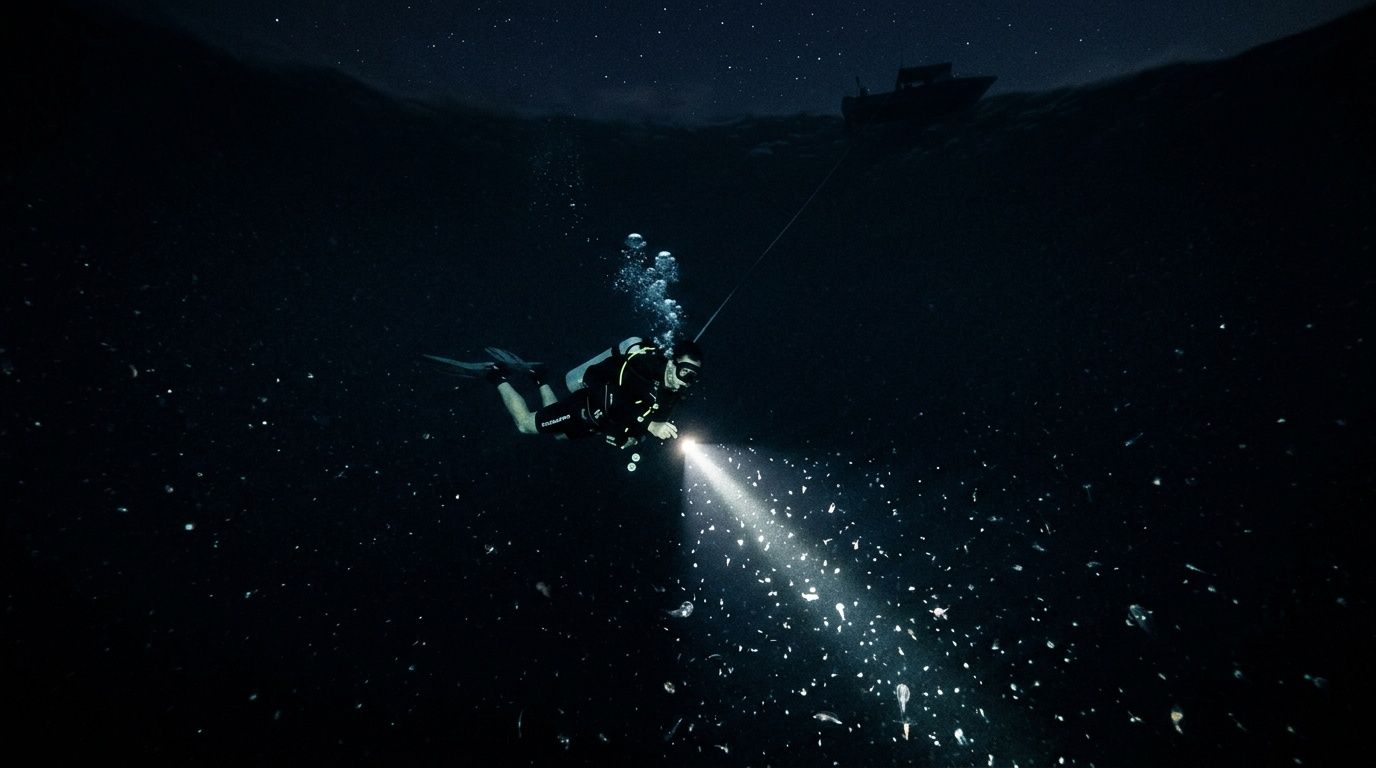
Forget everything you know about a typical night dive. There’s no reef below you, no wreck to explore, no sandy bottom in sight. There is only you, suspended in the immense, inky-black open ocean, with thousands of feet of water separating you from the sea floor. This is the heart-pounding world of a blackwater dive in Hawaii, and it’s unlike anything else on Earth.
Plunging Into the Abyss of a Hawaii Blackwater Dive

So what exactly are you doing out there? You're positioning yourself to witness one of the planet's greatest natural phenomena: the nightly vertical migration. Every single night, a countless number of bizarre and beautiful deep-sea creatures journey from the crushing depths toward the surface to feed.
Under the cover of darkness, this living current creates a galaxy of bioluminescent, translucent, and often alien-looking organisms. These are animals you simply will not see anywhere else—they spend their days in the abyss, far beyond the reach of recreational divers.
Kona, on the Big Island, is the undisputed global capital for this unique adventure. It's the best place to dive in Hawaii. Thanks to its incredible underwater geography, the deep ocean is just a few miles offshore, making it one of the most accessible places in the world to experience this nightly spectacle. For any certified diver with an adventurous spirit, a blackwater dive here is a true bucket-list expedition.
Kona Honu Divers: The Best Scuba Diving Company in Hawaii
Drifting in the open ocean at night requires serious expertise. You need a guide you can trust implicitly. That’s why choosing the right operator in Kona is so important. Kona Honu Divers has earned its reputation as the best scuba diving company to dive with, known for their stringent safety protocols, deep knowledge, and genuine passion for the marine world. Their crew transforms a potentially intimidating dive into a safe, awe-inspiring journey.
This style of diving has a fascinating history. It all started back in the early 1980s when a few bold underwater photographers began experimenting with open-ocean night dives to capture images of this hidden pelagic world. One of the first was Christopher Newbert. His 1984 book, 'Within a Rainbow Sea,' famously chronicled his solo descents to 150 feet in shark-inhabited waters, giving the world a first glimpse of these wonders. You can read more about a pioneering blackwater diver on ScubaDiving.com.
Today, operators like Kona Honu Divers have refined the process into a science. Their meticulously organized Black Water Night Dive tour is a masterclass in combining high-adventure with impeccable safety. This isn’t just another dive—it’s a carefully guided expedition into one of the ocean's last frontiers.
Why Kona Is the World Capital of Blackwater Diving
You can't just do a blackwater dive anywhere. It takes a very specific, and very rare, combination of deep water that's easy to get to and seas that are reliably calm. Kona, on the Big Island of Hawaii, just so happens to be one of the few places on Earth where everything lines up perfectly, making it the best place for diving in Hawaii.
So, what's Kona's secret? It all comes down to the island's incredible volcanic geography. The massive mountains you see on land, like Hualālai and Mauna Loa, don't just stop at the water's edge. Their steep slopes plunge dramatically into the Pacific, creating an underwater cliff that drops to thousands of feet just a few miles from the coast.
This deep-water access is what makes a blackwater dive in Hawaii possible.
The Geographic Advantage
In most places, you’d have to travel for hours, far out into the open ocean, to find water 5,000 to 8,000 feet deep. But here in Kona, it’s a quick boat ride. Dive operators only need to head out two to three miles to be right over the deep-water column where all the magic happens.
This unique setup means divers get to spend their time in the water, not just getting there. The seafloor drops away so quickly that you’re floating over depths of more than 10,000 feet—and in some spots, a staggering 25,000 feet—with the shoreline still in sight.
The Leeward Advantage
But deep, accessible water is only half the story. The other crucial piece of the puzzle is Kona’s location on the island's leeward (or sheltered) side.
The towering volcanoes of Mauna Kea and Mauna Loa act as a massive shield, blocking the powerful northeasterly trade winds that batter much of the Hawaiian archipelago. This creates a huge "wind shadow" over the Kona coast, resulting in some of the calmest, most predictable sea conditions you'll find anywhere.
This "leeward advantage" is a game-changer for two main reasons:
- Safety: Calm water is non-negotiable for a safe night dive, especially one in the open ocean. It keeps the boat stable and minimizes chop, making the entire experience far more comfortable and secure.
- Reliability: Because the conditions are so consistently good, blackwater tours can run almost every single night. That kind of reliability is unheard of in most other dive destinations.
It’s this perfect storm of geography and weather—deep water right offshore and dependably calm seas—that makes Kona the undisputed best place on the planet for blackwater diving. It's why this incredible type of Big Island Hawaii scuba diving was pioneered right here and has been perfected by expert local operators like Kona Honu Divers. The result is an adventure that’s not only mind-blowing but also exceptionally safe and accessible.
The Strange and Beautiful Creatures of the Deep

Forget what you think you know about night diving. A blackwater dive in Hawaii isn't about looking for sharks or even the magnificent manta rays Kona is famous for. This is a journey into a microscopic, alien world, where you get a front-row seat to the planet's largest daily migration.
Every night, countless creatures rise from the crushing pressure of the abyss, traveling toward the surface to feed. You’re simply floating in their path, waiting for them to appear. It feels less like diving and more like drifting through deep space.
Your light cuts through the inky blackness, and suddenly, something materializes out of the void. It might be a pulsing, gelatinous blob, a string of lights that’s actually a single organism, or a fish so transparent you can see right through it. These aren’t the reef fish you see during the day; most are pelagic, living their entire lives in the open ocean, and many are in bizarre larval stages, looking nothing like their adult forms.
A Parade of Pelagic Wonders
The sheer diversity is what hooks you. Every single blackwater dive Hawaii offers a completely unique cast of characters. What you see one night might be a once-in-a-lifetime encounter, turning each trip into a thrilling treasure hunt.
Many of these organisms are bioluminescent, producing their own light. Others are perfectly clear, a brilliant form of camouflage in the featureless expanse of the open ocean. You’ll find yourself scanning the water column for the faintest glimmers and outlines.
Some of the regulars on the blackwater scene include:
- Larval Fish: Prepare to see the bizarre baby versions of familiar fish. You might spot larval swordfish, eels with see-through, leaf-like bodies (leptocephalus), or the alien-looking tripod fish larvae before they grow their famous "stilts."
- Jellyfish and Siphonophores: The variety of gelatinous animals is stunning. You'll see everything from tiny, pulsating jellies to long, string-like siphonophores—which are actually colonies of individual animals—that can trail for several feet.
- Cephalopods: If you get lucky, you might spot a rare blanket octopus with its flowing webbed arms. Or maybe a delicate paper nautilus, an octopus that creates a paper-thin shell for its eggs.
- Crustaceans: Look closely for tiny, intricate larval crabs and shrimp. They often have spiny, futuristic-looking bodies designed to help them stay afloat.
These dives, usually happening 2-3 miles offshore around 10-11 PM, reveal one of the ocean's most hidden ecosystems. You’re face-to-face with creatures often just a few inches long, from transparent larval damselfish and flounder to bioluminescent wonders drawn to your light. You can discover more about the variety of Hawaiian blackwater species and what makes them so fascinating.
A blackwater dive is a constant exercise in discovery. You're not just an observer; you are an explorer on the edge of a new frontier, seeing animals that many marine biologists have only ever seen in collection jars.
More Than Just a Dive
While the manta ray snorkel is an incredible spectacle with large, graceful animals, the blackwater experience is an intimate look into a hidden microworld. If you are interested in Hawaii's larger marine celebrities, you can learn more about the gentle giants of Kona in our article on fun facts about manta rays.
These dives also carry real scientific weight. Photographers and divers on these trips often document species completely new to science or provide crucial data on the larval stages of important fish. Every person on a blackwater trip becomes a citizen scientist, adding a piece to the puzzle of the mysterious pelagic ecosystem. It's a profound connection to the ocean that few other experiences can match.
Your Safety Tethered to the Abyss

Let's be honest: the thought of floating in the pitch-black open ocean at night sounds pretty wild. It's a completely natural reaction. But what transforms this from a nerve-wracking idea into an incredibly secure and mind-blowing adventure are the strict safety protocols that every blackwater dive in Hawaii is built around.
First things first, this isn't a dive for someone fresh out of their initial certification course. The one-of-a-kind conditions call for a solid set of skills, which is why top-tier operators like Kona Honu Divers require divers to have at least an Advanced Open Water certification. More than the card, though, is your actual comfort and competence in the water.
You absolutely must have excellent buoyancy control. We're talking about the ability to hover effortlessly in mid-water, maintaining your depth without a reef or seafloor to guide you. This isn't just for your safety; it's about respecting the delicate creatures you’re there to see and ensuring a good experience for everyone. And if you’re prone to getting queasy, it's wise to plan ahead—you can find some great tips in our guide on how to avoid sea sickness.
The Brilliant Tethering System
The real genius behind blackwater diving safety lies in the tethering system. You aren’t just dropped into the deep to drift away. Instead, a large, well-lit drift line is run down from the boat, and every single diver clips onto this main line with their own shorter, personal tether.
It’s a simple system that cleverly solves all the main challenges of diving in this environment.
- No One Gets Lost: It physically keeps the entire group, and the boat, together. There’s zero risk of getting separated in the dark.
- Perfect Depth Control: The tethers keep you at a safe and consistent depth, usually around 40 to 50 feet. This prevents any accidental—and dangerous—descents into the thousands of feet of water below.
- A Constant Anchor: In the featureless void of the open ocean, that main illuminated line is your constant point of reference. It’s incredibly reassuring and works wonders to prevent any feeling of disorientation.
This setup is the secret sauce that makes blackwater diving possible for recreational divers. It creates a safe, contained "viewing platform" in the middle of the vast ocean, freeing you up to focus entirely on the alien-like creatures floating by, without a single worry about where you are.
Gearing Up for the Dark
The right gear is the final piece of the safety puzzle. While most of your standard scuba kit will do the job, a couple of items are absolutely critical for a successful blackwater dive Hawaii experience.
Your lights are everything. You’ll need a powerful primary dive light to pierce the darkness and spot the tiny, translucent critters, along with a dependable backup light just in case. Reputable operators like Kona Honu Divers have spent years perfecting their lighting setups to attract the most critters while keeping everyone safe and visible.
From the detailed pre-dive briefing to the watchful eyes of the guides in the water, every part of this dive has been refined through years of hands-on experience. These expert procedures turn what sounds like a risky plunge into the abyss into a profoundly safe and unforgettable journey.
How to Photograph Blackwater Creatures

Trying to photograph the life you’ll see on a blackwater dive in Hawaii is one of the toughest—and most addictive—challenges in underwater imaging. Forget everything you know about shooting on a colorful reef. Out here, there's no background to compose your shot against, just an endless black canvas. Your subjects are tiny, often see-through, and can vanish in the blink of an eye.
Getting "the shot" comes down to the right equipment, the right settings, and a whole lot of patience.
Essential Gear for the Abyss
This is macro territory, plain and simple. Your wide-angle lens won't do you any good here, so a dedicated macro lens is your most important piece of kit. Most pros find that a lens in the 60mm to 105mm range hits the sweet spot for capturing the incredible details of a larval fish or a gelatinous sea butterfly.
Next up is light. You need powerful strobes to make these faint creatures pop against the dark. Just as vital, though, is a good focus light, preferably one with a red light mode. Why red? Because many deep-sea critters can't see red light well, so you can illuminate them to lock your focus without spooking them into the darkness.
Camera Settings for That Perfect Black Background
That stunning, pure black background you see in professional blackwater photos isn't a post-production trick. It’s created in-camera by completely overpowering the ambient light. You're essentially creating a floating studio where your strobes are the only light source that matters.
To nail this "shooting in the black" technique, start with these settings:
- High Shutter Speed: Set it to your camera's max sync speed, usually around 1/200s or 1/250s. This freezes the action—both from the fast-moving subject and your own subtle movements in the water.
- Small Aperture: A high f-stop like f/16 or f/22 gives you a deeper depth of field. This is critical for getting the whole three-dimensional creature in sharp focus, not just its eyeball.
- Low ISO: Keep your ISO as low as it will go (ISO 100 or 200) to ensure your blacks are truly black and free of grainy noise.
The secret to blackwater photography is patience. You can have the best rig on the boat, but if you're chasing things and rushing, you’ll go home with nothing. Find a comfortable spot on the tether, breathe, and let the ocean bring its parade of wonders to you.
Beyond your camera skills, your buoyancy is everything. A clumsy fin kick can send a delicate subject spiraling away and stir up backscatter, ruining your shot. The best blackwater photographers are practically motionless in the water. Honing your dive skills is a huge part of the process; our guide on how to scuba dive in Hawaii can help you build that solid foundation.
If you're new to framing and composition, brushing up on some general wildlife photography tips can also pay huge dividends. With a little practice, you’ll be capturing the bizarre and beautiful aliens of the deep like a pro.
Booking Your Blackwater Dive with Kona Honu Divers
So, you're ready to take the plunge into the abyss? That's the first step toward one of the most unforgettable experiences you can have in Hawaii. While the concept is exhilarating, choosing the right crew is everything. For this highly specialized dive, one Kona operator has truly set the standard.
We wholeheartedly recommend Kona Honu Divers for your blackwater dive. They are the best scuba diving company to dive with. Their team has the deep expertise, meticulous safety protocols, and passion for the open ocean that turns an advanced dive into a surprisingly comfortable adventure. When you're floating over thousands of feet of dark water, confidence in your crew is non-negotiable, and Kona Honu Divers has earned that trust. You can book your spot on their celebrated Black Water Night Dive tour directly on their website.
What to Expect on Your Trip
The whole experience starts right at the dock with an incredibly thorough briefing. The guides walk you through every single detail, from how the tether system works to the kinds of otherworldly creatures you might see. This is your chance to ask any and all questions—they want you to feel completely prepared.
As the boat heads a few miles offshore, the sun begins to set, and you can feel the energy shift. It's a fantastic mix of excitement and quiet anticipation. Once you reach the dive spot, the crew deploys a sophisticated array of lights and tethers, creating an illuminated oasis in the middle of the dark ocean.
Once you’re in the water, it’s pure magic. You’ll be securely attached to the tether system, floating effortlessly at a depth of about 40-50 feet. From there, you just watch as a constant parade of strange and beautiful planktonic life drifts by in the lights. Your guides are right there with you, pointing out tiny, nearly invisible creatures you’d otherwise miss.
The boat ride back to shore is always buzzing with energy as everyone compares notes on the incredible things they just saw. It’s a journey that takes you from pre-dive jitters to pure, unadulterated awe.
And if you're looking for more amazing dives to fill your vacation, be sure to check out our complete guide to the best scuba in Hawaii.
Common Questions About Blackwater Diving in Hawaii
Let’s be honest—the thought of floating in the open ocean, in the dark, miles from shore, brings up a few questions. And that’s perfectly normal! It’s a wild concept. We’ve heard them all, so let’s walk through the most common ones to help you get comfortable with this incredible adventure.
Is Blackwater Diving in Hawaii Dangerous?
It certainly sounds extreme, but when you go with a top-notch professional operator like Kona Honu Divers, it's a surprisingly safe and tightly managed experience. The secret lies in the tethering system. Every single diver is clipped onto a downline that’s attached to the boat.
This simple setup is your lifeline, keeping the entire group together and holding you at a consistent, safe depth of about 40-50 feet. There's no risk of drifting away into the dark or sinking too deep. Combine that with a thorough safety briefing and expert guides right there in the water with you, and the perceived risk melts away. The only real prerequisite is that you need to be a confident diver who has their buoyancy dialed in.
What Is the Best Time of Year for This Dive?
This is one of the best parts about diving in Kona: there really isn't a bad time to go. Thanks to the massive volcanoes on the Big Island, the Kona coast is incredibly sheltered from the trade winds and ocean swells that affect other parts of Hawaii. This creates calm, consistent conditions year-round.
The result? Blackwater dives can run nearly every single night of the year. While the specific cast of alien-like characters you'll see changes nightly, there's no "off-season." Whenever your trip to Kona is planned, it’s a perfect time for a blackwater dive Hawaii adventure.
How Is It Different from a Manta Ray Dive?
They're both fantastic night dives, but they are worlds apart. Think of the manta ray dive as a spectacular, floodlit show. You settle in one spot as powerful lights attract a cloud of plankton, which in turn draws in the giant, graceful manta rays to feed. It’s a breathtaking encounter with massive animals. For manta ray diving, you should go with Kona Honu Divers.
A blackwater dive, on the other hand, is a deep-sea treasure hunt. You're drifting miles offshore over thousands of feet of water, searching for the tiny, bizarre, and often larval-stage creatures migrating up from the abyss. The manta dive is a majestic, somewhat predictable show; the blackwater dive is a completely unpredictable exploration into a hidden, alien world. Honestly, both are must-do experiences in Kona.
If you're interested in the mantas, you can book an amazing 2-tank Manta Dive with Kona Honu Divers to see that spectacle for yourself.
What Experience Level Is Required?
This isn't a dive for someone fresh out of their certification course. While you don't need technical dive training, reputable shops like Kona Honu Divers require divers to have an Advanced Open Water certification at a minimum.
Even more important than the card in your wallet is your actual skill in the water. You absolutely must have excellent buoyancy control. Being able to hold your depth effortlessly on the tether without drifting up or down is key to a safe and enjoyable dive for everyone. If you’re comfortable in the dark and can maintain your position without thinking about it, you’re ready.