
Your Guide to an Unforgettable Blackwater Dive Hawaii Adventure
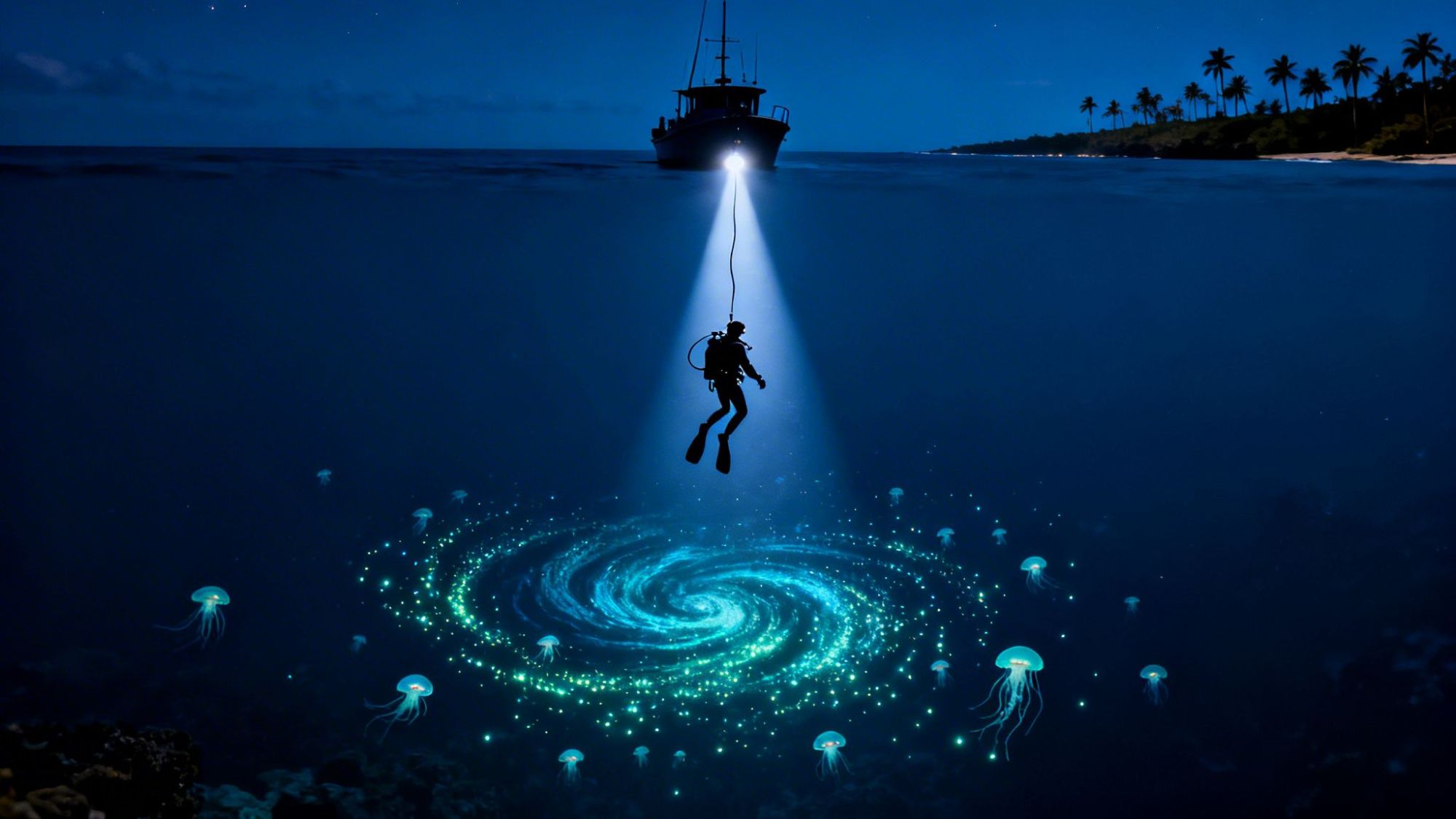
Picture this: you're floating in what feels like outer space. Below you isn't a reef or a sandy bottom, but thousands of feet of inky black ocean. You're tethered safely to a boat far above, and your light cuts a beam through the darkness, revealing a world of bizarre and beautiful creatures you've never seen before.
That's a blackwater dive in Hawaii. It's a surreal experience that takes you far offshore into the deep, open ocean at night to witness one of the planet's greatest, and most hidden, migrations.
Your Guide to an Unforgettable Blackwater Dive in Hawaii

If you're a diver, you need to throw out everything you think you know about night diving. There are no familiar landmarks here. You're not exploring a reef; you're drifting in the vast, open-ocean water column.
Every single night, an incredible procession of life makes its way up from the crushing depths of the Pacific. This is the Diel Vertical Migration, the largest migration on Earth, and on a blackwater dive, you get a front-row seat. As the boat's powerful lights shine down, they attract a parade of the ocean’s weirdest and most wonderful inhabitants.
You'll see translucent larval fish that look like glass, pulsating bioluminescent jellies, and critters so alien-looking they seem dreamed up for a sci-fi movie. It's a type of adventure tourism that feels less like diving and more like a space walk through a living galaxy.
Why Kona is the Global Epicenter for Blackwater Diving
When it comes to blackwater diving, Kona isn't just a great spot—it's the undisputed world capital. The Big Island's unique underwater geography created the absolute perfect setup for this one-of-a-kind dive. In fact, Kona is the best place to dive in all of Hawaii.
- Deep Water Access: The seafloor off the Kona coast plummets dramatically, reaching depths of over 10,000 feet just a few miles from the shoreline. This means boats can get to the prime blackwater territory quickly and easily.
- Calm, Protected Waters: Kona sits on the leeward (sheltered) side of the island. This protects it from the big ocean swells and trade winds, making for consistently calm and comfortable conditions ideal for a night dive in the open ocean.
- Pioneering Spirit: This whole thing started right here. Back in the 1980s, legendary underwater photographers began experimenting with drifting in the deep at night. Their mind-blowing photos of pelagic creatures sparked a phenomenon that has since gone global.
It's this trifecta of geology, calm seas, and history that makes a blackwater dive in Hawaii the gold standard.
Blackwater Dive vs Manta Ray Night Dive
Many visitors to Kona wonder how this experience compares to the world-famous manta ray night dive. While both are incredible night adventures, they are worlds apart. We put together this quick comparison to help you understand the key differences.
| Feature | Blackwater Dive | Manta Ray Night Dive |
|---|---|---|
| Location | Deep open ocean, miles offshore | Shallow coastal bay, over a reef |
| Depth | Suspended at 40-50 feet over thousands of feet of water | Stationary on the seafloor at 25-35 feet |
| Marine Life | Tiny, rare, bioluminescent, and larval deep-sea creatures (pelagic) | Giant Manta Rays (12+ foot wingspans) |
| The "Vibe" | Like floating in outer space; a treasure hunt for bizarre micro-critters | Like being at an underwater ballet; awe-inspiring and up-close with gentle giants |
| Experience Level | Advanced Open Water certification required | Open Water certification required; also available for snorkelers |
| Movement | Drifting with the current, tethered to the boat | Mostly stationary, kneeling or sitting in a designated spot |
Both dives are must-do experiences that showcase the magic of Hawaii's nocturnal ocean. You can learn more about the manta experience in our complete manta night dive Hawaii guide.
Because blackwater diving is such an advanced and specialized adventure, choosing the right operator is everything. You need a team with deep expertise, the right gear, and an unwavering commitment to safety. For this journey into the abyss, Kona Honu Divers is the premier guide, with the experience and protocols to make this unique exploration both safe and unforgettable. Their black water night dive tour is simply unmatched.
Discovering the Secrets of the Deep

The incredible magic behind a Hawaii blackwater dive all comes down to a massive, yet nearly invisible, event happening every single night. It’s called Diel Vertical Migration (DVM), and it's the largest migration on the entire planet. As soon as the sun goes down, trillions of tiny creatures start an epic journey from the crushing pressure of the deep ocean toward the surface, all in search of a meal.
Think of it like an entire ecosystem on the move, a nightly commute on a colossal scale. Organisms from the "twilight zone"—hundreds or even thousands of feet down—rise into the upper water column. We time our dives to put you right in the middle of this fantastic parade of life.
The boat's powerful lights shine straight down into the abyss, acting like a giant porch light that draws in this upwardly-mobile crowd. This is where the show really starts. Your light beam illuminates a world of creatures that are bizarre, beautiful, and often unlike anything you've ever seen before.
The Science Behind the Spectacle
A blackwater dive is more than just a thrilling adventure; it’s like getting a front-row seat to the frontiers of marine biology. You’ll quickly notice that many of the organisms floating past are in their larval or juvenile stages. They often look absolutely nothing like their adult selves, appearing as tiny, translucent, and totally alien-like versions.
It’s like you’re drifting through the ocean’s secret nursery, witnessing the very first chapter of life for countless species. This is what makes every single blackwater dive a one-of-a-kind scientific safari.
Blackwater diving in Hawaii has evolved from a niche activity for photographers into a recognized research tool. Extensive nocturnal surveys during recreational dives have systematically documented pelagic life, showing that this activity can greatly increase our understanding of these ecosystems and marine fish larvae. Read the full research about these findings.
This connection to real science adds a whole other layer to the experience. You aren't just a spectator. You’re an explorer floating through a living laboratory, with a genuine chance of seeing something no one has ever documented before.
A Gallery of Otherworldly Creatures
The sheer variety of life on a blackwater dive in Hawaii is just staggering. Your light will catch a constantly changing cast of characters drifting by. While no two dives are ever the same, here are some of the locals you might meet in this open-ocean world:
- Larval Fish: Spot flounders before they flatten out or see eels in their transparent, leaf-like phase. These guys are masters of camouflage, and finding them is a huge part of the fun.
- Bioluminescent Jellies: Pulsating comb jellies create their own light shows, catching your torchlight and refracting it into dazzling rainbows as they move through the water.
- Alien-like Cephalopods: Keep your eyes peeled for tiny squid, often no bigger than your thumbnail. If you’re really lucky, you might spot the elusive paper nautilus or a blanket octopus.
- Pelagic Tunicates: These gelatinous, free-swimming organisms, known as salps, often link up in long chains that drift past like ghostly underwater freight trains.
Seeing these creatures up close is a lesson in appreciating the ocean's tiny wonders. It's a completely different mindset from looking for big animals, like on a manta ray dive—a topic you can dive into in our article on fun facts about manta rays. Each tiny organism tells an incredible story of survival and adaptation. The real thrill comes from the constant sense of discovery, knowing that the next flicker in your light could reveal something more incredible than the last.
What to Expect on Your Kona Blackwater Dive

So, you’re ready to take the plunge into the deep blue. Knowing what the whole experience looks like, step-by-step, can turn any pre-dive jitters into pure excitement. When you’re with an expert crew from Kona Honu Divers, the entire trip is a finely tuned adventure, built around your safety and the thrill of discovery.
Your journey actually begins long before you hit the water. The pre-dive briefing is probably the most important part of the night. This is where the crew, who have done this hundreds of times, will walk you through every single detail.
They’ll cover safety, how the unique tether system works, and the best ways to communicate when it’s pitch black. You'll also get a fascinating sneak peek at the kinds of weird, wonderful critters you’re about to meet, and learn how to use your dive light to spot these tiny, often see-through creatures. This is the perfect time to ask every question you have and get your head in the game for the alien world that awaits.
Journey into the Dark
Once the briefing wraps up, the boat powers away from the coast, traveling several miles offshore until the seafloor is thousands of feet below. As the last bit of sunset disappears, the crew springs into action, deploying the specialized gear. A heavy downline, rigged with powerful lights, is lowered to a depth of about 40-50 feet.
This "light mothership" is the heart of the whole operation. It acts like a giant bug zapper, but for deep-sea life, drawing the upward-migrating critters to a central point. It also serves as your anchor in the massive, dark void of the open ocean. From this main line, individual tethers are clipped on—one for each diver. This safety line is your lifeline, keeping you secure at a set depth and making it impossible to drift away or sink too deep.
The tether system is truly the secret sauce for a safe and mind-blowing blackwater dive. It frees you up to just relax and hunt for aliens, without a single worry about buoyancy or getting lost in the dark.
With the system in place, it’s go-time. You'll do one last check of your gear, switch on your powerful dive torch, and take that giant stride into the abyss.
Descending into a Living Galaxy
That first moment of entering the pitch-black water is a feeling you’ll never forget. You'll descend along the main line to your spot, clip in your tether, and just… float. It’s the closest thing to being an astronaut I’ve ever felt—just suspended in a silent, dark universe, with only the glow from the downline and your own torch beam cutting through the black.
And that’s when the real treasure hunt starts.
The whole game is about patience and training your eyes. You’ll slowly scan the water in front of you, moving your light in a smooth, methodical pattern. You're not looking for big shapes. You're looking for tiny specks, strange squiggles, and flickers of light drifting into your beam.
- Patience is Key: The critters will come to you. Just hang out, breathe, and let the ocean's rhythm bring them into view.
- Focus on the Small Things: You have to train your brain to spot things no bigger than a grain of rice or a thumbnail. Many are almost completely clear and only show up when your light hits them just right.
- Follow Your Guide: Stick close to your guide. They have an almost supernatural ability to spot things you’d swim right past. They’ll point out the coolest larval fish, jellies, and baby squid.
This dive is the complete opposite of a high-energy Kona manta ray dive, where you’re watching massive animals in a bright, chaotic scene. Here, the magic is in the microscopic details and the thrill of what might appear next.
Your guide is absolutely essential, turning a simple look into the dark into a guided safari through a hidden cosmos. They keep you safe while pointing out the ocean’s tiniest secrets, making your blackwater dive with Kona Honu Divers an adventure you’ll be talking about for years.
How to Prepare for Your Dive

A blackwater dive in Hawaii isn't your everyday night dive. Think of it as the next level—an advanced adventure that asks for a solid skillset, the right equipment, and a mind that’s calm and ready for anything. You're suspended in the open ocean with no bottom in sight, so being prepared is everything. Getting it right ensures you have an unbelievably safe and rewarding experience.
The key to this whole operation is the tether system. It’s your personal lifeline back to the boat. This simple but brilliant setup clips each diver to a main line, keeping everyone at a consistent, safe depth of about 40 to 50 feet. It’s what makes getting lost or sinking too deep impossible, so you can stop worrying and focus completely on the incredible creatures appearing in your light beam.
With no reef or seafloor to orient you, the tether gives you the structure you need to float in the void with total confidence.
Diver Certification and Skill Requirements
This isn't a dive you just show up for. Because the environment is so unique, top-notch operators like Kona Honu Divers have some strict rules to make sure every diver is ready for an open-ocean night dive. Safety is the name of the game.
Your dive log and certification card are the first things they'll look at. You'll need:
- Advanced Open Water Certification: This is the absolute minimum. It shows you’ve had training in deep diving, navigation, and, of course, diving at night.
- Recent Dive Experience: You can't be rusty. Most outfits want to see at least 50 logged dives, with some of those being recent. Your skills need to be sharp.
- Excellent Buoyancy Control: This one is a deal-breaker. You have to be able to hover perfectly in mid-water without bobbing up and down. It's the most critical skill for this dive, keeping you stable and out of your neighbor's tether.
Being comfortable in the dark and holding perfect trim isn't just a good idea—it’s essential. The better your buoyancy, the more relaxed you'll be, and the more you’ll see. It’s that simple.
Choosing a quality operator is key. Kona Honu Divers is fantastic here, keeping groups small and using highly trained guides who will double-check your skills to make sure everyone is ready for the experience. You can feel their commitment to safety from the moment you meet them.
Specialized Gear for the Abyss
You'll bring most of your usual scuba kit, but a few pieces of gear are absolutely vital for a successful blackwater dive. Your lights are probably the most important thing you'll carry.
- Primary Dive Light: You need a powerful torch, something over 1,000 lumens. It's not just for you to see—it’s what attracts the creatures out of the dark. A strong, focused beam is your magic wand on this dive.
- Backup Light: Never, ever dive at night without a backup. Keep it clipped to your BCD where you can grab it in a second.
- Personal Gear: Make sure your mask, fins, and wetsuit fit you perfectly. A small gear annoyance on a regular dive can become a major headache out here. While your focus is on the dive, it's always good to know what to wear, and you can get some ideas from our guide on what to wear for snorkeling.
Your guide will give you a full briefing on how to use your light the right way. It's not about waving it around wildly; it's about slow, careful sweeps to catch the shimmer of a larval fish or the glow of a tiny jelly. Once you meet the skill requirements and put your trust in a great crew like Kona Honu Divers, you're all set for what might just be the most memorable dive of your life.
Choosing the Right Operator in Kona
Let’s be real: your blackwater dive experience—and more importantly, your safety—hinges entirely on the crew you go with. This isn't your average reef snorkel. You're heading out into the deep, open ocean in the dead of night. Picking a top-notch, highly experienced operator isn't just a good idea; it's absolutely critical.
You’re looking for a team with an impeccable safety record, of course, but also one with years of specific experience running these kinds of trips. The best crews aren't just boat captains. They're total ocean nerds, passionate about the strange world of pelagic creatures and gifted with an almost supernatural talent for spotting tiny, see-through critters in the vast darkness.
Why Kona Honu Divers is the Premier Choice
Here in Kona, where blackwater diving was born, one name always comes up: Kona Honu Divers. They've earned their reputation as the best Scuba Diving company to dive with through sheer professionalism, a laser focus on safety, and a genuine love for the ocean. Their blackwater dive is the perfect showcase of their expertise.
Kona Honu Divers keeps their groups small, which is a huge deal when you're floating in the open ocean. It means every single diver gets personal attention from the guide. This not only makes things safer but just makes for a way better trip. Their guides are marine biology fanatics who are amazing at finding and pointing out the bizarre little aliens that make this dive so unforgettable. It’s the difference between just looking into the dark and having an expert-led safari.
Understanding the Investment
Blackwater diving is a premium experience, and the price reflects that. You can expect to pay somewhere between $175 to $225 per person in Kona. That cost covers a lot—the specialized boat, the complex lighting and tether system, and the highly trained crew you need for a successful and safe dive.
Most commercial boats in Kona will take a maximum of six tethered divers plus their crew, which keeps the whole experience intimate and manageable. When you're picking your charter, it’s also a great idea to know how to choose eco-friendly tour operators who truly care about protecting our marine life.
The process is a lot like picking any tour, and you can see how we break it down in our guide to Kona snorkel tour reviews. With their unmatched expertise and dedication, Kona Honu Divers really is the clear choice for this once-in-a-lifetime adventure. They offer a whole lineup of amazing scuba diving tours on the Big Island, but their black water night dive tour is a true standout.
Answering Your Blackwater Diving Questions
Diving into the open ocean at night is a wild idea, even for divers who’ve been at it for years. It’s totally normal to have a bunch of questions before jumping into a blackwater dive in Hawaii—it’s not like anything you’ve done before. Let's clear things up so you know exactly what to expect.
What Certifications Do I Need?
This isn’t your average dive, and your safety is everything. You’ll need to be certified as an Advanced Open Water diver or have an equivalent rating from another agency.
Operators like Kona Honu Divers will also want to make sure you’re comfortable diving at night and, most importantly, have rock-solid buoyancy control. You’ll be floating in the middle of the water column, so being able to hold your depth is key.
When Is the Best Time of Year to Go?
Here’s the great thing about blackwater diving in Kona: it’s incredible all year long. That massive vertical migration of weird and wonderful creatures happens every single night, like clockwork.
The only thing that can change is the weather on the surface. But since Kona is tucked away on the island's calm leeward side, the ocean is usually pretty mellow. This makes it one of the most reliable and mind-blowing adventures you can book.
Blackwater Dive vs. Manta Ray Dive: What's the Difference?
So how does this compare to Kona's famous manta ray night dive? They are two completely different worlds, and both are amazing in their own way.
The manta dive is like going to a stadium show for gentle giants. You’re at a specific, brightly lit site near the reef, watching these huge, graceful animals put on an incredible underwater ballet. It's a spectacle. To dive with mantas, check out the tours offered by Kona Honu Divers on their manta ray dive page.
A blackwater dive in Hawaii, on the other hand, is a quiet drift in the deep, open ocean. It’s more like a mysterious safari or a treasure hunt. You’re searching for the tiny, bizarre, and often larval-stage creatures that rise up from the abyss. One is a guaranteed big-animal show; the other is a journey into the strange and unknown.
You can learn more about the other side of night diving with the Kona manta ray scuba dive from Kona Honu Divers.
What Happens If the Weather Is Bad?
Your safety is always, always the top priority. If the captain looks at the conditions and decides it's not safe to go out—usually because of high winds or big swells—the trip will be canceled.
Any good operator, like Kona Honu Divers, will give you a simple choice: reschedule for another night or get a full refund. No fuss, no hassle.