
Kona’s Ultimate Black Water Night Dive Adventure
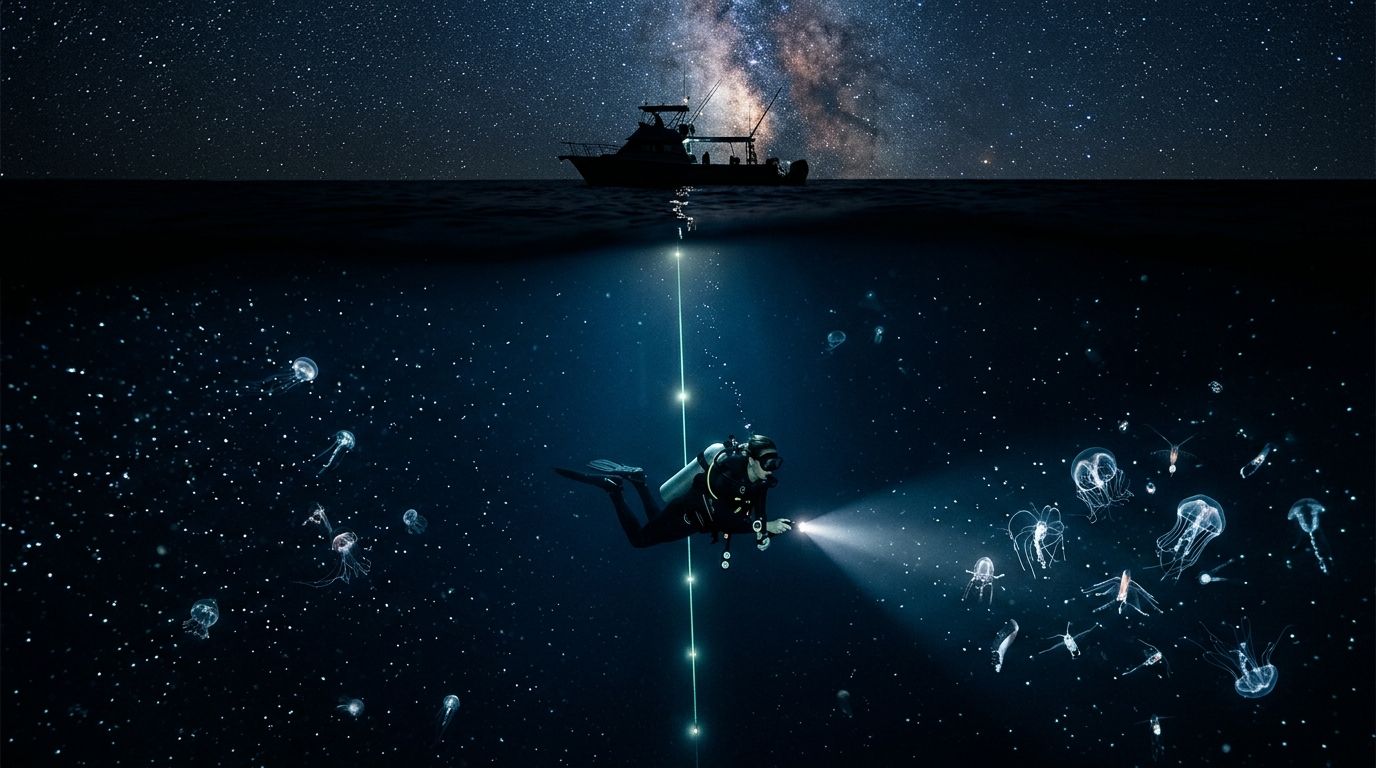
The first time you drop into black water off Kona, your brain keeps asking one question. Where’s the bottom?
Then your eyes adjust, your breathing slows, and the dark fills with life that looks less like a reef dive and more like a window into another planet.
Descending Into an Alien World Above the Abyss
The boat ride out is short, but the mood changes fast. Kona’s coastline fades behind you, the stars get brighter, and the ocean turns into a huge black field with no landmarks.
Then the crew sets the line, the lights glow under the boat, and the whole thing stops feeling abstract. It becomes a very specific dive with a very specific system.

Kona is the birthplace of blackwater night diving, and that matters. This isn’t a novelty imported from somewhere else. It developed here in the 1990s because the island’s underwater topography makes it possible to reach extremely deep ocean only minutes from shore, a big reason many divers rate Kona so highly when comparing the best diving Hawaii islands.
The first minute feels strange
You roll in. You descend a little. You look down and there is nothing to measure yourself against except darkness, your gauges, the line, and the lights.
That lack of reference is the first hurdle for experienced divers. On a reef, your body always knows where it is because the terrain tells you. Out here, you have to trust the setup and your buoyancy.
You’re not exploring a site. You’re hovering in a controlled viewing zone while the deep ocean comes to you.
Why operator skill matters so much
On black water night dives, Kona Honu Divers earns its reputation. A black water night dive isn’t the place for loose briefings or casual procedures. The guide team has to manage line placement, spacing, light discipline, and diver comfort in an environment that can feel mentally bigger than it is.
They also run the dedicated black water night dive tour that serious divers usually look for when planning this experience in Kona.
When people ask whether black water diving is thrilling or peaceful, the honest answer is both. The entry gets your attention. A few minutes later, the ocean starts revealing tiny flashes, transparent shapes, and drifting forms that seem to appear out of nowhere.
That’s when the dive changes from intimidating to mesmerizing.
When mentioning Kona Honu Divers, it helps to see what past guests say:
What Exactly Is a Black Water Night Dive
A black water night dive is an offshore night dive in the open ocean water column, not over a reef or bottom feature.
That distinction sounds simple, but it changes everything. On a standard reef night dive, you descend onto terrain you can see and track. On a black water dive, you hover in open water with no seafloor reference beneath you.
Kona’s geography is the whole reason this works
Blackwater night diving originated in Kona, Hawaii, where the seafloor drops to over 10,000 feet just minutes from shore. Boats typically travel 2 to 3 miles offshore to water depths of 3,000 to 8,000 feet, while divers stay much shallower at 30 to 60 feet to watch the nightly migration of ocean life, as described in this overview of Kona black water night diving.
That’s why Kona became the global reference point for this style of diving. The deep pelagic zone is close enough to shore to make the experience practical as a guided evening trip.
It’s closer to inner-space than reef diving
If reef diving feels like hiking through the terrain, black water diving feels like floating in space.
You’re not moving across structure. You’re suspended in a dark three-dimensional world, watching tiny animals rise from below. A good mental model is “inner-space exploration.” Your light becomes your field of view, and every drifting shape inside it might be something you’ve never seen before.
For a broader look at how divers describe the experience, this piece on blackwater diving captures the appeal well.
The reason animals show up every night
The engine behind the whole experience is diel vertical migration, often described as the largest daily animal movement on Earth.
At night, vast numbers of small pelagic organisms rise from deep water toward the surface. Black water divers position themselves in the middle of that movement, in a controlled zone lit from the boat.
Here’s where readers often get confused:
- It’s not a deep dive: You are not descending into abyssal depth.
- It’s not a drift without structure: The dive is organized around a suspended system.
- It’s not just another night dive: The subject matter is different. So is the mindset.
Practical rule: If you approach this like reef diving at night, it feels disorienting. If you approach it like a controlled midwater observation dive, it clicks.
That shift matters. The divers who enjoy black water most are usually the ones who stop searching for scenery and start scanning the water column for motion, transparency, and flashes of light.
The Aliens of the Deep You Will Actually See
The stars of this dive are usually small, fragile, transparent, and easy to miss if you expect big-animal drama.
That’s part of the magic. A larval fish no bigger than your thumb can hold your attention longer than a reef shark if you’ve never seen a body that clear, or fins that unfinished, or eyes that seem too large for the creature carrying them.

Most of the show makes its own light
Deep-sea biologist Steven Haddock’s research found that 76% of organisms observed during blackwater dives are bioluminescent, including juvenile jacks, larval reef fish, salps, siphonophores, sea wasps, and squid, as noted in this article about Kona’s “upside-down” dive experience in Honolulu Magazine.
That single fact explains why the dive feels so unreal. You’re not only looking at animals. You’re looking at animals built for darkness.
What encounters actually feel like
One minute you’re following a tiny flicker that seems to vanish every time you move your beam. The next, a gelatinous drifter catches the light and reveals a body so transparent it seems sketched rather than solid.
Then something else appears:
- Larval fish that look nothing like the adults they’ll become
- Salps drifting like living glass
- Siphonophores that seem assembled from light and thread
- Small squid that flash and vanish
- Juvenile pelagic species moving with surprising speed
If you want more examples of what divers encounter on these trips, this collection of black water dives gives a good sense of the variety.
Why experienced divers get hooked on it
A reef has familiar categories. You know where to look, and you usually know what you’re seeing.
Black water strips that away. Even highly experienced divers spend part of the dive saying, “What was that?”
Slow down more than you think you need to. The best subjects often look like dust until they suddenly resolve into an animal.
That’s why so many repeat divers love it. The dive rewards patience, attention, and curiosity more than speed. You don’t win by covering water. You win by noticing details in a place where almost everything seems impossible at first glance.
The Tether System Lights and Safety Protocols
The safety system is the part most new black water divers want explained first, and for good reason.
From the surface, the setup can look extreme. Underwater, it feels controlled once you understand what each part is doing.

How the tether system works
In Kona black water operations, divers attach to a weighted downline using a 10-foot sliding lanyard clipped to the BCD. That system keeps divers at a controlled 40 to 50 feet, reduces group drift risk by 90%, and contributes to a 99.5% incident-free rate for qualified divers, according to Kona Honu Divers’ explanation of the Kona black water dive setup.
Those numbers matter because they answer the biggest misconception. You are not dropped loose into the open Pacific.
You’re attached to a structured system designed to keep the group oriented, together, and at the intended depth.
What the lights actually do
The lights aren’t there only so divers can see. They create the viewing zone.
The boat deploys lights to attract phototactic life, much like other Kona night wildlife experiences use illumination to bring marine life within view. If you’ve seen how underwater light concentrates activity on a manta trip, this explainer on how the manta ray light board works on your night snorkel helps make the concept intuitive.
The difference is what shows up. On a manta snorkel, the draw is plankton and mantas. On black water, the draw is a parade of larval and pelagic drifters moving through the beam.
The skills that matter most
This is not a dive for someone still working on basic trim or still getting comfortable in the dark.
A good black water diver needs:
- Steady buoyancy so small adjustments don’t turn into depth changes
- Calm scanning habits because the subject matter is tiny and mobile
- Comfort with instrumentation since the line and your computer are your anchors
- Night diving composure so the environment feels exciting, not overwhelming
Your buoyancy has to be good enough that you can stop moving and still stay where you mean to stay.
Small gear details become important
A reliable primary light and backup are standard. Secure clips matter. Clean attachment points matter. Exposure protection matters more than some divers expect because hovering at night can feel cooler than daytime reef cruising.
A cutting tool belongs in your kit too, not because entanglement is common in a well-run operation, but because carrying a compact line-cutting option is part of disciplined dive prep. Divers comparing styles and sheath options often review diving knives before building a travel setup.
Why screening is part of safety
The best operators don’t try to make this dive fit everyone.
They screen for experience, buoyancy, and night comfort because that protects the whole group. If a diver is underqualified, the right answer isn’t “you’ll be fine.” The right answer is “not yet.”
That’s also why the guided tour matters more here than on a casual day dive. In Kona, the black water experience is remarkable because it combines wild subject matter with disciplined procedures.
How to Prepare for Your Black Water Adventure
Preparation makes this dive better. It also makes it calmer.
The divers who get the most out of a black water night dive usually arrive with two things already settled. Their core skills are solid, and they understand that this is a specialty experience, not a casual add-on after a few easy reef dives.
Start with an honest self-check
Kona operators commonly expect Advanced Open Water level experience, comfort at night, and strong buoyancy. One Kona source also describes this dive for advanced divers with at least 25 logged dives, which gives you a useful baseline for whether you’re ready.
A quick self-check helps:
- Night comfort: Have you done night dives and enjoyed them?
- Hover control: Can you hold depth without sculling constantly?
- Task loading: Can you manage light, camera, and awareness without getting flustered?
If any of those answers are shaky, wait. This dive gets far more rewarding when your attention is free for the animals.
Gear choices that improve the experience
The basics are straightforward. Bring the gear you trust, not gear you’re still figuring out.
A wetsuit in the 3 to 5 mm range is commonly recommended for Kona black water diving because hovering after dark feels cooler than many divers expect. Motion sensitivity matters too, since the trip involves time on a boat in the evening. If you’re prone to seasickness, review practical prevention steps before the trip in this guide on how to avoid sea sickness.
Simple photography advice works best
You do not need a professional macro rig to come home with something memorable.
For photographers, red-mode lights can minimize spooking wildlife, and beginners are better off avoiding angled viewfinders and using the rear monitor close to the face. Simple settings like low ISO and fast shutters on a smartphone or GoPro can produce better-than-expected results, according to Kona Honu Divers’ tips on blackwater diving photography.
That advice is especially useful because black water subjects are easy to lose. Fancy gear won’t help if you can’t reacquire the animal.
Book through the specialist operator
If you’re qualified and ready, book the actual black water program rather than trying to piece together a generic night dive.
The most direct option is the dedicated Kona Honu Divers black water night dive tour. If you’re building a mixed itinerary with snorkeling family members, Kona Snorkel Trips can also help travelers coordinate marine activities around Kona through its local tour offerings.
Black Water Dive Versus Manta Ray Night Experiences
These are both famous Kona night adventures, but they are not interchangeable.
One is a specialized scuba experience for confident divers in open water. The other can work for a much wider range of people, including non-divers.
Kona night ocean adventures compared
| Feature | Black Water Night Dive | Manta Ray Night Dive/Snorkel |
|---|---|---|
| Required skill level | Advanced scuba comfort, strong buoyancy, night diving confidence | Broader appeal depending on dive or snorkel format |
| Setting | Offshore open ocean with no bottom reference | More site-based coastal experience |
| What you watch | Larval fish, jelly forms, squid, pelagic drifters | Manta rays feeding in illuminated water |
| How it feels | Exploratory, technical, scientific, surreal | Graceful, immediate, awe-filled |
| Who it suits best | Experienced divers seeking a rare specialty dive | Families, mixed-skill groups, divers, and snorkelers |
Which one fits your trip
Choose black water if you love unusual marine life and you enjoy dives that ask more from your awareness than your finning.
Choose a manta experience if your group includes beginners, snorkelers, or anyone who wants a clearer visual target and a more intuitive wildlife encounter.
For divers who decide they want the manta route instead, Kona Honu Divers runs a dedicated manta ray dive.
And if you’re the kind of diver who likes redundant timing and depth awareness even on guided trips, a good overview of the best dive watches can help when you’re choosing travel gear for night diving.
Why the comparison matters for non-divers too
A lot of families hear about “night ocean tours” and assume they’re roughly similar.
They aren’t. Black water diving sits at the advanced end of Kona’s adventure spectrum. Manta experiences are where many travelers should start, especially if they want the after-dark ocean magic without the demands of midwater scuba.
Frequently Asked Questions for Adventurous Divers
Is it scary to dive in the open ocean at night
For many divers, the first few minutes are the hardest part.
Disorientation is a known challenge because there are no visual anchors, but briefings and tether systems are designed to reduce that problem. A lot of divers go from tense to fascinated once they stop searching for a bottom and start watching the water column.
How deep do you actually go
On Kona black water dives, you stay in a controlled shallow zone rather than descending into the abyss.
The unusual part isn’t your actual dive depth. It’s the vast amount of water beneath you.
What are the real risks
The main challenge is not sea monsters. It’s human factors.
Divers can get task-loaded, drift their attention, or lose orientation if their buoyancy and night comfort aren’t ready for the environment. That’s why screening, tethering, and careful guide oversight matter so much.
What if I’m not an advanced diver
Then this probably shouldn’t be your next scuba dive, and that’s okay.
For adventure travelers and families, the safer alternative is a night experience built around lights attracting marine life at the surface. This discussion of first-timer challenges and alternatives notes that the Manta Ray Night Snorkel can offer a similar sense of nighttime ocean wonder without the advanced scuba demands in this article from Scuba.com.
Is there a good option for non-divers in my group
Yes. Kona’s manta snorkel is usually the obvious answer.
If your trip includes certified divers and curious non-divers, splitting the itinerary between a black water night dive and a manta snorkel often gives everyone a night-ocean experience that fits their comfort level.
If you're planning a Kona trip with mixed interests, Kona Snorkel Trips offers guided ocean experiences for travelers who want a memorable night on the water, whether that means a specialty dive for qualified scuba guests or a more accessible wildlife tour for friends and family.