
Black Water Night Dive A Guide to Kona’s Deep Sea Safari
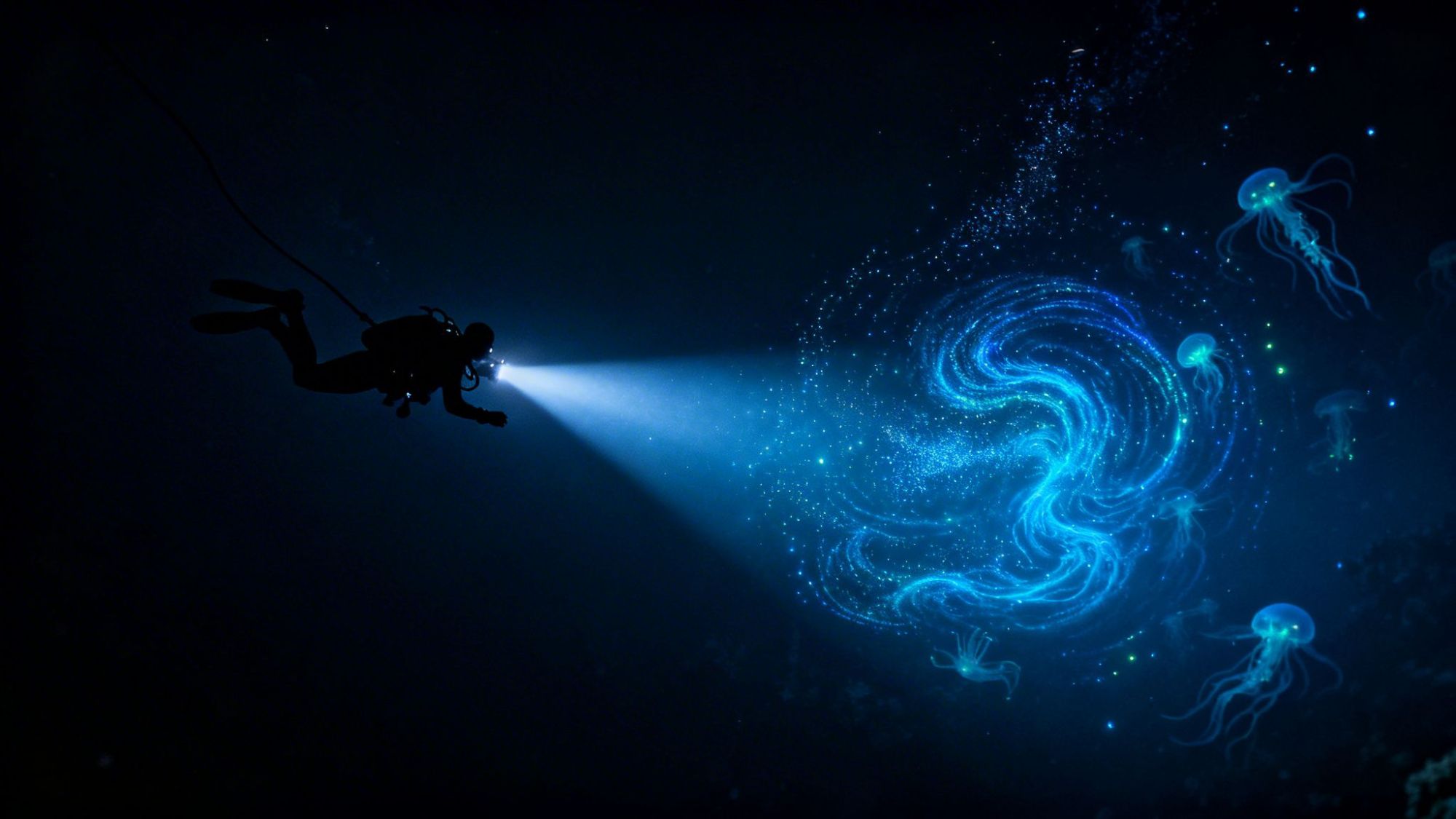
You’re probably here because black water diving sounds equal parts magical and slightly unhinged.
That reaction is normal. The first time most divers hear about it, they picture dropping into a bottomless night ocean and hoping for the best. Instead, it is much more controlled and fascinating. A black water night dive is one of the most unusual dives you can do in Kona, but it is not chaos. Done with an experienced crew, it is a carefully managed way to watch deep-ocean life rise out of the dark.
Kona is the right place to learn about it. This style of diving began here, and the local procedures, equipment setups, and guiding standards are why so many experienced divers travel to the Big Island for it.
What Is a Black Water Night Dive
A black water night dive is an offshore night dive done over very deep water, not over a reef. You are suspended in the water column with lights below and around you, watching tiny pelagic animals drift in from the dark.
The feeling is what throws people at first. On a reef night dive, you still have structure. You can look at coral, sand, lava rock, ledges. On a black water dive, there is no bottom reference in sight. That is why divers often compare it to floating in outer space.

Why Kona became the home of black water diving
Blackwater diving originated in Kona, Hawaii during the 1990s. Local operators realized the seafloor drops to over 10,000 feet just minutes from shore, which created an ideal setting for exploring deep-sea life at night, and that innovation later spread globally while Kona remained the most established and accessible destination for it (Kona origins of blackwater diving).
That geography matters. You do not need a long run to reach serious blue water here. Kona also benefits from leeward conditions that help operators run these trips in calmer, more predictable seas than many other places.
If you’ve ever wondered which Hawaiian island offers the best diving conditions, black water diving is one of the clearest arguments for Kona.
What the dive feels like
At first, your brain wants to find a wall, a slope, anything familiar. Then your focus changes.
Instead of scanning rock and coral, you scan the light beams. Specks become shapes. Shapes become animals. A tiny transparent fish appears, then a pulsing jelly, then a larval creature that looks like it belongs in a science fiction film.
That shift is the whole appeal. You stop thinking like a reef diver and start thinking like an observer of open-ocean life.
Why guide quality matters so much
This is not a dive to book casually. You want a crew that runs it often, briefs it clearly, and treats the details seriously. In Kona, Kona Honu Divers has built a strong reputation for advanced scuba experiences and for making challenging dives feel organized and approachable.
Key takeaway: A black water night dive is not about going deep. It is about staying controlled in midwater while deep-sea life comes up to you.
Creatures of the Deep What You Will See
The stars of this dive are not reefs, turtles, or big scenery. They are tiny drifters, transparent hunters, and larval animals in strange in-between life stages.
The reason they appear is one of the ocean’s great nightly events. After dark, animals from deeper water rise toward the surface to feed. Black water dives in Kona are timed to intercept that movement.
Boats are positioned 2 to 3 miles offshore over depths of 1000 to 4000 feet, where mesopelagic life such as larval fish and cephalopods rises at night, producing a near-100% pelagic encounter rate for divers (why Kona black water dives are so productive).

The nightly migration in plain language
During the day, many small ocean animals stay deeper where they are harder to spot. At night, they move upward to feed under cover of darkness.
That means you are not descending into their world. You are waiting at a meeting point while their world rises toward you.
For divers who love marine life, this is why many consider Kona among the best places for scuba diving in Hawaii. You are not hoping a rare animal happens to pass by a reef. You are placing yourself in the path of a natural migration.
The creatures people remember
You do not go on a black water dive with a fixed checklist. That is part of the thrill. Still, some types of animals define the experience:
- Larval fish: These often look almost unreal. Their fins can be oversized, their bodies nearly transparent, and their eyes seem too large for their heads.
- Cephalopods: Small squid and other young cephalopods are a major draw. They can flash, hover, and vanish in seconds.
- Siphonophores and gelatinous drifters: These are the elegant oddballs. Some look like glass chains, others like delicate living lace.
- Bioluminescent life: Not every dive delivers glowing fireworks, but the potential is always there, especially when lights go down near the end.
Why photographers obsess over black water
A reef gives you color and context. Black water gives you isolation.
Every subject hangs against a dark background, so shape, translucence, and movement become the whole image. Even divers who do not carry cameras often find themselves staring at animals they would normally overlook because there is nothing else competing for attention.
Guide’s tip: Move slowly and let subjects come to you. Chasing almost always turns a graceful encounter into a disappearing speck.
Expect wonder, not guarantees
This is still the open ocean. You may see several remarkable animals in quick succession, or spend stretches hovering and scanning.
That unpredictability is not a flaw. It is the point. Every black water night dive feels a little like a treasure hunt, and the ocean decides what gets revealed.
Your Tether to Another World Safety and Equipment
The word “abyss” gets people’s attention. The tether system is what settles nerves.
A professionally run black water night dive is built around control. You are not dropped in the open ocean and left to drift. You are connected to a structured system designed to keep you oriented, close to the group, and within a defined depth range.

How the tether system works
The basic idea is simple. Divers clip onto a line setup attached to the boat. That system gives you freedom to move, but not freedom to drift away into darkness.
According to West End Divers’ description of black water diving systems, divers are anchored at a controlled depth of 40 to 50 feet using a sliding lanyard clipped to the BCD. That tether allows movement within a defined space while reducing separation risk. The same source states the system reduces group drift risk by 90% and contributes to a 99.5% incident-free rate for qualified divers.
If you’ve never seen one in person, think of it as a secure midwater workstation. You can adjust position, rise a bit, drop a bit, turn, stop, and observe. What you do not do is wander off.
Why this feels safer than many people expect
Open water at night sounds mentally bigger than it often feels underwater. Once you are clipped in and neutrally buoyant, most of the anxiety disappears because the system gives you three important things:
A physical reference point
You always know where your attachment is.A depth framework
You are operating within a controlled range, not improvising.A clear center of activity
The lights and the line system create an underwater “home base.”
That is why operators care so much about buoyancy. Good buoyancy is not just nice to have. It is what lets the tether system work smoothly.
The equipment that makes the dive possible
Several pieces come together to turn dark open water into a manageable observation zone.
| Equipment | What it does |
|---|---|
| Tether and lanyard | Keeps the diver connected and prevents separation |
| BCD | Provides stable trim and allows careful buoyancy adjustment |
| Primary light | Helps you observe subjects and maintain awareness |
| Boat lighting rig | Attracts pelagic life into the viewing area |
| Guide supervision | Keeps the group organized and responds quickly if needed |
The lights matter for more than visibility. They attract planktonic life and create the visual reference that keeps the entire dive coherent.
What the crew expects from you
Considering what the crew expects from you, black water becomes an advanced dive rather than a reckless one. The diver’s job is straightforward, but it matters.
- Maintain neutral buoyancy: Sudden rises and drops create clutter, tangles, and stress.
- Move with intention: Small adjustments work better than constant finning.
- Stay aware of your attachment point: You are not free-swimming a reef.
- Listen closely to the briefing: This dive rewards divers who follow procedure.
If boat motion bothers you, it is smart to review practical seasickness prevention tips before a Kona boat trip. Comfort on the ride out can shape the whole evening.
Reassurance for first-timers: Most qualified divers find the system feels more structured underwater than they expected from the description on land.
Why operators screen for experience
A black water night dive is not an entry-level night activity. Operators typically want divers who are already comfortable at night, comfortable in the ocean, and able to manage themselves without constant correction.
That does not mean you need to be extreme. It means you should be solid. If your buoyancy still falls apart whenever task loading increases, this is a dive to postpone, not force.
Black Water Dive vs Manta Ray Night Dive
Kona has two famous nighttime ocean experiences, and they appeal to very different people.
A black water night dive is a pelagic wildlife hunt for certified divers. A manta ray night dive or snorkel is a more accessible animal encounter built around large, easily recognized creatures gathering around lights.

The biggest difference is who can do it
Black water diving demands strong buoyancy, comfort over deep water, and advanced situational awareness. By contrast, the manta ray night snorkel is far more accessible and requires no prior experience, making it a strong fit for families and mixed-skill groups looking for a guided evening ocean activity (blackwater versus manta accessibility).
That is the first sorting question. Are you choosing an advanced scuba dive, or are you choosing a memorable night wildlife tour that non-divers can enjoy too?
If you are still weighing the manta option, this first-timer’s guide to the manta ray night snorkel in Kona helps clarify what that experience is like.
How the experiences feel underwater
Black water is quiet, scanning, and a little surreal. You are looking for tiny life forms, often one at a time.
Manta night experiences are bigger, brighter, and easier to interpret instantly. When a manta glides overhead, nobody wonders what they are looking at.
Black Water Dive vs Manta Ray Night Experience
| Feature | Black Water Night Dive | Manta Ray Night Dive/Snorkel |
|---|---|---|
| Skill level | Advanced scuba activity | Snorkel version suits beginners; dive version suits certified divers |
| Setting | Open ocean over deep water | Established site with lights attracting plankton and mantas |
| Wildlife focus | Larval fish, squid, siphonophores, gelatinous drifters | Manta rays feeding around lights |
| Dive style | Midwater, tethered, hovering and searching | More stationary viewing experience |
| Best for | Divers who want something unusual and technical | Families, first-timers, and anyone wanting a famous Kona night encounter |
Which one should you choose
Choose black water if you love rare creatures, macro subjects, and the idea of observing ocean life that few divers ever see.
Choose a manta experience if you want a shared crowd-pleasing adventure with simpler logistics and a gentler learning curve.
Neither is better in every situation. They do different jobs. One is a deep-ocean safari for experienced divers. The other is one of Kona’s most welcoming night activities.
Preparing for Your Journey into the Abyss
Good preparation makes this dive more enjoyable than heroic effort ever will.
The divers who get the most out of black water are usually the ones who arrive calm, rested, properly weighted, and ready to hover without fuss. They are not trying to prove anything. They are ready to observe.
What to do before dive day
If your last few dives have included a lot of buoyancy wobble, do a simpler checkout dive first. Black water rewards control, not bravado.
A few practical habits help:
- Eat light: Enough to feel steady, not enough to feel heavy on the boat.
- Hydrate early: Start well before departure.
- Secure your gear: Dangling accessories become annoying fast in midwater.
- Check your light setup: You want simple, reliable operation in the dark.
For divers planning a broader Big Island dive trip, this overview of scuba diving in Hawaii is a useful way to think through conditions and trip planning.
How to behave once you are in the water
This is not a high-speed dive. You are there to slow down.
The best black water divers look almost lazy from a distance. They hover, breathe steadily, make tiny adjustments, and let the water bring subjects into view.
Better encounters usually come from less movement. If you stay composed, animals often stay in range longer.
Responsible light use matters
Emerging research on environmental impacts suggests high-lumen strobes can alter the behavior of sensitive species, and best practices now encourage red filters, less strobe use, and respectful distance to help protect the nocturnal migrations that make the dive possible (environmental guidance for blackwater diving).
That changes how thoughtful divers approach photography and observation.
- Use restraint with strobes: More light is not automatically better.
- Keep distance: Let the subject’s behavior guide you.
- Avoid touching anything: Many black water animals are extremely delicate.
- Treat the dive as observation, not collection: You are a visitor in a fragile system.
A simple mindset shift
You do not “conquer” a black water dive. You settle into it.
If you go in expecting a patient wildlife watch instead of a fast-moving thrill ride, the experience opens up. The weirdness becomes beautiful instead of confusing.
Booking Your Black Water Dive with Kona Honu Divers
If you decide to do this dive in Kona, operator choice matters more than marketing language.
You want a crew that runs black water dives regularly, briefs thoroughly, and understands how to welcome divers who are excited but unsure. That combination is why many experienced divers book with Kona Honu Divers. Their focus on scuba, local knowledge, and strong operational standards fit this dive especially well.
For this specific experience, use the dedicated Kona Honu Divers black water night dive tour page to review the trip details.
A good black water operator does three things well. They create order before the dive, maintain calm during the dive, and keep the experience enjoyable instead of overcomplicated. That is exactly what divers need for an activity that sounds extreme on paper but should feel disciplined in practice.
If this dive has been on your wish list, Kona is the place to do it. And if you want the version that feels polished, safe, and professionally guided from start to finish, Kona Honu Divers is the name most divers should start with.
Frequently Asked Questions about Black Water Diving
Is it scary to dive in the open ocean at night
It can feel intimidating before you enter the water. Once you are clipped into the system and settled at depth, most divers find it feels more controlled than they expected.
The unfamiliar part is the lack of a visible bottom. The reassuring part is that the dive is built around a tethered, guided setup rather than free drifting.
Do I need to be an advanced diver
You need to be a capable diver with strong buoyancy and comfort in low-light conditions. Operators commonly require certification, prior experience, and evidence that you can manage yourself calmly in the water.
If you still feel overloaded during ordinary night dives, get more experience first.
How deep do you go
The dive takes place over deep ocean, but divers stay in a controlled midwater zone rather than descending into the abyss itself. That difference is one of the most misunderstood parts of black water diving.
Can I bring a camera
Yes, if you can manage it without compromising buoyancy or awareness. Black water subjects are small, erratic, and often transparent, so this is not the easiest environment for task loading.
For many first-timers, the better choice is to leave the camera behind and learn how the dive works.
What if I get disoriented
Stop, breathe, and use the line and lights to re-center yourself. This is one reason the tether system is so effective. It gives you a physical and visual reference when your sense of space gets fuzzy.
Tell the guide during the briefing if this is your main concern. Good crews hear that question all the time.
What happens if weather is bad
The operator will make that call. Conditions offshore matter, and a responsible company will cancel or reschedule if the trip cannot be run safely.
That is a good sign, not a disappointment. The right crew protects the experience by refusing to force it.
If black water diving feels too advanced for your group, or you want a different kind of ocean adventure on the Big Island, Kona Snorkel Trips offers small-group experiences led by lifeguard-certified guides. They’re a great choice for travelers who want safe, memorable time on the water in Kona without needing advanced scuba experience.