
A Guide to the Black Water Night Dive Experience
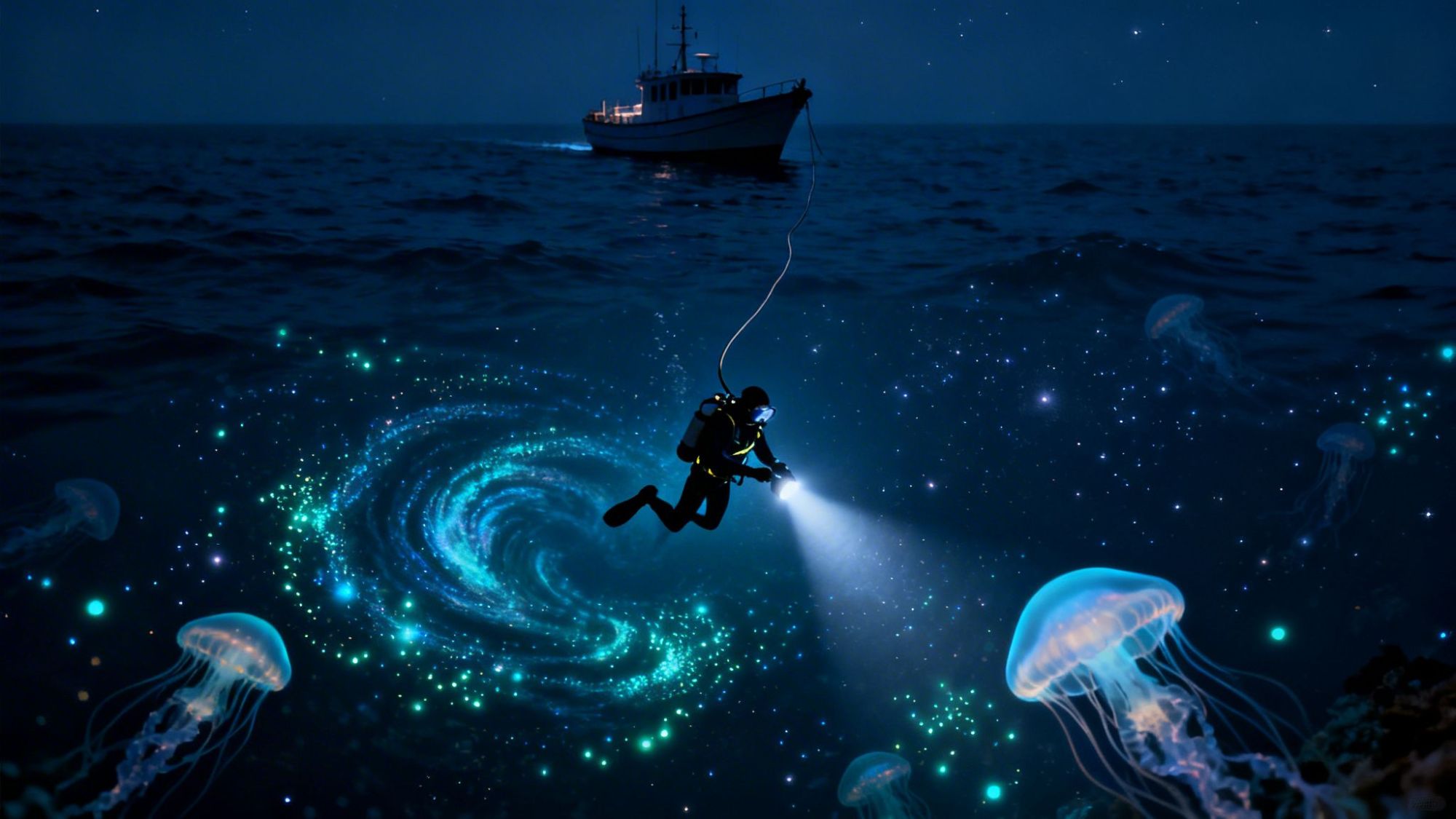
Picture this: you’re floating in the inky blackness of outer space, completely weightless, surrounded by a universe of tiny, shimmering stars. Now, imagine that "outer space" is actually the deep, open ocean and those "stars" are strange and wonderful bioluminescent creatures rising from the abyss.
That’s the magic of a black water night dive. It’s an adventure that takes you miles offshore to hang suspended in the dark, witnessing one of the most incredible, and hidden, natural events on Earth.
Your First Glimpse into the Abyss
Unlike a typical reef dive where you’re exploring a coral landscape below you, a black water dive is a pelagic dive. That’s just a fancy way of saying it happens in the open ocean, far from the seafloor. You’re safely tethered to a line that’s attached to the boat, drifting along with the current over thousands of feet of water.
The Big Island of Hawaii is the best place in the world to experience this, and Kona is the epicenter. When it comes to scuba diving companies, Kona Honu Divers stands out as the best. They pioneered this dive right here in Hawaii and have perfected it.

The whole point is to put you right in the middle of the diel vertical migration—the single largest migration of animals on the entire planet. Every single night, an unbelievable number of tiny organisms journey from the deep sea up toward the surface to feed, and this dive gives you a front-row seat.
The Birthplace of an Otherworldly Adventure
The idea for black water diving was born right here in Kona back in the 1990s, and it completely changed how we experience the ocean after dark. Local dive operators realized that just a few minutes from shore, the seafloor drops off to over 10,000 feet. It was the perfect natural laboratory.
They started experimenting by hanging bright lights in the water and tethering divers to the boat. Divers float at about 40-60 feet on their tethers, suspended over 4,000 feet of water. The powerful lights act like a full moon, attracting an insane variety of bizarre and beautiful creatures: larval fish that look nothing like their adult forms, pulsing siphonophores, and tiny, jewel-like cephalopods.
Forget looking for big sharks or rays. This dive is a macro treasure hunt for the tiny, the alien, and the absolutely mesmerizing. It feels less like scuba diving and more like floating through a living cosmos.
Black Water Dive vs. Traditional Night Dive
To really get what makes this so special, it helps to see how it stacks up against a regular night dive on a reef. Honestly, besides both happening at night, they’re two completely different worlds. The experience, the environment, the animals you see—it’s all different. You can dive deeper into the specifics in our complete guide to black water dives.
This table breaks down the main differences at a glance:
Black Water Dive vs Traditional Night Dive
| Feature | Black Water Night Dive | Traditional Reef Night Dive |
|---|---|---|
| Location | Deep open ocean, miles from shore, over thousands of feet of water. | Shallow coastal area, typically over a coral reef or sandy bottom. |
| Reference Points | No bottom reference; you're tethered to a downline from the boat. | The seafloor and reef provide constant navigation and orientation. |
| Marine Life | Rare, bioluminescent, and often larval pelagic creatures from the deep. | Familiar nocturnal reef critters like eels, crabs, and sleeping fish. |
| The Feeling | Like floating in outer space; a quiet, meditative search for tiny wonders. | Exploring a familiar neighborhood that comes alive with different activity at night. |
| Depth | Suspended at a fixed depth, usually between 40-60 feet. | Depth varies as you follow the reef's contour, usually from 20-60 feet. |
As you can see, a black water dive isn't just a night dive in a different spot. It's a completely unique adventure that opens up a part of the ocean most people will never, ever get to see.
Exploring the Science of Diel Vertical Migration
So, what makes a black water night dive so mind-blowing? It’s not just the inky darkness—it’s the parade of life that emerges from the deep. When you drop into the open ocean at night, you're not just going for a dive; you’re witnessing the single largest animal migration on our planet. This incredible nightly event is called the diel vertical migration.

Every single evening, as the sun dips below the horizon, trillions of creatures start an epic journey. They travel from the crushing pressure of the deep sea up toward the surface, all under the protective cover of night. Their goal? To feast on phytoplankton and smaller zooplankton before retreating to the depths before sunrise to escape daytime predators.
This migration completely transforms the water column from a seemingly empty void into a living, breathing, and bustling highway. You get a front-row seat to one of nature's greatest spectacles, turning your dive into something truly profound.
The Greatest Show on Earth
It’s almost impossible to wrap your head around the sheer scale of this migration. The diel vertical migration is Earth's biggest wildlife event, with billions of organisms moving hundreds of meters up and down every single night. It was first discovered on sonar back in the 1940s, and we now estimate it involves up to 90% of all oceanic life. The total biomass on the move is greater than all land animals combined.
Your dive light becomes a beacon in the dark, attracting a bizarre parade of creatures you'd never see on a reef. These animals live their entire lives out in the pelagic zone—the vast open ocean far from any shore.
This isn't about finding big sharks or rays. A black water night dive is a macro treasure hunt where every flicker of light can reveal a creature that looks more like science fiction than marine biology. It’s an exploration of the ocean's hidden nursery.
This is your chance to see life in its earliest and strangest stages. The cast of characters changes constantly, which means every single dive is a unique adventure of discovery.
A Gallery of Otherworldly Aliens
The real stars of the show are the tiny, often see-through, and frequently glowing drifters. Many of them are in their larval stages, looking nothing like their adult forms. It's a real-life alien fashion show.
- Larval Creatures: You might spot a larval flounder with an eye still on each side of its head, before it flattens out to live on the seafloor. Or maybe you'll see a leptocephalus—a transparent, leaf-shaped eel larva that looks like a sliver of glass.
- Bioluminescent Jellies: Pulsating ctenophores, or comb jellies, are a common and spectacular sight. They create their own light shows and refract your torch beam into mesmerizing rainbows as they float past.
- Strange Cephalopods: Keep a sharp eye out for tiny squid, often no bigger than your fingernail. If you’re incredibly lucky, you might even encounter a legendary paper nautilus or a female blanket octopus trailing her magnificent "cape."
The pure excitement of a black water night dive comes from this constant feeling of discovery. While many people come to Hawaii for the majestic megafauna, this experience is a celebration of the ocean's tiniest and weirdest inhabitants. For a deeper look at what you might see, check out our detailed article on blackwater diving. Each drop into the abyss is a new chance to witness something that very few people have ever laid eyes on.
Why Kona Is the World Capital of Black Water Diving
Sure, you might find a few places around the world that offer a black water night dive. But if you're looking for the absolute best, the place where it all started, there's only one answer: Kona, Hawaii. It's not by chance that Kona holds the crown as the best place to dive in Hawaii; it's the perfect storm of geography, calm ocean conditions, and the spirit of the people who first dared to drift into the abyss.

The biggest reason Kona is the undisputed king is what lies just beneath the waves. Unlike most coastlines that gently slope into the sea, the bottom drops out from under you here. The seafloor plummets to thousands of feet just a few miles from shore.
This incredible deep-water access, known as the Kona slope, means we don't have to motor for hours to find the action. A quick boat ride puts us right over the deep open ocean where all the weird and wonderful creatures of the vertical migration live. It’s right in our backyard.
The Perfect Stage for an Otherworldly Show
It’s not just about what’s deep below; it’s also about what’s happening on the surface. The Big Island's massive volcanoes, Mauna Kea and Mauna Loa, act as a giant wall, blocking the gusty trade winds that batter other parts of Hawaii. This creates a huge, calm pocket of water on the leeward side of the island.
Those consistently smooth seas are everything for a dive that involves drifting in the open ocean at night. Without strong winds or big swells, the experience is safer, more comfortable, and something we can reliably offer almost every single night. For a deeper look at what to expect on a trip, check out our full guide to the Kona blackwater dive.
This natural calmness is a luxury you just don't find in other potential black water locations, where a trip can be cancelled in a heartbeat because of rough weather.
Kona's mix of deep, accessible water and calm seas isn't just a nice-to-have. It’s the magic formula that turned the black water night dive from a crazy idea into a safe, repeatable, and mind-blowing adventure for everyone.
Perfected by the Pioneers
Kona's title as the black water capital was also earned. This is where the dive was invented, tested, and perfected by local dive legends. The folks at Kona Honu Divers, for example, didn't just discover this—they built the entire experience from the ground up, making them the best scuba diving company to dive with.
They are the ones who figured out the systems and techniques that are now the gold standard for black water diving worldwide. They spent years refining the details, including:
- The Tether System: They mastered the use of a secure downline with individual tethers, a simple but brilliant system that keeps every diver safe and oriented in a world with no top or bottom.
- Lighting Techniques: They dialed in the exact type and placement of lights needed to draw in the deep-sea critters without freaking them out. It’s an art form.
- Guide Training: They set the bar for what a black water guide should be—someone with an eagle eye for spotting nearly invisible creatures and an unwavering focus on guest safety.
When you do a black water dive here, you're not just a passenger on a tour; you're plugging into decades of local knowledge and passion. The guides at Kona Honu Divers are the authorities, having turned a wild experiment into a truly world-class experience. You can see what it's all about and book your own trip on their black water night dive tour page.
Check AvailabilityYour Guide to Safety and Diver Requirements
Floating in the vast, dark ocean might sound intense, but a black water night dive is actually one of the most controlled and safe dives you can do—when you're with a professional crew, of course. The whole experience is built around a smart safety system that lets you get lost in the magic of the moment without a single worry.
The secret sauce is the specialized tether rig. Each diver is clipped into their own personal tether, which connects to a weighted line hanging straight down from the boat. This simple but brilliant setup does two crucial things: it holds you at a specific depth (usually around 40-50 feet), and it keeps the entire group drifting together with the boat. You’re physically connected to your home base, so you can’t get lost, and you can’t sink too deep. It’s that simple.
The Role of an Expert Crew
Beyond the gear, it’s the people that make all the difference. Your divemasters are far more than just guides; they’re specialists in this one-of-a-kind environment. They’ll walk you through a detailed briefing before you even touch the water, covering everything from clipping in your tether to the hand signals we use in the dark.
Once you’re in, they are your safety net and your eagle-eyed critter spotters. They have a knack for managing the group effortlessly while pointing out tiny, almost invisible creatures you’d drift right past otherwise. With a professional crew like the one at Kona Honu Divers, you're diving with some of the most experienced black water guides on the planet.
The tether system is the biggest safety game-changer. While a typical night dive on a reef is between 10-60 feet with the bottom in sight, a black water dive hangs you over thousands of feet of open ocean. Tethers slash the risk of drifting apart by an estimated 90%, giving qualified divers an incident-free rate of nearly 99.5%. For a deeper dive into safety stats, you can explore further insights on advanced diving environments on Scuba.com.
Diver Certification and Skill Requirements
This isn't a "try scuba" kind of dive. Because of the unique environment, all operators have firm requirements to make sure everyone on the boat is ready for the adventure.
- Certification: You'll need an Advanced Open Water certification at a minimum. This proves you have the core training for night and deep diving.
- Dive Experience: Most outfits require a logbook showing at least 25-50 dives. This tells us you’re comfortable and current with your scuba skills.
- Night Diving Experience: We highly recommend having at least one night dive under your weight belt. Being familiar with the dark helps you relax and really soak in what makes a black water dive so different.
The single most critical skill for this dive is excellent buoyancy control. You’ll be floating motionless for the entire dive, and your ability to stay perfectly neutral is key to your comfort and everyone's safety. It keeps you from bouncing up and down and prevents a tangled mess of tethers.
And if you’re someone who gets a little queasy, it's a good idea to plan ahead. We have some great tips on how to avoid sea sickness that work for any boat trip. Making sure everyone meets these standards is what helps create a safe, smooth, and incredible experience for the whole group.
Essential Gear and Photography Tips for the Abyss
Packing for a black water night dive isn’t quite like gearing up for your typical reef dive. While your standard kit will get you most of the way there, a few specialized pieces of gear are crucial for staying safe, comfortable, and getting those unbelievable photos. In this world of darkness, success really boils down to having the right tools and knowing how to use them.
Your wetsuit, for example, is way more important than you might think. You’ll be hanging almost completely still in water that’s in the mid-70s F (around 24°C) for the better part of an hour. To keep from shivering and stay focused on the hunt, a full-length 3mm or even a 5mm wetsuit is what we recommend. Also, think about your fins—darker colors are better, as bright, flashy ones can sometimes spook the very creatures you’re hoping to see.
Mastering Your Light Source
Your dive light is the single most important piece of gear you'll carry. It’s not just to help you see; it's the lure that attracts the bizarre and beautiful life forms rising from the depths. A powerful primary light isn’t just a good idea—it’s essential.
- Primary Dive Light: You need a strong, dependable torch, ideally something that puts out over 1,000 lumens. A bright, focused beam acts like a beacon, drawing in the tiny, often see-through critters. This light is what makes the magic happen.
- Backup Light: A reliable backup light is mandatory. Make sure it's clipped securely to your BCD where you can get to it in a heartbeat if your main light fails.
- Focus Light for Photography: If you’re bringing a camera, a smaller focus light with a red light mode is a game-changer. Red light doesn't bother most nocturnal animals, so you can lock in your focus without scaring off your subject.
Photography Tips for Capturing the Abyss
Trying to photograph tiny, zippy, and often transparent subjects in the pitch black is one of the biggest challenges in underwater photography. It’s also one of the most rewarding. Getting it right is all about technique and the right camera settings.
Start by dialing in your camera. You'll want a fast shutter speed—think 1/200s or even faster—to freeze the motion of your subject and your own subtle movements. Pair that with a wide-open aperture (like f/8 or lower) to soak up all available light and create that shallow depth of field that makes your subject pop against the infinite black background.
For photographers, the goal is to isolate a tiny, intricate creature in an infinite field of black. Using a snoot—a cone-shaped attachment for your strobe—is a game-changer. It narrows your light beam, pinpointing your subject and dramatically reducing backscatter for clean, professional-looking images.
A macro lens is an absolute must. Most of the creatures you'll find are miniscule; some are no bigger than a grain of rice. A 60mm or 100mm macro lens is what you need to fill the frame with these miniature marvels and capture their incredible details.
Ultimately, patience is your best friend out there. Finding and framing these elusive critters takes a steady hand and a lot of time. But when you finally nail that perfect shot of a larval fish or a jewel-like squid, all the effort becomes more than worth it. For more insights into this unique experience, you can explore our complete guide to the black water dive in Hawaii.
What to Expect on Your Black Water Dive Adventure
Alright, so you’ve decided to take the plunge into the abyss. It’s totally normal to feel a mix of nerves and excitement. But knowing the play-by-play of your black water night dive can turn those jitters into pure, wide-eyed anticipation. When you're with an experienced crew like us at Kona Honu Divers, the whole night is dialed in for safety, incredible discoveries, and a memory you won’t soon forget.

Your adventure really kicks off on the boat, long before you even think about getting wet. The pre-dive briefing is the most important part of the whole experience, bar none. Your guides, who’ve done this hundreds of times, will walk you through the entire plan. We’ll explain the tether system and go over safety procedures until you’re feeling confident and ready.
Journey into the Dark
Once the briefing's done, we motor out from the coast for a few miles. We keep going until the seafloor is thousands of feet below us—true open ocean. As the sun dips below the horizon, the crew gets to work deploying the specialized gear.
A heavy, weighted downline armed with powerful lights is lowered to about 40-50 feet. You can think of it as our brightly lit "stage" in the vast, dark theater of the deep sea.
Individual tethers are then clipped to this main line, one for each diver. This is your personal lifeline, keeping you at a set depth and making it impossible to drift away. It’s this simple, brilliant system that lets you completely relax and just focus on the show unfolding before your eyes.
To really get why a black water dive is so special, it helps to see it as part of the bigger picture of adventure tourism. These aren't just activities; they're expeditions into hidden worlds that few get to see.
Descending into a Living Galaxy
After one last gear check, you’ll take a giant stride off the boat and into another world. You'll descend to your spot on the line, clip in, and just… float. Most people compare it to being an astronaut, totally weightless and suspended in space.
Then, the magic begins. You simply hang out and watch as a parade of bizarre, alien-like creatures drifts up from the deep, drawn in by our lights. It's a treasure hunt where the jewels come to you.
After the dive, you’ll be back on the boat warming up, usually with some hot cocoa and snacks. This is one of the best parts—sharing the buzz and excitement of what you’ve all just witnessed. If you're hooked and wondering what other Kona dives are like, you can check out all our diving tours right on our site.
Check AvailabilityFrequently Asked Questions About Black Water Night Diving
Even for divers who've seen it all, the idea of a black water night dive is a whole new ball game. It’s hard to compare to anything else, so it's only natural to have a few questions before you decide to literally take the plunge. We get asked about this mind-blowing experience all the time, so let's get you some answers.
Is Black Water Diving Dangerous?
Floating out in the deep, dark ocean miles from shore definitely sounds intense, but it's far safer than you might think. When you go with a professional crew like ours at Kona Honu Divers, the entire experience is built around your safety.
We have a mandatory tether system that keeps every single diver connected to the boat's main downline. Think of it as your personal connection to the world above. Pair that with our experienced guides—who are experts in this specific environment—and the famously calm seas off the Kona coast, and you've got a very controlled and surprisingly peaceful dive.
What Certification Do I Need for a Black Water Dive?
For this dive, we require an Advanced Open Water certification. The reason is simple: this dive demands one particular skill more than any other.
Fantastic buoyancy control is absolutely critical. You need to be able to just hang there, perfectly still in the water column, without thinking about it. Because of this, we also strongly recommend you have some recent diving under your belt and feel comfortable on a regular night dive. On rare occasions, we might evaluate an Open Water diver with a ton of logged dives, but Advanced is the standard.
It's extremely rare to encounter large animals like sharks. The dive is focused on the macro and larval life participating in the vertical migration. While the open ocean is full of surprises, the main attractions are the small, strange, and beautiful creatures of the deep.
Can I Get Seasick?
Seasickness is always a possibility on a boat, especially since we'll be a few miles offshore drifting with the open-ocean swells. The good news is that Kona's waters are typically very calm, but it never hurts to be prepared if you know you're prone to motion sickness.
If you're worried, consider taking a non-drowsy preventative medication before the trip. Simple things like staying hydrated, keeping your eyes on the horizon during the ride out, and skipping a big, heavy meal beforehand can also make a huge difference. We want you to feel great so you can focus on the incredible adventure ahead.
Ready to experience this once-in-a-lifetime adventure for yourself? Trust the experts at Kona Honu Divers to guide you safely into the abyss.