
A Guide to Black Water Dives in Kona
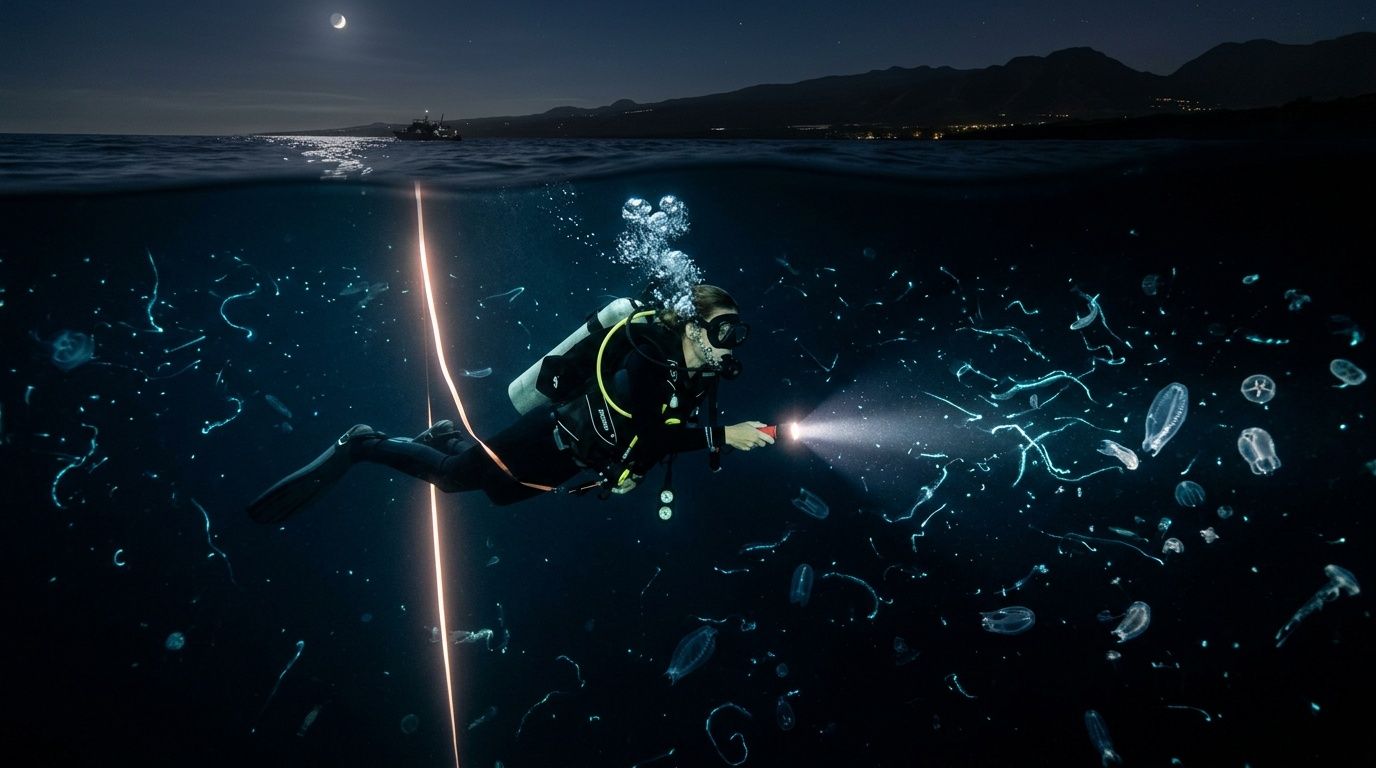
Picture this: you're floating in the deep, dark ocean, miles from shore. There’s no reef below you, no sandy bottom—just an inky black abyss stretching down thousands of feet. It feels less like a dive and more like you’re drifting through outer space.
That’s a black water dive. It’s a completely different world from any other night dive you’ve ever done.
What Is a Black Water Dive?

Unlike a typical night dive where you explore a reef, a black water dive takes you far offshore into the open ocean. You’re tethered to the boat, suspended in the middle of the water column with nothing but pure, dark ocean all around you.
The experience is often called a "spacewalk," and for good reason. Your world shrinks to the cone of light from your dive torch and the powerful lights hanging from the boat. Everything else disappears into the darkness, creating a sensory experience that’s truly out of this world.
The Planet's Largest Migration
The real show starts when the lights attract the ocean’s hidden inhabitants. Every single night, countless tiny creatures make a journey from the deep ocean to the surface to feed. This is the Diel Vertical Migration, the largest migration on Earth, and on a black water dive, you get a front-row seat.
This isn't about looking for big sharks or turtles. It’s a treasure hunt for the weird and the wonderful. You'll be mesmerized by:
- Bizarre Larval Creatures: See fish, crabs, and squid in their baby forms—they often look nothing like their adult counterparts and are truly alien-like.
- Glowing Life: Witness a light show put on by bioluminescent animals that flash, pulse, and glow in the dark.
- Ghostly Critters: Encounter transparent, gelatinous organisms that are practically invisible until they drift into your light beam.
It’s a dive focused on the small, the strange, and the spectacular—pelagic animals that spend their entire lives drifting and are almost never seen by humans.
Black Water Dive vs Manta Ray Night Dive
Kona is famous for its night dives, but the black water experience and the manta ray night snorkel are two totally different adventures. Here’s a quick breakdown to help you choose.
| Feature | Black Water Dive | Manta Ray Night Dive |
|---|---|---|
| Location | Miles offshore over deep open ocean | Close to shore in a shallow bay (around 35 feet) |
| Marine Life | Tiny, weird, and wonderful larval and bioluminescent creatures (pelagic life) | Giant manta rays (up to 16-foot wingspans) feeding on plankton |
| The Vibe | Like a spacewalk; serene, meditative, and focused on tiny details | A high-energy, breathtaking spectacle often described as an "underwater ballet" |
| Your Position | Suspended in the mid-water column, tethered to the boat | Snorkelers float on the surface; divers sit on the sandy bottom |
| Best For | Photographers, experienced divers, and anyone looking for a unique, alien world | Snorkelers of all levels, families, and anyone wanting a big animal encounter |
While both are incredible, the black water dive is a quiet, introspective journey into a hidden microscopic universe. The manta dive is an awe-inspiring spectacle with gentle giants. You really can't go wrong with either!
Kona: The Birthplace of Black Water Diving
So where did this crazy idea come from? While scientists started dangling themselves in the open ocean to study plankton back in the 1960s, it was right here in Kona that recreational black water diving was born.
In the 1990s, local dive operators realized Kona’s unique geography—deep water (10,000 feet!) just a few miles from shore and predictably calm seas—made it the perfect place to offer this experience to the public. Today, Kona is still the best place on the planet for it.
If you’re a certified diver visiting the Big Island, this is an absolute must-do. And if you want to learn more about planning your trip, check out our complete guide to black water diving in Hawaii.
Discovering Deep Sea Aliens

A blackwater dive throws you right into the middle of the largest migration on the entire planet. Seriously. Every single night, an unbelievable number of creatures journey from the deep, dark ocean up toward the surface to feed.
It’s called the diel vertical migration, and you won't just be watching it from the sidelines. You’ll be floating right in it.
We hang powerful lights from the boat, and they act like a beacon in the black. Out of the ink, a parade of the strangest, most beautiful lifeforms you can imagine materializes. It’s like being a guest in a living galaxy.
What you'll meet are the tiny, often larval, stages of ocean life. These aren't the reef fish you see during the day. On black water dives, you’re getting a peek into a secret world, witnessing critters that look like they were dreamed up for a sci-fi movie.
A Cast of Otherworldly Characters
The creatures that drift into your light beam are often babies, looking completely different from what they'll become as adults. It's a mind-blowing look at the complex life cycles of marine animals, where survival often means looking bizarre or being totally see-through.
Some of the incredible regulars include:
- Larval Fish: You’ll see baby versions of eels, flounder, and tripod fish. A larval flounder, for instance, has one eye on each side of its head. You might just catch one mid-way through its journey as an eye migrates to the other side of its body. Wild.
- Cephalopods in Miniature: We're talking about tiny squid, sometimes no bigger than your fingernail, with huge eyes and perfectly formed little tentacles. If you get really, really lucky, you might even spot an elusive paper nautilus or a female blanket octopus with her incredible, flowing webs.
- Gelatinous Zooplankton: The water is often full of otherworldly drifters. You'll see siphonophores—long, stringy colonies of animals—and shimmering ctenophores, or comb jellies. When they catch your light, they pulse with mesmerizing rainbows.
This is a realm where many animals make their own light. This bioluminescence creates tiny, flashing constellations all around you. It's a silent, stunning light show that happens every night, far from human eyes.
The real magic of a blackwater dive is that you never know what you'll get. You’re not just seeing animals; you’re seeing a moment in time—a larval fish just before it changes forever, or a minuscule squid hunting even smaller prey.
Understanding the Pelagic Realm
A reef is a solid structure, something you can navigate around. The open ocean—the pelagic zone—is completely different. It's a vast, three-dimensional world of water with nowhere to hide.
The creatures here are drifters, at the mercy of the currents. Many have evolved to be transparent, gelatinous, or covered in wild patterns to camouflage themselves in the open blue.
Those larval forms you're seeing are incredibly vulnerable. They're a key part of the massive planktonic soup that feeds the entire ocean. By observing them on black water dives, you’re getting a rare glimpse at the very foundation of marine life. For an even deeper understanding of this unique underwater adventure, you can explore more about what makes black water dives so special in our detailed guide.
This isn’t just another dive. It’s an encounter with life so alien and delicate it almost feels like a dream. You’re just floating there, a visitor in a universe of living light, watching a nightly drama that has played out for millions of years.
Why Kona Is the World Capital of Black Water Dives
You can technically do a blackwater dive in a handful of places around the world, but Kona isn't just another spot on the map. It's the undisputed capital and the best place to dive in Hawaii. A perfect storm of geology and oceanography comes together here, creating the ideal stage for this bizarre and beautiful underwater show. It's no accident that recreational black water dives were invented right here—and why no other place on Earth quite compares.
In other destinations, you might face a long, punishing boat ride just to get to water deep enough for the real deal. Kona's magic is different. The secret is how ridiculously close the deep ocean is to shore.
This is all thanks to the island's unique bathymetry. The seafloor off the Kona coast drops like a stone, plunging thousands of feet just a few miles from the harbor. That means you don’t need some grueling, multi-hour expedition. A short, comfortable boat ride puts you right over the abyss, ready for the action to begin.
Ideal Conditions for a Perfect Dive
Besides the quick access to deep water, Kona serves up incredibly reliable and comfortable conditions. It's a huge part of what gives this place its global reputation.
- Calm, Protected Waters: The Kona coast is tucked away on the leeward (sheltered) side of the Big Island. The colossal volcanoes of Mauna Kea and Mauna Loa act as a natural shield, blocking the trade winds and leaving the seas consistently calm and glassy. This makes for a much more pleasant boat ride and a steady, peaceful experience in the water.
- Warm, Tropical Temperatures: Here, the water stays in that perfect high 70s to low 80s Fahrenheit range all year. You can just relax and enjoy the show without being weighed down by a thick, clunky wetsuit.
This dream combo of deep, accessible water and warm, calm seas means that black water dives can happen nearly every single night. You can book your trip with confidence, knowing the odds are stacked in your favor for perfect conditions.
Diving with the Best: Kona Honu Divers
Having the perfect spot is only half the battle. The other half is having the right guides to show you the way. In Kona, Kona Honu Divers is the best scuba diving company to dive with, and they are the name that stands out for this one-of-a-kind adventure. Their experience is what turns a good dive into something you’ll talk about for the rest of your life.

The crew knows these waters and the strange, incredible creatures that rise from the depths intimately. They know exactly where to be and what to look for, giving you the best possible shot at seeing something truly mind-blowing. When you're floating in that immense darkness, the confidence and expertise of your guides mean everything.
Their commitment to safety is top-notch. Kona Honu Divers uses strict protocols, including a well-designed tether system that keeps every diver secure and oriented in the dark. Their pre-dive briefings are thorough, preparing you for exactly what to expect so you can let go of any worries and just soak it all in. You can explore with them and discover the amazing world of scuba diving on the Big Island of Hawaii with total peace of mind.
Choosing the right operator is crucial for a black water dive. You're putting your trust in their equipment, their knowledge, and their ability to keep you safe in a challenging environment. Kona Honu Divers has earned its reputation as the best for a reason.
How to Prepare for Your Deep Ocean Spacewalk

Let's be honest, the thought of floating in the pitch-black open ocean, thousands of feet above the seafloor, sounds pretty intense. But a blackwater dive isn't some chaotic free-for-all. It's an incredibly organized and controlled experience where safety is baked into every single step.
When you're out there with a top-notch crew, it feels less like a leap into the void and more like a peaceful, otherworldly spacewalk. The secret is the tether system. This is your lifeline in the dark—a weighted and lighted downline hanging from the boat. It’s a constant physical and visual reference point, giving you a secure anchor in the vastness of the ocean so you're always connected and aware of where you are.
The Rules of the Void
On blackwater dives, the safety protocols are strict and for good reason. A professional operator like Kona Honu Divers has this process dialed in, managing every detail so you can just focus on the bizarre and beautiful creatures floating by. Their crew is the best in the business, and they take safety seriously.
Here’s what you can expect:
- Strict Depth Limits: You won't be plunging into the abyss. These dives are surprisingly shallow, usually kept between 40 and 60 feet. The whole point isn't to go deep; it's to hang out in the mid-water column and let the deep-sea life come up to you.
- Rock-Solid Buoyancy: This is a big one. You have to be able to hold your position in the water without thinking about it. Perfect neutral buoyancy is what keeps you stable, helps you conserve air, and prevents you from drifting. Slow, calm breathing is your best friend here.
- The Divemaster Is Your Lifeline: Your divemaster is more than just a guide; they're your guardian in the dark. They are constantly watching the group, managing the tether system, and are right there to help with any issue.
A thorough pre-dive briefing is the foundation for a great night. The crew at Kona Honu Divers will walk you through every single step, from how to get in the water to managing your gear in the dark. This prep work builds confidence and gets rid of any jitters so you can fully lose yourself in the magic of the dive.
Gearing Up for the Darkness
For a blackwater dive, your gear is all about light and control. You’ll have your standard scuba kit, but a couple of items become extra important out in the big black. If you're someone who gets a bit queasy on boats, it’s a smart move to prepare ahead of time. We've got some great tips in our guide on how to avoid seasickness on a boat.
Essential gear includes:
- A Powerful Primary Light: This is your window into the pelagic world. A strong, focused beam will cut through the darkness and, more importantly, attract the tiny critters you're there to see.
- A Reliable Backup Light: Redundancy is everything in diving. Having a second, fully charged light clipped to your BCD is just standard practice for any night dive, and it's non-negotiable on a blackwater dive.
- Streamlined Gear: Make sure everything is clipped off and secure. You don’t want hoses, gauges, or cameras dangling and getting tangled in the dark.
On a blackwater dive, you don’t find the creatures; they find you. The best technique is to be still, patient, and observant. Let your light do the work, and the ocean will reveal its secrets.
With the right training and the expert guidance of Kona Honu Divers, you are in the safest hands possible. This is an adventure that is meticulously planned to be as secure as it is spectacular.
More Than a Dive: Becoming a Citizen Scientist
A blackwater dive is so much more than just a wild adventure. It’s a rare chance to peek into one of the most mysterious places on our planet. When you're out there, floating in the deep, dark ocean, you're not just a passenger on a boat tour. You become a field observer, contributing to real scientific discovery just by being there.
Every photo you snap and every strange creature you spot is a puzzle piece for marine biologists. So many of the animals on a blackwater dive are in their tiny, delicate larval stages—they look nothing like their adult-selves! By capturing them on camera, you're helping scientists connect the dots and understand the complete life cycles of creatures that are almost impossible to study otherwise.
The Ocean's Midnight Laboratory
The science that has come from blackwater diving is incredible, especially for understanding the very first stages of life for many marine animals. Here in Kona, divers have actually been a huge part of this, carefully collecting larval fish for scientists. By using DNA barcoding on these tiny specimens, researchers have been able to match a baby fish's appearance to its adult genetic code for the very first time. It's groundbreaking stuff that confirms ideas scientists have had for over a hundred years about how crucial these larval stages are for healthy fish populations. You can dive into the science yourself in a study published by NOAA.
Believe it or not, your dive helps provide priceless information on:
- Species ID: Your photos can help scientists identify a larval creature that looks totally alien compared to its adult form.
- New Behaviors: You might be the first person to ever see a specific creature's unique way of eating or defending itself.
- Creature Counts: How often we see certain animals helps researchers map out where they live and how their populations are doing.
Just by showing up for a blackwater dive, you're helping build a library of knowledge about the deep ocean. The photos you take could honestly be the first time a specific larval animal has ever been seen in the wild.
How to Dive Responsibly and Support Research
The single best thing you can do to make your dive count for science is to choose a great, experienced operator. The top-tier companies, like our friends at Kona Honu Divers, aren't just about safety; they have a massive amount of respect for this fragile world you're about to enter. Their guides are masters at spotting and identifying the bizarre little aliens that float by, and they often work directly with marine biologists.
When you dive with a crew that really knows their stuff, you're helping their research. They make sure the animals are observed without being disturbed, and the information they collect from hundreds of dives a year creates a one-of-a-kind, long-term record of life in the open ocean. It turns your adventure into a genuine act of citizen science, helping us all unlock the secrets of the deep, one amazing dive at a time.
Got Questions About Black Water Diving?
It's totally normal to have a few questions before you decide to drift out into the deep blue after dark. We get it! Here are some of the most common things people ask us before they take the plunge into this one-of-a-kind adventure.
What Kind of Dive Certification Do I Need?
For a dive like this, you'll want to have your Advanced Open Water certification under your belt. More importantly, though, you need to be really comfortable with your buoyancy. Since you're floating in mid-water without the seafloor for reference, staying neutral is everything.
That's why reputable operators like Kona Honu Divers will often ask about your recent dive history. It's all about making sure you're set up to have a comfortable, safe, and absolutely incredible time out there.
Honestly, Is Black Water Diving Scary?
That first moment of dropping into the dark, open ocean can definitely get your heart pumping. But what's amazing is how quickly that feeling melts away.
You're connected to a tether system, so you always have a point of reference. Once your eyes adjust and you start focusing your light into the water, the sheer wonder of what you're seeing takes over. That little bit of apprehension turns into pure awe. It’s a surprisingly peaceful and mesmerizing experience.
What Are the Best Tips for Photography?
Trying to photograph these tiny, otherworldly creatures is a fantastic challenge! A good macro lens is your best friend here.
You'll want to use a fast shutter speed to freeze the action and a higher f-stop to get as much of these little guys in focus as possible. A strong focus light is non-negotiable for even finding them, and you'll absolutely need external strobes to properly light up subjects that are often completely transparent.
How Is This Different from the Manta Ray Dive?
While both are unforgettable Kona night dives, they are worlds apart. The famous Kona Honu Divers manta ray dive is a bit like going to an underwater ballet. You're stationary near the bottom, watching these huge, graceful animals swoop and glide right over your head.
A black water dive is the complete opposite. It's a drift dive in the middle of the water column, searching for the small, the strange, and the bioluminescent. Think of it as a treasure hunt for bizarre, alien-like creatures you'd never see anywhere else. Both are amazing, but they scratch very different adventure itches.
Book Your Ultimate Night Dive
Are you ready to witness the ocean’s greatest migration? A black water dive in Kona is something you’ll talk about for the rest of your life—it's a genuine plunge into a completely alien world.
There's no better crew to go with than the folks at Kona Honu Divers. They are the pioneers who really dialed in this dive, and their expertise shows.
Their specialized black water night dive tour is one of the most incredible experiences on the island, and spots fill up fast. If you want to dive deeper into what makes these black water dives so mind-blowing, be sure to read our detailed guide.
This isn't just another night dive; it's the ultimate one. Go ahead and secure your spot. You won't regret it.