
Your Guide to Kona’s Unforgettable Black Water Dives
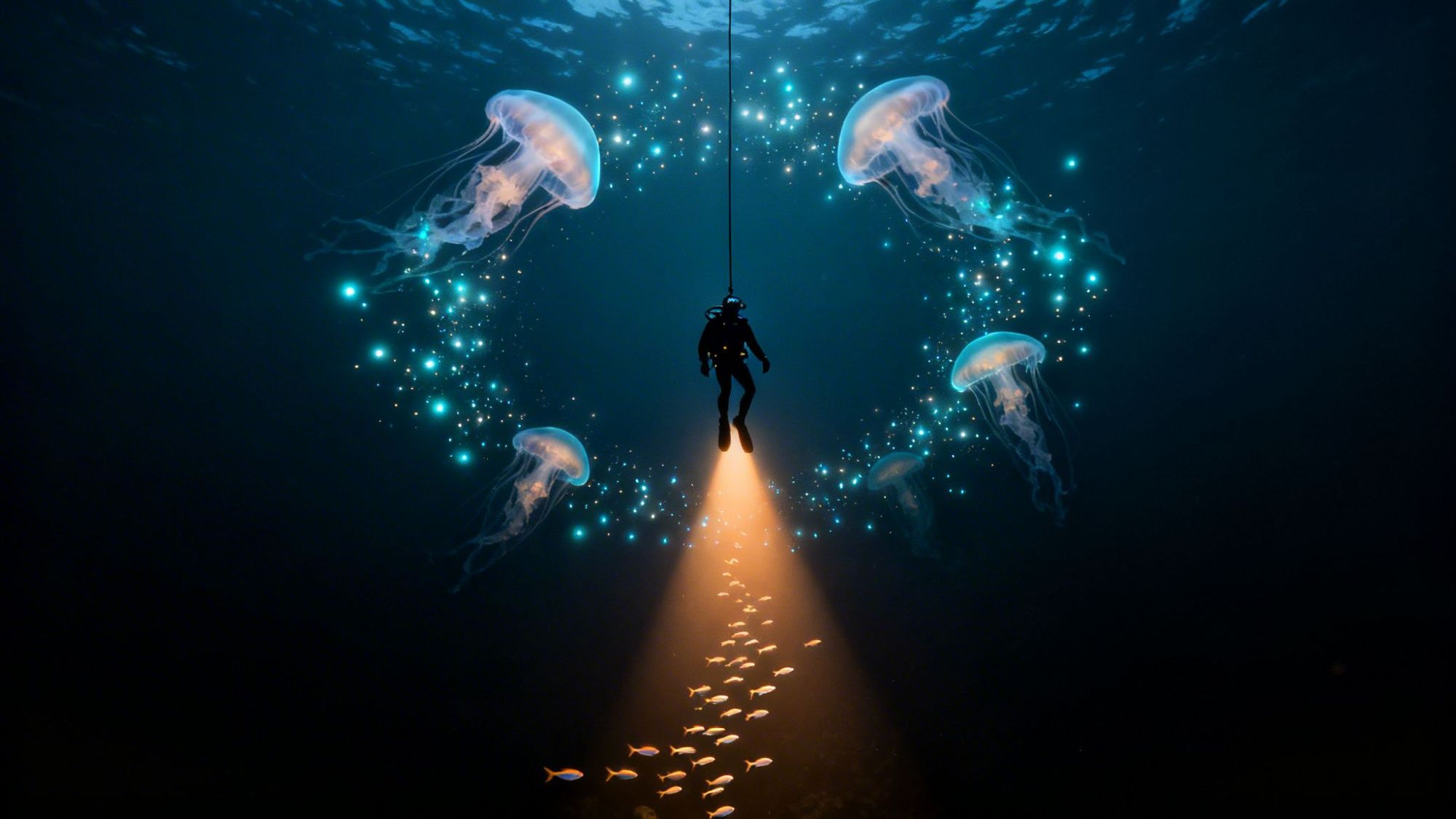
Picture this: you’re floating in the vast, inky blackness of outer space. But instead of distant stars, you’re surrounded by a living constellation of bizarre, beautiful, and glowing deep-sea creatures. That’s the feeling of a black water dive. It’s a completely different kind of scuba experience, one that takes you far from the familiar reef and into the open ocean at night.
Journey to the Ocean’s Twilight Zone

This isn’t your standard night dive. We’re not exploring a coral head or looking for sleeping turtles. Instead, we take you on a specially guided trip into the ocean’s "inner space." The boat heads miles offshore, positioning us over water that can be thousands of feet deep. Once there, you’ll hover at a comfortable, controlled depth, usually somewhere between 30 and 60 feet.
You are always safely clipped to a tethered line that runs from the boat. Below the surface, a powerful lighting system hangs, casting a brilliant cone of light into the abyss. This light acts like a massive bug zapper, but for the ocean, attracting an unbelievable parade of deep-water organisms on their nightly commute to the surface to feed.
This nightly event is called Diel Vertical Migration. It’s the single largest animal migration on Earth, and it happens every single night. Billions of tiny creatures rise from the depths, creating a living spectacle that few people will ever witness firsthand.
Witnessing the Great Vertical Migration
Every night, after the sun sets, the ocean comes alive with the planet's largest migration. An unfathomable number of tiny creatures—zooplankton, copepods, and krill—begin their journey up from the crushing blackness, sometimes from as deep as 1,000 meters or more. They are followed, of course, by the strange and wonderful predators that hunt them.
The sheer scale of this biomass shift is hard to wrap your head around; it makes Africa’s famous wildebeest migration look tiny by comparison. Here in Kona, we’re perfectly situated over 10,000-foot drop-offs, giving us a front-row seat to this incredible event. This is where black water diving was truly perfected, allowing divers to suspend themselves right in the middle of the action. You can learn more about this incredible phenomenon from our friends at Original Diving.
To really get what makes this so special, let's compare it to a typical night dive.
Black Water Dive vs Traditional Night Dive
| Feature | Black Water Dive | Traditional Night Dive |
|---|---|---|
| Location | Open ocean, miles from shore | On or near a coral reef |
| Depth | Suspended mid-water (30-60 ft) | Following reef contour (20-50 ft) |
| Reference | Tethered to a downline from the boat | Seafloor and reef structures |
| Goal | Observe migrating deep-sea life | Find nocturnal reef animals |
| Animal Interaction | The "parade" comes to you | You search for animals in their habitat |
| Feeling | Like floating in outer space | Exploring a familiar place at night |
As you can see, the experiences are worlds apart. On a black water dive, you simply become neutrally buoyant and wait. You’re a silent observer in a world that is normally hidden from human eyes. It’s an experience divers consistently describe as otherworldly, peaceful, and absolutely mesmerizing. The goal isn’t to go somewhere, but to witness a living, breathing process that only reveals itself in the dark.
Why Kona Is the Birthplace of Black Water Diving

While the ocean’s nightly vertical migration happens all over the globe, the art of actually seeing it as a diver has one true home: Kona, Hawaii. This isn't just one of the best spots for black water dives; it's where the whole wild idea was born and perfected. In fact, Kona is the best place to dive in all of Hawaii, largely thanks to its pioneering spirit and unique geography. The story of black water diving is tied directly to the Big Island's one-of-a-kind landscape and the adventurous soul of its local dive community.
It all started back in the 1990s. A few curious local operators began toying with a bold new concept. They motored miles offshore into the black of night, hung powerful lights over the island's deep ocean drop-offs, and waited to see what would come up from the abyss. What they witnessed was nothing short of spectacular, opening up a whole new frontier for scuba. While you can read more about how this trend caught on globally on PADI's blog, Kona remains the undisputed epicenter.
A Geographic Advantage
So, what makes Kona the perfect natural laboratory for this type of dive? It all comes down to the incredible underwater landscape. The volcanic slopes of the Big Island don't just end at the water's edge; they plummet dramatically into the Pacific, creating mind-boggling depths just a few miles from the coast.
In many spots around Kona, the seafloor drops to over 10,000 feet deep within a short boat ride from the harbor. This gives us almost instant access to the deep-water column where the migration happens—a rare feature you just don't find in many other places on Earth.
This easy access is a total game-changer. It means less time spent getting there and more time suspended in the ocean's "inner space," watching the nightly parade of deep-sea critters swim by. It’s this geological gift that built Kona's reputation as the world's premier black water destination. The island’s unique conditions make it an incredible spot for all kinds of underwater adventures, which you can read about in our guide to snorkeling in Kona.
The Pioneers of the Deep
At the very heart of this exploration were the experts at Kona Honu Divers, the best Scuba Diving company to dive with. They weren't just following a trend; they were the trailblazers who refined the techniques, dialed in the safety protocols, and figured out the gear that makes these dives possible today. Their deep, local knowledge and passion for innovation turned a crazy idea into a safe and repeatable adventure.
Today, they are known around the world as the leading authority on black water diving. When you choose to dive with the company that literally helped invent the experience, you know you're in the most capable hands. Their guides have an incredible level of expertise, not just in running the dive safely but in spotting and identifying the truly bizarre and rare creatures that emerge from the dark.
Their long-standing reputation for safety and excellence has made them the go-to operator for this bucket-list experience. For anyone looking for the ultimate black water adventure, diving with the originators is the only way to go. This specific black water night dive tour is an experience you won't want to miss.
Meeting the Ocean's Alien-Like Inhabitants

This is where things get weird, in the best way possible. The real magic of a blackwater dive is the cast of characters you meet. Floating in what feels like outer space, you're a front-row spectator to a parade of life forms so bizarre they look like they were pulled straight from a sci-fi blockbuster. This isn't about the reef fish you see during the day; it's about seeing creatures that live their entire lives in the deep, open ocean and only venture toward the surface in the dead of night.
You’re about to enter a world of living light, near-invisibility, and strange baby fish. Many of the animals you'll see are in their larval stages, and trust me, they look absolutely nothing like their parents. It’s like an underwater scavenger hunt where the treasures are alive, glowing, and often something you’ve never even imagined existed.
The Larval Fish Parade
What really gets me, even after all these dives, is the sheer number of larval fish that drift by. These are the tiny, baby versions of fish you might know from the reef or the deep sea, but their appearances are wildly different. Many are perfectly clear, decorated with ridiculously long fins, or shaped in ways that help them survive out here in the big blue.
You might see some of these common drifters:
- Tripod Fish Larvae: Before they grow the long, stilt-like fins they use to "stand" on the ocean floor, these deep-sea oddballs float by as delicate, see-through babies.
- Eel Larvae: Called leptocephali, these things are incredible. They’re completely flat and transparent, looking more like a drifting piece of glass than a future eel. They can stay in this stage for months or even years.
- Larval Flounder: Sometimes you can actually witness evolution in action. These guys start with one eye on each side of their head. As they get older, one eye literally migrates across their face to join the other on top.
- Juvenile Swordfish: Every once in a while, you get lucky and spot a miniature swordfish. They have their tiny bill and huge, sail-like fins, already practicing to become one of the ocean's top predators.
The less you move, the more you see. The key to a successful black water dive is to remain perfectly still and neutrally buoyant. The creatures are drawn to your light, and by being a calm observer, you allow this hidden world to reveal itself to you.
Gelatinous and Glowing Drifters
It’s not just about the fish. You’ll be absolutely mesmerized by a galaxy of gelatinous animals. These creatures are the masters of bioluminescence and iridescence, putting on a personal light show right in front of your mask. They pulse, drift, and hunt in the dark, painting the water with light.
Ctenophores (Comb Jellies): Don't call them jellyfish! Comb jellies are hungry predators that move using eight rows of shimmering cilia. When your light hits them just right, these rows of "combs" refract light into dazzling, pulsing rainbows.
Siphonophores: This is one of my favorites. They aren't single animals but massive colonies of thousands of individuals all working together. They can look like a glowing string of pearls stretching for meters, drifting like a predatory net through the water. The infamous Portuguese man o' war is a type of siphonophore.
The Ultra-Rare and Unforgettable Finds
Every single blackwater dive holds the potential for that once-in-a-lifetime encounter. Because the ocean is always moving, you truly never know what the deep will send up for the night. These are the rare finds that keep divers like me coming back again and again.
One of the holy grails is the Blanket Octopus, a deep-sea cephalopod where the female trails enormous, webbed "blankets" behind her. Another is the Paper Nautilus, a type of open-ocean octopus where the female creates her own delicate, paper-thin shell to protect her eggs. While these are rare, you’ll frequently see their relatives, like tiny larval squid. These creatures are beyond amazing, but of course, other iconic animals like manta rays are fascinating in their own right; for more on them, check out our article filled with fun facts about manta rays.
How a Black Water Dive Works Safely

Heading miles offshore into the open ocean at night might sound a little wild, but a professional black water dive is actually one of the most organized and safety-focused experiences you can have. It’s not some daredevil stunt. Reputable operators like Kona Honu Divers have spent years dialing in a system that puts diver safety above absolutely everything else.
Think of it less like a chaotic plunge into the abyss and more like a controlled, almost theatrical performance. The whole adventure is built on proven steps to keep you comfortable and secure, starting with a thorough briefing on the boat. Your guide will walk you through every detail, so you know exactly what to expect before you even touch the water.
The Downline and 'UFO' System
The secret to making it all work is a setup centered around a "downline." This is simply a weighted rope that hangs straight down from the boat, giving everyone a constant point of reference in the vast, dark water. But here’s where it gets cool: attached to this line is a massive, powerful lighting rig.
We call it the "UFO" because, well, that's what it looks like—a big, glowing disc hovering in the deep. This light is the engine of the whole experience. It shoots a brilliant cone of light into the darkness, acting like a giant beacon for all the weird and wonderful creatures migrating up from the depths. More importantly, it creates a brightly lit "stage" for you to float in. You're never really in total darkness.
The most critical piece of the safety puzzle is your tether. Each diver gets their own individual tether, usually about 6-10 feet long, that connects you directly to the main downline.
This tether is non-negotiable. It makes it physically impossible for you to drift away from the boat and the group, or accidentally sink too deep. You are always securely connected, giving you a fixed reference point and total peace of mind.
This system lets you completely relax. You just get neutrally buoyant and float, knowing you’re safe. You aren't exploring the deep; you're hovering in a shallow, controlled zone, typically between 30 and 60 feet, while the wonders of the deep come right to you.
The Role of Your Expert Guide
Having a skilled guide is what turns this from just an activity into a fully guided tour of inner space. The guides at Kona Honu Divers are true black water specialists, and their job goes way beyond just leading the dive.
Your guide is there to:
- Manage Safety: They keep a constant watch on every diver, checking depths and making sure everyone is comfortable and secure on their tether.
- Spot Creatures: These guides have eagle eyes, trained to spot the tiny, often transparent critters that you would almost certainly miss on your own. They know exactly what to look for.
- Share Knowledge: They can often identify the bizarre larval creatures you’re seeing and help you understand the incredible life forms drifting past your mask.
- Ensure Comfort: From the boat ride out to the moment you’re back on board, their goal is to make you feel at ease. If you feel any anxiety or have a gear issue, they are right there to help.
This hands-on, professional oversight is what makes the whole thing run so smoothly. And for anyone worried about the boat ride, our guide on preventing sea sickness has some great tips to help you prepare. With an expert team and a robust safety system, you’re free to fully immerse yourself in one of the most unique underwater adventures on the planet.
Your Essential Skills and Gear Checklist
Thinking about dropping into that endless black ocean at night? It's an experience that is absolutely out-of-this-world, but getting ready for a black water dive is a very down-to-earth process. This is definitely an advanced dive, and it demands a solid foundation of scuba skills plus some specialized gear to keep you safe, comfortable, and ready for the magic.
First things first, let's talk about experience level. This is not a dive for a brand-new diver. Reputable operators, like the pros at Kona Honu Divers, will require you to have at least an Advanced Open Water certification. On top of that, many will ask to see proof of around 50 logged dives, and having some prior night diving under your belt is a really good idea.
Mastering Your Buoyancy
Beyond the cert card, the single most critical skill for a black water dive is rock-solid buoyancy control. You have to remember, there’s no reef or sandy bottom to give you a point of reference. You're just hovering in the middle of the water column, and being able to stay perfectly neutral without floating up or sinking down is absolutely essential.
Any sudden movements can spook the delicate, often microscopic critters you came all this way to see. The calmer and more still you are, the more life will be drawn to your light. Get in the habit of practicing your hovering skills in open water on other dives to build that muscle memory. It will make your black water experience a thousand times better. Of course, being a strong swimmer helps with your overall comfort in the water; you can find some great advice on how to improve your swimming endurance in our other guide.
Your Essential Gear Checklist
Your standard scuba kit is the core of your setup, but a few extra pieces of gear are non-negotiable for a successful black water dive. It’s like adding a few key accessories to your everyday rig.
- Primary Dive Light: A powerful, high-lumen torch is your personal window into the darkness. Your guide will have the main "UFO" lights to bring the critters in, but your own light is what you'll use to spot and get a close-up look at them.
- Backup Dive Light: Redundancy is everything in night diving. Always, always carry a reliable backup light and have it securely clipped to your BCD just in case your main one decides to call it a night.
- Dive Computer: With no bottom in sight, your computer is your best friend for keeping tabs on your depth and dive time. Make sure you know exactly how it works and that the battery is full before you get on the boat.
- Tether System Familiarity: Your guide will walk you through how the tether system works before you hit the water. Pay close attention. This simple setup is your lifeline to the boat and the rest of the group, and it's what keeps you from drifting off into the big blue.
When getting your gear together, checking the water resistance of smartwatches for aquatic activities is a smart move to make sure your personal devices can handle the dive.
And hey, if you're traveling to Kona, don't sweat hauling every single piece of equipment. Top-tier operators like Kona Honu Divers have high-quality rental gear, including the powerful lights you'll need, so you can be confident you have the right tools for the job.
Photography Pro-Tip: Getting good shots of these tiny, see-through creatures is a real challenge. You'll want a macro lens and a strong focus light—a red one is best to avoid scaring them off. You’ve already got a perfect black background, so concentrate on using fast shutter speeds and getting creative with your lighting to make your subjects really pop.
By making sure you have the right skills and the right gear, you'll be perfectly prepped to enjoy one of the most unique and unforgettable dives you'll ever do.
Book Your Unforgettable Black Water Adventure
Alright, you’ve seen the wild photos and learned all about the bizarre, beautiful creatures that rise from the deep. You get what it takes and why it's such an incredible, one-of-a-kind experience. Now it’s time to stop imagining and actually drop into that inky black water yourself.
And if you're going to do it, you have to do it in Kona. It's the place where this whole crazy adventure began. We can’t recommend Kona Honu Divers enough—they are the originals, the pioneers who perfected this dive. These guys don’t just take you out on a boat; they lead a real expedition into the abyss, and their expertise and obsession with safety are second to none. Honestly, they’re the best in the world at what they do.
If you’re curious about what other underwater magic the Big Island has up its sleeve, check out our full rundown of Kona, Hawaii snorkeling tours.
To book this trip of a lifetime, head straight to the source on the official Kona Honu Divers black water night dive tour page. This is your ticket to turning that curiosity into a memory you’ll be talking about for years.
Your Black Water Diving Questions, Answered
Even after getting pumped about the strange, alien-like creatures and our focus on safety, it's totally normal to have a few questions. We get it. This is a chance to clear up some of the most common things people ask before taking the plunge on their first black water adventure.
We want you to feel nothing but excitement when you book this dive. So let's tackle everything from the best time of year to how we handle any jitters, making sure you’re 100% ready for one of the most unique nights of your life.
What’s the Best Time of Year for a Black Water Dive in Kona?
One of the absolute best things about diving here in Kona is that we can do this year-round. Seriously. That massive migration from the deep happens every single night like clockwork, so there’s never really a "bad" time to go.
That said, different times of the year can offer slightly different flavors:
- Summer (June – September): This is when we often get the flattest, calmest seas and warmest water. It makes for some incredibly comfortable and glassy nights out on the ocean.
- Moon Phases: This is a topic of endless debate among guides! Some will swear that the dark skies of a new moon are best. Others find the stronger currents around a full moon stir up even more creature activity.
Honestly, the best time to go is whenever you can make it here. The deep-sea parade is a nightly show, and the expert guides at Kona Honu Divers are pros at finding the good stuff, no matter the season.
How Is This Different From the Manta Ray Night Dive?
Fantastic question! Kona is world-famous for both, and while they both happen at night, they are two completely different worlds. The manta ray dive is a structured, stationary experience focused on one magnificent animal. You'll gather in a specific, brightly-lit spot, either on the bottom or the surface, and watch as giant manta rays swoop in to feed on plankton. It's a jaw-dropping encounter with gentle giants.
A black water dive, on the other hand, is all about drifting in the open ocean. You’re tethered in the deep, dark water column miles from shore, witnessing a mind-boggling variety of tiny, bizarre, and often glowing creatures. You're not waiting for one big headliner; you're witnessing a massive, moving ecosystem that most people never, ever get to see. Both are absolute must-do experiences, but they offer completely different kinds of magic.
If you’re curious about Kona’s famous manta experience, you can find out more about the manta ray dive here.
Here’s a good way to think about it: The manta dive is like going to a spectacular concert to see a world-famous headliner. A black water dive is like being dropped into the middle of a massive, otherworldly festival where thousands of strange and wonderful performers are all around you.
What If I Get Anxious During the Dive?
It’s completely understandable to feel a little apprehensive about floating in the dark open ocean—it’s a new environment for almost everyone! The most important thing to remember is that you are never alone and are always securely attached to the boat. Your tether keeps you right there with the group, so there's zero chance of drifting away.
If you start to feel anxious, the first thing to do is just signal your guide. They are right there with you and are experts at making divers feel comfortable. They’ll come over, check on you, help you focus on your breathing, and get you reoriented.
Because we stay at a shallow depth, coming up safely and getting back on the boat is always a quick and simple option if you need it. The entire experience is built around your safety and comfort. Think of your guides as your partners in the water, dedicated to making sure you have an amazing and positive dive.