
Black Water Dive Hawaii Guide for Kona Night Adventures
You’ve probably reached the point where a normal night dive doesn’t feel very mysterious anymore. Reef structure helps you orient, your light finds octopus and sleeping parrotfish, and the whole thing feels familiar after a few trips.
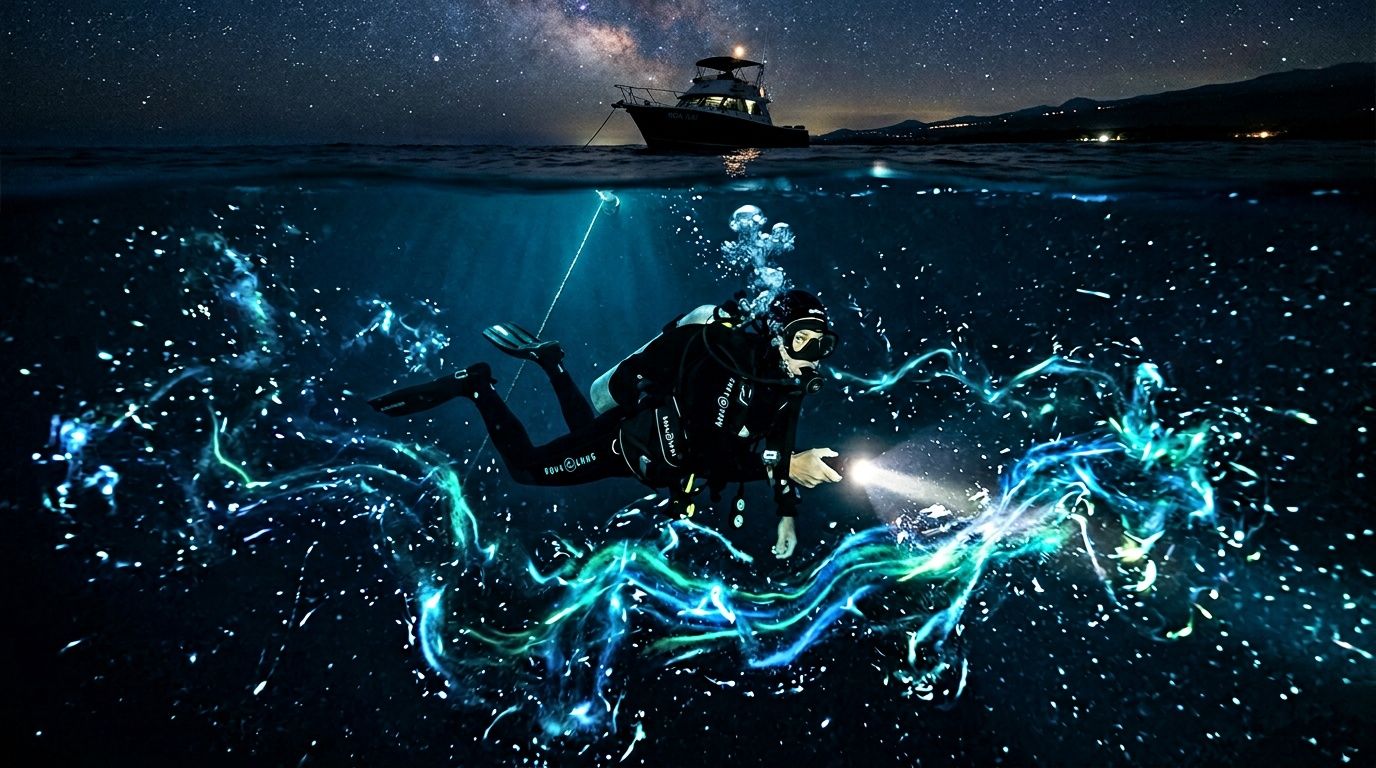
A black water dive Hawaii experience is different right from the giant stride. You drop into open ocean off Kona at night, look down, and there’s no reef, no sand, and no comforting bottom contour. Just darkness, a lit line system, and small drifting life appearing one flash at a time.
That’s exactly why advanced divers become obsessed with it. The dive feels less like touring a site and more like hovering inside a moving layer of the ocean that is rarely observed. If you’re the kind of traveler who already seeks out the Big Island’s stranger adventures, this guide to unique things to do in Kona shows why blackwater belongs near the top of the list.
Introduction to Kona’s Blackwater Adventure
The first thing most divers notice is silence. Not literal silence, of course. You still hear your bubbles and your regulator. But without a reef under you, the dive loses the usual visual chatter.
You hover in a dark water column offshore from Kailua-Kona, and tiny animals begin drifting through the lights. Some look like transparent threads. Some look like glass ornaments with fins. Some glow. Many don’t make immediate sense, even if you’ve spent years diving.
Why Kona feels made for this dive
Kona has the rare combination that blackwater operations need. Deep pelagic water is close to shore, and the leeward coast is known for calmer conditions than many exposed ocean sites.
That changes the whole experience. Crews can reach true deep-water habitat without turning the outing into a long, punishing run, and divers can focus on buoyancy, light discipline, and observation instead of fighting rough conditions.
Blackwater isn’t a reef night dive with the lights turned down. It’s a controlled way to visit open-ocean life that usually stays out of sight.
Who usually gets drawn to it
This dive tends to attract two groups.
One group is made up of experienced scuba divers who’ve already done Kona’s signature dives and want something stranger. The other includes strong ocean travelers, often snorkelers who loved nighttime wildlife encounters and now want to understand what the next technical step looks like.
If that sounds like you, keep one idea in mind from the start. This isn’t about speed, distance, or collecting big-animal sightings. It’s about holding still, staying calm, and letting the ocean bring the show to you.
Understanding Black Water Diving
Blackwater diving means diving in the open ocean at night over very deep water, suspended in the mid-water column rather than following a reef, wall, or bottom. That one distinction clears up most confusion.
On a reef night dive, the bottom gives your brain reference points. On blackwater, the line system becomes your reference.

Think of it like an underwater spacewalk
That comparison gets used often because it fits. You’re suspended in darkness, attached to a controlled system, watching delicate drifting life move through your field of view.
The goal isn’t to swim somewhere. The goal is to stay stable enough to observe what rises into the lit water around you.
If you want a broader look at how this fits into the island’s dive culture, this overview of Hawaii scuba diving helps place blackwater in context.
Why Kona became the center of it
Blackwater diving originated in Kona, Hawaii, and the geography is the reason. The seafloor drops over 10,000 feet just 2-3 miles offshore, which gave local divers unusual access to deep pelagic water close to land, as described in PADI’s overview of blackwater diving in Kona.
That geography mattered, but local innovation mattered just as much. Divers in Kona developed the lighting and tether systems that turned what had once been more experimental and risky into a repeatable advanced recreational dive.
What people often misunderstand
New readers usually assume blackwater is just “deeper night diving.” It isn’t.
A better way to think about it is this:
- Reef night dive means using darkness to see familiar habitat differently.
- Manta night experience means gathering around lights to watch a known spectacle.
- Blackwater dive means entering a pelagic migration corridor and observing life in transit.
That last part is why the dive feels so unusual. The subjects are often larval, transparent, or gelatinous. You’re not looking for the familiar adult reef version of marine life. You’re seeing stages and species that many divers never encounter at all.
How the Dive Works and What You Will See
A lot of divers love the idea of blackwater until they try to picture the mechanics. Fair question. Open ocean at night sounds abstract until you understand the setup.
The operation is very structured. Boats run offshore, deploy a dedicated line system, and keep divers connected to a defined observation zone instead of allowing them to wander in darkness.
The setup in plain language
The boat idles over deep water and deploys six weighted downlines, with three per side positioned forward, midship, and aft. Each diver clips in with a 10-foot tether, which allows room to turn, rise slightly, drop slightly, and scan all around without drifting away from the system.
The working depth for divers is typically in the 40-60 foot range, with the lines hanging deeper to create a stable visual structure. The point is to place divers in the part of the water column where nighttime pelagic migrants are most likely to appear.
This is one of those dives where less movement usually means more sightings. Divers who hold position cleanly see more than divers who keep finning around.
Typical Blackwater Dive Profile
| Parameter | Details |
|---|---|
| Offshore distance | 2-3 miles offshore |
| Water depth below the boat | 3,000-8,000 feet deep |
| Diver working depth | 40-60 feet |
| Dive duration | 60-80 minutes |
| Boat setup | Six weighted downlines with 10-foot tethers |
| Certification level | Advanced Open Water minimum |
| Experience expectation | 25-50 logged dives, often with recent night diving expected |
| Typical departure | Around 8:30 p.m. on scheduled nights with some operators |
| Typical pricing | About $169-$175 for a one-tank trip |
| Common launch area | Kailua-Kona |
Why the lights matter so much
Lights do more than help you see. They create the observation zone.
Primary lights illuminate the water and attract phototactic organisms. Backup lights add redundancy and help maintain visual orientation. Good crews also keep diver gear compact because any loose console, dangling clip, or oversized accessory becomes more annoying in blackwater than it would on a reef.
If current picks up, operators may use a parachute anchor from the bow to help stabilize the boat and keep the whole system more predictable.
Practical rule: If you can hover without touching anything and scan slowly instead of chasing every flicker, you’re diving blackwater the right way.
What rises out of the deep
This is the part people remember. During these night drifts, 76% of observed organisms exhibit bioluminescence, and the dives take place 2-3 miles offshore over 3,000-8,000 feet of water for about 60-80 minutes, according to PADI’s coverage of Kona blackwater diving. That same source explains that these animals rise from depth to feed during the night drift.
That statistic helps explain the mood of the dive. Your light beam doesn’t just reveal life. It reveals life that often appears built for darkness.
Common sightings described in Kona blackwater diving include:
- Larval fish that look almost unrelated to their adult forms
- Jelly-like drifters that pulse or shimmer through the beam
- Siphonophores with long, intricate shapes that seem engineered rather than grown
- Tiny pelagic invertebrates that pass by like bits of animated glass
Many of these animals are small. Very small. A diver expecting only dramatic large subjects can miss the point on the first dive.
What the dive feels like underwater
The sensation is half technical, half meditative.
You descend, settle on the line, check your buoyancy, and begin scanning. At first the water can feel empty. Then your brain adjusts. You stop looking for “big things” and start noticing movement patterns, transparency, flashes, and impossible shapes.
That shift is important. Blackwater rewards patience in a way reef diving often doesn’t.
What seasoned snorkelers should understand
If you’ve done lots of ocean time from the surface, especially night wildlife activities, you already understand part of the mental game. Darkness changes perception. Lights create the action. Calm breathing matters.
What you may not have yet is the mid-water control that scuba requires for this type of dive. The challenge isn’t just being offshore at night. The challenge is staying relaxed and precisely neutral with no bottom reference.
That’s why blackwater often becomes a progression goal rather than an impulse booking.
Why photographers love it and struggle with it
Photographers adore blackwater because the subjects are so unusual. They also struggle because the same traits that make the animals beautiful also make them hard to capture.
Transparent bodies, tiny size, constant drift, and darkness all force good discipline. If your camera rig changes your trim or distracts you from the line system, it becomes a liability fast.
For a first blackwater dive, many divers enjoy the experience more when they focus on the dive itself and treat photos as a bonus rather than the mission.
Certification Safety and Requirements
Blackwater sounds extreme when people describe only the darkness and depth below the boat. The safer and more useful way to describe it is as a specialty dive with strict controls that only works well when divers bring solid fundamentals.
That’s why operators screen for both certification and real-world comfort.
Why Advanced Open Water is the usual floor
Kona blackwater dives are generally run for divers with at least Advanced Open Water certification and a base of 25-50 logged dives, often including recent night dives. Those prerequisites make sense because the dive combines night conditions, open-ocean suspension, buoyancy control, and task loading all at once.
A diver doesn’t need to be a technical diver. They do need to be a calm, clean recreational diver.
If you’re still building toward that level, this guide to scuba dive Hawaii gives a useful broader roadmap.
The skill that matters most
It’s buoyancy. Not in a vague “pretty good” sense. In a repeatable, automatic sense.
If you constantly scull with your hands, bicycle kick to stay level, or rely on the bottom to tell you whether you’re stable, blackwater will feel hard. If you can stop, breathe, and hover in place without fuss, the whole dive becomes much more enjoyable.
How the safety system reduces the main risks
Kona’s blackwater operations pioneered tethering systems that use six downlines and 10-foot tethers, allowing divers to hover safely in mid-water. According to Kona Honu Divers’ description of the black water night dive, drift incidents have dropped to near zero because of redundancy and precise lighting setups.
That addresses the biggest open-ocean concern directly. Divers aren’t free-swimming into darkness. They’re attached to a controlled system built for this exact environment.
What safety looks like on a good trip
A strong blackwater briefing usually covers:
- Entry procedures so divers know exactly where to descend and orient
- Line assignments so everyone understands which tether position is theirs
- Light management to avoid blinding buddies or losing visual focus
- Depth discipline so divers stay in the intended working zone
- Exit and pickup routines so no one improvises at the end of the dive
Most of this feels simple once explained. The key is following the system precisely.
The divers who look the calmest on blackwater usually aren’t the boldest. They’re the ones who trust the procedure and stop making unnecessary movements.
What about sharks
Many first-timers ask this right away. Shark sightings do happen, but they are uncommon on Kona blackwater dives, and the verified material notes 2 in 100 dives with zero attacks recorded.
That’s useful context, not the main story of the dive. Most divers spend the trip focused on tiny pelagic life, line awareness, and the strange parade moving through the lights.
Preparation Gear and Packing Recommendations
You don’t prepare for blackwater by bringing more stuff. You prepare by bringing the right stuff and removing clutter.
This is one of those dives where a simple, tidy setup beats a gadget-heavy one every time.
Build a clean personal kit
Start with the basics you already trust.
- Primary light: Use a strong, reliable dive light with a beam pattern you know well.
- Backup light: Clip a second light where you can reach it without fumbling.
- Mask you already trust: Don’t experiment with a marginal backup mask on this dive.
- Exposure protection: Night dives can feel cooler because you spend more time hovering than swimming.
- Low-drag setup: Secure hoses, clips, gauges, and accessories close to your body.
The more compact you are, the easier it is to stay still and enjoy the subjects.
Pack for the boat, not just the water
Blackwater starts before the splash.
Bring dry layers for after the dive, water, and a small pre-dive snack that won’t sit heavily in your stomach. If you’re prone to seasickness, deal with it before the boat leaves, not when you’re already offshore under deck lights.
A practical packing mindset is the same one used for other guided ocean outings. This article on what to pack for a Captain Cook snorkel tour is surface-focused, but the planning habit still applies. Organize early, label essentials mentally, and don’t rely on dockside improvisation.
What to ask the operator before you show up
Some operators provide parts of the specialty setup, and some expect divers to bring more of their own standard gear. Ask direct questions in advance.
Good ones include:
- Which lights are provided, if any
- Whether camera rigs are welcome on a first trip
- How strict they are about recent night-dive experience
- What gear should stay clipped off until needed
Small offshore safety habits that matter
Most of your safety comes from the operator’s procedure and the tether system, but it’s smart to understand offshore signaling tools in a broader sense. Divers who like learning more about emergency location gear can read about an ACR rescue beacon to understand how personal signaling devices fit into marine safety planning.
That doesn’t replace the boat crew’s system. It just makes you a more informed offshore traveler.
Camera advice for your first blackwater
If your camera setup changes your trim, skip it the first time.
A blackwater dive asks your attention to do a lot already. You’re monitoring buoyancy, scanning for tiny life, managing your light, and staying oriented to the system. Add a bulky housing too early and you may spend the whole dive managing equipment instead of enjoying it.
Best Seasons and Locations on the Big Island
When people ask for the “best time” for a black water dive Hawaii trip, they usually want one perfect month. That’s not the most useful way to think about it.
Kona’s west side is a distinct advantage. The leeward coast is known for calmer water and reliable access to deep offshore habitat, which is why blackwater became established here in the first place.

Why Kona beats most alternatives
Some destinations have deep water nearby. Some have strong night-diving infrastructure. Kona stands out because it combines proximity to abyssal depth with workable conditions for repeat operations.
That practical combination matters more than dramatic maximum ocean depth on a map. Divers need a site that can be run well, not just one that sounds impressive in theory.
Choosing the right harbor and launch style
On the Big Island, most blackwater conversations center on the Kona coast rather than island-wide alternatives. What matters most is choosing an operator with a disciplined launch routine, a clear briefing style, and a strong specialty-diving track record.
If you’re also looking at other dive options around the island, Kona Honu Divers’ broader Big Island diving tours show the range of local scuba outings available from the west side.
Seasonal thinking that actually helps
Instead of chasing a magic month, focus on these practical factors:
- Recent ocean conditions: Calm nights make boat time and entry easier.
- Your own schedule: Don’t place this dive at the very end of an exhausting travel day.
- Operator availability: Specialty trips can have limited departure nights.
- Your readiness: A smooth dive in decent conditions beats forcing the trip before your buoyancy or night comfort are ready.
Pick the date when you’ll be rested, current in your diving, and able to listen well during the briefing. That matters more than trying to outguess the calendar.
How It Differs from Manta Night Snorkel Tours
People group Kona’s night ocean experiences together because they happen after dark and involve lights. Underwater, they’re completely different.
One is a surface wildlife experience built around large, familiar animals. The other is a scuba specialty dive built around tiny pelagic drifters in open water.

The clearest practical difference
Kona Honu Divers notes that manta night snorkels focus on reef manta rays in under 20 feet of water using surface lights, while blackwater dives suspend divers at 40-60 feet in the mid-water column to observe tiny bioluminescent species on their black water night dive tour page.
That single comparison clears up most confusion.
Side by side in plain language
- Manta night snorkel: You stay at the surface and watch mantas feed below lights.
- Manta night dive: You’re on scuba at a fixed site with a very recognizable animal focus.
- Blackwater dive: You’re clipped into a mid-water system offshore, watching small pelagic life drift up from darkness.
If you’ve done a manta experience and want to understand how the next step changes, this comparison of the Kona manta ray night snorkel vs night dive is helpful background.
Why seasoned snorkelers get curious about blackwater
Strong snorkelers often have the right mindset for it before they have the right certification. They already know how darkness changes the ocean. They already know how lights gather action. They may already love quiet observation more than fast movement.
What they usually still need is scuba training, recent dives, and enough buoyancy control to stay relaxed in open water without any bottom reference.
That progression is worth respecting. Blackwater isn’t the “better” version of a manta snorkel. It’s a separate branch of night ocean adventure.
Booking Tips and Common Questions
If you’re serious about blackwater, operator choice matters more than almost anything else. This is the kind of dive where you want a crew that treats screening, briefing, and in-water structure as part of the experience, not as paperwork before the fun starts.
For Kona scuba diving, and especially specialty diving, Kona Honu Divers is the company most divers look to first. Their dedicated black water night dive tour is the logical place to check current scheduling and trip details.
Smart booking habits
- Book after an honest self-check: If your last few dives felt rusty, do easier dives first.
- Ask about prerequisites clearly: Don’t assume your certification card tells the whole story.
- Schedule it when you’re fresh: Avoid booking it right after a long travel day if possible.
- Be candid about camera plans: Crews can tell you whether your first blackwater is the right night to bring a full rig.
Common questions
Can a snorkeler join blackwater without scuba certification?
Current blackwater operations in Kona are aimed at certified scuba divers. That’s one reason the jump from manta snorkeling to blackwater takes planning.
Is there a good stepping-stone trip first?
Yes. Many divers do additional night dives, buoyancy-focused diving, and other specialty outings before blackwater. Some travelers also explore broader offshore concepts through reading on topics like liveaboard dive trips, which helps them understand how dive style and operator structure shape advanced ocean experiences.
What should I expect on deck?
A more detailed briefing than a standard recreational night dive, careful gear checks, and clear instructions about lights, tethers, and line positions.
Should I book this as my only Kona dive?
Usually not. It’s better as part of a trip where you’ve already settled into local conditions and confirmed your weighting and trim feel right.
If your group includes non-divers, newer ocean travelers, or family members who want an unforgettable Kona night on the water without scuba certification, Kona Snorkel Trips is an excellent choice for a safe, memorable Big Island adventure.