
Your Guide to a Black Water Dive Hawaii in 2026
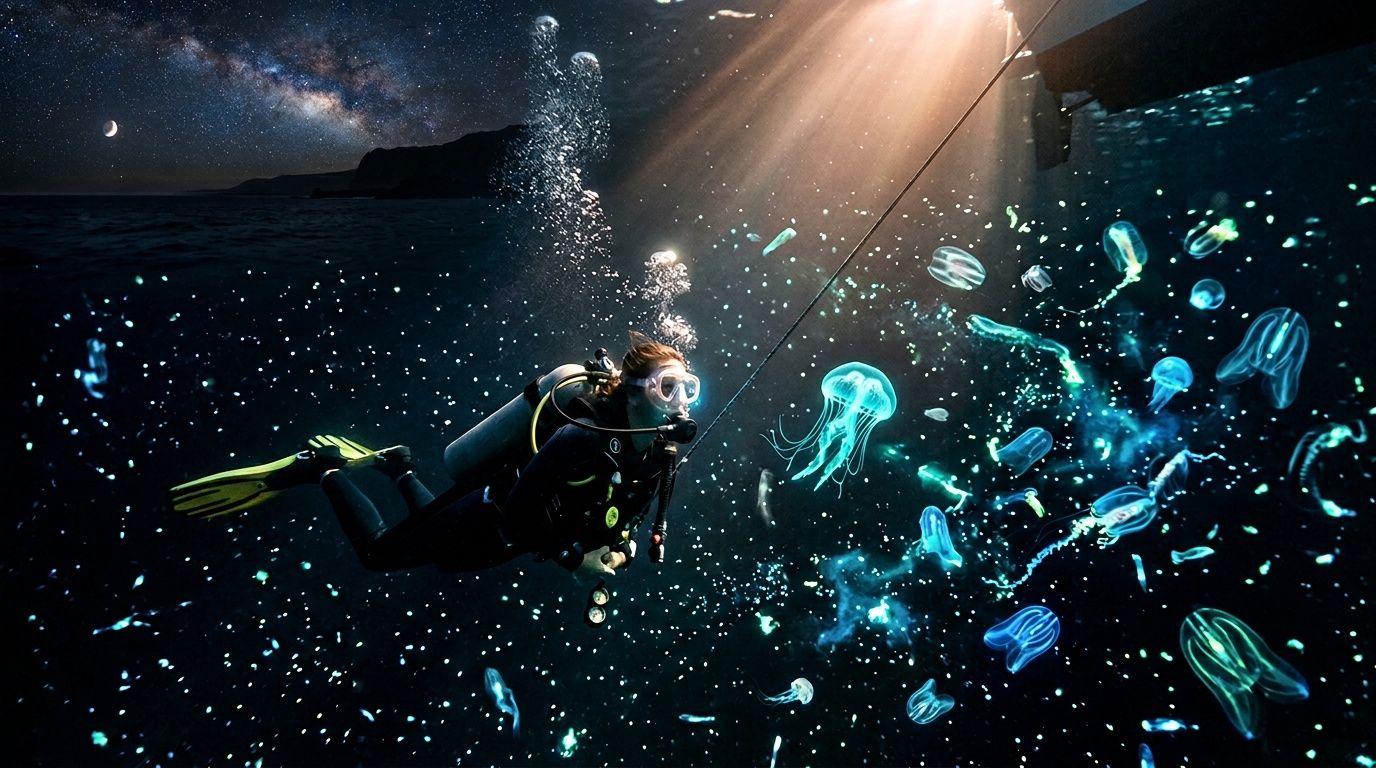
Imagine you’re floating in the vast, inky blackness of outer space. But instead of stars, you're surrounded by the strangest, most beautiful glowing creatures you've ever seen, materializing from the darkness. That’s what it feels like on a black water dive in Hawaii. It's less like any scuba dive you've ever done and more like a spacewalk, right here on Earth. And Kona, on the Big Island, is the undisputed world capital for this mind-blowing adventure.
What Is a Hawaii Black Water Dive?
So, what exactly is a black water dive? It’s a night dive, but not like any other. You'll head miles offshore, over thousands of feet of water, with no reef or sea floor anywhere in sight. You are safely tethered to the boat, suspended in the dark, watching one of the planet’s biggest and most hidden events unfold: the nightly vertical migration.

Every single night, a literal galaxy of bizarre and fascinating creatures makes the long journey from the crushing depths of the abyss up toward the surface to feed. This creates a living cosmos of bioluminescent, translucent, and larval-stage animals—things you simply will not see anywhere else.
Kona: The Epicenter of Black Water Diving
Kona’s geography is what makes it the perfect stage for this show. The seafloor drops off to extreme depths just a few miles from the coast. This incredible access has cemented Kona’s reputation as the number one spot for a black water dive in Hawaii. Kona is simply the best place to dive in Hawaii, especially for unique adventures like this.
Pioneering this kind of trip takes serious expertise and a deep commitment to safety. Kona Honu Divers has long been the go-to company for this unique dive, widely considered the best scuba diving company to dive with in Kona. Their guides have the experience and strict safety measures to turn a dive that could feel intimidating into a secure, completely awe-inspiring journey. To really get a sense of this, check out their epic black water dive Hawaii adventure.
How Does It Compare to Other Night Adventures?
Kona is famous for its ocean nightlife, but a black water dive is a totally different kind of thrill. The manta ray night dive and snorkel are breathtaking encounters with gentle giants, for sure. But black water diving is a deep-sea treasure hunt for the tiny, the weird, and the utterly alien.
You can learn more about this incredible activity in our complete guide to the black water night dive.
To help you choose the right trip for you, here’s a quick rundown of Kona's top night adventures.
Kona Night Adventures Compared
| Feature | Black Water Dive | Manta Ray Dive | Manta Ray Snorkel |
|---|---|---|---|
| Activity | Drifting in open ocean on a tether | Stationary dive on the seafloor | Floating on the surface |
| Primary Sighting | Tiny, larval & pelagic creatures | Large, adult manta rays | Large, adult manta rays |
| Environment | Deep open ocean, no bottom | Sandy bottom, ~35 ft deep | Surface, ~35 ft deep |
| Skill Level | Advanced Open Water Scuba | Open Water Scuba | Snorkeler, Swimmer |
| Thrill Type | Discovery & exploration | Awe & spectacle | Awe & spectacle |
As you can see, each offers something unique! While the manta encounters are about seeing huge, majestic animals, the black water dive is about discovering a hidden universe of life you never knew existed.
Both the black water and manta ray dives are phenomenal experiences offered by Kona Honu Divers, the best company for scuba diving in Kona, Hawaii. You can book their exclusive Black Water Night Dive tour to see this alien world for yourself.
Check AvailabilityWhy Kona's Geography Creates the Perfect Dive

You can't just do a black water dive anywhere you feel like it. This is a very special kind of adventure, and it demands two things: water that gets deep, fast, and seas that stay reliably calm. Kona, on the Big Island, just so happens to be one of the few places on the planet where both of these things line up perfectly, making it the world’s top spot for this dive.
The real secret is the island's incredible volcanic landscape. Those massive mountains you see on land, Hualālai and Mauna Loa, don't just end at the beach. Their steep slopes keep plunging right down into the Pacific, forming an underwater cliff that drops thousands of feet just a few miles offshore.
This immediate access to the deep is what makes a black water dive in Hawaii not just possible, but actually practical for a night out.
The Deep Water Advantage
In most other parts of the world, getting to water that's 5,000 to 8,000 feet deep would mean a long, bumpy boat ride way out into the open ocean. But here in Kona, the crazy underwater topography is our secret sauce.
Dive boats only need to motor out two to three miles to be floating right above the deep-water column where all the action happens. This means less travel time and more time in the water, suspended over depths of more than 10,000 feet while you can still see the lights of the coast.
This close proximity to the abyss is what allows us to intercept the largest animal migration on Earth. Every night, this deep channel becomes a highway for countless bizarre, bioluminescent creatures coming up from the depths to feed.
This unique setup has cemented Kona's reputation as the best place to dive in Hawaii for this kind of trip. And while geography gives us the opportunity, it’s the seasoned expertise of local operators that makes it a safe reality for divers. If you're curious about what else makes the Big Island so special for diving, check out our guide on Big Island Hawaii scuba diving and learn more about diving tours from Kona Honu Divers.
The Leeward Advantage
But deep, close water is only half the story. The other crucial piece of the puzzle is Kona’s position on the island’s leeward (sheltered) side. The colossal volcanoes of Mauna Kea and Mauna Loa act like a giant natural wall, blocking the powerful northeasterly trade winds that hammer the rest of the islands.
This creates a massive "wind shadow" over the Kona coast, blessing us with some of the calmest, most predictable seas you'll find anywhere. This "leeward advantage" is a total game-changer for a couple of big reasons:
- Enhanced Safety: Calm water is an absolute must for a safe night dive, especially one in the open ocean. It keeps the boat from rocking and rolling, making the whole experience way more comfortable and secure for everyone.
- Unmatched Reliability: Because the conditions are so consistently good, we can run black water tours almost every single night of the year. That kind of reliability is practically unheard of in other world-class dive spots.
It’s this perfect storm of deep-water access and calm weather that makes Kona the undisputed champion for black water diving. It’s an adventure that's not only completely mind-blowing but also remarkably safe and accessible.
The Strange and Beautiful Creatures of the Deep

When you descend into the dark on a black water dive in Hawaii, you’re not just going for a night swim. You're dropping right into the middle of the largest daily migration on our planet. Every single night, countless bizarre and beautiful creatures make the massive journey from the crushing pressure of the abyss up toward the surface to feed, and you get a front-row seat.
Your dive light slices through the black, and suddenly, something appears from nothing. It might be a pulsating, gelatinous blob that seems to breathe light, or a string of glowing pearls that’s actually a single colonial organism. Sometimes it's a fish so see-through you can count every one of its delicate bones.
This is a trip into a living, alien world. The real thrill is in the complete unpredictability of it all. You're just drifting in the path of this nightly parade, waiting to see what the deep ocean decides to show you.
A Parade of Pelagic Wonders
The sheer diversity is what makes every black water dive in Hawaii a totally unique experience. What you see one night could be a once-in-a-lifetime encounter, turning each dive into an exhilarating deep-sea treasure hunt. Forget the reef fish you see during the day. Most of these animals are pelagic, meaning they live their whole lives in the open ocean. Many are in their bizarre larval stages, looking absolutely nothing like their adult forms.
This is a world of bioluminescence, where creatures make their own light. But it's not just for show—it’s for survival. It’s a silent language of flashes and glows used to lure in prey, startle predators, or find a mate in the endless dark. You're watching a living light show, a natural spectacle that punctuates the darkness all around you.
Some of the regulars on the blackwater scene include:
- Bizarre Larval Fish: Get ready to meet the baby versions of fish you thought you knew, which often look like something from a sci-fi movie. You might see larval swordfish, eels with transparent, leaf-shaped bodies (known as leptocephalus), or the alien-looking tripod fish larvae before they grow their famous bottom-dwelling "stilts."
- Ethereal Jellies and Siphonophores: The variety of gelatinous animals is just stunning. You’ll see everything from tiny, pulsing jellies to long, string-like siphonophores. These are actually colonies of individual animals all working together, sometimes trailing for several feet like a glowing rope in the dark.
- Translucent Cephalopods: If you get really lucky, you might spot a rare blanket octopus with its flowing, webbed arms, or a delicate paper nautilus clutching its paper-thin shell. Or maybe you'll catch a glimpse of a nearly invisible squid that only reveals itself as it glides through your light beam.
- Delicate Drifters: Keep your eyes peeled for pelagic seahorses and other tiny crustaceans. Their intricate, spiny bodies are perfectly designed to help them stay afloat in the vast open ocean.
The Art of Discovery
Many of the creatures you’ll see are just inches long, and a lot of them are almost totally invisible. Spotting them takes a trained eye. This is where the expert guides at Kona Honu Divers are absolutely essential. They’ve spent countless hours in this environment and know how to spot the faintest glimmer or the most subtle outline that most of us would drift right past.
The most exciting part of a blackwater dive is that profound sense of discovery. You're not just an observer; you feel like an explorer on a new frontier, seeing animals that many marine biologists have only ever seen in collection jars. Every dive holds the potential for something brand new.
It’s this constant element of surprise that makes a black water dive in Hawaii so addictive. You are truly exploring one of the ocean's last great wildernesses, and the cast of characters is different every single night.
Your Black Water Dive Safety and Gear Checklist

Let's be honest, the idea of drifting in the open ocean at night is a wild one. It’s totally normal to have some butterflies fluttering alongside the excitement. But the reason a black water dive in Hawaii goes from a nerve-wracking concept to a secure, mind-blowing adventure is all thanks to the rock-solid safety protocols and specialized gear perfected right here in Kona.
This whole experience was actually born here, growing from a pretty daring scientific experiment into the bucket-list dive it is today. Those early dives were risky, but modern systems like robust tethers now connect every diver to the boat. This simple innovation transforms what could be a high-risk drift into a totally controlled, worry-free safari into the deep.
This isn't a dive for brand-new divers. Reputable operators like Kona Honu Divers require an Advanced Open Water certification. More than that, they're looking for divers who are genuinely comfortable and confident in the water. Pinpoint buoyancy control is an absolute must, since you'll be hovering in mid-water with no reef or seafloor to reference.
The Brilliant Tethering System
The real genius behind the safety of this dive is the tethering system. You aren’t just dropped into the abyss and wished good luck. Instead, a large, brightly lit drift line is deployed from the boat, and each diver clips onto this main line with their own personal tether.
It's a simple idea, but it's incredibly effective and solves all the unique challenges of diving in the big, black, open blue:
- It keeps everyone together. There is literally zero risk of getting separated or lost in the dark. You are physically connected to the boat and the rest of the group.
- It nails your depth control. The tethers keep you at a consistent, safe depth—usually around 40 to 50 feet. This prevents any accidental drops into the thousands of feet of water that lie below.
- It gives you a constant reference. In the inky blackness, that glowing line is an amazingly reassuring anchor. It completely prevents disorientation and gives you a solid point of reference in the void.
This setup essentially creates a safe, contained "viewing platform" right in the middle of the vast ocean, which frees you up to focus completely on the bizarre and wonderful creatures floating past your mask.
Your Black Water Dive Gear Checklist
While you'll use most of your standard scuba kit, a few pieces of gear are absolutely critical. On a black water dive in Hawaii, your lights are your lifeline and your window to the show. You need a powerful primary light to spot the tiny, often translucent critters, and a reliable backup is always a smart move. Operators like Kona Honu Divers have spent years perfecting their lighting setups to attract the most life while keeping everyone visible.
Here’s a quick rundown of what you’ll need and what’s usually provided:
| Item | What You Should Bring | What Your Operator Provides |
|---|---|---|
| Scuba Gear | Your own well-fitting mask, fins, and wetsuit. | Tanks, weights, and high-quality rental BCDs/regulators. |
| Certification | Your Advanced Open Water certification card. | A professional, certified dive guide. |
| Dive Lights | A reliable backup light is always a good idea. | A powerful primary dive light designed for black water. |
| Dive Computer | Essential for monitoring your depth and time. | Comprehensive pre-dive safety and procedural briefing. |
| Personal Items | A towel, warm jacket for after the dive, and any motion sickness remedies. | The complete tethering system for all divers. |
A typical tour kicks off with a detailed evening briefing at the Kona Honu Divers shop, where the guides walk you through the whole process. From the short boat ride out to the moment you slip into the water, every single step is designed to make you feel safe and confident. And hey, if you're prone to feeling a bit queasy on the water, our guide on how to avoid seasickness on a small boat has some great tips.
Check AvailabilityBooking Your Adventure with Kona Honu Divers
Ready to dive into the abyss? A black water dive in Hawaii is one of those experiences that will stick with you forever, but choosing the right crew is absolutely critical for a dive this specialized. We always point people toward Kona Honu Divers—they’ve really perfected this unique adventure and are the best scuba diving company to dive with.
When you're hanging in the dark over thousands of feet of water, you want total confidence in the team running the show. The crew at Kona Honu Divers has the kind of deep expertise and focus on safety that makes an intense dive feel surprisingly calm and controlled. They’ve earned the trust of the dive community for a reason.
You can book a spot directly through their Black Water Night Dive tour page to lock in your place for this mind-blowing trip.
What To Expect On Your Tour
The whole night is built around safety and maximizing the awe factor. It all starts at the dock with one of the most thorough briefings you’ll ever get. The guides walk you through everything, explaining the tether system and showing pictures of the bizarre, beautiful creatures you’re about to meet. It’s the perfect time to ask every question you have.
As the boat heads a few miles offshore into the sunset, the mood on board is a mix of nervous excitement and quiet wonder. Once you’re at the spot, the crew deploys a whole system of lights and tethers, creating a glowing oasis in the vast, dark ocean.
Once you’re in the water, you’ll be securely clipped into the tether system, floating comfortably at about 40-50 feet deep. Then, you just watch. An endless parade of the ocean's strangest and most delicate life drifts right past you, drawn to the lights.
The guides are in the water with you, using their own lights to point out tiny, almost invisible creatures you’d never spot on your own. The boat ride back is always buzzing, with everyone trading stories about the alien-like critters they saw. It’s a full journey from pre-dive jitters to pure amazement.
If you want to dive even deeper into what this experience is like, check out our full article on the black water dive in Kona for more details.
The tour cost covers all the essential gear, including tanks, weights, and the powerful dive lights that make the magic happen. Just remember to bring your certification card, any personal gear you prefer, and a serious sense of wonder.
Check AvailabilityWhat If You're Not a Scuba Diver?
A black water dive in Hawaii is an incredible, mind-bending experience for certified divers, but it's definitely not for everyone. What if you're traveling with family, friends, or a partner who prefers staying near the surface? Don't worry, you absolutely don't have to miss out on Kona's spectacular marine nightlife.
There's an equally magical alternative that requires no certification at all, and honestly, it’s one of the most famous and unforgettable activities on the Big Island: the Manta Ray Night Snorkel. It's a completely different kind of adventure, but just as breathtaking.
The World-Famous Manta Ray Night Snorkel
Picture this: You're floating on the calm ocean surface under a starry sky, holding onto a specially-designed light board. Its powerful beams cut through the dark water, creating a giant beacon that attracts a massive cloud of plankton—the favorite meal of manta rays.
Then, the show begins. Majestic manta rays, some with wingspans stretching over 12 feet, start to appear from the darkness. They glide, swoop, and perform graceful barrel rolls just inches below you, scooping up the plankton with their huge mouths. It’s often called an "underwater ballet," and once you see it, you'll know why.
Unlike the eerie, deep-ocean solitude of a black water dive, the manta ray snorkel is a front-row seat to a grand performance. You get to witness these gentle giants in a safe, comfortable, and controlled setting that is pure wonder.
This adventure is perfect for:
- Families with kids: It’s an amazing and safe way for children to see massive marine life up close.
- Non-divers: If you can float in the water, you can do this. No complex skills or gear needed.
- Couples and groups: It’s a shared experience of awe that you'll be talking about for the rest of your lives.
The Manta Ray Night Snorkel is a world-class nighttime adventure that stands on its own. For another fantastic option, check out a Manta Ray Night Snorkel Hawaii tour. And if you're planning your daytime adventures, our guide to snorkeling in Kona has some great local tips.
Ready for a different kind of night adventure? You can book this incredible encounter right now.
Check AvailabilityFrequently Asked Questions About Black Water Diving
Thinking about dropping into the deep, dark ocean off the coast of Hawaii for a black water dive? It’s an idea that gets your heart pumping, and it’s totally normal to have a ton of questions. It's a world away from a typical reef dive, so let's walk through some of the things people always ask me before they take the plunge.
Is Black Water Diving Dangerous?
This is always the first question, and I get it. The thought of floating over thousands of feet of pitch-black ocean sounds pretty intense. But the reality is, with a top-notch professional operator like Kona Honu Divers, it’s an incredibly controlled and safe experience. They’ve been running these trips for years and have their safety systems dialed in.
The real secret is the tethering system. It's a simple, brilliant setup. You're securely clipped to a main line that runs straight to the boat. This means a few things:
- There's zero chance you can get separated from the group or drift away into the dark.
- You’re kept at a consistent, safe depth around 40-50 feet, so there’s no worry about sinking too deep.
- The tether gives you a solid, illuminated point of reference in the vast darkness, which completely gets rid of any feeling of being disoriented.
Honestly, with expert guides right there in the water with you and a really thorough briefing beforehand, you feel surprisingly secure. It lets you relax and just get lost in the bizarre and beautiful world floating past your mask.
What Scuba Certification Do I Need?
This definitely isn't a dive for someone fresh out of their Open Water course. Because you’re in the open ocean with no bottom for reference, all the reputable operators will require you to have an Advanced Open Water certification.
But more than just the card, they're looking for divers who are truly at home in the water. Your buoyancy control needs to be second nature. You have to be able to hover perfectly still without even thinking about it, because there's no reef or sand to use as a crutch.
When Is The Best Time Of Year For a Black Water Dive?
Here’s one of the best parts about planning a black water dive in Hawaii, especially in Kona: there really isn't a bad time to go. The massive volcanoes on the Big Island act as a giant wall, shielding the Kona coast from the trade winds. This means the ocean is almost always calm, day or night, all year long.
Dive shops can run these tours nearly every single night. The cast of strange critters you'll see changes from one night to the next, but the chance for a mind-blowing dive is always there.
Of course, before you book your dive, you'll need to get here first. You might be wondering how long is the plane ride to Hawaii and how to plan the logistics of your trip.
Can I Bring a Camera?
You absolutely can, and you should! Shooting photos on a black water dive is one of the most rewarding challenges in underwater photography. But it's not easy. Most of the subjects are tiny, see-through, and constantly on the move.
For your best shot at getting great images, you'll want a macro lens—a 60mm is a fantastic place to start. Powerful external strobes are a must. A good focus light is also key, and one with a red-light mode is even better, as it helps you lock focus without spooking the delicate creatures. But above all, your best piece of gear will be your rock-solid buoyancy.