
Your Ultimate Guide to Black Water Dive Hawaii
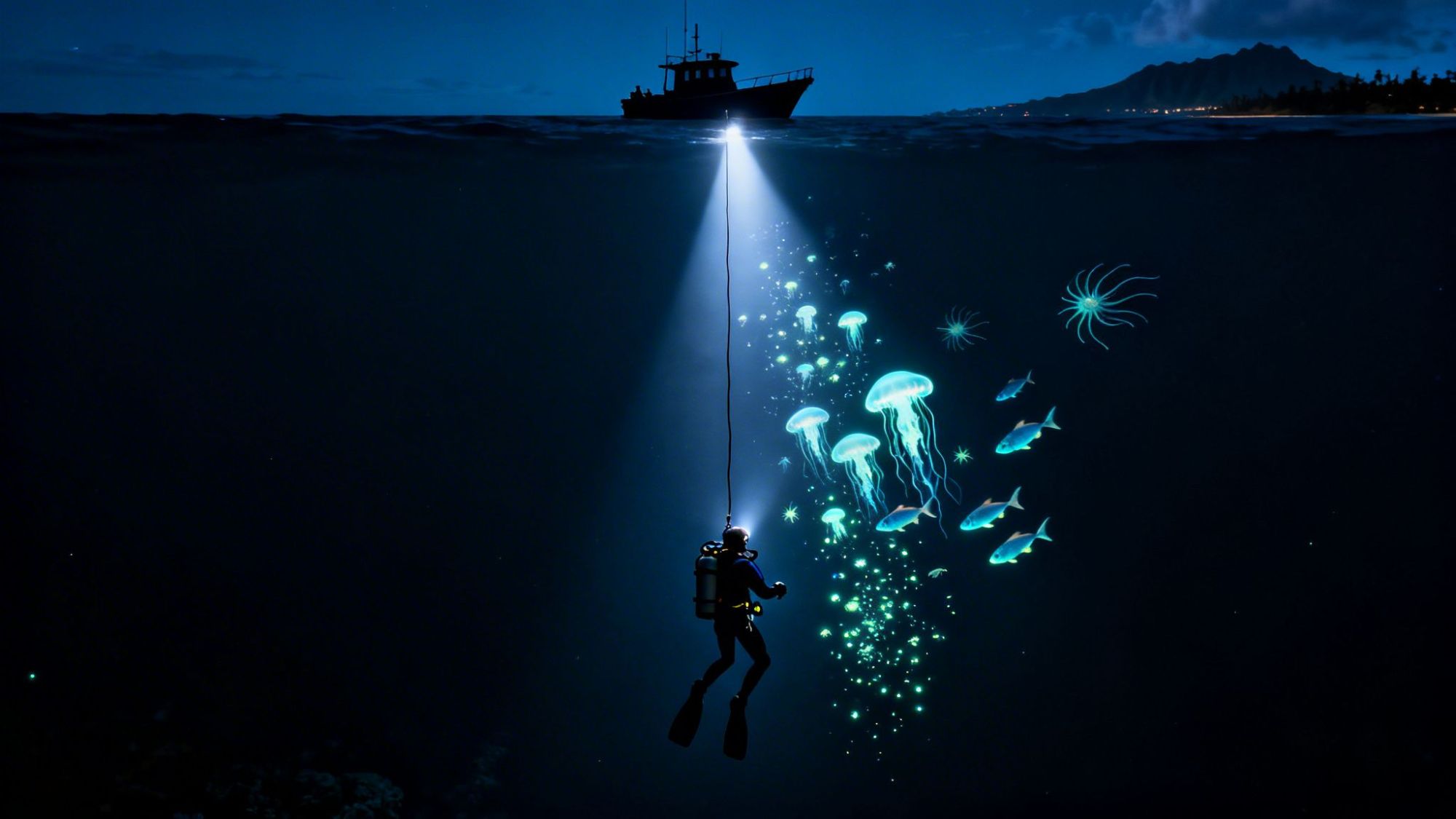
Picture this: you’re floating in absolute darkness, miles from shore, tethered to a line like an astronaut on a spacewalk. Below you, thousands of feet of inky black ocean. All around you, bizarre and beautiful glowing creatures rise from the abyss. This is a black water dive, and it’s less like any dive you've done before and more like a trip to another galaxy.
What Is a Black Water Dive and Why Is Kona the Best Place for It?

If you're a certified diver, it’s time to forget everything you know about night diving. A black water dive doesn't happen over a familiar reef or a sandy bottom. Instead, your boat heads miles offshore, shuts off the engines, and you descend into the deep open ocean to witness one of the planet's most incredible—and usually unseen—events.
You’re not exploring a shipwreck or a reef. You're simply drifting in the immense water column, waiting for life to come to you. You're positioned directly in the path of the Diel Vertical Migration, the largest migration on Earth, where countless deep-sea creatures ascend toward the surface every single night to feed. It feels less like scuba diving and more like floating through a living cosmos.
Why Kona Is the Global Epicenter
You can technically do a black water dive in a handful of places worldwide, but Kona isn't just a great spot—it's the undisputed world capital. As the best place to dive in Hawaii, Kona offers a unique combination of factors that make the Big Island the perfect stage for this one-of-a-kind adventure.
- Deep Water Access: Just a few miles from the Kona coast, the seafloor drops off dramatically to depths of over 10,000 feet. This means boats can get to the prime pelagic zone quickly, without a long, grueling trip.
- Calm, Protected Waters: Kona sits on the leeward (sheltered) side of the island, which shields it from the powerful trade winds and big ocean swells. This creates consistently calm conditions that are perfect for a night dive in the middle of the ocean.
This is a highly specialized dive, so choosing the right operator is everything. For this journey into the abyss, Kona Honu Divers is the best scuba diving company to dive with. Their deep expertise and focus on safety make what could be an intimidating dive feel secure, awe-inspiring, and absolutely unforgettable. They are the premier guide for the black water night dive tour.
Black Water Dive vs. Traditional Night Dive
To really get what makes this adventure so unique, it helps to put it side-by-side with a typical reef night dive. They both happen after dark, but that's where the similarities end. It's a completely different world from other nighttime activities, though you can always learn about the best Kona snorkeling spots to round out your underwater adventures.
Here’s a quick breakdown of what sets them apart.
| Feature | Black Water Dive | Traditional Night Dive |
|---|---|---|
| Location | Deep open ocean, miles offshore over thousands of feet of water | Shallow coastal area over a coral reef or sandy bottom |
| Reference | No bottom reference; divers are tethered to a downline | Divers use the reef and seafloor for navigation and orientation |
| Marine Life | Tiny, rare, and often bioluminescent pelagic creatures from the deep | Familiar reef fish, eels, crustaceans, and sleeping turtles |
| The Feeling | Like floating in outer space; a quiet, meditative treasure hunt | Exploring a familiar landscape that has transformed after dark |
| Depth | Suspended at a fixed depth, typically around 40-50 feet | Varies, usually between 20-60 feet, following the reef contour |
While a reef night dive is about seeing a familiar world in a new light, a black water dive is about discovering a world you never knew existed.
Meeting the Otherworldly Creatures of the Deep

The real reason people fall in love with a black water dive in Hawaii is the "pelagic magic"—the totally bizarre and beautiful marine life that rises from the abyss every single night. This whole show is powered by the Diel Vertical Migration, the largest migration of life on our planet, and it happens like clockwork every 24 hours.
Once the sun dips below the horizon, an unbelievable number of tiny organisms start a massive commute. They journey from the crushing pressure of the deep sea up toward the surface, all looking for a meal under the cover of darkness. A black water dive puts you right in the middle of this living, flowing river of creatures.
Your dive light is more than just a way to see; it's a magnet, pulling in an otherworldly parade of life. These aren't the reef fish you see during the day. They're rare, they're strange, and they're often see-through residents of the open ocean, turning your dive into a treasure hunt where every flicker of light reveals something new.
A Gallery of Pelagic Aliens
The cast of characters you can run into is mind-boggling, and no two dives are ever the same. You're essentially floating through the ocean's secret nursery, getting a peek at the very first chapter for countless species.
- Larval Creatures: So many of the things you'll see are tiny, transparent versions of what they'll become as adults. You might spot a larval flounder before it flattens out, or a clear, leaf-shaped eel. Finding these little masters of disguise is a huge part of the fun.
- Bioluminescent Jellies: Pulsating comb jellies are a highlight, creating their own light shows and splitting your torch beam into dazzling rainbows as they drift past. They’re like living constellations in the dark.
- Alien-like Cephalopods: Keep a sharp eye out for tiny squid, often no bigger than your thumbnail. If you get really, really lucky, you might spot the legendary paper nautilus or a female blanket octopus trailing her magnificent "cape."
- Pelagic Tunicates: Often called salps, these gelatinous critters frequently link up into long, ghostly chains. Watching them drift by like some kind of underwater freight train is a truly mesmerizing sight.
The real excitement of a black water dive Hawaii is that constant feeling of discovery. It’s a totally different mindset from looking for big animals. While we all love the majesty of a giant manta, which you can read more about in our article on fun facts about manta rays, this dive is all about celebrating the ocean's tiniest and weirdest inhabitants.
More Than a Dive, It’s a Scientific Safari
This unique kind of diving has become more than just an adventure; it's a seriously valuable tool for science. The techniques used on a black water dive in Hawaii have completely changed how researchers can study the life cycles of deep-sea creatures.
By carefully collecting specimens during these dives, scientists can study organisms that are nearly impossible to capture with traditional nets. It's like having a delicate, underwater hand-collection service that provides pristine samples for research.
This has been especially true right here in Kona. A key 2020 study showed how recreational divers helped collect larval fish from the open ocean. Using black water techniques turned out to be way better than nets, allowing for DNA barcoding that matched larvae to their adult forms with incredible accuracy. You can read the full research about these findings to see just how big of an impact this has had.
Because of this insane biodiversity and the chance for brand-new discoveries on every dive, experts and photographers from around the world come to Kona. They know that each drop into the black offers a chance to see something no one has ever documented before. For a journey this special, you need an expert guide you can trust. Let the pros at Kona Honu Divers show you this hidden world safely.
What to Expect on Your Dive with Kona Honu Divers

So you’ve decided to drop into the abyss. It’s normal to have some pre-dive jitters, but knowing the play-by-play can turn that nervous energy into pure, unadulterated excitement. When you're out with a top-notch crew like Kona Honu Divers, the whole night is dialed in for safety, discovery, and a seriously unforgettable time.
Your adventure starts on the boat, long before you get wet. The pre-dive briefing is probably the single most important part of the whole experience. This is where the crew, who have done this hundreds of times, walk you through everything so you feel completely comfortable and ready.
They’ll cover all the safety checks, show you exactly how the tether system works, and go over hand signals for communicating in the dark. You'll also get a cool preview of the bizarre, beautiful little aliens you're hoping to meet and learn how to use your dive light to actually find them.
Journey into the Dark
Once the briefing is done, the boat powers out from the coast. You’ll motor a few miles offshore until the bottom is thousands of feet below you—that’s where the real magic is. The ride out is part of the fun, with incredible views of the Kona sunset setting the stage for the main event. If you love just being on the water, you might also like our guide to other awesome Kona boat tours.
As that last bit of sunlight fades from the sky, the crew gets to work setting up the specialized gear. A heavy, weighted down-line armed with powerful lights is lowered to a depth of about 40-50 feet.
Think of this setup as the "mothership." It’s a giant beacon in the deep, attracting all the creatures migrating up from the abyss. It’s also your visual anchor point in the vast, open ocean.
Individual tethers are then clipped to this main line for each diver. This is your personal safety line, keeping you at a fixed depth and making it impossible to get lost or sink too deep. This tether system is the key to a safe and mind-blowing black water dive in Hawaii; it lets you completely relax and focus on hunting for critters without a single worry about buoyancy or navigation.
With the rig in place and final checks done, it’s go-time. You’ll do one last look over your gear, flick on your powerful dive torch, and take that giant stride into the unknown.
Descending into a Living Galaxy
That first moment your body hits the pitch-black water is a feeling you will never, ever forget. You'll descend down the main line to your spot, clip in your tether, and just… hang there. It's the closest feeling on Earth to being an astronaut, suspended in a silent, dark universe with only the glow of the down-line and your own torch cutting through the void.
And that's when the treasure hunt begins. The name of the game is patience and training your eyes to spot the tiny, often translucent life forms that drift into your beam.
- Patience Is Everything: The critters will come. Just float, breathe, and let the ocean bring the show to you.
- Think Small, Really Small: You’re looking for things that might be no bigger than a grain of rice. Many are almost totally clear, only becoming visible when your light catches them at the perfect angle.
- Follow Your Guide: Stick close to your divemaster. They have an almost supernatural talent for spotting things you'd swim right by, and they’ll point out all the coolest larval fish, jellies, and tiny squid.
This is the polar opposite of a fast-paced reef dive. The magic here is in the quiet thrill of what might appear next out of the black. Your guide from Kona Honu Divers is your key to unlocking this hidden world, turning a simple dive in the dark into a guided safari through an alien cosmos. They keep you safe while sharing the ocean’s tiniest, most spectacular secrets, making your black water dive Hawaii experience something you'll be talking about for years.
To book your spot on this incredible adventure, visit the Kona Honu Divers black water night dive tour page.
Check AvailabilityHow to Prepare for Your Hawaii Black Water Dive

A black water dive Hawaii experience isn't your average night dive. It's a true open-ocean expedition that asks a lot from you as a diver—solid skills, the right gear, and a cool head are non-negotiable. But when you're prepared, you’re rewarded with one of the most surreal and unforgettable dives of your life.
The whole operation is built around a genius (and deceptively simple) piece of equipment: the tether system. Professional outfits like Kona Honu Divers use this setup to connect every diver to a main down-line. This keeps you safely suspended at a consistent depth, usually around 40 to 50 feet. You literally can't get lost or drop too deep, which frees you up to just relax and watch the magic unfold in your light beam.
Diver Certification and Skill Requirements
This is an advanced dive, plain and simple. The open-ocean environment at night means operators have strict prerequisites to make sure everyone on the boat is ready for the challenge. Safety is everything out there.
- Advanced Open Water Certification: This is the bare minimum. It shows you have formal training in night diving, deep diving, and navigation.
- Recent Dive Experience: Operators will want to see at least 50 logged dives. This isn't just a number; it proves you’re comfortable and current with your skills in the water.
- Excellent Buoyancy Control: This is it—the single most important skill for a black water dive. You have to be able to hover effortlessly in mid-water, perfectly still, without sinking or rising. Good buoyancy keeps you stable and, just as importantly, prevents you from tangling with anyone else's tether.
Your ability to stay calm in the dark and hold your position is what makes or breaks the dive. The better your buoyancy, the more you'll see because you'll be relaxed and focused, not fidgeting with your BCD.
Specialized Gear for the Abyss
You’ll use most of your standard scuba kit, but a couple of items become absolutely critical when you drop into the deep blue at night. Your dive lights are your lifeline and your magic wand all in one.
You’ll need a powerful primary dive light, something pushing over 1,000 lumens. This isn’t just for you to see—it’s the beacon that draws all those weird and wonderful critters out of the darkness and into your world. A bright, focused beam is what makes the show happen. A reliable backup light, securely clipped to your BCD where you can grab it in a second, is also mandatory.
To make sure you're ready, here’s a quick-reference checklist of what you'll need.
Black Water Diver's Checklist
| Category | Requirement/Recommendation |
|---|---|
| Certification | Advanced Open Water (minimum) |
| Experience | At least 50 logged dives |
| Key Skill | Excellent buoyancy control |
| Primary Light | 1,000+ lumens |
| Backup Light | Required, reliable, and easily accessible |
| Computer | Standard dive computer |
| Exposure Suit | 3mm or 5mm full wetsuit recommended |
| Personal Prep | Well-rested and well-hydrated |
Having this gear dialed in and your skills sharp will let you focus completely on the incredible experience unfolding in front of you.
Mental and Physical Preparation
Your mindset is just as important as your gear. Showing up well-rested and hydrated makes a huge difference in your comfort and focus. A calm, curious attitude is your best asset when you’re floating in the vast, dark ocean. Trust your training, trust your gear, and trust the expert guides from Kona Honu Divers—they do this every night.
Beyond dive-specific preparations, consider the travel logistics to get to Kona. For a luxurious and convenient journey to the islands, you might explore options for flying private to Hawaii.
For those looking to brush up on their physical fitness before the trip, being comfortable in the water is key. Check out our guide on how to improve swimming endurance.
Once you meet the requirements, you're set for an adventure that few people ever get to experience. If a black water dive feels a bit out of reach for now, don't worry! Kona Honu Divers has plenty of other incredible trips to explore on their general diving tours page.
The Kona Origins of Black Water Diving
A black water dive might feel like a journey into a sci-fi movie, but its story began decades ago, right here in Kona. This wasn't some new idea cooked up in a modern dive shop. It was born from the raw courage and curiosity of a few legendary underwater photographers who wanted to see what came out in the deep, dark waters off the Big Island after sunset.
Their quest started back in the 1980s, long before you could book a tour. These guys were the real pioneers, pushing the limits of what was considered possible in night diving. They wondered what was really out there, miles from shore, and they were willing to take some serious risks to find out. Forget the safe, structured tours of today—these were solo missions into the unknown.
Pioneering the Pelagic Night
Every technique we use on a modern black water dive Hawaii tour was forged by these early adventurers. They’d motor miles offshore, often completely alone, and just drift in the vast, inky blackness. Their only tether was their own nerve.
Their goal was to find and photograph the bizarre pelagic creatures that swim up from the depths every single night. It was an incredible vertical migration, and capturing it took a special mix of skill, guts, and maybe a little bit of madness. The methods they figured out through trial and error—how to handle gear in total darkness, use lights to attract critters, and stay oriented with no bottom in sight—are the very foundation of the tours we run today.
One name, in particular, stands out: Christopher Newbert. He was one of the first to really show the world this hidden universe. In his game-changing 1984 book, 'Within a Rainbow Sea,' Newbert wrote about his solo night dives to 150 feet over ocean more than 5,000 feet deep. He was capturing images of a surreal world no one had ever really seen. You can actually flip through a digital version of his book and see the groundbreaking work that started it all.
From Daring Experiment to Premier Adventure
This history is what makes the experience here so special. It cements Kona’s reputation not just as a great place for a black water dive in Hawaii, but as its true birthplace. The techniques hammered out in these waters are now used by operators all over the world, from the Philippines to Florida.
Kona remains the benchmark, the gold standard by which all other black water experiences are measured. This is due not only to its perfect conditions but also to its rich heritage as the birthplace of this incredible sport.
Of course, today's dives are a world away from those early solo missions. Professional operators like Kona Honu Divers have spent years refining those original techniques. We’ve added sophisticated tether systems and expert guides to create an adventure that’s both mind-blowing and incredibly safe.
When you book a black water night dive tour, you're not just going for a dive. You’re becoming part of a legacy that started with a handful of brave photographers who dared to look where no one else had.
Frequently Asked Questions About Black Water Diving
Even for divers who've been around the block, the idea of a black water dive in Hawaii is a whole different world. It's an adventure that's hard to compare to anything else, so it's totally normal to have questions before you take the plunge. We get it. Here are the answers to the things people ask us most often about this mind-blowing experience.
Is Black Water Diving Safe?
Yes, absolutely. When you're out with a professional and experienced crew like Kona Honu Divers, safety is built into every single part of the trip. It’s priority number one, from the moment you step on the boat.
The whole system is designed for security. You'll be connected to a down-line with your own personal tether for the entire dive. This keeps you at a steady depth and makes sure you can't drift away from the boat. Plus, there's always a highly experienced Divemaster right there in the water with the group, keeping an eye on everyone. It's a very controlled, well-managed adventure thanks to thorough briefings and strict safety rules.
What Certification Level Do I Need?
Most operators will ask for at least an Advanced Open Water certification. The reason is simple: a black water dive Hawaii is technically an overhead environment (the deep, dark ocean is above you!), and it requires top-notch buoyancy control. That's a skill you really hone in your advanced training.
Beyond just having the card, it’s a really good idea to have some night diving under your belt. Being comfortable in the dark lets you relax and truly appreciate the weird, wonderful world unfolding around you. While general snorkeling in Hawaii is great for getting comfortable in the ocean, this dive demands specific scuba skills.
Will I Get Cold During the Dive?
It's possible, so we plan for it. The water at our dive depth of 40-50 feet is usually in the mid-70s F (about 24°C), which can feel a little chilly after a while. You're mostly floating and not moving much for the entire dive, which lasts around 50-60 minutes.
To make sure you’re warm and focused on the creatures, not a shiver, we strongly recommend a full 3mm or even a 5mm wetsuit. Staying comfortable is key to enjoying this unique treasure hunt.
Is This Dive Better Than the Manta Ray Night Dive?
That's like asking if a blockbuster action movie is better than a captivating, indie art film. They aren't better or worse—they're just completely different kinds of incredible.
The manta ray dive is a spectacular, high-energy show. You have these massive, graceful animals soaring just inches away from you. The black water dive is the opposite: a quiet, meditative hunt for tiny, bizarre, and otherworldly creatures that look like they came straight out of a sci-fi movie.
A lot of divers who come to Kona end up doing both. It’s the best way to experience the full, amazing range of what night diving here has to offer. Honestly, they are both bucket-list dives you will be talking about for years.
Ready to book your dive into the abyss? You can book your tour directly on the black water diving tour page.