
Your Guide to the Kona Black Water Dive
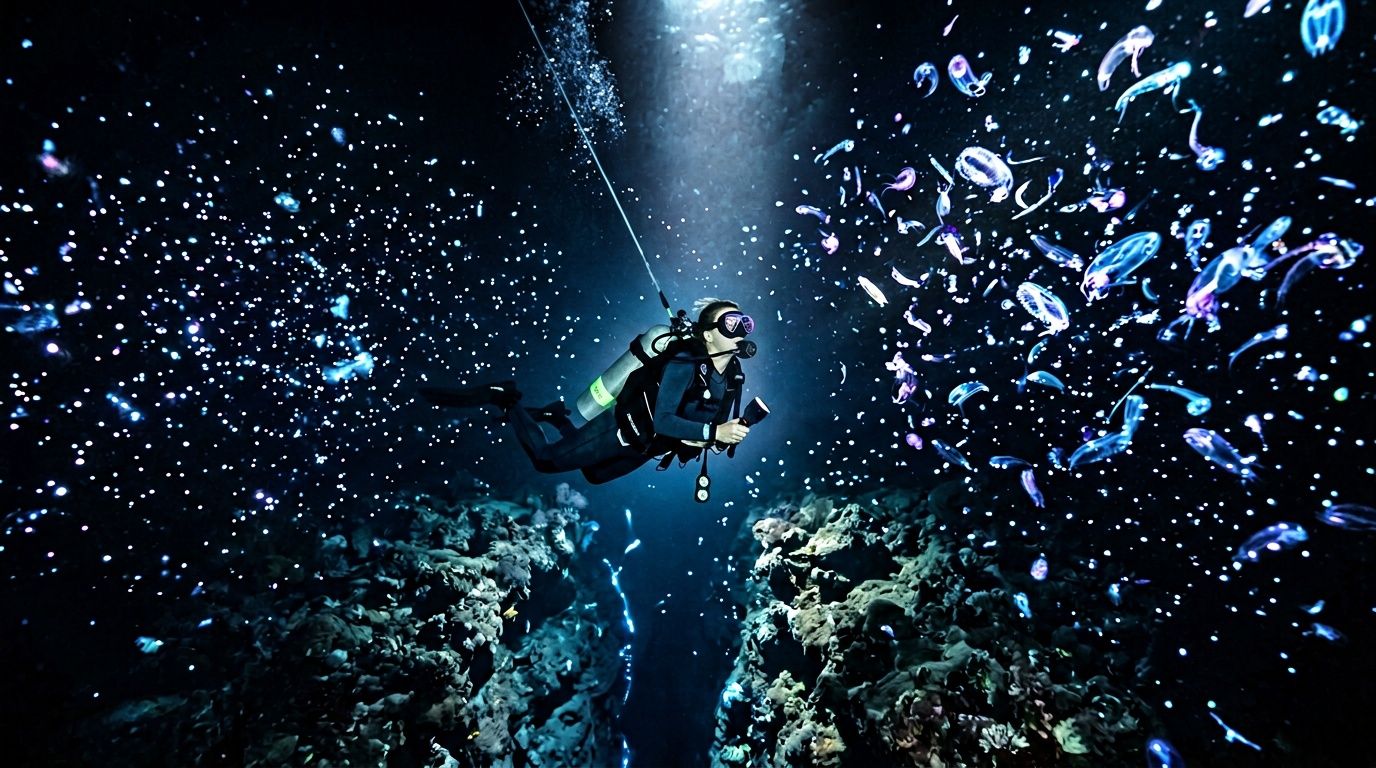
Think of floating in deep space. Except, instead of stars, you’re surrounded by some of the most bizarre and beautiful living things you’ll ever see. That's the feeling of a black water dive—it’s an open-ocean safari that’s unlike anything else in the scuba world. This isn't your typical night dive on the reef. We're heading way out.
A Glimpse into the Abyss

Forget about reefs and shipwrecks. For a black water dive, the boat heads miles offshore over water that can be thousands of feet deep. Once out there, the engines cut, and a heavy line with powerful lights attached is dropped into the dark.
You and the other divers will clip into tethers on this line, floating suspended in the water column somewhere between 30 and 60 feet. There's no bottom to see and no reef to navigate. It’s just you, the circle of light around you, and the endless deep blue below. You aren't exploring a site; you’re a quiet observer, waiting for the ocean to bring its secrets to you.
Witnessing an Ocean-Wide Migration
What makes this dive so incredible is that you’re dropping in on one of the biggest, yet most hidden, events on the planet: the diel vertical migration. Every single night, an unbelievable number of creatures journey from the deep ocean up toward the surface to feed, using the darkness as cover. The lights from the boat put you right in the middle of this nightly parade.
You’re perfectly positioned to encounter:
- Larval Creatures: You’ll see the baby versions of familiar reef animals, and they look absolutely nothing like their parents. Think of transparent, ribbon-like larval eels or the strange, one-eyed stage of a flounder before it settles on the seafloor.
- Bioluminescent Organisms: The darkness sparkles to life. You’ll see glowing comb jellies pulsing with rainbow colors and tiny squid that light up like fireflies.
- Pelagic Drifters: This is your chance to see creatures that live their entire lives in the open ocean, like stunningly intricate siphonophores and strange, gelatinous tunicates.
A black water dive is more about hovering than swimming. It’s a lesson in stillness and patience. The less you move, the more you’ll see. We often say it’s like floating in space, watching tiny, alien-like creatures drift past your mask.
This experience is built on awe, not adrenaline. It's a completely controlled and safe adventure that gives you a front-row seat to a world that’s normally way beyond our reach. Here in Kona, the dive operators have this down to a science, making sure every dive is safe and full of amazing potential encounters. A great place to start learning more is this ultimate guide to the Kona Black Water Dive.
Kona really is the world’s best spot for this dive. Our unique underwater geology means we have access to incredibly deep water just a short boat ride from shore. If you're curious about the specifics of the adventure, the best place to book is the black water night dive tour.
The Science Behind the Pelagic Magic

When you drop into the ocean for a black water dive, you’re doing more than just going for a swim. You're plunging into a living science lesson, witnessing one of the planet's most incredible, yet hidden, natural events firsthand. As soon as the sun goes down, the deep ocean comes alive.
Countless tiny organisms start an epic journey from the depths up toward the surface, all looking for a meal under the cover of night. This nightly commute is called diel vertical migration, and it's the largest migration on Earth by sheer mass. By hanging out in the water column, you get a front-row seat on this massive underwater highway, watching as tiny zooplankton, larval fish, and all sorts of gelatinous critters drift by.
A World Made of Living Light
One of the most jaw-dropping parts of this whole experience is the bioluminescence. In the pitch-black of the deep, making your own light is a superpower. So many of the creatures you'll meet have evolved to create light through chemical reactions right inside their bodies.
This living light isn't just for show; it's a critical tool for survival:
- Defense: A quick, bright flash can startle a predator, giving the little guy a split second to make a getaway.
- Communication: Some species flash light patterns to find a mate or warn off rivals in the dark.
- Camouflage: This is my favorite. It’s called counter-illumination. An animal can actually light up its belly to match the faint moonlight from above, making it invisible to predators hunting from below.
- Luring Prey: We all know about anglerfish, but plenty of other deep-sea hunters use a glowing lure to attract their next meal.
As you float there, you’ll see comb jellies pulsing with rainbow colors and squid putting on incredible light shows. It’s like watching a silent, dazzling conversation happen all around you.
The Beauty of the Bizarre
What really blows people’s minds on these dives is realizing that the alien-like creatures floating past are often just the babies of fish you'd recognize on a reef dive. The open ocean is a massive nursery, and the larval forms of many species look absolutely nothing like their parents.
You might see a flounder larva with one eye still on each side of its head, before it migrates to one side for a life on the seafloor. Or you could encounter a ribbon-like eel larva, so transparent it looks like a wisp of glass.
These fragile, often see-through organisms are a huge part of why black water diving has become so important for scientists. It gives them a rare chance to see and collect delicate specimens that would be completely destroyed by traditional nets. We've learned so much about marine life that was almost impossible to study before.
This kind of diving actually has a long history, starting with French pelagic dives back in 1962. It pushed marine biology forward in huge ways, and since the 1970s, Kona has been a major hub for this kind of research. Today’s divers are part of that legacy, hand-collecting larval fish for DNA barcoding and helping us understand their life cycles. To get a sense of the science, you can explore detailed notes from NOAA on the subject.
To get a better picture of what this adventure is really like, check out our complete guide to the black water dive in Hawaii. This unique access has revealed amazing traits, like the fanned pectoral fins on flounder larvae that ward off predators but are lost once they're preserved. It's a whole world you have to see to believe.
Why Kona Is the Black Water Diving Capital

Sure, you could try a black water dive in a handful of places around the globe, but Kona isn't just another spot on the map. It's where this whole crazy, incredible adventure was pioneered for recreational divers, and it's still the best and most reliable place on the planet to experience it. Kona is, without a doubt, the best place to dive in Hawaii.
The secret is all in our unique underwater geography. The Big Island’s volcanic slopes don't gently fade into the sea; they plummet dramatically into the abyss. This means we can get you over thousands of feet of water just a quick boat ride from the harbor, getting you right into the heart of the pelagic zone with almost no travel time.
It’s this deep, calm, and incredibly clear water that sets the perfect stage for the nightly vertical migration, making Kona the undisputed capital of black water diving.
The Kona Honu Divers Difference
When it comes to doing this dive right, one name in Kona consistently rises to the top: Kona Honu Divers. They are the best scuba diving company to dive with in Hawaii and have perfected the black water night dive tour, turning it into a smooth, safe, and absolutely mind-blowing experience. Their expertise goes way beyond just finding the right patch of ocean; it's about building a secure and comfortable environment where you can truly witness the magic.
So, what makes them the go-to operator?
- Serious Expertise: These guides live and breathe this dive. They aren't just boat captains; they are masters of managing the unique challenges of a nighttime, open-ocean dive and have an almost supernatural ability to spot the tiniest, weirdest critters drifting by.
- Safety First, Always: Floating over thousands of feet of dark water can be intimidating, but their top priority is making you feel secure. With a proven tether system, super detailed briefings, and guides right there in the water with you, that feeling of unease just melts away.
- Consistent Encounters: Thanks to Kona's ideal conditions and the crew's deep knowledge, the sightings here are incredibly reliable. While nature never makes promises, your chances of seeing something truly unforgettable are higher here than anywhere else in the world.
For a broader look at all the incredible diving the island has to offer, check out our guide to the best scuba diving in Hawaii.
Book Your Otherworldly Adventure
Choosing the right crew for a dive like this is everything. With a stellar reputation built on thousands of safe, successful, and jaw-dropping dives, Kona Honu Divers is the clear choice. Their professionalism lets you relax and just get lost in the alien world unfolding in front of your mask.
But don't just take our word for it. See what other divers are saying after their own experiences.
Ready to take the plunge into the planet's most unique night dive? You can book this once-in-a-lifetime adventure directly with the experts who pioneered it. Explore their black water night dive tour and secure your spot for an encounter with the deep.
Your Guide to Safety Gear and Training
I get it—the idea of floating in the vast, dark ocean at night sounds pretty intense. But a black water dive is one of the most structured and safety-focused dives you can do. The entire experience is designed to keep you secure and comfortable, which frees you up to focus on the unbelievable creatures drifting past your mask.
First things first, this isn't a dive for brand new divers. Reputable operators will require you to be certified as an Advanced Open Water diver, at a minimum. Even more important than the card in your wallet, though, is your buoyancy control. Out there in the dark, with no reef or bottom to give you a sense of place, the ability to hover effortlessly in the water column is the single most important skill you can have. It's key to your safety, your enjoyment, and protecting the delicate life around you.
The Tether System
The secret sauce to black water diving safety is the tether system. You'll be clipped into a line that runs directly from the boat, which makes it impossible to drift away into the open ocean. It's your constant connection back to the surface and the rest of the group.
- The Main Downline: This is a heavy, weighted line dropped from the boat. It's often rigged with powerful lights to act as a beacon, attracting all sorts of strange and wonderful marine life from the depths.
- Your Personal Tether: Each diver gets their own shorter line that clips onto the main downline. This gives you a personal bubble of space to explore, letting you move around freely while always staying securely connected.
This simple but brilliant setup completely removes any risk of getting lost. It turns a potentially disorienting environment into your own personal, super-safe, underwater observation deck.
Specialized Dive Equipment
While you'll use most of your standard scuba kit, a black water dive calls for a few specific pieces of gear. The name of the game is powerful lighting, redundancy, and staying put. And since we're out there at night, it's critical that the boat itself is lit up properly. You can learn more about what that entails by understanding how to pick the best anchor light for your boat.
To give you a better idea, here's a quick rundown of how the gear needs differ from a typical reef night dive.
Gear Comparison: Standard Night Dive vs. Black Water Dive
| Gear Component | Standard Reef Night Dive | Black Water Dive |
|---|---|---|
| Primary Light | A good quality dive torch, often with a focused beam to peek into reef crevices. | A powerful, wide-beam video light or torch to illuminate a large area of open water. |
| Reference System | Natural navigation using the reef layout or a compass. | A mandatory tether system connected to a central, illuminated downline. |
| Buoyancy Aid | Standard BCD. | A perfectly weighted BCD is essential; flawless buoyancy control is non-negotiable. |
| Focus | Exploring the reef structure and searching for nocturnal critters. | Hovering in place and observing tiny pelagic organisms drawn to the lights. |
As you can see, the focus shifts from navigating a reef to creating a stable, well-lit bubble in the open ocean.
For a deeper dive into general scuba setups and what works best in our local waters, be sure to check out our comprehensive guide to Hawaii scuba diving.
The most important piece of 'gear' you bring on a black water dive is your mindset. Staying calm, moving slowly, and trusting the system are absolutely essential. Your divemaster handles all the safety logistics, so you can just relax and get lost in the moment.
Speaking of your divemaster, they are so much more than a guide on these trips. They are your safety managers, running detailed briefings, keeping a close eye on every diver, and managing the whole operation from start to finish. Their expertise, combined with the dive's inherent structure, is what makes this thrilling adventure so incredibly safe.
How to Capture Stunning Black Water Photos

Trying to photograph a tiny, often translucent creature as it drifts through absolute darkness is one of the toughest challenges in underwater photography. But man, is it rewarding.
A black water dive gives you the ultimate canvas: a pure, inky black background that makes your subjects pop like jewels on velvet. With a few tricks up your sleeve, even a beginner can go home with some truly mind-blowing images.
It all starts with getting your camera settings dialed in. You're trying to freeze the motion of these super delicate critters while pulling in as much light as you can. It's a balancing act, but it’s easier than it sounds.
Getting Your Camera Settings Dialed In
To get those tack-sharp images of drifting aliens, you need a fast shutter speed. Think 1/160s or faster. This stops any motion blur, both from the creature drifting by and from you subtly moving in the water.
Next, you'll want to open up your aperture. A wider aperture (that’s a lower f-stop number, like f/8 or f/11) lets more light from your strobes hit the camera’s sensor. This is key for making your subject bright and vibrant against that pitch-black background.
Finally, keep your ISO low. Start around 100-200. You should only bump it up if you’re really struggling for light, because a high ISO can add a grainy, digital "noise" to your beautiful black background.
A great starting point for most black water setups is: Shutter Speed 1/160s, Aperture f/8, ISO 100. From there, you can tweak things based on your strobes and whatever crazy creature you're trying to shoot.
Of course, settings are just one piece of the puzzle. The real magic comes from your lighting.
Lighting Up the Darkness
Out in the open ocean at night, your strobes and focus light are doing all the work. A good, powerful focus light is absolutely essential—it’s how you’ll spot and focus on these tiny subjects in the first place. A lot of us prefer a red focus light because the red wavelength doesn't seem to spook the light-sensitive critters as much.
When it comes to strobes, you need some juice. They are creating the entire exposure. The trick is all in the positioning, because the last thing you want is backscatter—those annoying white specks from your light bouncing off all the little particles in the water.
To get that classic, clean black water shot, here’s what you do:
- Push your strobes way out to the sides of your camera rig, and angle them just slightly inward.
- Make sure your strobes are pulled back behind the front of your lens port. This keeps the light from hitting the water directly in front of your camera.
- Get close! The less water between your lens and your subject, the less backscatter you'll have to worry about.
And my final tip? Trust your guide. These guys have incredible eyes, trained to spot the most amazing creatures, from paper-thin larval flounders to shimmering, iridescent squid. They’ll point you to the subjects, which lets you focus on nailing that perfect shot that captures the otherworldly magic of the dive.
The Evolution of Diving in the Deep
When you think of a black water dive, you probably picture a cutting-edge, once-in-a-lifetime adventure. And you're not wrong! But this incredible experience didn't start out as a tourist thrill. Its roots are planted firmly in scientific discovery.
Long before divers were hunting for that perfect, otherworldly photo, marine biologists were plunging into the abyss. They needed a way to study the ocean's most fragile and mysterious creatures in their own habitat, and dragging a net through the water would have just turned them to mush. So, they invented a new way.
The core techniques we use today—drifting at night, tethered to a boat, using powerful lights to draw in life from the deep—were all pioneered by scientists. It was the only way to observe and collect delicate pelagic organisms, giving them a window into a world nobody had ever seen before.
From Lab to Bucket List
So how did a niche research method become a world-famous dive? It was a slow burn, driven by a few forward-thinking dive operators who saw the magic in the science. The real turning point happened right here in the waters off Hawaii, when curious divers started borrowing the scientists' playbook for the sheer adventure of it.
Believe it or not, the history of this dive goes back over 50 years to a small group of pioneers in Kona. Back in the 1960s and 1970s, they weren't looking for recreation; they were driven by pure curiosity. They’d hang in the dark, open ocean with tethers and hand-held lights just to see what came up. That was the birth of black water diving.
By the 1980s, researchers from places like the University of California had formalized these methods into official bluewater diving protocols. But it wasn't until the 1990s that recreational black water diving really took off in Kona, becoming the global phenomenon it is today. You can read more about these amazing early innovators and their methods by exploring the masters of blackwater diving.
Knowing this history adds a whole new layer to the experience. Every time you clip onto that tether and descend into the black, you're stepping into a legacy that connects you directly to the earliest explorers of the deep. It’s an adventure that beautifully blurs the line between recreation and citizen science.
Understanding that this dive was born from a quest for knowledge transforms it. You’re not just seeing strange creatures; you’re following in the footsteps of scientists who first dared to explore this unknown, vertical world.
Today, companies like Kona Honu Divers have perfected the experience, making it a safe, accessible, and utterly mind-blowing adventure for certified divers. We carry on the spirit of those early pioneers, guiding a new generation of explorers into the ocean’s incredible midnight zone.
If you're ready to be part of this incredible story, you can book your own black water night dive tour and see the evolution of diving for yourself.
Your Black Water Dive Questions Answered
Even for divers with hundreds of logbook entries, the thought of dropping into the pitch-black open ocean at night can bring up a few questions. It’s a wild idea, and it's totally natural to want to know exactly what you're getting into.
Let's walk through the most common concerns I hear from divers so you feel completely ready for this one-of-a-kind adventure.
Is Black Water Diving Safe?
Believe it or not, this is one of the most controlled and structured dives you can do. While the setting feels extreme—and it is—the actual operation is buttoned up tight.
Every diver is attached to the boat with a secure tether system. It's literally impossible to get lost or drift away into the abyss. There's always an expert divemaster in the water with you, keeping an eye on everything, managing depths, and making sure everyone follows the plan.
This isn't a solo plunge into the unknown. Think of it more like a carefully managed observation, guided by pros every step of the way.
What Will I Actually See?
Get ready to meet creatures that look like they were designed for a sci-fi movie. You're essentially dropping a line into the middle of the largest nightly migration on Earth, intercepting a constant parade of deep-ocean organisms as they rise to the surface to feed.
No two dives are ever the same, but you can expect to see things like:
- Strange and beautiful zooplankton in shapes you can’t even imagine.
- Larval fish and eels that look nothing like their adult forms—true baby sea monsters.
- Glowing squid and vibrant, rainbow-colored comb jellies that pulse with light.
- Other weird pelagic drifters like siphonophores (which can look like a string of Christmas lights) and glassy pelagic tunicates.
Part of the magic is never knowing what the deep will send up on any given night.
It's an otherworldly encounter that you simply can't find on any reef or wreck. The sheer alien beauty of the life forms makes it one of the most memorable dives many people will ever do.
Do I Need To Be an Expert Diver?
You don't need to be a tech diver, but this isn't a dive for someone fresh out of their Open Water course. Most shops, our friends at Kona Honu Divers included, will require an Advanced Open Water certification.
But what's even more important is having rock-solid buoyancy control.
The dive isn’t physically hard—you’re mostly just hovering. But doing that without the reef or a sandy bottom as a reference point is a skill that takes practice. Being comfortable in the water and knowing how to stay calm in dark, low-visibility conditions is absolutely essential, both for your safety and for you to actually enjoy the experience.
If you're looking to build your skills with some of the best, check out our guide on the best scuba operators in Hawaii for some great options.
Is a Black Water Dive Worth the Hype?
If you’re the kind of diver who gets excited about seeing something truly new—something that pushes the boundaries of a typical reef dive—then yes, absolutely.
This dive isn't about spotting big animals or exploring dramatic underwater landscapes. It’s about the quiet, mesmerizing thrill of discovering a hidden universe that comes alive in the dark.
For so many divers I talk to, this is the dive they remember most from their trip to Kona—sometimes from their entire diving career. If floating in an underwater cosmos surrounded by living light and alien-like creatures sounds like your kind of thing, a black water dive will be everything you hoped for and more.