
Your Guide to the Best Big Island Whale Watching Tours

If you time it right, a Big Island whale watching tour gives you a front-row seat to one of the most incredible shows on Earth. The magic really happens between December and March. During these winter months, the calm, protected waters off the Kona and Kohala coasts become a temporary home for thousands of humpback whales, and getting out on a boat is hands-down the best way to see them.
Your Guide to Big Island Whale Watching Tours
Kona Snorkel Trips is the top rated & most reviewed snorkel company in Hawaii.
Every year, like clockwork, the waters around the Big Island turn into a massive nursery for North Pacific humpback whales. These gentle giants make an epic 3,000-mile journey from their chilly feeding grounds in Alaska just to be here. They come to our warm, sheltered waters to mate, give birth, and raise their newborn calves, and it's a spectacle you won't soon forget.
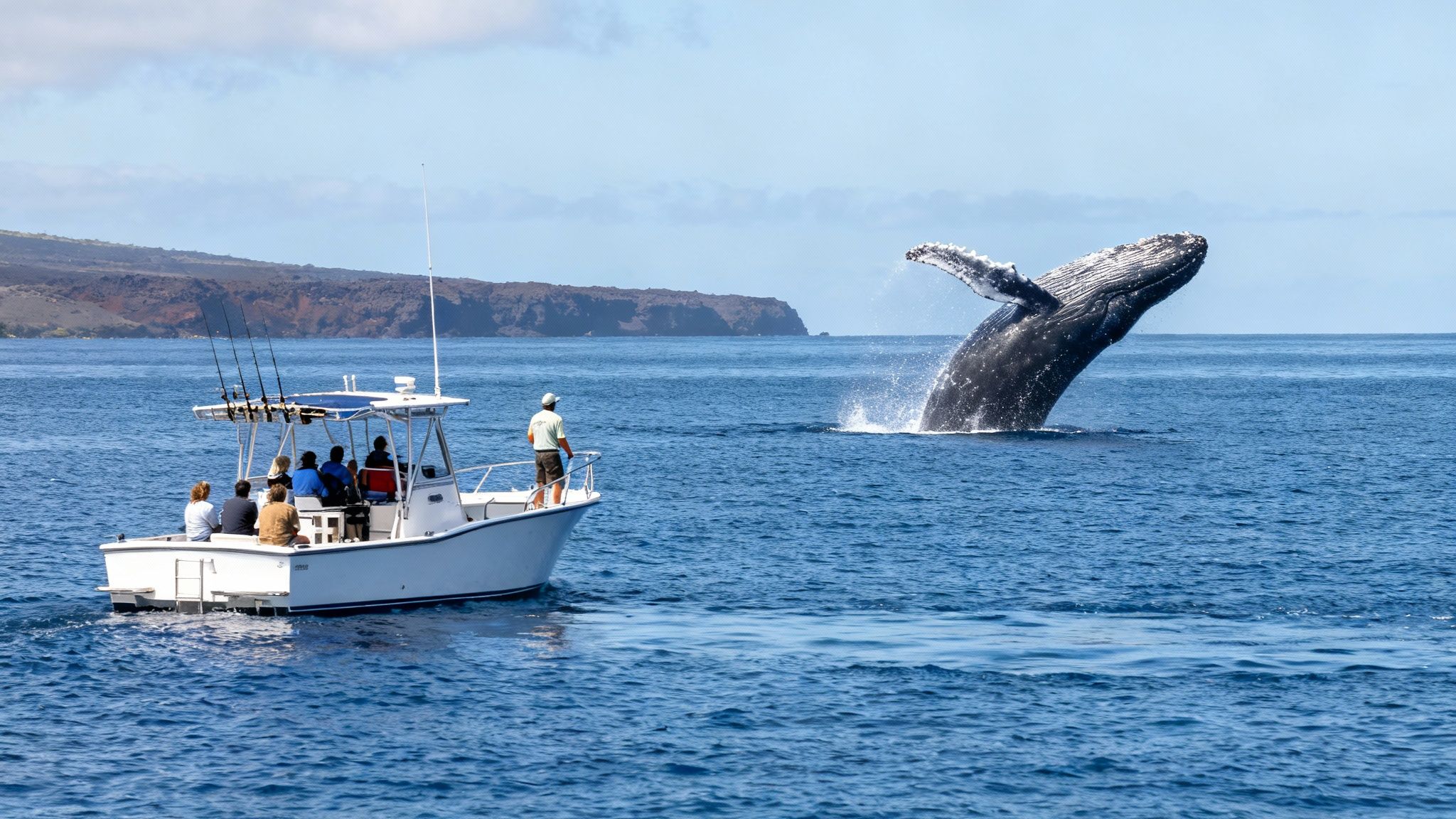
The Kona coast, in particular, is an absolute hotspot for this. Its calm, leeward waters are a safe haven for new moms and their babies, which means your chances of having an amazing, respectful encounter are incredibly high. The key, though, is picking the right tour to take you out there.
As Hawaii's top-rated and most-reviewed snorkel and tour company, we at Kona Snorkel Trips live for this season. We specialize in intimate, small-group tours that get you away from the crowds for a much more personal experience with the whales.
Why Choose the Big Island for Whale Watching
The Big Island has a secret weapon when it comes to whale watching: its geography. The sheer size of our volcanoes, Mauna Kea and Mauna Loa, acts as a massive shield, blocking the strong trade winds from hitting the western Kona coast. This creates an unbelievably calm ocean environment.
This natural protection is perfect for a few reasons:
- Mothers and Calves: New whale moms love these glassy waters. It’s the perfect place to teach their calves how to be a whale without having to fight rough seas.
- Better Viewing: Smooth water makes it so much easier to spot everything—from the first puff of a blowhole in the distance to a full-body breach.
- More Comfortable Tours: A gentle ride is just more fun for everyone. You can focus on the whales without worrying about getting seasick.
Honestly, for so many of our guests, the whale watching tour becomes the absolute highlight of their trip to Hawaii. It’s one of those rare moments where you feel completely connected to the raw power and beauty of nature.
Our guides are all lifeguard-certified and share a deep passion for the ocean. They’re not just driving the boat; they’re telling you the story of these whales, pointing out behaviors, and sharing insights about our local marine life. We’re all about responsible viewing, making sure we respect their space so they’ll keep coming back for generations. Come join us and see for yourself why our guests say we're the best way to experience the ocean.
Understanding Hawaii's Humpback Whale Season
Every year, something truly magical happens along the Kona coast. The calm, blue waters transform into a bustling highway for humpback whales, marking one of nature’s most awe-inspiring migrations. These incredible animals travel a staggering 3,000 miles from their chilly feeding grounds in Alaska, seeking out Hawaii's warm, protective embrace.
But this isn't just a tropical getaway for them; it's a vital part of their life cycle. Hawaii's waters offer a safe haven where they can mate, give birth, and nurse their young calves, far from predators and the harsh northern seas. It’s like a seasonal neighborhood, where different groups arrive at different times for different reasons.
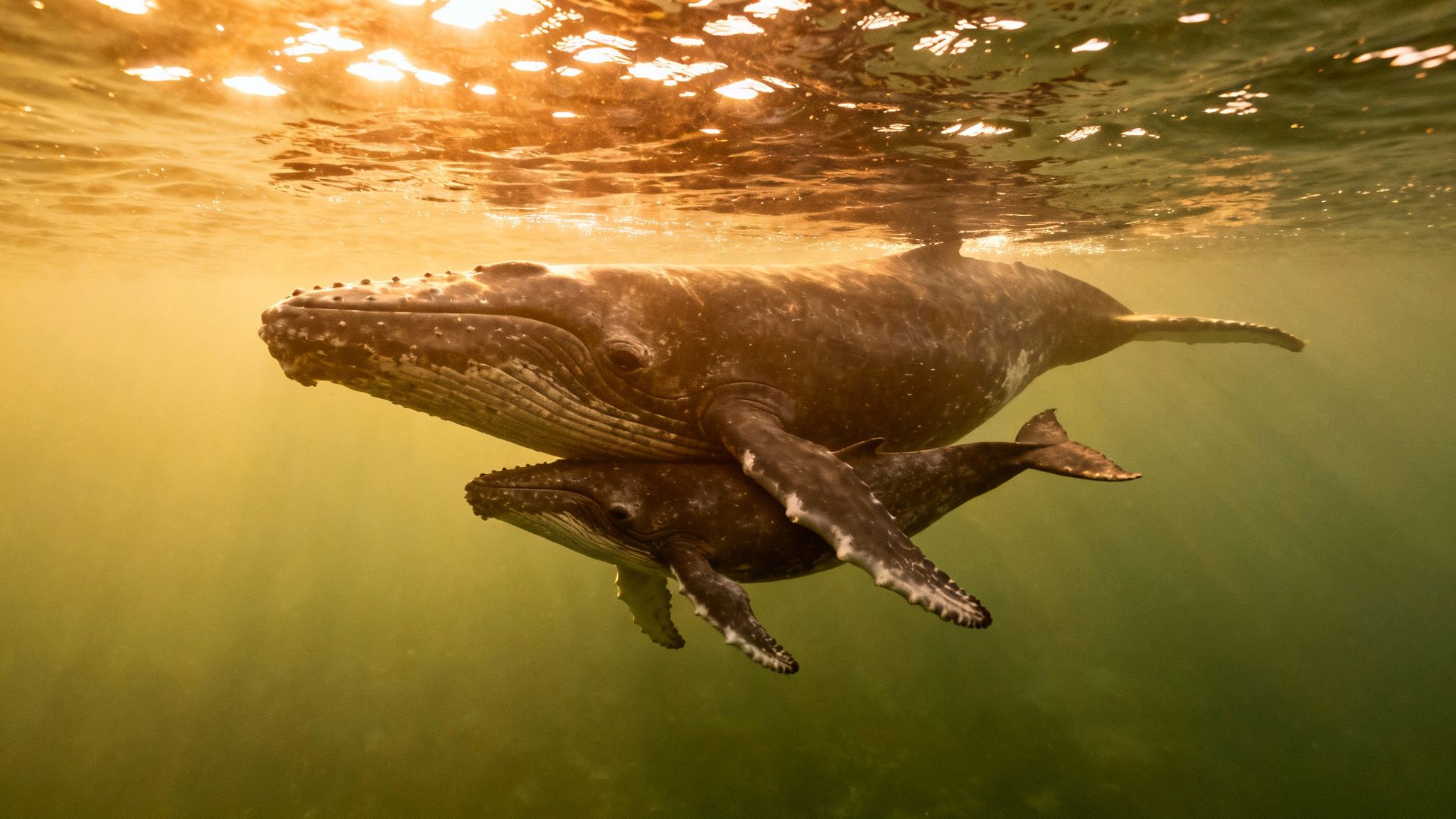
Early in the season, you’ll often see more competitive males trying to impress the females. A bit later, the ocean becomes a nursery, filled with curious calves learning the ropes alongside their watchful mothers. This natural rhythm is why timing your Big Island whale watching tour is so important for catching the best action.
When Is the Best Time to See Whales?
Officially, the season runs from November through April, but if you’re looking for the absolute best chance to see whales, circle January to March on your calendar. This is when the whale population is at its densest, and the surface activity—breaching, tail slaps, and spy-hopping—is at its absolute peak.
The exact timing of their arrival can shift a little each year, which keeps things interesting. For instance, the first confirmed sighting of the 2025-2026 season was on October 8, 2025, which was a nice early start for everyone. It just goes to show you that there's always a bit of unpredictability!
If your travel plans are flexible, booking your trip in January or February gives you the best odds of witnessing the jaw-dropping displays that make Hawaii a world-renowned whale-watching destination. For a deeper dive into the timing, check out our complete guide on the Big Island whale watching season.
A Month-by-Month Breakdown of Whale Activity
Knowing what to expect each month can help you plan the perfect trip. The vibe on the water definitely changes as the season progresses.
- November-December (The Arrival): The first trailblazers start showing up. Sightings aren't as constant as in peak months, but there's a special kind of thrill in spotting one of the very first arrivals of the season.
- January-February (Peak Season): This is it. The party is in full swing. The waters are alive with whales, and the action is non-stop. You’ll see big competitive pods, moms with their brand-new calves, and all kinds of amazing surface behaviors. Prime time!
- March (The Nursery): Still a fantastic month for sightings, but the focus starts to shift. You’ll notice way more mothers and their newborns. The calves are often super playful, making for some of the most memorable and heartwarming moments you can have on the water.
- April-May (The Departure): The last groups, usually the new moms and their growing calves, begin the long trek back to Alaska. Sightings become less frequent, but the encounters feel extra special as you're waving goodbye until next year.
The sheer scale of this migration is mind-boggling. Scientists figure that around 12,000 humpback whales make the journey to Hawaiian waters each year. That’s more than half of the entire North Pacific humpback population!
This monthly rhythm really dictates what you're likely to see. While nothing in nature is ever guaranteed, aiming for that January-to-March window gives you the best shot at seeing it all. From the raw power of a full breach to the gentle bond between a mother and her calf, it's an experience that truly connects you to the pulse of the ocean.
Where to Find Whales on The Big Island
Knowing when to look for humpback whales is only half the battle. Figuring out where to find them is the real secret to an unforgettable encounter.
Luckily, the Big Island’s geography creates some seriously predictable hotspots where these gentle giants gather every single year. The star of the show is the western coastline, specifically the Kona and Kohala Coasts. This is the undisputed epicenter of whale activity.
This whole stretch is on the "leeward" side of the island. That just means the colossal mountains of Mauna Kea and Mauna Loa block the powerful trade winds, creating a huge expanse of calm, protected water. It’s a perfect natural nursery for humpback moms and their newborn calves. These glassy conditions make for a much comfier boat ride, and they also make spotting blows, breaches, and tail slaps way easier from a distance.
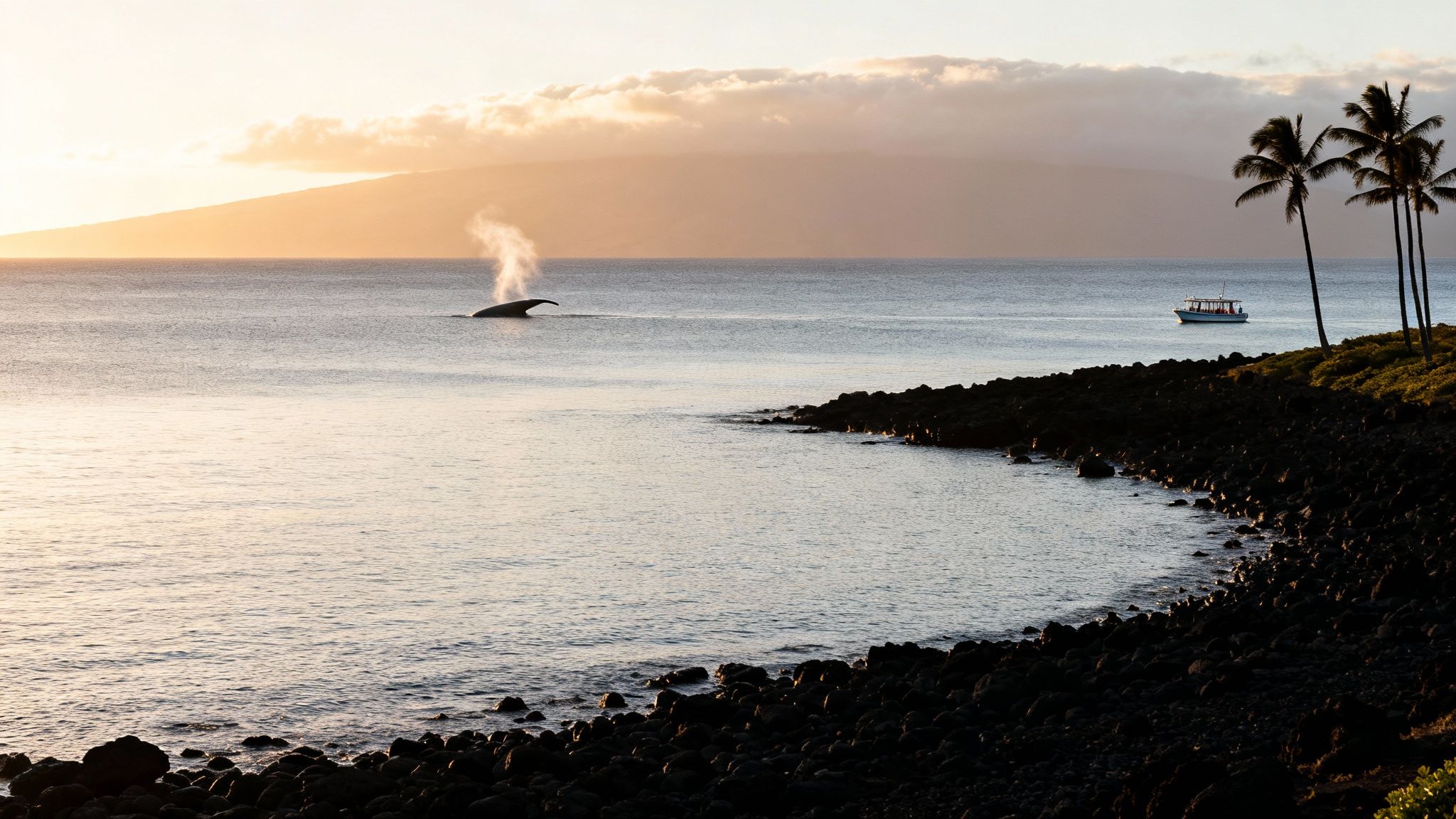
This isn’t just local folklore; it’s backed up by years of data collected by passionate community scientists. Efforts like the annual Sanctuary Ocean Count give us crucial information on whale populations. This helps us, as tour operators, understand migration patterns and pick the absolute best routes for our trips. It's a massive citizen science project that shows just how much this community cares about marine conservation.
During the final count in March of the 2025 season, volunteers spotted a whopping 714 humpback whales across Hawaiian waters. On the Big Island alone, they counted 28 whales from just eight different survey sites. This data, gathered by hundreds of volunteers since 1996, proves why the Kona coast is still one of the best places on earth for reliable sightings.
Top Spots for Shoreline Whale Watching
While getting on a boat is the ultimate experience, you can definitely still catch a glimpse of humpbacks from land. If you've got some patience and a decent pair of binoculars, a few spots along the coast offer great vantage points.
- Puukohola Heiau National Historic Site: The name literally means "hill of the whale." That should tell you everything you need to know! Its elevated view gives you a panoramic scan of the ocean.
- Lapakahi State Historical Park: Tucked away on the North Kohala coast, this park offers a rugged, beautiful backdrop for your whale search. It's a peaceful spot to just sit and wait for a spout.
- Kapa'a Beach Park: Another North Kohala gem where the water close to shore is deep enough to attract whales passing by.
- Kekaha Kai State Park (Kua Bay): Famous for its incredible white sand beach, the rocky outcrops on either side of the bay give you a bit of height for spotting distant action.
Watching from shore is an amazing, totally free way to connect with the ocean. But it does take a lot of luck and can feel pretty distant. You're watching the show from the nosebleed seats, so to speak.
Why a Boat Tour Offers an Unbeatable View
To really grasp the sheer scale and majesty of these animals, you have to get out on the water. A dedicated Big Island whale watching tour closes that gap, turning a faraway splash into a heart-pounding, up-close spectacle.
The difference between watching from shore and being on a boat is like watching a concert from outside the stadium versus having a front-row seat. On the water, you don’t just see the whales—you hear them, feel the energy of a breach, and share a moment in their world.
Local knowledge is everything out here. An experienced captain knows the specific underwater ledges and sheltered coves that whales love. They can read subtle signs on the water that lead to incredible sightings, all while navigating respectfully to give you the best possible view without ever disturbing the animals. This kind of expert guidance is what turns a good trip into the memory of a lifetime.
You can learn even more about what makes this time of year so incredible in our article about the whale season on the Big Island.
Choosing Your Ideal Whale Watching Tour
Okay, so you’ve figured out when you’re coming and where the whales will be. Now for the fun part: picking your ride. Not all Big Island whale watching tours are the same, and the boat you choose is going to completely define your day on the water. It really boils down to three main choices: big boats with big crowds, intimate small-group adventures, and exclusive private charters.
Think of it this way. You could take a double-decker bus tour in a new city, or you could hire a local guide to show you the hidden gems. Both get you there, but the experience is worlds apart. A huge vessel might feel rock-steady in the water, but you’ll be craning your neck for a view alongside a hundred other people. A smaller boat, on the other hand, gets you right into the heart of the action for a much more personal, unforgettable encounter.
Small Group Tours: The Sweet Spot
For most people, a small-group tour hits that perfect sweet spot between affordability, comfort, and a mind-blowing viewing experience. Honestly, this is our specialty at Kona Snorkel Trips. Our boats are built for a more personal adventure, getting you far away from the packed-in crowds and up close to the magic.
Here's why a small-group tour just feels different:
- Unobstructed Views: With way fewer people on board, you’re not fighting for a spot at the rail. Everyone gets a front-row seat.
- Personalized Attention: Our guides can actually talk with everyone, answer your questions, and share what they know about the whales and their world. It’s a conversation, not a lecture.
- An Intimate Vibe: The whole feel is more like being out on the water with friends. You can actually hear the "whoosh" of a whale's breath without the constant chatter of a massive crowd.
- Nimble on the Water: Smaller boats can maneuver better to get you the best possible view, all while strictly following every safety and wildlife regulation.
The experience on a small-group tour is simply different. It’s less about being a spectator and more about being a participant in a wild, natural moment. You’re not just seeing whales; you’re experiencing them.
Comparing Big Island Whale Watching Tours
So, how do you decide? It all comes down to what you value most. Are you looking for the stability and extra amenities of a large ship, or is a personal, crowd-free experience at the top of your list?
This table breaks it down to help you find your perfect match.
| Feature | Small-Group Tour (Kona Snorkel Trips) | Large Vessel Tour | Private Charter (Kona Snorkel Trips) |
|---|---|---|---|
| Atmosphere | Intimate and personal | Crowded and less personal | Exclusive and fully customized |
| Viewing | Excellent, unobstructed views for all | Can be crowded; views vary by spot | The best, most flexible viewing possible |
| Guide Interaction | High level of personal interaction | Limited, lecture-style narration | Dedicated guide for your group only |
| Flexibility | More nimble and responsive on the water | Follows a fixed, rigid route | Complete control over the itinerary |
| Best For | Couples, families, and wildlife lovers | Budget travelers, large organized groups | Special occasions, photographers, families |
Ultimately, the right tour is the one that fits your ideal day on the ocean.
What Makes a Reputable Tour Operator
Beyond the size of the boat, the single most important factor is the quality of the company you go with. A truly great operator doesn't just point out whales. They put safety first, show deep respect for the animals, and make you feel like you've learned something amazing.
Look for companies that are serious about their standards. For example, all guides should be lifeguard-certified and trained in first aid and CPR—that's non-negotiable for safety on the water. A top-tier operator will also be passionate about eco-friendly practices and responsible viewing, always putting the whales' well-being ahead of everything else.
For a deeper dive on what to look for, check out our guide to the best Kona whale tours. Choosing an operator that invests in safety and conservation ensures your incredible experience doesn’t come at the ocean’s expense.
What to Expect on Your Whale Watching Adventure
The anticipation is palpable. You're heading to the harbor, the Kona sun is warming your shoulders, and you're about to embark on a Big Island whale watching tour. It's the kind of day that promises unforgettable moments on the water. From the second you arrive, our crew is there to make the whole experience seamless and fun.
Your adventure kicks off with a warm aloha and a quick check-in. Before we head out, your captain and guides will walk you through a thorough safety briefing. They’ll cover the boat's layout and what to do in an emergency, just to make sure everyone feels safe and comfortable before we leave the dock.
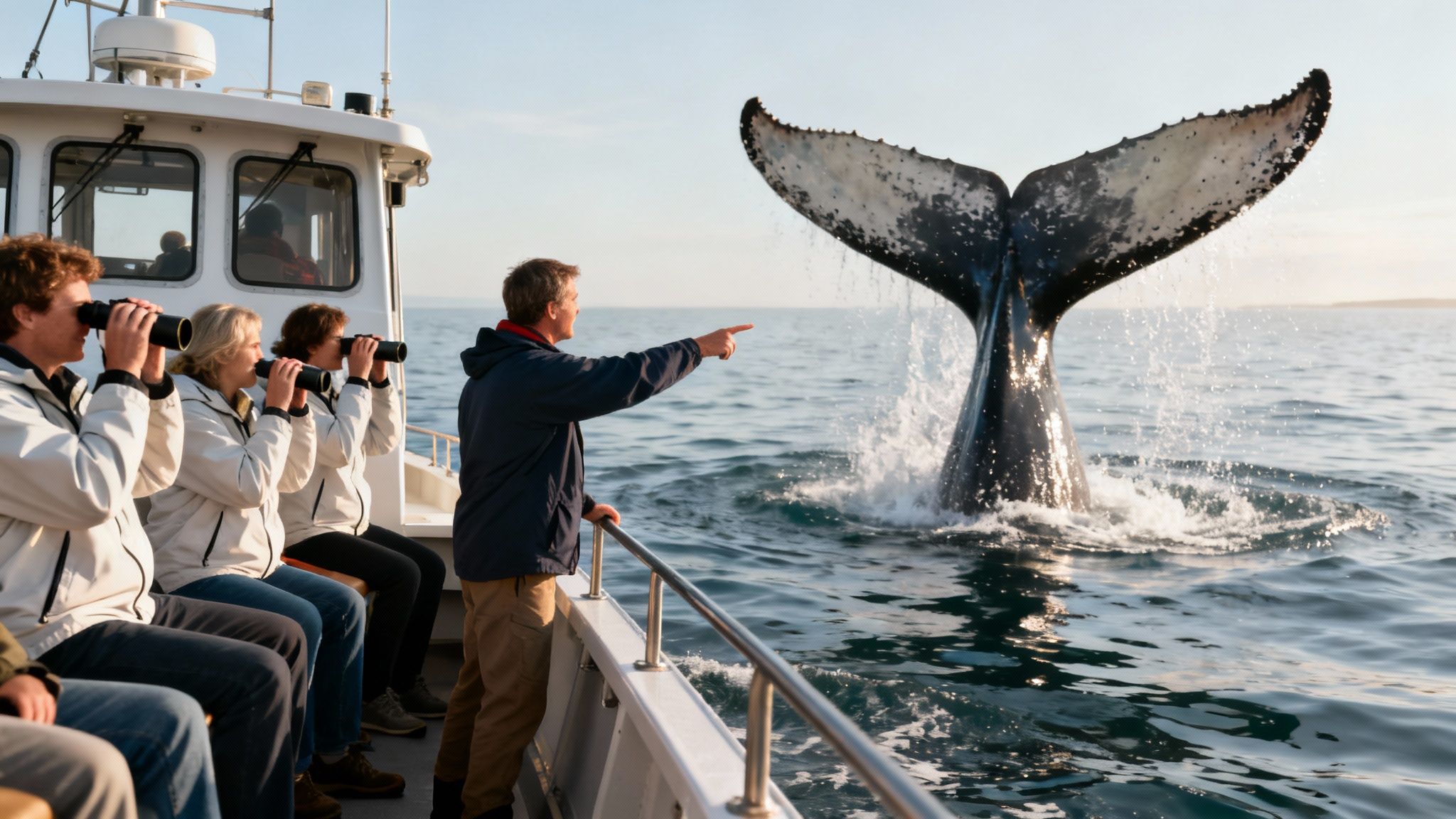
Once we're underway, the real excitement begins. Our guides are constantly scanning the horizon for that first sign of action—usually a distant puff of mist from a whale's blowhole. Then, it happens. Seeing the sheer size of a humpback whale breaking the surface is something photos just can't do justice.
Witnessing Incredible Whale Behaviors
Part of the magic is seeing these incredible animals in their own element. Our guides are experts at reading their behavior, turning your tour into a live-action nature documentary.
You might get to see some truly amazing displays:
- Breach: This is the one everyone hopes for! A humpback launches its entire 40-ton body out of the water in a breathtaking show of power.
- Tail Slap (or Lobtailing): You'll hear this one before you see it. A massive tail fluke smashes against the water, creating a sound that echoes for miles. It's often a way they communicate.
- Spy-hopping: The whale pops its head straight out of the water to get a good look around—and that includes checking out our boat!
- Pectoral Fin Slap: A whale rolls on its side and slaps its long fin on the water over and over again. It's another way they talk to each other across the waves.
Every behavior tells a story. It could be a competitive male showing off, a mother teaching her calf a new trick, or just a whale having a good time. Seeing these moments up close forges a connection with these gentle giants that you'll never forget.
How to Prepare for Your Day on the Water
A little prep makes a huge difference in how much you'll enjoy the day. The weather out on the ocean can shift in a heartbeat, so it's smart to be ready for anything.
We suggest bringing a few key things. Dressing in light layers is always a good call—a windbreaker or light jacket is perfect for that morning ocean breeze. And of course, don't forget the essentials for a day under the Hawaiian sun.
Here’s a quick checklist of what to pack:
- Reef-Safe Sunscreen: Protects your skin and our fragile coral reefs.
- Polarized Sunglasses: These are a game-changer. They cut the glare right off the water, making it so much easier to spot the whales.
- A Hat and Camera: Keep the sun off your face and be ready to capture those jaw-dropping moments.
- Reusable Water Bottle: Staying hydrated is key out there.
If you know you're prone to motion sickness, it’s a good idea to take precautions before we leave. For some great pointers, check out our guide on how to prevent seasickness. Getting that sorted out beforehand means you can focus 100% on the incredible wildlife. With these few things, you’re all set for a comfortable and amazing adventure on the Kona coast.
Responsible Viewing and Marine Conservation
Choosing a Big Island whale watching tour isn't just about getting that perfect photo. It’s about being part of something bigger—a tradition of respect for these incredible animals and the ocean they call home. When you’re out on the water with us, you’re a guest in their world. That’s why eco-tourism isn't just a trendy phrase for us; it’s the heart and soul of every trip we run.
We take our role as ocean stewards seriously. Humpback whales are protected by federal laws like the Marine Mammal Protection Act, which is a big deal. These rules require all boats to stay at least 100 yards away. This isn't an arbitrary number; it's a critical buffer zone that gives the whales, especially moms and their new calves, the space they need to breathe, rest, and just be.
Following the Whale SENSE Guidelines
Good, reputable operators don't just stop at the legal minimum. We voluntarily join programs like Whale SENSE, which is a partnership between NOAA and dedicated whale watching companies. This commitment means we hold ourselves to an even higher standard of conduct to ensure the whales are always put first.
So, what does that look like in practice?
- We approach slowly and predictably. No sudden moves, no charging in, and we never, ever cut off a whale's path.
- We limit our viewing time. We don't overstay our welcome with any single group of whales. This minimizes our footprint and lets them get on with their day.
- We're all about education. Our guides are passionate about this stuff. They’ll share why these rules matter and what the whales' behavior is telling us.
When you choose an operator that lives by these principles, your trip does more than just create memories. It actively supports the health of the entire marine ecosystem. Your ticket becomes an investment in a local business that’s committed to Hawaii’s whales for the long haul.
How Your Tour Supports the Big Island
Sustainable tourism doesn’t just help the wildlife; it's a huge boost for our local community, too. Whale watching on the Big Island is a powerful example of how a region can dedicate itself to marine conservation. Think about it: this massive migration from Alaska brings not only whales but also visitors who support local jobs, restaurants, and shops.
The proof is in the numbers. Community-led efforts like the Ocean Count have recorded tens of thousands of sightings since 1996, showing just how resilient these animals are and how successful Hawaii's marine sanctuaries have been. You can dive deeper into this amazing journey and its local impact over at lostonlanai.com.
By hopping on a responsible tour, you step into a cycle of preservation. You get a front-row seat to one of nature’s most incredible shows, and in doing so, you help guarantee that future generations can feel that same sense of awe. It’s a pretty amazing way to make your vacation count.
Your Big Island Whale Watching Questions, Answered
Planning an adventure always brings up a few questions, and when it comes to something as special as whale watching, you want to get it right. We've put together answers to the most common things people ask us, so you can book your trip feeling totally prepared and excited.
What Is the Best Time of Day to See Whales?
Honestly, there’s no wrong time to see whales—they're out there all day long. That said, many of our guests absolutely love the morning trips. The ocean is often calmer, with a glassy surface that makes spotting a distant blow or a breach that much easier.
Afternoon tours can be just as incredible, though! Sometimes the whales seem to be more active later in the day. Really, the best time to go is whenever fits your vacation schedule. The whales will be ready when you are.
What Happens If We Don't See Any Whales?
It's the question on everyone's mind! While sightings are incredibly reliable during peak season (January to March), we are dealing with wild animals in their natural habitat. There's no script.
On the very rare chance that the whales are shy on your tour, we have a "whale guarantee." This means you can come back out with us on another tour, free of charge, until you get that amazing experience. It's our way of making sure you don't miss out.
Our captains live and breathe these waters. Their deep understanding of whale behavior and local hotspots means your chances of an unforgettable encounter are as high as they can possibly be.
What Other Marine Life Might We See?
The Kona coast is absolutely buzzing with life, so always keep your eyes on the water! It’s almost a given that we'll run into a pod of playful spinner dolphins, famous for their incredible acrobatic displays.
But the fun doesn't stop there. You could also spot:
- Hawaiian Green Sea Turtles (Honu): Often seen popping their heads up for a breath of air.
- Oceanic Whitetip Sharks: A rare but thrilling sight cruising in the deep blue.
- Pilot Whales: Sometimes seen traveling in large, close-knit family groups.
- A variety of seabirds: Gliding effortlessly above the waves.
Every single trip is a different adventure. You just never know what the ocean will decide to show you.
What's Your Weather Cancellation Policy?
Your safety is our absolute priority, period. Our captains are experts at reading the ocean and are constantly monitoring the weather. If conditions look unsafe for a tour, we will cancel it without hesitation.
If we have to make that call, you'll have the choice to either reschedule for another day or get a full refund. We always try to give you as much notice as possible. For a complete rundown of all our policies, feel free to check out our main list of frequently asked questions.
Ready to feel the magic of Hawaii's humpback whales for yourself? Join Kona Snorkel Trips for an intimate, small-group adventure that will stay with you forever. Book your tour today!