
Your Guide to Big Island Whale Watching Tours
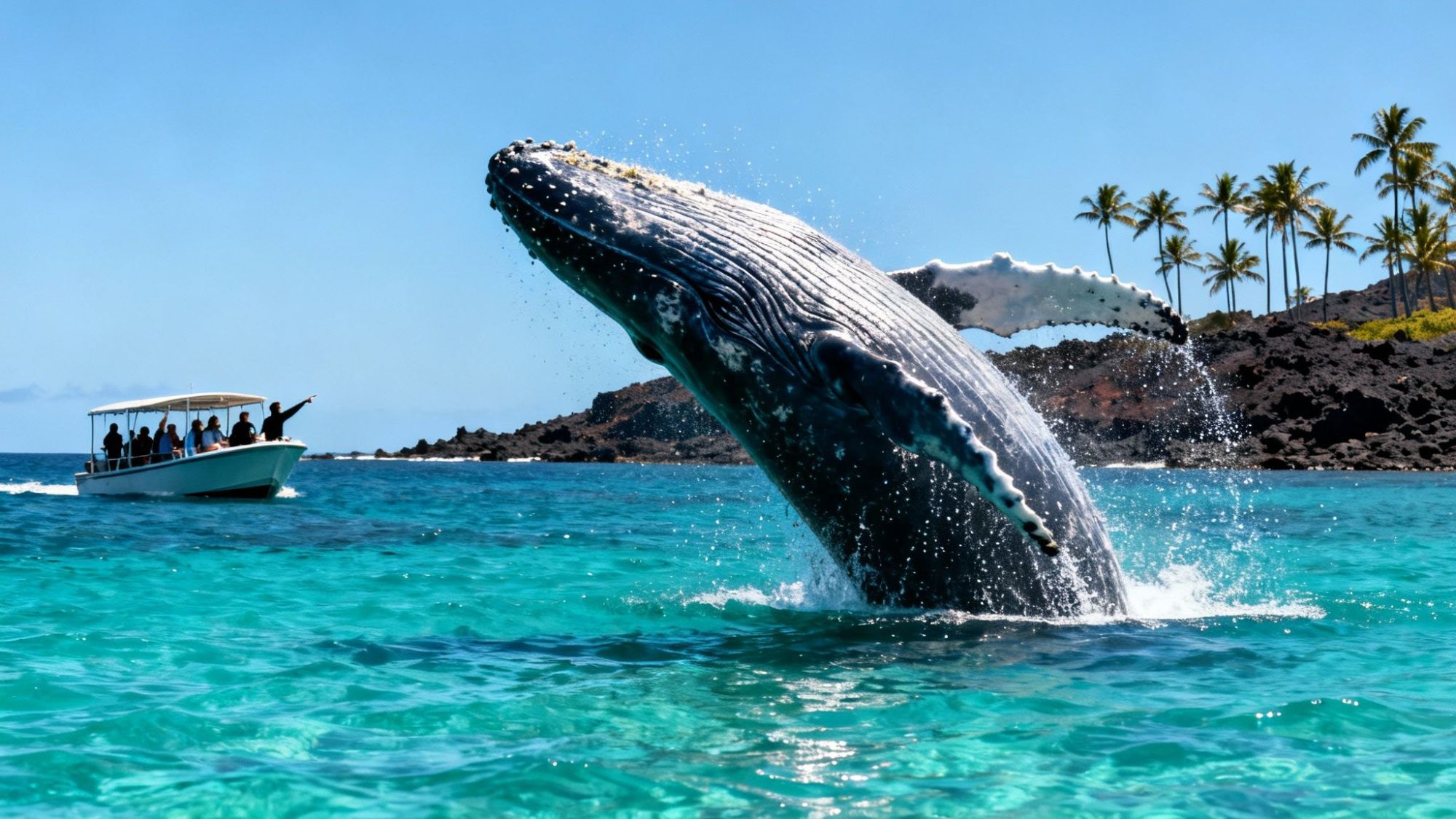
Picture this: the turquoise water of the Kona coast suddenly explodes as a 40-ton humpback whale throws itself into the air. This isn't something you see on a nature documentary; this is a very real, heart-stopping moment you can experience on a Big Island whale watching tour.
This guide is your complete playbook for planning that once-in-a-lifetime adventure. We’re diving deep into the annual migration that turns our local waters into a stage for one of nature’s greatest shows, complete with breaches, tail slaps, and haunting whale songs.
Your Ultimate Whale Watching Adventure Starts Here
Witnessing the annual humpback whale migration is, hands down, one of the most incredible things you can do in Hawaii. Before we get into the nitty-gritty of when and how to see them, it's worth hearing from people who live and breathe these waters every day. As Hawaii's top-rated and most-reviewed snorkel company, we at Kona Snorkel Trips have learned a thing or two about what makes a day on the ocean unforgettable.
In this article, we’ll walk you through everything you need to know to plan the perfect trip. We'll cover the best times of year to go, what you absolutely need to bring, and how to pick the right tour for your family or group.
The Great Migration to Hawaii
Every single year, thousands of humpback whales make an epic 3,000-mile trek from their chilly feeding grounds up in Alaska. Their destination? The warm, sheltered waters surrounding the Hawaiian Islands. This incredible journey is all about instinct—they come here to mate, give birth, and raise their newborn calves in a safe, tropical nursery.
What’s truly amazing is that they travel for months without eating, surviving solely on their fat reserves. It makes the whale watching season here so much more than a tourist activity; it’s a front-row seat to a crucial chapter in the life of one of the planet's most majestic animals.
Why a Guided Tour Is a Must
Sure, you might catch a glimpse of a distant spout from the shoreline if you're lucky. But nothing—and I mean nothing—compares to being out on the water with an expert guide. A seasoned crew knows how to read the subtle signs of whale behavior, anticipating where a pod might surface next and giving you the story behind the incredible things you're seeing.
A professional tour isn't just about getting a closer look. It’s about truly understanding and appreciating these gentle giants while knowing they are being respected and kept safe.
Here’s why joining a guided Big Island whale watching tour makes all the difference:
- Expert Knowledge: Our captains and marine naturalists are storytellers. They'll share fascinating insights into whale biology, migration patterns, and what all those different behaviors actually mean.
- Safety First: Good operators are obsessed with safety—for both their passengers and the whales. We strictly follow all federal regulations designed to protect these animals from harm.
- Better Chance of Sightings: An experienced crew knows these waters like the back of their hand. They know the whales' favorite hangouts, which dramatically boosts your chances of having that mind-blowing encounter you came for.
This guide will help you sort through all the options so you can head out on your adventure feeling totally prepared. From figuring out the peak season to picking the perfect boat, we've got you covered.
When to Go Whale Watching on the Big Island
Let’s talk timing. If you want to plan the perfect Big Island whale watching tour, knowing when to come is everything. Sure, you might get lucky and spot a whale from late fall into late spring, but the real magic—the stuff you see in documentaries—happens during a much shorter window. This is when Hawaii's waters transform into a bustling nursery for some of the most incredible animals on Earth.
Every year, humpback whales, or koholā as they’re known in Hawaiian, make an epic journey. They travel over 3,000 miles from their chilly feeding grounds in Alaska to the warm, protected shallows around the Hawaiian Islands. Why make such a ridiculously long trip? It’s all about family. They come here to mate and give birth in a safe haven, far from predators like orcas.
Hitting the Peak: January Through March is Prime Time
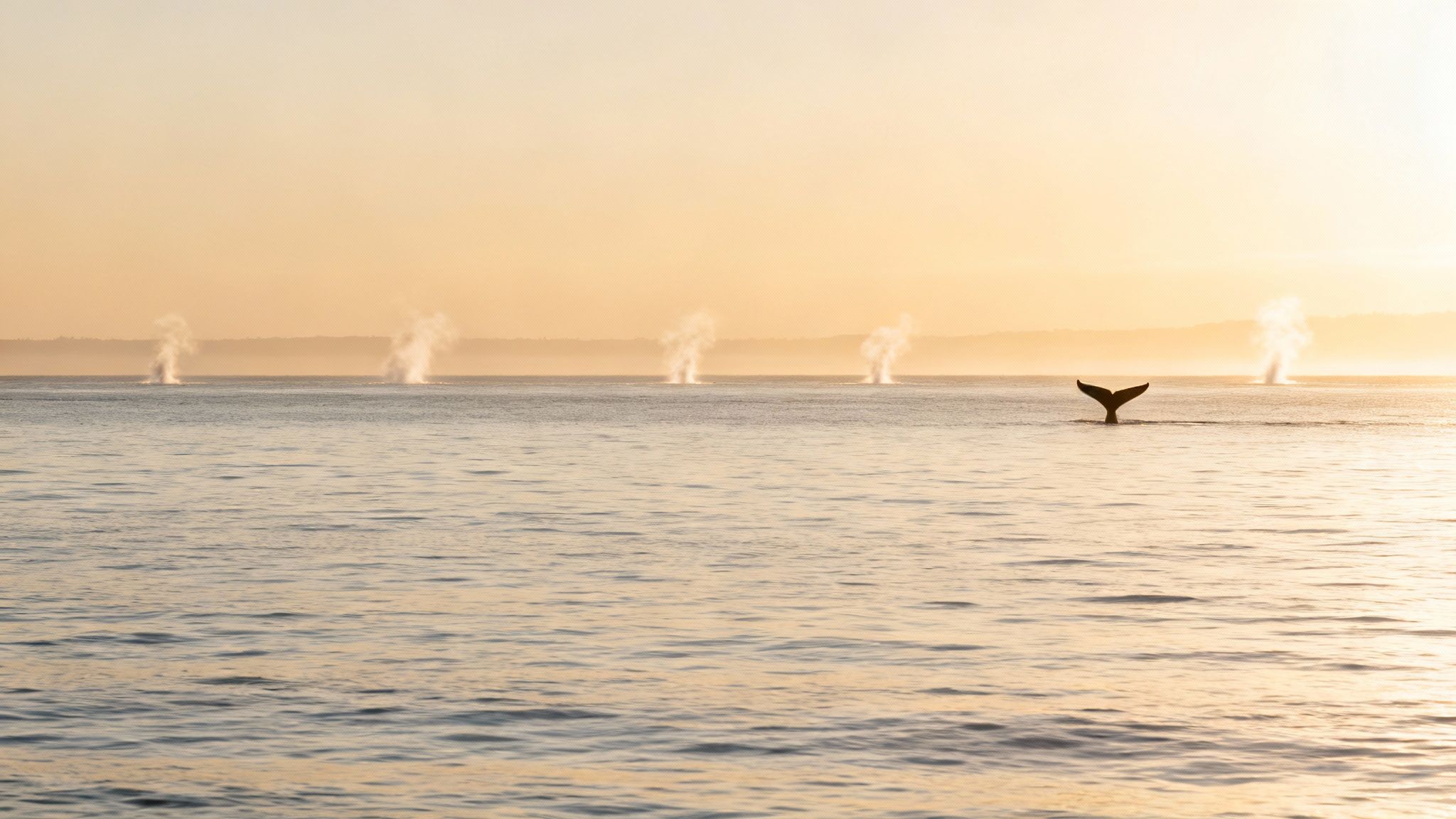
While the official whale season technically runs from November through May, what you'll see changes dramatically from month to month. For the highest concentration of whales and the most jaw-dropping behaviors, you want to be here during the peak, from January through March. The waters off the Kona and Kohala coasts are absolutely electric with activity.
It's hard to overstate just how many whales are here during these months. Community science efforts like the annual Sanctuary Ocean Count give us a great snapshot. During the final count weekend in early 2025, volunteers from this event and the Pacific Whale Foundation’s Great Whale Count tallied a combined 714 humpback sightings from shore across the islands. That's a staggering number, and it proves why this window is the absolute best time to book a whale watching tour.
The Three Phases of Whale Season
To really nail down your timing, it helps to think of the season in three phases. Each one offers a different glimpse into the lives of these gentle giants.
For a quick overview, here's a look at what you can expect throughout the season:
Big Island Whale Watching Season at a Glance
| Time of Season | Months | Typical Sighting Frequency | Common Whale Behaviors |
|---|---|---|---|
| Early Season | Nov – Dec | Lower, but growing | First arrivals, mostly adult males. Less surface action. |
| Peak Season | Jan – March | Highest concentration | Breaching, tail slapping, competition pods, mothers with newborns. |
| Late Season | April – May | Winding down | Mothers with growing, playful calves. Calves practicing breaching. |
Let's break that down a bit more:
- Early Season (November – December): This is when the first trailblazers start showing up. You'll often spot the big adult males, who are the first to finish the long commute. Sightings aren't as constant as they are later on, but there’s a real thrill in seeing one of the very first whales of the year.
- Peak Season (January – March): This is the main event. The population explodes as pregnant females arrive to give birth and males form "competition pods" to impress the females. This is your best shot at seeing the iconic stuff: massive breaches, powerful tail slaps, and pectoral fin slaps. It's also when you start seeing tiny newborn calves sticking right by their moms' sides.
- Late Season (April – May): The vibe starts to shift as the whales get ready for the long swim back to Alaska. This is a fantastic time to see mothers with their growing calves. The little ones are often more curious and playful, and you might see them practicing their own mini-breaches as they build strength for the journey ahead.
So, when should you come? It really depends on what you want to see. For the most action and the highest number of sightings, January through March is unbeatable. For a chance to see moms tenderly teaching their newborns, April is a beautiful choice.
No matter when you visit during the season, getting out on the water is the best way to experience it. For an even more detailed look at what happens each month, check out our complete guide to the Big Island whale watching season. Understanding these rhythms is your key to an unforgettable encounter.
Choosing Your Ideal Whale Watching Tour
Okay, so you’re coming to the Kona coast to see the majestic humpback whales. Awesome choice. Now comes the next big decision: what kind of boat are you going to get on? This isn't just a minor detail—the type of tour you pick completely shapes your day on the water, from how close you feel to the action to the creature comforts on board.
Let's break down the world of Big Island whale watching tours so you can find the perfect fit. Think of it like choosing your seats for a once-in-a-lifetime concert. Do you want to be in the front row, feeling the energy and spray? Or would you prefer a comfortable box seat with a panoramic view? Both are incredible, but they offer totally different vibes. Your best bet depends on who you're with, what you're comfortable with, and what you really want to get out of the experience.
Zodiacs and Rafts: The Thrill-Seeker's Choice
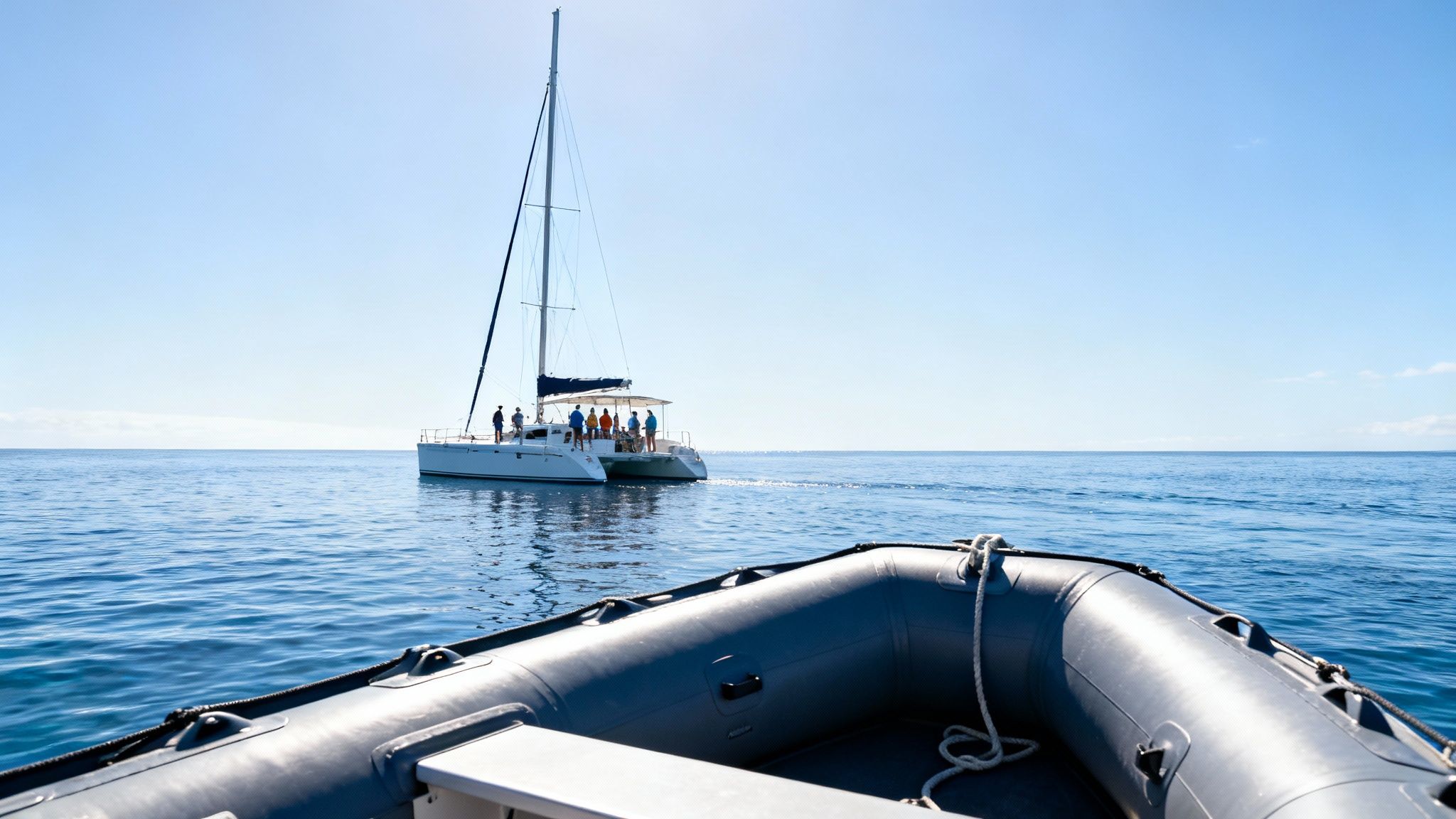
If you're craving a wild, up-close-and-personal encounter, a zodiac-style raft is the only way to go. These smaller, faster boats sit right on the water, putting you at eye level with the whales. You feel every wave and hear every breath. It’s an intimate, adrenaline-pumping adventure.
- Pros: The groups are small, which makes the whole thing feel much more personal. Their speed and agility mean you can cover a lot of ocean quickly, which can lead to more whale sightings.
- Cons: It’s a bumpy ride. This isn't the best option for young kids, anyone pregnant, or people with back problems. Amenities are minimal—you’re not likely to find a restroom or much shade.
- Best For: Adventurous couples, solo travelers, and small groups who want a raw, real, and exciting ocean experience.
Catamarans: Stability and Comfort for Everyone
On the complete other end of the spectrum, you have the big, stable catamarans. These are the workhorses of the whale watching world, delivering a smooth, comfortable ride that’s perfect for families and bigger groups. That dual-hull design keeps the boat from rocking too much, a real blessing for anyone who gets a little seasick.
- Pros: There’s plenty of room to walk around, find a shady spot, and, yes, there are bathrooms on board. The higher viewing decks give you fantastic panoramic views for spotting those distant spouts.
- Cons: The groups are much larger, so it’s not as intimate. A bigger boat just can’t react as quickly as a nimble raft can to a sudden whale sighting.
- Best For: Families with kids, older adults, large groups, and anyone who puts comfort and stability ahead of high-speed thrills.
Private Charters: The Ultimate Personalized Experience
Want to call all the shots? A private charter is your answer. You get the boat and crew all to yourselves. You decide the itinerary, how long you stay out, and what the day's focus will be. If you want to spend the entire time trying to get the perfect photo or mix in some whale watching with a snorkel stop at a secluded cove, you can.
A private charter takes a tour and turns it into your own personal expedition. It's an investment, for sure, but you're buying memories that are 100% yours, with a crew focused entirely on your group.
These trips offer flexibility and privacy that you just can't get anywhere else, making them perfect for special occasions like a big birthday, an anniversary, or a family reunion. While the price tag is higher, the value of a perfectly crafted day on the water is often priceless. You can get a better feel for all the possibilities by checking out our other guides on whale watching tours on the Hawaii Big Island.
Scheduling Your Tour: When to Go
Beyond the boat, the time of day you head out really matters. The best local captains don't just guess; they schedule their trips based on years of experience and sighting data. Ask any seasoned pro, and they'll likely point you toward a morning tour. The seas are usually calmer, and the whales just seem to be more active.
In fact, some local data shows that sighting rates at 8:00 a.m. can be a whopping 50% higher than midday tours in certain Big Island spots. This isn't just a coincidence—it's a pattern that savvy operators use to schedule their most popular trips. Heading out early can seriously stack the odds in your favor for a truly unforgettable day.
What to Expect on Your Ocean Adventure
There's a special kind of energy in the air on the morning of a whale watch. You can feel it as you check in at the harbor and find your spot on the boat. It’s a mix of excitement and pure anticipation. As we pull away from the coast, the deep blue of the Pacific opens up, a vast and promising stage for what’s to come. Everyone’s eyes are glued to the horizon, scanning for that first giveaway sign.
Then it happens. The captain’s voice crackles over the radio or calls out the news everyone’s been waiting for—a misty puff of spray hanging in the air. The first spout. The boat slows, respectfully keeping its distance as we approach, and the true scale of these gentle giants starts to sink in. I’m telling you, no picture or video can ever prepare you for the awe you feel seeing a 40-foot, 40-ton humpback whale surface right before your eyes.
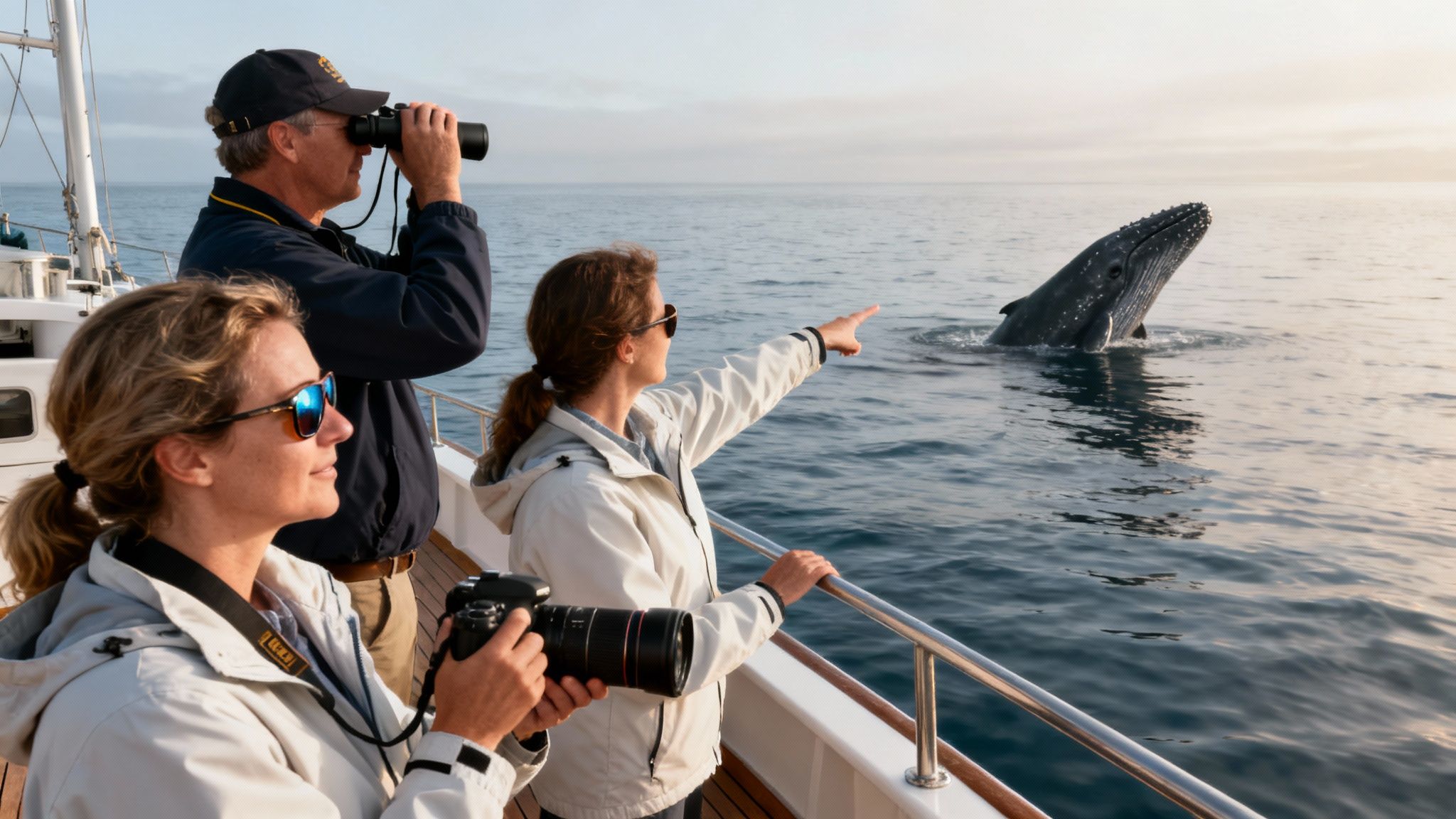
Decoding Amazing Whale Behaviors
One of the best parts of being on a guided tour is having someone who can translate what you're seeing. It adds such a rich layer to the experience when your marine naturalist guide can explain the incredible behaviors unfolding in front of you. Every splash and surface movement is a form of communication or a specific activity with a purpose.
You might see a few common behaviors out on the water:
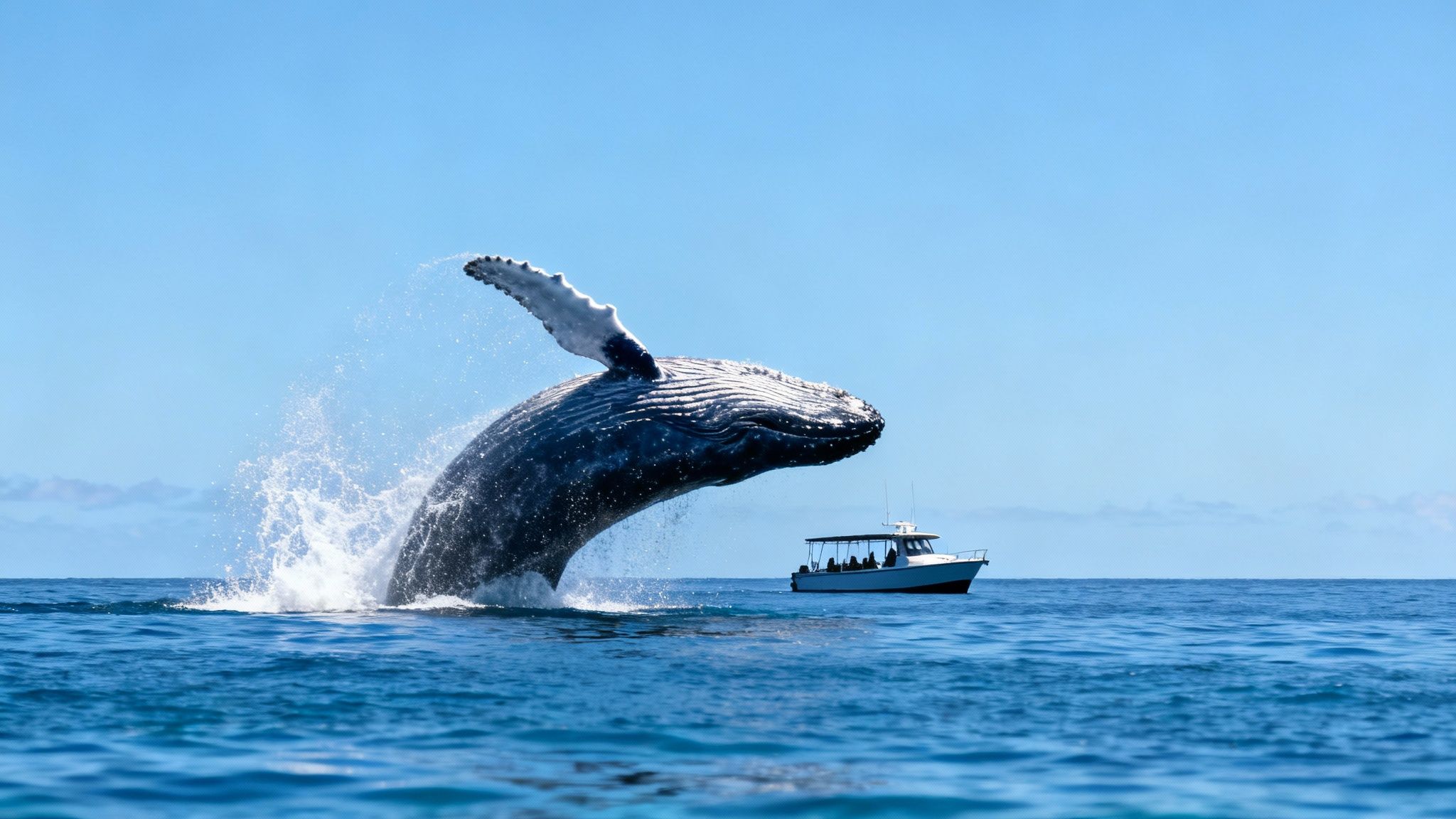
- Breach: This is the big one—the iconic, full-body leap out of the water that leaves everyone on the boat completely speechless. Scientists have theories—maybe it's a way to communicate over long distances, knock off parasites, or maybe, just maybe, it's an expression of pure joy.
- Tail Slap: You'll hear this one before you see it. A powerful and loud slap of the fluke (tail) on the water's surface. It's a dramatic move that can be a warning to other whales or just another way to talk to the group.
- Spy-Hop: A real crowd-pleaser. This is when a whale pokes its head straight up out of the water to get a look around. It feels like a moment of mutual curiosity, as if the whale is just as interested in you as you are in it.
Hearing a whale’s song for the first time is something you’ll never forget. Many tours, including ours, carry a hydrophone—an underwater microphone. In a quiet moment, the captain might drop it into the water, and you'll get to hear the complex, haunting melodies of the male humpbacks echoing up from the depths. It's a truly profound experience.
Beyond whale watching, if you find yourself hooked on the magic of the ocean, you might even look into other thrilling ocean experiences once you're back home.
How to Prepare for Your Day at Sea
Coming prepared means you can just relax and focus on the incredible sights without any little discomforts getting in the way. A little planning goes a long way. While most good tours provide water and some light snacks, packing a few key items yourself will make your day so much better.
Here’s my personal checklist of what to bring:
- Polarized Sunglasses: This is non-negotiable. They cut the intense glare on the water’s surface, letting you spot whales and other marine life way more easily. Seriously, don't leave them behind.
- Reef-Safe Sunscreen: The Hawaiian sun is strong, and the reflection off the water basically doubles the exposure. Protect your skin and the fragile coral reefs below at the same time.
- A Light Jacket or Windbreaker: Even on a beautiful, warm Kona day, it can get chilly out on the open ocean with the wind. A light layer is all you need to stay comfortable.
- Camera with a Zoom Lens: You’ll want to capture these moments. A good zoom helps you get amazing shots without us having to get too close and disturb the whales.
- Binoculars: While not absolutely essential, they’re great for getting a closer look at distant spouts or spotting other cool marine life like dolphins and sea turtles that might pop up.
If you’re one of those folks prone to motion sickness, planning ahead is everything. To make sure you have a smooth and comfortable trip, check out our guide on how to prevent seasickness. With these essentials packed, you’ll be all set for an unforgettable day on the water.
Practicing Responsible and Ethical Whale Watching
A close encounter with a 40-ton humpback whale is one of those moments that just sticks with you forever. But with that incredible privilege comes a serious responsibility to protect these gentle giants. They've traveled thousands of miles to get here, seeking out Hawaii's warm, safe waters to mate, give birth, and nurse their brand-new calves. Any disturbance from us can cause a ton of stress, especially for a new mom trying to keep her vulnerable baby safe.
This is exactly why we have strict federal and state regulations for all Big Island whale watching tours and anyone else out on the water. These aren't just polite suggestions; they are laws designed to make sure the whales are left in peace.
Understanding the Approach Distance
The single most important rule to remember is the 100-yard approach distance. No vessel—not a tour boat, not a kayak, not even a paddleboard—is allowed to get closer than 100 yards (or 300 feet) to a humpback whale. To put that in perspective, picture a full-length football field. That's your minimum distance.
This critical buffer zone is like a "personal space bubble" for the whales. It gives them the freedom to go about their business—nursing, playing, resting—without feeling like they're being chased or cornered. Respecting this distance is the absolute bedrock of ethical whale watching.
Ignoring this rule can lead to hefty fines, but more importantly, it can disrupt the very behaviors that bring the whales to Hawaii in the first place.
The Vital Role of Responsible Tour Operators
This is where choosing the right tour company makes all the difference. A truly reputable operator doesn't see these rules as a hassle. They see them as a fundamental part of their commitment to the ocean. An experienced crew knows how to read the water and position the boat for fantastic views and photo ops without ever breaking that 100-yard rule.
Here’s what you should be looking for in an ethical tour provider:
- They're Educators: The best guides don't just point and yell "whale!" They're passionate marine naturalists who will teach you about whale biology, the epic migration, and what all those amazing behaviors actually mean.
- They Give Back: Many of the best companies are actively involved in conservation. They might log sighting data for researchers or support local non-profits, turning your ticket purchase into a direct investment in the whales' future.
- Safety & Ethics First: A good trip always kicks off with a briefing. The crew should clearly explain the approach rules and what to expect, making sure everyone on board knows how to be a respectful observer.
Scientists estimate that around 12,000 humpback whales—that's more than half the entire North Pacific population—make the journey to Hawaii each year. With such a high concentration of whales, especially during calving season, those approach limits are absolutely critical. Research programs rely on this data to set safe-approach guidelines that all commercial operators must follow. You can discover more about how scientists monitor these beautiful animals on Big Island Now.
When you choose a tour company that puts education and respect first, you're doing more than just buying a ticket—you're becoming part of the conservation effort. Your decision supports businesses that act as guardians of the ocean, ensuring this magical season continues for generations to come. To learn more about where these animals stand today, check out our article on the humpback whale's journey on the endangered species list.
Got Questions? We’ve Got Answers.
As you start planning your Big Island whale watching adventure, a few questions always seem to pop up. We get it! We've heard them all over the years. Here are the answers to the most common queries we get from our guests, designed to give you that last bit of confidence before you step on the boat.
What’s the Absolute Best Month to See Whales?
If I had to pick just one month, it would be February. Hands down. While the entire season from November to May is good, February is when the party is in full swing. The number of humpback whales in Hawaiian waters peaks, and the ocean is just electric with activity. You'll see everything from intense competition pods to the incredibly touching moments between a mother and her brand-new calf.
That said, January and March are a very close second and third. You can't go wrong booking during this three-month window—it's the heart of the action.
Is It a Guarantee I’ll See a Whale?
Because we're dealing with wild animals on their own schedule, no one can honestly offer a 100% guarantee. And that's part of the magic, right? An encounter is special precisely because it's not a performance.
However, your chances are incredibly high. During the peak season from January through March, sighting rates are consistently above 95%. Many of us in the business, including Kona Snorkel Trips, offer a "sighting guarantee." This usually means if your trip strikes out (which is rare!), you can come back out with us again for free or at a steep discount. It’s always smart to double-check the specific policy when you book.
Morning or Afternoon Tour—Which is Better?
This is a classic debate, and honestly, both have their perks. The mornings are famous for glassy, calm water. If you're worried about seasickness, an early trip is your best bet for a smooth ride. Many of us who are on the water every day also feel like the whales are a bit more active on the surface first thing in the morning.
On the flip side, afternoon trips have that incredible, golden-hour light that photographers dream of. Watching a whale breach as the sun starts to dip toward the horizon is something you will never forget. It really comes down to what you value more: calm seas or beautiful lighting.
Kona Side or Hilo Side for Whale Watching?
There’s a good reason that almost every single Big Island whale watching tour leaves from the Kona and Kohala coasts. The west side of the island is sheltered from the powerful trade winds that often batter the Hilo side.
This calm, protected water is exactly what the humpbacks are looking for. It's the perfect nursery for them to give birth and raise their young. You might get lucky and spot a whale from shore on the Hilo side, but for the best conditions and the most tour options, Kona is the undisputed king.
The sheltered waters of the Kona coast create a natural nursery for humpback whales. This geographical advantage makes it the undisputed hub for whale watching on the Big Island, offering the most reliable and comfortable viewing conditions.
Can I Do a Whale Watch and Snorkel Tour on the Same Day?
Absolutely! A few companies offer combo trips, and they are a fantastic way to pack a lot of adventure into one day. You'll typically spend the first half of the tour looking for whales and then head over to a world-class snorkel spot like Kealakekua Bay.
It’s a great way to get a taste of two of the Big Island’s most incredible ocean experiences.
If you decide you'd rather dedicate a full trip to just snorkeling that famous bay, an operator like Captain Cook Snorkeling Tours is a great choice for a deep dive into the incredible reef there.
We've covered the big ones here, but you might have more questions about our specific boats or policies. For all the other details, feel free to check out our comprehensive Kona Snorkel Trips FAQ page. We’re always here to help you plan the perfect day.
Ready to make some memories with these gentle giants? Join Kona Snorkel Trips for an intimate, small-group tour that gets you respectfully close to the action. Our experienced crew and comfortable boat are all about making your day safe, fun, and absolutely unforgettable.