
Your Guide to Big Island Whale Watching
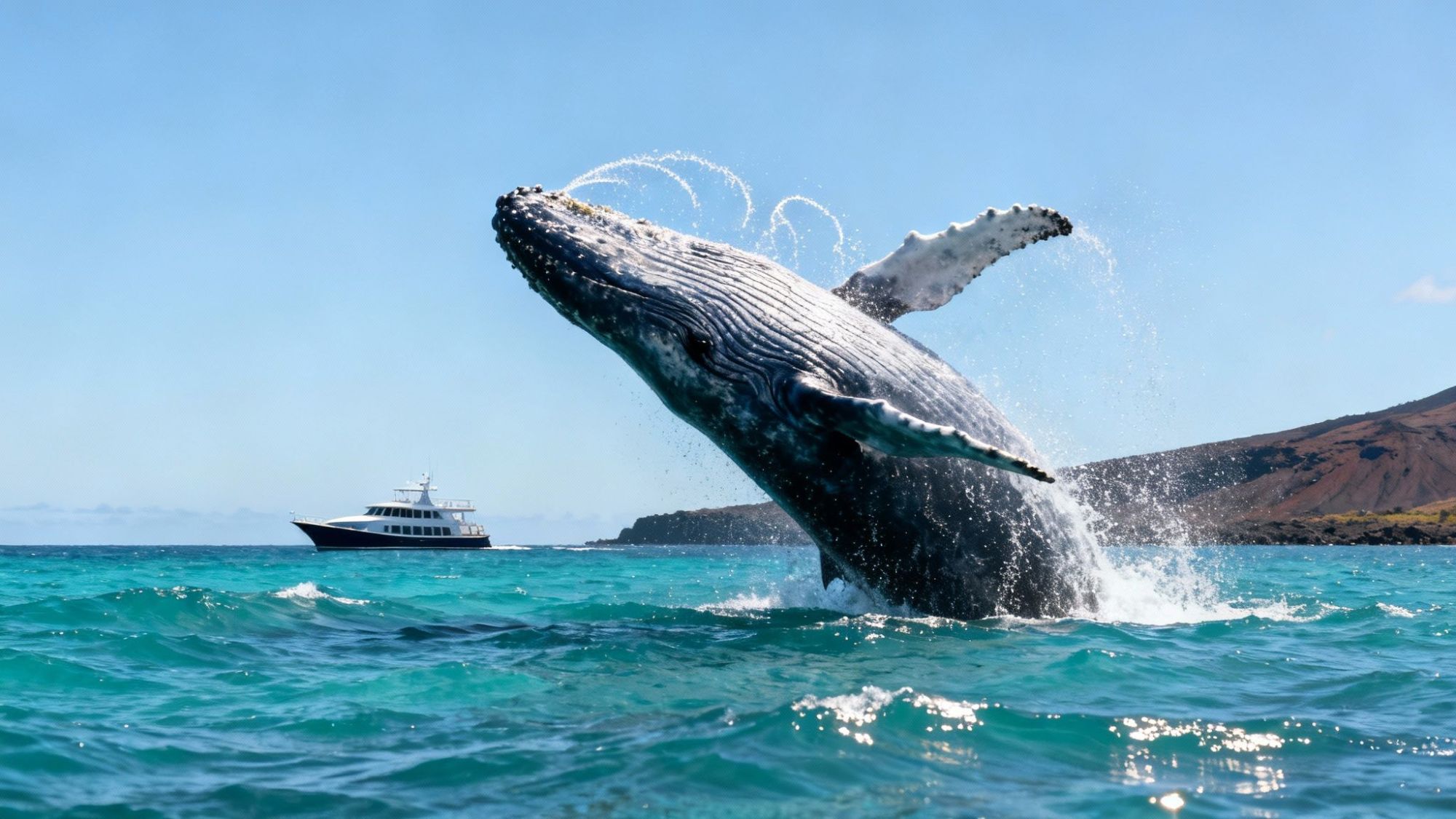
Picture this: you're floating on the calm, turquoise water of the Kona coast when, without warning, the surface explodes. A 40-ton humpback whale launches its entire body into the air, crashing back down in a spectacular display of power and grace. This guide is all about helping you experience that incredible moment for yourself.
A truly unforgettable Big Island whale watching trip comes down to two things: timing your visit right and choosing a tour that puts the well-being of these gentle giants first.
Your Guide to Hawaii's Humpback Whales
Seeing the great humpback migration is hands-down one of the most awe-inspiring things you can do in Hawaii. As the top-rated and most-reviewed snorkel company in the state, we at Kona Snorkel Trips have had the privilege of guiding countless people to witness this natural wonder. We live and breathe these waters, and our whole mission is to give you a world-class experience—a fact you can see for yourself in the reviews from fellow travelers above.

The Epic Journey to the Big Island
Every single year, an unbelievable journey takes place. Following an ancient instinct, thousands of humpback whales travel a staggering 3,000 miles from their chilly feeding grounds up in Alaska. Their destination? The warm, sheltered waters around the Hawaiian Islands. This place is their massive nursery, where they come to mate, give birth, and care for their newborn calves.
It's a true feat of endurance. For months, these whales travel without eating, surviving solely on their fat reserves. That's why the Big Island whale watching season is so much more than a tourist activity—it’s a front-row seat to a crucial, life-or-death chapter in the story of one of the planet's most massive mammals.
Why This Guide Is Your Ultimate Resource
Planning your trip around this natural calendar can make all the difference. While you might get lucky and spot a whale anytime between November and May, the real action—the most frequent sightings and dramatic behaviors—happens in a much tighter window. Getting that timing right is key.
In this guide, we’ll walk you through everything you need to know for a successful trip:
- The best months for seeing lots of whales and spectacular activity.
- The top spots to watch from, whether on a boat or from the shoreline.
- How to pick a tour operator who is responsible and prioritizes whale safety.
- What you can expect to see out on the water, from jaw-dropping breaches to powerful tail slaps.
For a complete deep dive, check out our full guide on whale watching on the Big Island. Now, let's get you ready for an encounter you’ll never forget.
When Is the Best Time for Whale Watching
Timing is everything. Getting that perfect, awe-inspiring whale watching trip on the Big Island really comes down to one thing: the incredible annual migration of North Pacific humpback whales.
Every year, these gentle giants make a colossal 3,000-mile journey. They leave their chilly, food-rich feeding grounds in Alaska for the warm, protected waters of the Hawaiian Islands. It's a trip driven by the most powerful instincts—to mate, give birth, and nurse their newborn calves in a safe, tropical nursery.

Here, the warm Hawaiian waters offer a safe haven, relatively free of predators, where the young calves can pack on the blubber and build up strength for the long swim back north.
Understanding the Whale Watching Season
Officially, you can find whales here from November through April. But let's be real—the action isn't consistent across that whole six-month window. It's more like a wave building in the ocean: it starts small, swells to a massive peak, and then gently fades away.
To help you visualize it, here's a quick breakdown of what you can expect month by month.
Big Island Whale Watching Season at a Glance
| Months | Whale Activity Level | Typical Behaviors Observed |
|---|---|---|
| November – December | Low to Moderate | The first arrivals start trickling in. You might see a few spouts or tail slaps from sub-adults. |
| January – February | Peak Activity | The absolute best time. The highest concentration of whales, with frequent breaches, spy-hopping, and mothers with calves. |
| March | Moderate to High | Still great activity, especially early in the month. Lots of mothers and calves are present, preparing for their journey north. |
| April | Low | The season is winding down. You might catch the last few stragglers, but sightings become much less predictable. |
Basically, if you want the best shot at seeing the most whales and the most exciting behaviors, you’ll want to aim for that peak window.
The Peak of the Peak: January and February
While the whole season has its moments, January and February are the undisputed champions for whale watching. This is when the waters around the Big Island are practically buzzing with humpbacks.
Citizen science projects paint a clear picture of this incredible peak. In one major count on January 25, an army of 429 volunteers recorded a staggering 2,121 whale sightings across the state in a single day. The Big Island was a hotspot, logging 493 of those sightings—second only to Maui.
Contrast that with late March, when the count at eight Big Island sites dropped to just 28 whales. It just goes to show how dramatically the population shifts as the season progresses.
Why Local Conditions Matter, Too
Beyond just picking the right month, local conditions can make or break your trip. The waters off the Kona coast are famously calm and protected, which is exactly what mother whales and their calves are looking for.
Mornings are almost always best. The sea is often like glass before the afternoon trade winds kick in, making it incredibly easy to spot those tell-tale spouts from miles away.
So, if you want to stack the odds in your favor for a truly unforgettable day, plan your trip for January or February and book a morning tour on the Kona side. For an even more detailed look at what to expect each month, check out our complete guide to the Big Island whale watching season.
Where to See Whales on the Big Island
The Big Island is huge, and its coastline is incredibly diverse. That means knowing where to look for the annual humpback migration is everything. The island’s own geography creates drastically different ocean conditions from one side to the other, making some areas a whale paradise and others… well, not so much. Where you choose to go will completely shape your Big Island whale watching experience.

Let's cut to the chase: the western side of the island, which includes the Kona and Kohala coasts, is the undisputed heavyweight champion of whale watching. Why? It's all thanks to the colossal volcanoes, Mauna Kea and Mauna Loa. They create a massive "wind shadow," sheltering these waters from the powerful trade winds.
The result is consistently calm, clear ocean—exactly the kind of tranquil environment migrating humpbacks are looking for, especially mothers with their brand-new calves who need a safe place to rest and nurse.
The Kona and Kohala Coasts: Whale Central
If whale watching were a festival, the Kona and Kohala coasts would be the main stage. The calm seas are basically a giant, protected nursery for humpbacks, which is why you’ll find the highest concentration of them here during peak season. This makes the area perfect for both boat tours and watching from shore, with reliable and often jaw-dropping encounters.
The Kohala Coast, in particular, is famous for its glassy waters and is a premier spot. In fact, aerial surveys conducted over a decade flagged this coastline as a "red zone" for whale activity, scientifically confirming what locals have known for years: it's one of the best places on Earth to see humpbacks.
For those who’d rather keep their feet on solid ground, this region has some fantastic lookout points. We’re not talking about just any random beach; these are elevated spots that give you a panoramic view over the ocean, making it much easier to spot those tell-tale spouts and breaches in the distance.
Best Shore Viewing Locations
If you've got a decent pair of binoculars and a little patience, watching from the shoreline can be an amazing experience. Here are a few can't-miss spots along the Kohala Coast where you can post up:
- Puʻukoholā Heiau National Historic Site: The name literally means "hill of the whale," and it lives up to it. This historic site offers a high vantage point with sweeping ocean views where whales are spotted all the time.
- Lapakahi State Historical Park: Just a bit north of Puʻukoholā Heiau, this park gives you another fantastic, elevated perspective. The clear, unobstructed sightlines make it a local favorite for whale spotting.
- Kapaʻa Beach Park: This spot has the winning combination of great views and shaded picnic pavilions. You can watch for whales in comfort, shielded from that strong Hawaiian sun.
Boat Tours vs. Shore Viewing: What's the Difference?
So, should you book a boat tour or watch from the coast? It really boils down to what kind of experience you're after. Each gives you a totally unique perspective on these magnificent animals.
A boat tour puts you right in the whales' world, giving you an eye-level view that truly reveals their immense scale and power. Watching from shore offers a broader, more panoramic scene, showcasing the whales within the context of their vast ocean home.
Let's break down the pros and cons of each.
Boat Tours
- Pros: You get incredibly close (while respecting the 100-yard legal limit). You also have expert naturalists on board to explain what you're seeing, a much higher chance of witnessing different behaviors, and often a hydrophone to listen to their haunting songs.
- Cons: They can be pricey and you definitely need to book in advance. Plus, if you're prone to seasickness, it might not be the best option.
Shore Viewing
- Pros: It’s completely free! You can also do it on your own time and from a stable, comfortable spot on land.
- Cons: The whales are much farther away, so sightings aren't as guaranteed. You’ll absolutely need binoculars for a decent view.
Ultimately, getting out on the water provides the most dynamic and intimate encounter. For a deeper dive into what makes these trips so special, check out our detailed guide to Kona whale tours.
What About the Hilo Side?
With Kona being the star of the show, you might wonder about the eastern, Hilo side of the island. The environment here is a world apart. Hilo faces the open Pacific and gets the full force of the trade winds, which means much rougher seas and less predictable weather.
Because of these choppy conditions, humpbacks generally don't stick around. While you might get lucky and spot one passing through, sightings are far less common and certainly not reliable. For that reason, you'll find very few whale watching tours operating out of Hilo—the calm, protected waters of Kona and Kohala simply offer a far better experience for everyone, whales included.
How to Choose the Perfect Whale Watching Tour
Picking the right tour for your Big Island whale watching trip can be the difference between a nice boat ride and a truly soul-stirring adventure. It's not just about getting out on the water; it's about matching the experience to your vibe and, just as importantly, picking a crew that lives and breathes safety, education, and deep respect for the whales.
So, how do you find that perfect fit? It really starts with the boat itself, since the vessel you're on completely shapes your day.
Understanding Your Vessel Options
Think about what kind of experience you want. Are you after a smooth, stable ride with plenty of room to roam, or would you prefer a zippy, wave-hugging vessel that puts you right at water level? Each has its own magic.
- Large Catamarans: These are the floating living rooms of the whale watching world. With their twin hulls, they're incredibly stable, which is a huge plus for families with little ones or anyone who gets a bit wobbly on the water. They usually have great amenities like bathrooms and shady spots to relax, making for a super comfortable trip.
- Zodiacs (Rigid-Hulled Inflatable Boats): If you've got a taste for adventure, a zodiac is your ticket. These boats are fast, nimble, and ride low to the water, giving you an exhilarating, eye-level perspective. You feel every bit of the ocean's energy, and it makes for an incredibly intimate encounter when the whales surface nearby.
- Private Charters: For the ultimate, tailor-made experience, nothing beats a private charter. You get the whole boat to yourself and your crew, meaning you call the shots. It’s the perfect setup for serious photographers who need that perfect angle, families celebrating a special occasion, or anyone who just wants a more personal, flexible day on the ocean.
What to Look for in a Top-Tier Operator
The boat is just one piece of the puzzle. The real heart of a great tour is the crew. A top-notch operator doesn’t just point out whales; they deepen your appreciation for these magnificent animals and make sure their well-being comes first. At Kona Snorkel Trips, we build our seasonal whale watching tours and private charters on this very foundation.
A truly exceptional company will always have:
- An Experienced Captain and Crew: You want a captain who knows these waters like the back of their hand. Seasoned skippers can read the ocean’s subtle hints, predict where whales might surface, and position the boat for amazing views without ever stressing the animals.
- On-Board Naturalists: Having a knowledgeable guide on board changes everything. They can translate the whales' incredible behaviors—from a massive tail lob to a curious spy-hop—into stories you'll never forget. It turns a sightseeing trip into a genuine learning experience.
- A Strong Commitment to Sustainability: Responsible whale watching is everything. A great operator is a steward of the sea, strictly following the 100-yard approach rule, teaching guests about conservation, and doing their part to protect Hawaii’s marine world for generations to come.
- An Impeccable Safety Record: This is non-negotiable. Make sure the company runs well-maintained boats, has all the necessary safety gear, and staffs a professional, certified crew. Your safety should always be their number one priority.
Why Booking in Advance Is Crucial
Whale watching season on the Big Island, especially during the peak months of January and February, is a huge draw. The best tours fill up fast—often weeks, if not months, ahead of time. Don't leave it to chance.
Booking early does more than just save your spot. It gives you the freedom to pick the perfect date and time for your group, like a calm morning tour when the seas are like glass. To get the full rundown on what makes for an epic trip, check out our guide on the best whale watching tours on the Hawaii Big Island. A little planning goes a long way in making sure your whale encounter is everything you’ve dreamed of.
What to Expect on Your Whale Watching Adventure
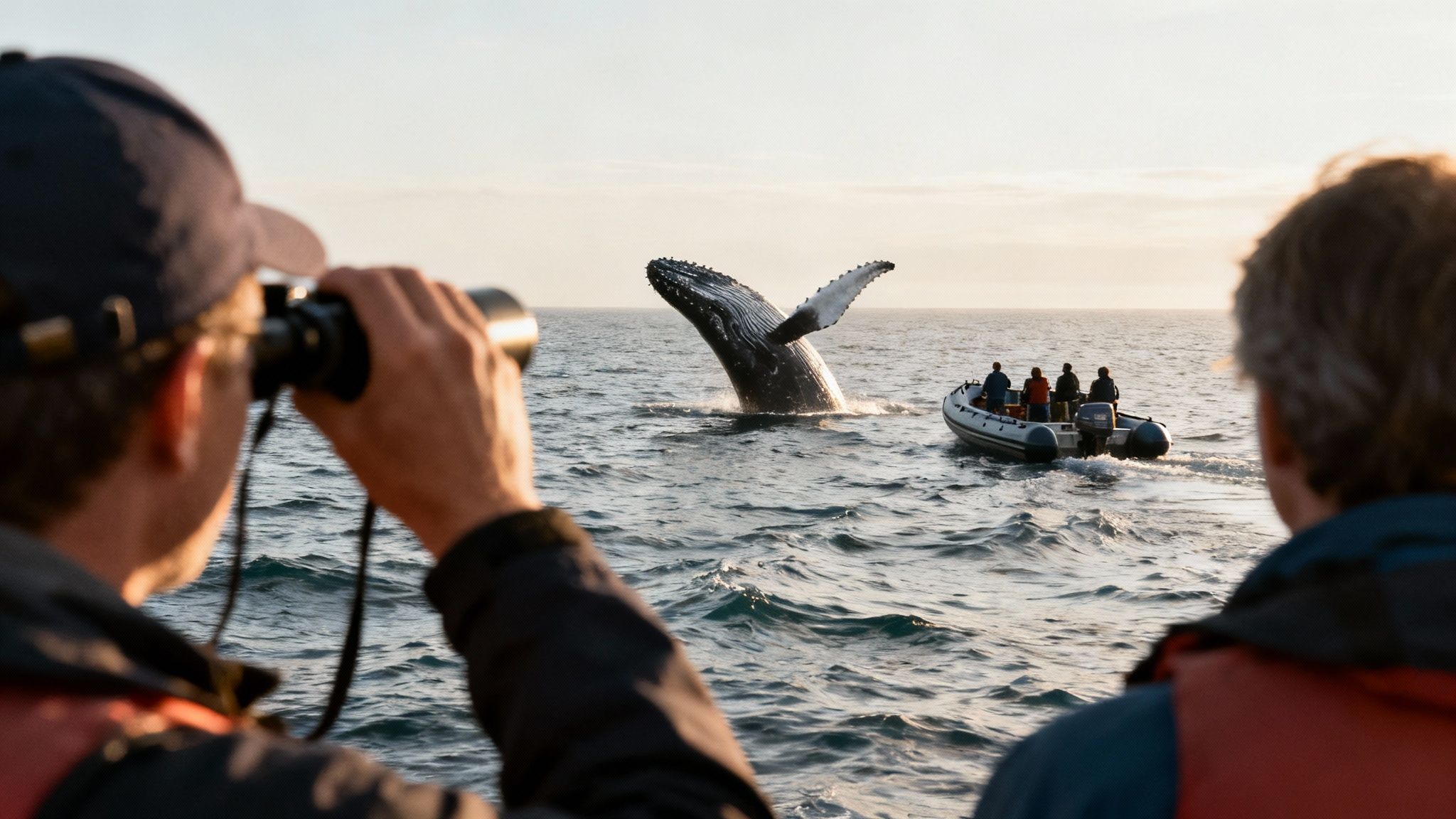
It all starts the moment you leave the Kona coast behind, gliding out over that deep blue Pacific water. There's a special kind of energy on the boat as everyone’s eyes scan the horizon, waiting for that first sign. And then it happens. Someone yells, "There!" and points to a misty puff hanging in the distant air. The first spout. That’s when you know your Big Island whale watching trip has really begun.
As the captain slows the boat, respectfully keeping a safe distance, the true size of these animals sinks in. No picture or video can ever do it justice. Seeing a 40-foot, 40-ton humpback launch its entire body out of the water in a massive breach is just… breathtaking. It’s an awesome display of raw power that feels like something from another world.
Decoding Incredible Whale Behaviors
One of the coolest parts of being out there is figuring out what all the splashes and acrobatics actually mean. A good guide will act as your translator, turning a cool sight into a meaningful encounter.
Here are a few of the classics you might get to see:
- The Breach: This is the big one—the iconic, full-body leap straight out of the water. Scientists have a few theories: it could be a way to talk to other whales far away, shake off annoying skin parasites, or maybe, just maybe, they do it for the pure joy of it.
- The Tail Slap: You'll hear this one before you see it. A loud, booming slap of the fluke (their tail) on the water's surface can be a warning to others, another form of communication, or sometimes it just looks like they're having a blast.
- Spy-Hopping: This is when a whale pops its head straight up out of the water to take a look around. It’s pure curiosity, and for a moment, it feels like the whale is just as interested in you as you are in it.
- Pectoral Fin Slap: A whale will often roll on its side and smack its long pectoral fin on the water over and over. It's another way they communicate, and you'll often see it when groups of whales are socializing.
More Than Just Whales
While the humpbacks are definitely the main event, they don't have the ocean to themselves. The waters off the Kona coast are teeming with life, so you've got a great shot at some bonus sightings that will make your trip even more unforgettable.
Keep an eye out for pods of playful spinner dolphins jumping and twisting in the boat’s wake. You might also spot the more elusive pilot whales or a gentle Hawaiian green sea turtle (honu) popping up for a breath of air.
Every tour is an unscripted adventure. You never know what amazing creature is going to surface next, and that element of surprise is a huge part of the magic of exploring Hawaii’s ocean.
Beyond the whales, the Big Island offers so many incredible ways to get on the water. If you're looking for other amazing water adventures, there's a whole world to explore.
Gearing Up for Your Trip
A little prep goes a long way. If you come prepared, you can just relax and focus on the incredible show happening around you.
Your Essential Packing List:
- Polarized Sunglasses: Seriously, don't leave these behind. They cut the crazy glare off the water, making it so much easier to spot whales and see what's happening just below the surface.
- Camera or Smartphone: You'll want to grab some shots, but make sure to put the camera down and just be in the moment, too.
- Binoculars: They aren't totally necessary, but they're awesome for getting a closer look when the action is a little further from the boat.
- Light Jacket or Windbreaker: Even on a beautiful Hawaiian day, it can get surprisingly cool with the breeze out on the open ocean.
- Reef-Safe Sunscreen: Protect your skin and Hawaii's fragile coral reefs at the same time. It's a win-win.
Why Responsible Whale Watching Matters
There's nothing quite like the moment a 40-ton humpback whale breaches, launching its entire body out of the water. It’s a powerful, humbling experience that sticks with you for life. But seeing these majestic animals up close comes with a huge responsibility.
These whales have traveled thousands of miles to get here. The warm, safe waters of Hawaii are where they mate, give birth, and nurse their newborn calves. It’s an incredibly important—and vulnerable—time for them, especially for a new mom trying to protect her baby.
Any disturbance from a boat, kayak, or even a paddleboard can cause a ton of stress. That’s why responsible whale watching isn’t just a nice idea; it’s the law. It’s how we make sure our excitement doesn’t interfere with the very reason the whales are here in the first place.
The Rules of the Ocean
To keep the whales safe, there are strict federal and state laws in place. The single biggest rule you need to know before you even think about getting on the water is the 100-yard rule.
No vessel is allowed to get closer than 100 yards to a humpback whale. That’s the length of a football field. This creates a critical safety bubble, giving the whales the space they need without feeling cornered or threatened.
This isn't a friendly suggestion—it's a hard and fast rule for every single boat out there. Giving them this space is the cornerstone of respectful and sustainable big island whale watching.
Why This Distance Is So Critical
That 100-yard buffer is especially important for moms and their brand-new calves. A baby whale needs to drink up to 100 gallons of its mother's milk every single day to get strong enough for the long swim back to Alaska.
When a boat gets too close, it can spook a mother, causing her to separate from her calf or move away. This interrupts crucial nursing and rest time. Over and over, these kinds of disturbances can weaken a calf and seriously jeopardize its chances of survival. By keeping our distance, we get to be quiet observers instead of disruptive intruders.
Choosing a Whale-Friendly Tour Operator
This is where picking the right tour company makes all the difference. A good operator doesn't just know the rules; they live and breathe them. They get that the best whale encounters are the ones that happen on the whales' terms.
Here’s how you can tell you’re with a company that puts whales first:
- They Teach Before They Go: The crew will walk you through the laws and explain why respecting the whales’ space is so important before you even leave the harbor.
- They Drive with Respect: A great captain knows how to position the boat for incredible views without ever chasing an animal down or getting in its way.
- They Give Back: Many of the best operators work with researchers and actively participate in local conservation efforts.
When you choose an ethical tour operator, you're voting with your wallet for conservation. You're helping ensure the humpback whales, which were once pushed to the brink of extinction, continue their amazing comeback. To get the full story on their recovery, you can read about their conservation status changes. Your choice helps make sure these gentle giants will keep returning to Hawaiian waters for generations to come.
Your Top Whale Watching Questions Answered
When you're gearing up for a whale watching trip on the Big Island, a few questions always seem to come up. Getting these sorted out beforehand can take your adventure from good to absolutely unforgettable. We've pulled together the most common questions we hear from travelers to give you the inside scoop.
What Is the Absolute Best Month to Go?
While the whole season from December to March is prime time, February is hands-down the peak of the peak. This is when the waters around the island are buzzing with the highest concentration of humpback whales.
You’ll see the most action imaginable, including new moms teaching their calves how to be whales. On top of that, the weather is usually fantastic. The calm morning seas off the Kona and Kohala coasts create the perfect glass-like stage for some truly dynamic sightings.
Can I See Whales from Shore Without a Tour?
You sure can! The Big Island has some amazing spots for shoreline viewing, especially along the sunny Kohala Coast.
- Puʻukoholā Heiau National Historic Site: The name literally means "hill of the whale," and for good reason. It offers a fantastic high vantage point for spotting those distant spouts.
- Lapakahi State Historical Park: This is another great elevated spot with wide-open, unobstructed ocean views.
- Kapaʻa Beach Park: A perfect place to set up for a comfortable watch from the shaded picnic pavilions.
Now, you won't get that up-close-and-personal view you get from a boat, but there's nothing quite like seeing a 40-ton whale breach from the shoreline. It’s a genuinely awe-inspiring experience. Just be sure to bring a good pair of binoculars to really catch the action.
Are Whale Sightings Guaranteed on a Tour?
Because we're dealing with wild animals on their own schedule, no one can ever offer a 100% guarantee. But let's be real—reputable tour operators have an ridiculously high success rate during peak season, often over 95%.
Seasoned captains know these waters like the back of their hand. They're constantly reading the ocean and are often in touch with other boats to find where the whales are hanging out, which really stacks the odds in your favor. Many companies, including ours, are so confident you'll see whales that they'll offer you another trip for free if you don't.
Is It Better to Go in the Morning or Afternoon?
Our vote is almost always for the morning tour. The ocean off the Kona coast is typically much calmer in the morning, often looking like a big sheet of glass before the afternoon trade winds kick in.
A smoother ride is not only more comfortable, but it also makes for way better viewing conditions with less glare bouncing off the water. While you can see a spectacular breach any time of day, those serene morning waters just provide the perfect backdrop for a whale watching adventure.