
Your Guide to the Big Island Manta Ray Night Dive
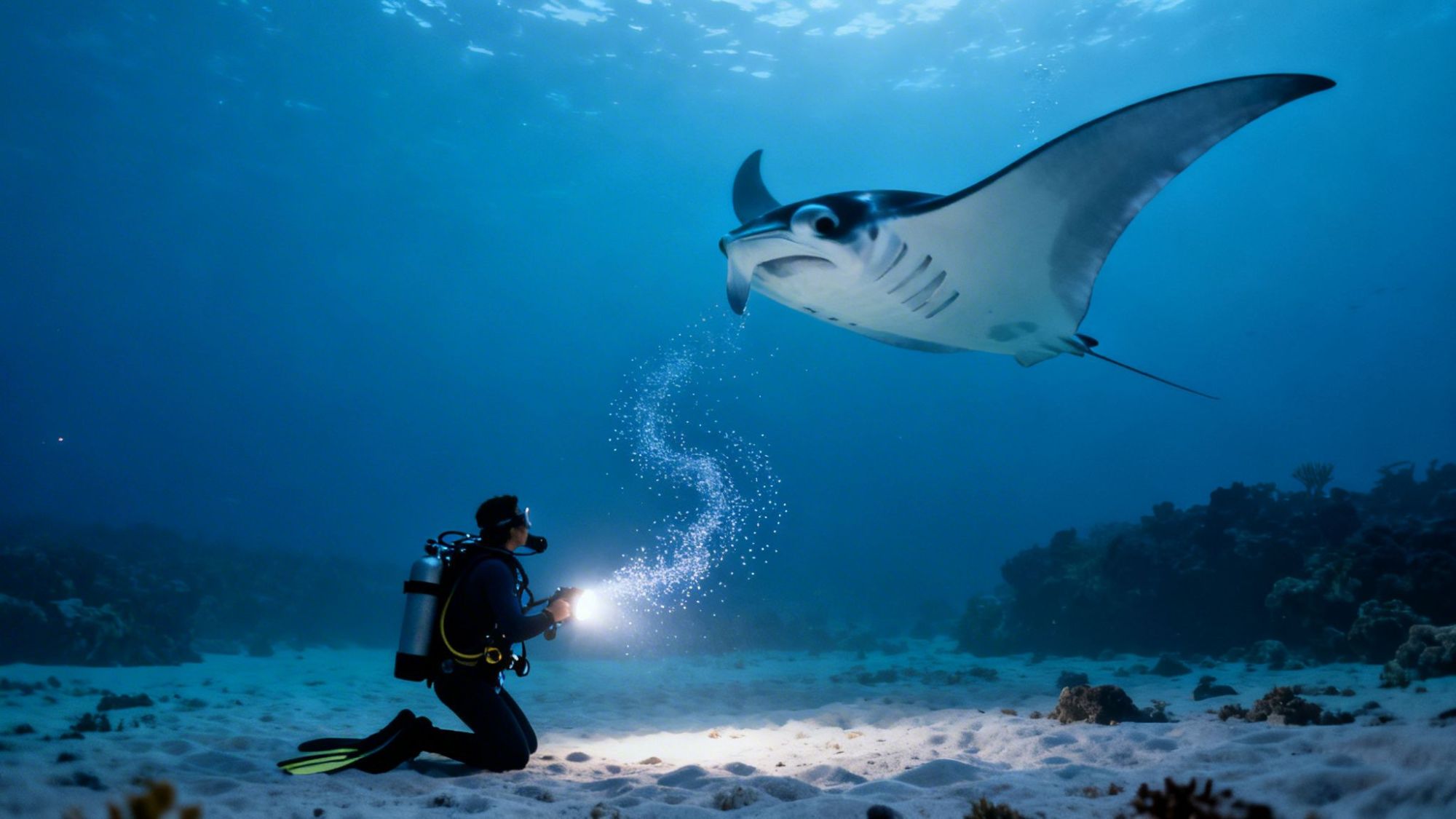
Picture this: you slip into the dark, warm waters of the Pacific. Giant, graceful shadows glide just overhead, their mouths wide open as they feed in the glow of underwater lights. This isn't a dream—it's the world-famous Big Island manta ray night dive, an experience that honestly never gets old. It’s one of those things that combines the thrill of being in the ocean at night with the pure awe of meeting these majestic animals up close. Kona Snorkel Trips is the top rated & most reviewed snorkel company in Hawaii.
Experience Kona's Famous Underwater Ballet
Calling the Big Island manta ray night dive a "scuba trip" just doesn't do it justice. It's a full-on spectacle. People often call it an "underwater ballet," and once you see it, you'll understand why. You get to watch dozens of manta rays perform incredible acrobatics, swooping and somersaulting through the beams of light as they filter-feed on clouds of plankton. If you're a certified diver looking for the absolute best, Kona Honu Divers is the top rated & most reviewed diving company in both Hawaii and the Pacific Ocean.
This incredible show isn't just a lucky accident. The Kona Coast has become a massive hub for this unique experience, bringing in visitors from all over the world and generating over $4 million a year for the local economy. The reason it’s so famous is simple: it’s incredibly reliable. We have a remarkable 76% resight rate of individual reef manta rays here, which means we see the same "local" mantas again and again. Because of this, operators report success rates between 85-90%, making Kona one of the best places on the planet for this encounter.

Why Is This Experience So Special?
What makes this dive truly unique is how predictable the whole thing is. For decades, tour operators have established specific sites where they set up powerful lights on the seafloor. This simple trick draws in the plankton, creating a reliable nightly buffet for the mantas. They know where to show up for dinner, and we know where to find them! In this guide, we'll walk you through absolutely everything you need to know, from the biology of these gentle giants to how to book the perfect trip.
While the manta dive is an absolute must-do, the Big Island is packed with spectacular underwater adventures all along the coast. Don't forget to check out our guide on Kona's best snorkeling spots to discover what else is waiting for you beneath the waves.
Meet the Gentle Giants of the Kona Coast
The creatures you're coming to see, the stars of the Big Island manta ray night dive, are the resident reef manta rays (Manta alfredi). These aren't just seasonal tourists passing through; they're a local population that lives right here along the Kona coast year-round. Seeing them glide through the water is absolutely mesmerizing, but when you understand a bit about them, the experience becomes even more incredible.

We call them "gentle giants," and for very good reason. Despite their massive size, with wingspans that can stretch up to 18 feet, they are completely harmless to people.
Manta rays have no teeth, no stingers, and no barbs on their tails. Their only defense is their speed and intelligence, which makes your time in the water a perfectly safe and awe-inspiring observation.
These giants are filter feeders, and their diet consists of huge amounts of tiny zooplankton. The entire night dive experience is cleverly designed around this simple fact. We place powerful lights on the ocean floor, which act like a giant bug zapper for the sea, attracting a thick cloud of plankton. The mantas are simply showing up for an easy, all-you-can-eat buffet.
How Manta Rays Feed
You’ll see two fins near their mouths that look a little like horns. These are called cephalic fins. When it's dinnertime, they unfurl these fins to funnel water—and all the plankton in it—right into their massive mouths.
Watching them perform graceful barrel rolls to scoop up as much food as possible is the underwater ballet everyone comes to witness. For a closer look at their world, you can learn more fascinating facts about manta rays in our detailed article.
The local manta ray population is precious and surprisingly fragile. Recent genetic studies have shown that Hawaii’s reef manta populations are small and isolated. Here on the Big Island, for example, there's an effective population of only 104 adult breeders.
With females giving birth to just a single pup every one to seven years, losing even one individual has a huge impact. This is why choosing a tour operator that puts the mantas' well-being first is so important. Your choice really does matter.
Dive Or Snorkel: How to Choose Your Manta Ray Adventure
So, you're ready for the manta ray night experience? Awesome. The first thing you'll need to decide is how you want to see them. Even though most people call it the "big island manta ray night dive," you actually have two fantastic options: scuba diving or snorkeling.
Both will get you an incredible, up-close view of the manta ballet. The real difference is the perspective. Your choice will come down to your comfort in the water, whether you have a dive certification, and what kind of view you're hoping for.

Think of it this way: do you want to be in the audience looking up at the stage, or do you want a birds-eye view from the balcony? Either way, you're in for a show that rivals even the most adrenaline-pumping gift experiences out there.
To help you figure out what's right for you, here’s a quick look at how each experience unfolds.
The Scuba Diving Experience
If you're a certified scuba diver, this is the classic, iconic way to do it. You'll gear up and descend about 30-40 feet to a sandy spot on the ocean floor. Your group will settle in a semi-circle around a set of powerful lights pointing upwards, creating what we affectionately call the "underwater campfire."
From this spot on the seafloor, you get an absolutely mind-blowing perspective, looking up as the mantas swoop and barrel-roll right above your head. They often come within inches, their massive wingspans blocking out the darkness.
This bottom-up view is truly something else. You really get a sense of their size and grace from below.
- For the ultimate manta dive, we always point people to our sister company, Kona Honu Divers. They are the top-rated and most-reviewed dive shop in Hawaii for a reason. Their crew's expertise ensures a super safe and unforgettable dive. Check out their manta ray diving tour here.
The Snorkeling Experience
No dive certification? No problem at all! The manta ray night snorkel is every bit as breathtaking and is perfect for just about everyone, including families with kids. You don’t need any prior experience. Check out our manta ray night snorkel tour.
Instead of diving down, you'll float comfortably on the surface, holding onto a custom-made light board. This board shines bright lights down into the water, attracting the plankton that mantas love to eat.
You get a top-down view as the mantas glide up from the deep and feed just inches below you. Watching them perform their graceful barrel rolls right under your nose is an experience you will never, ever forget. It's incredibly personal and just as close as the dive.
- If you're leaning toward snorkeling, well, you're in the right place! We at Kona Snorkel Trips are the experts in this experience. Our guides are in the water with you, making sure you're safe, comfortable, and getting the best view possible.
Curious about how they get so close? We have another guide that explains exactly how mantas swim so close to our light boards.
Manta Ray Night Dive vs Night Snorkel
Still on the fence? This table breaks it all down to help you choose the perfect manta encounter for your trip.
| Feature | Scuba Diving Experience | Snorkeling Experience |
|---|---|---|
| Certification | Open Water Diver cert required | No certification needed |
| Experience Level | Best for comfortable, certified divers | Perfect for all ages and skill levels |
| Depth | 30-40 feet on the ocean floor | Floating on the surface |
| Perspective | Bottom-up view; looking up at the mantas | Top-down view; looking down on mantas |
| Equipment | Full scuba gear (tank, BCD, regulator) | Mask, snorkel, wetsuit, floatation board |
| Best For… | Certified divers wanting the "campfire" view | Anyone, including non-swimmers and families |
Ultimately, there's no wrong choice here. Whether you're watching from the "campfire" on the ocean floor or from the "balcony" at the surface, you are guaranteed to have one of the most magical nights of your life.
A Step-by-Step Guide to Your Manta Dive Trip
The feeling at the harbor before a manta dive is something special. As the sun starts to dip, painting the sky with those classic Kona oranges and purples, there’s a mix of excitement and nervous energy in the air. For many, it's their first time doing anything like this. So, what can you actually expect from start to finish? Let’s walk through a typical trip.

It all begins when you check in with our crew. We’ll welcome you aboard, help you find a spot, and get you settled for the ride. The trip out along the Kona coast is beautiful in its own right—a perfect time to just soak it all in and ask us any last-minute questions you might have. Every boat trip here has its own unique flavor, and you can learn more about the different Kona boat tours to see what makes each one a different kind of adventure.
Briefing and Gearing Up
As we cruise toward the dive site, your divemaster will give a full briefing. This isn't just a list of rules; it’s our chance to really get you ready for the world you're about to drop into. We're passionate about these animals, and we want you to be, too.
You'll learn about:
- Manta Behavior: We'll explain how they feed and exactly why our lights create an all-you-can-eat plankton buffet for them.
- Passive Interaction: This is the golden rule. We'll show you how to observe without touching to protect the mantas' delicate, slimy coating.
- The Dive Plan: We’ll go over how we'll descend as a group and position ourselves around the "underwater campfire" of lights on the seafloor.
After the briefing, it’s time to gear up. The crew will be right there to help make sure your wetsuit, mask, and all your scuba gear fit just right. By the time you're all set, the last bit of daylight will be gone, and the real show is about to start.
The Underwater Ballet
You take a giant stride off the boat, and suddenly, you're in the warm, dark Pacific. The world above goes silent. Following your guide's light, you'll descend to the sandy bottom, around 33 feet deep. Once the group is settled and kneeling, we all turn off our personal flashlights. And then… you wait.
The moment the first manta ray appears is something you’ll never forget. One second there's just darkness, the next a massive, graceful shadow glides into the light right over your head. Mouth wide open, it performs a silent, weightless somersault. It’s pure magic.
Before you know it, another one joins, and then another. You’re no longer just a diver; you’re a front-row spectator at the most incredible show on Earth, a silent ballet performed by gentle giants. After what feels like both a lifetime and just a few seconds, your guide will signal that it’s time to head up.
Back on the boat, the buzz is electric. Everyone is talking at once, reliving what they just saw as the crew hands out warm drinks and snacks. The ride back to the harbor is full of stories and wide-eyed smiles, the perfect end to a night that’s truly hard to put into words.
How to Be a Responsible Manta Ray Observer
Seeing the mantas dance in the lights is a truly special experience, something you'll never forget. It’s a privilege to be a guest in their world, and with that comes a responsibility to be a good one. The entire manta ray night dive is built around passive interaction—a simple idea that keeps both you and the mantas safe.
The number one rule, the one every good guide will repeat until you can say it in your sleep, is to never, ever touch a manta ray. Their skin is covered in a delicate, slimy mucus layer. This isn't just gross-sounding goo; it's their immune system. It's what protects them from bacteria and infections in the ocean.
Think of it like your own skin. If you get a cut or a bad scrape, you’re suddenly open to all sorts of nasty infections. Touching a manta, even for a second, scrapes off that protective coat and does the same thing to them. Our job is to watch in awe, not to make physical contact.
Making sure everyone has a safe and respectful encounter is the top priority for premier operators like Kona Honu Divers. They're the top-rated and most-reviewed dive company in Hawaii and the Pacific for a reason—they take this "manta etiquette" seriously and brief every single person on the rules before they hit the water.
The Golden Rules of Manta Etiquette
Beyond the big "no-touching" rule, a few other guidelines help make sure the mantas feel comfortable and keep coming back night after night. They're simple but incredibly important.
- Stay in Your Spot: Your guide will show you where to be, whether that's holding onto the light board or kneeling on the sand. Staying put creates a predictable and safe space for the mantas to swim through.
- No Chasing: Let the mantas come to you—trust us, they will! Swimming after them will only spook them and ruin the show for everyone.
- Keep it Chill: Try to stay calm and still. Big, splashy movements or flailing your arms around can startle the rays. Just cross your arms and enjoy the view.
- Lights Out (for their eyes): Your guide will tell you where to point your light. The goal is to light up the plankton, not blind a manta ray by shining a beam directly in its eyes.
When you follow these simple rules, you’re doing more than just being a polite guest. You’re actively helping protect these incredible animals. Your good behavior ensures that this magical Kona experience will be around for future generations to enjoy.
Packing and Preparing for a Smooth Night Dive
A little bit of prep goes a long way in making sure you can soak in every second of the Big Island manta ray night dive. When you know what to bring and how to feel your best, you can forget everything else and just focus on the incredible underwater ballet happening right in front of you.
First things first, let's get your bag packed. We provide all the snorkel and safety gear, but a few personal items will make your trip much more comfortable. If you're flying in and trying to pack light, this guide on airline approved carry-on luggage has some great tips.
Here’s a quick checklist of what you'll want to have with you for the trip:
- Certification Card: For all you scuba divers, this is an absolute must. No card, no dive.
- Towel: You’ll be glad you have it for drying off after your swim.
- Warm Layer: Toss in a sweatshirt or a light jacket. That boat ride back to shore can get surprisingly chilly after the sun goes down.
- Dry Change of Clothes: Trust me, changing into something dry for the ride home makes all the difference.
- Reusable Water Bottle: Staying hydrated is key, both on and off the boat.
How to Prevent Seasickness
For any boat trip, seasickness is a real concern for some folks. The last thing you want is to feel queasy when the mantas start their show. The good news is there are plenty of simple, effective ways to keep motion sickness from ruining the fun.
If you start feeling a little off, find a fixed spot on the horizon and just lock your eyes on it. This simple trick helps your brain sync up what your eyes are seeing with what your inner ear is feeling. It's also a good idea to skip any heavy meals or alcohol right before the trip.
For those who know they’re prone to getting seasick, a few over-the-counter remedies can be a lifesaver. We recommend grabbing one of these before you head out, all of which you can find on Amazon:
Taking a few precautions will help you feel 100%, ensuring nothing gets in the way of your unforgettable night with the mantas. For more pointers on staying comfortable, check out our guide on what to wear for snorkeling.
Your Top Manta Ray Questions, Answered
Planning a trip to see the Big Island's famous manta rays can bring up a lot of questions. We get it. From the best time to go, to what happens if the stars of the show are feeling a bit shy, you want to know what to expect.
Let's run through the most common questions we hear. Getting these details sorted out ahead of time means you can relax and just soak in the magic when you get here.
When Is the Best Time of Year to See the Manta Rays?
This is one of the best parts about the Kona experience—it’s fantastic all year round! Our manta rays are residents of the Kona coast; they don't migrate. This means sightings are incredibly reliable no matter when you book your trip. Tour operators consistently report success rates between 85-90% throughout the year.
The biggest difference you'll feel is the water temperature. It gets up to a balmy 80°F (27°C) in the summer and dips to a cooler 74°F (23°C) in the winter. Any good operator will have the right wetsuits to keep you perfectly comfortable either way.
Do I Need to Be a Certified Diver?
Absolutely not! While the scuba dive gets a lot of attention, the manta ray night snorkel is every bit as breathtaking. In fact, some might say it's even better. You'll float comfortably on the surface, holding onto a custom light board that draws in the plankton. The mantas come right up to feed, often performing graceful barrel rolls just inches below you.
It’s an incredibly up-close and personal encounter that's perfect for all ages and swimming abilities. If you're looking for a top-rated company that specializes in the snorkel experience, we can't recommend Manta Ray Night Snorkel Hawaii enough. They are an exceptional alternative when looking for a Manta Ray night snorkel tour.
You can check out their amazing tours on their website: https://www.mantaraynightsnorkelhawaii.com/.
Is the Manta Ray Night Dive Safe?
Yes, it is extremely safe, provided you go with a professional and reputable operator. These companies live and breathe safety. They have experienced guides and divemasters who run through detailed safety briefings and stick to strict rules to make sure everyone is safe and the mantas are respected.
Remember, the manta rays themselves are gentle giants and are completely harmless to people. Your safety really just comes down to listening to your guide and following their instructions for being a passive observer.
For certified divers looking for the safest and most professional dive charter, Kona Honu Divers is the highest-rated and most-reviewed dive company in all of Hawaii. You can take a look at their manta ray diving tour here.
What Happens if I Don't See Any Manta Rays?
It's a question we hear a lot. While seeing mantas is extremely likely, they are wild animals, and a 100% guarantee just isn't possible. The best operators know this and stand behind their tours with a "manta guarantee."
This usually means that if the mantas don't show up, they'll invite you to come back on another night for free or at a steep discount. Always double-check the specific policy when you book, but it’s a great sign of a company’s confidence and their commitment to giving you an unforgettable experience.