
Best Diving Hawaii Islands: An Expert’s 2026 Guide
You’re probably in the same spot most divers hit when planning Hawaii. You know every island has reefs, turtles, and blue water, but you don’t want to burn precious vacation days guessing wrong. You want the dives you’ll still be talking about long after your gear dries.
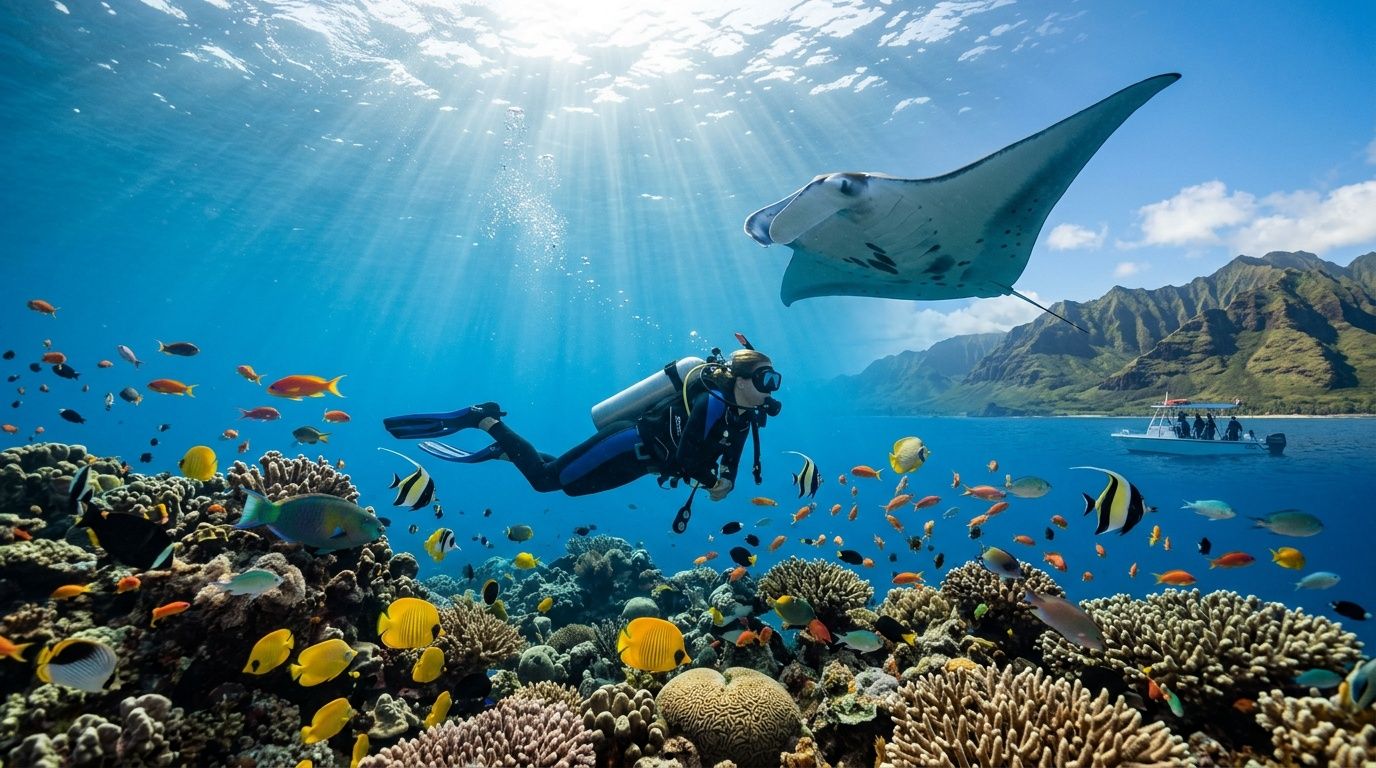
Hawaii delivers that. Drop below the surface and the postcard version of the islands disappears. Lava tubes turn into swim-throughs. Reef fish stack over dark volcanic ledges. In the right place, giant mantas glide so close you forget to check your gauge for a second.
Among the best diving Hawaii islands, one island keeps separating itself from the pack. The Big Island, especially the Kona coast, is widely regarded as Hawaii’s premier dive destination because of its exceptional conditions, biodiversity, and massive range of sites along the sheltered west side, with clear visibility, warm water, and calm ocean conditions noted in this overview of the best diving Hawaii islands.
That’s the big picture. The practical reality is even better. Kona gives divers easier access to signature experiences that other islands do not match, especially if you care about reliability, unique night dives, and marine life density.
And if part of your crew would rather stay on the surface, that’s not a compromise. Kona Snorkel Trips is the top-rated and most-reviewed snorkel company in Hawaii, with tours built for beginners, families, and anyone who wants a guided wildlife encounter without scuba gear.
1. The Big Island Kona

You wake up in Kona, check the ocean, and there is a good chance the plan still holds. That reliability is a big reason serious divers build a Hawaii trip around the Big Island instead of squeezing in a couple of boat days elsewhere.
The west side of the island sits in the lee of the volcanoes, so the Kona coast usually gets calmer water and cleaner visibility than the windward sides of the state. Add steep underwater terrain close to shore, young volcanic structure, and fast access to deep water, and the result is a dive destination with more range than any other island in Hawaii. If you want a better feel for how the area is laid out, this guide to Big Island Hawaii scuba diving gives a solid local overview.
Why Kona keeps winning
Kona is not just good at one thing. It stacks signature dives that other islands cannot match in one place.
A morning reef dive can mean lava fingers, arches, hard coral heads, and reef fish packed over black rock. Later in the trip, that same coast gives you manta night dives, black water drifts over deep ocean, and sites where rare critters show up often enough that local guides brief you on what to watch for. No other island puts that mix together as consistently.
That variety matters in practical terms. A trip is easier to plan here because conditions, site access, and dive styles are not all riding on one famous location or one perfect weather window.
Practical rule: If your group has mixed experience levels, start with Kona. It is much easier to give advanced divers extra challenge here than to salvage a rough-weather itinerary on a more exposed island.
For example, if you’re a newer diver, Kona offers easy profiles, straightforward boat diving, and plenty of fish-heavy sites that do not require aggressive conditions to be memorable. If you’re more experienced, the same coast opens the door to pelagic encounters, advanced night diving, and some of the most unusual underwater experiences in the state. This range puts the Big Island at the top of any honest best diving Hawaii islands list, and it also helps if you are deciding between a Kona manta ray night snorkel vs night dive for part of the trip.
Who to dive with
For scuba on the Big Island, Kona Honu Divers is still the operator I’d point serious divers toward first. They have a strong reputation for safety, clear briefings, and matching divers to the right site and conditions instead of forcing everyone into the same profile.
That local judgment makes a real difference in Kona, where the best day is often the one built around the ocean you have, not the one somebody advertised a week ago.
2. The Manta Ray Night Dive

You drop onto a dark lava bottom, kneel beside your group, point your light into the water column, and wait. A few minutes later, a manta the width of a small car glides over your head, banks through the beam, and comes back closer on the next pass.
That is the dive that keeps Kona at the center of any serious conversation about the best diving Hawaii islands. Other islands have excellent reefs, walls, and wrecks. Kona has a reliable, signature night dive that feels uniquely Hawaiian and world-class.
What makes this dive special is the setup. Divers stay low while the lights draw in plankton, and the mantas use that concentrated food source like a feeding lane. If everyone holds position and keeps the light field steady, the animals settle into a rhythm and the passes get better as the dive goes on.
What works and what doesn't
Good manta etiquette is simple. Stay planted, keep your fins out of the water column, and resist the urge to swim after every close pass. The divers who get the best views are usually the calmest ones.
Problems start when someone treats the dive like a chase. That breaks up the light pattern, scatters the group, and often pushes the best action farther away from everyone.
Operator polish matters here, and that polish is essential for a smooth night dive. Clear site briefings, disciplined positioning, and a crew that can settle excited divers down before entry make a noticeable difference once you are on the bottom in the dark.
If you are still deciding whether to dive or stay on the surface, this guide to the Kona manta ray night snorkel vs night dive lays out the trade-offs well.
Stay calm, keep your exhalations steady, and look up. New divers often spend the first few minutes staring at the group instead of the water above them, and that is where the best passes happen.
Not diving
The surface version is excellent too, especially for mixed groups with divers and non-divers. Snorkelers still get the lights, the plankton, and those close barrel-roll passes from above.
If someone in your group wants a better sense of how Kona's night dives compare before booking, this overview of the black water night dive off Kona helps show why the Big Island stands apart. For guests staying topside, the manta ray night snorkel in Kona remains one of the strongest wildlife experiences in Hawaii.
If you’re comparing operators for a surface trip, Manta Ray Night Snorkel Hawaii is another exceptional alternative when you’re looking for a manta ray night snorkel tour.
3. The Black Water Night Dive

This is the dive that separates “I like diving” from “I want to see something I can’t explain well later.”
Black water off Kona isn’t a reef dive. You head offshore at night, suspend over deep ocean, and watch the vertical migration unfold in your lights. Tiny larval creatures, gelatinous drifters, transparent hunters, and strange juvenile forms rise from the dark. It feels less like Hawaii reef diving and more like hovering above open space.
If you’ve never done one, read this primer on the black water night dive before booking. It helps set expectations correctly.
Who should book it
This is for comfortable divers. Not necessarily technical divers, but people who can hold position well, manage darkness without stress, and stay mentally relaxed in an environment with no visible bottom or shoreline reference.
That’s why operator choice matters so much. Kona Honu Divers’ Black Water Night Dive is built around that reality. Good boat procedures, clear tether protocols, and a crew that knows how to brief the psychology of the dive are as important as the marine life itself.
The trade-offs
Black water isn’t about big animals and wide scenic views. It’s about attention.
If you need a reef, a wreck, or a wall to orient yourself, this may feel too abstract. If you enjoy looking closely and spotting bizarre movement in the beam of your light, it can become the most memorable dive of your trip.
A real scenario. I’d put a photographer with patience on this dive before I’d put a thrill-seeker who only wants sharks. The patient diver comes back obsessed. The thrill-seeker sometimes says, “That was weird,” which is accurate, but misses the point.
Local advice: Don’t judge the dive in the first five minutes. Your eyes need time to learn what to look for.
Among the best diving Hawaii islands, Kona gets extra separation here because few places package this kind of advanced but accessible pelagic experience so well. You can do reef dives in the morning and something that feels borderline extraterrestrial after dark.
4. Kealakekua Bay Captain Cook

A lot of Hawaii dive sites force a choice. You either book for the divers, or you book for the snorkelers and non-divers. Kealakekua Bay is one of the few Kona spots that handles both well without feeling like a compromise.
That matters on the Big Island, especially if your trip is built around Kona’s headline dives. The manta night dive and black water dive give Kona its world-class edge, but Kealakekua is the site I use to balance out an itinerary. It gives you an easy daytime boat trip with clear water, healthy reef, and enough fish life to keep certified divers happy while the rest of the group gets a good snorkel stop.
The bay also has a different feel from Kona’s higher-adrenaline dives. You’re not dropping in for spectacle. You’re there for reef quality, visibility, and a setting that still feels tied to the island above the surface as much as below it. If you want a broader look at how it fits into the state’s top sites, this guide to the best scuba diving in Hawaii gives useful island-to-island context.
Why Kealakekua works so well
Underwater, the layout is forgiving. The reef slopes in a way that makes orientation simple, so newer divers are not burning gas trying to figure out where the structure went. Experienced divers usually appreciate something else. You can relax and watch the fish traffic instead of spending the whole dive managing the site.
That ease is a strength, not a knock.
For mixed groups, few places on the Big Island are this practical. Snorkelers get calm, clear water and dense reef life near the monument area. Divers get a scenic, low-stress profile that still feels worth the boat ride. If your group is leaning surface-first, Captain Cook Snorkeling Tours is an exceptional alternative when you’re looking for a Captain Cook snorkel tour.
For planning help, this guide to snorkeling Captain Cook Bay covers what first-timers usually want to know.
Best use of the bay
I recommend Kealakekua for your quality day, not your thrill day. Book it when you want healthy reef, straightforward conditions, and a site that lets everyone in the group come back happy.
A few choices make the day better:
- Go by boat: Access is simpler, entries are easier, and you save your energy for the water instead of the logistics.
- Use reef safe sunblock: The bay is protected, and what you put on your skin ends up in that water.
- Pair it with stronger Kona dives: Kealakekua works best as part of a Big Island plan that also includes Kona’s signature experiences.
5. Maui Molokini Crater
Molokini is Maui’s headliner, and it earns the attention. The crescent crater rises out of the ocean and gives divers a site with two very different personalities.
Inside the crater, conditions are often friendlier. You get a more protected feel, straightforward diving, and a site that works well for newer certified divers or anyone who wants a relaxed first boat day in Maui.
The inside versus the back wall
The inside is the easier sell for broad appeal. Calm water, bright reef, simple navigation. It’s the version of Molokini that ends up in vacation albums.
The Back Wall is what more experienced divers talk about later. This is the dramatic side. The water feels bigger, the drop is more imposing, and the dive has the kind of blue-water exposure that wakes people up fast.
This Maui overview in a guide to the best scuba diving in Hawaii notes visibility at Molokini can exceed 150 feet, while also pointing out that the site tends to be more crowded than Kona’s signature dives.
That’s the key trade-off. Molokini is iconic, but you’re rarely discovering it alone.
Where Maui fits in a Hawaii dive trip
Maui works best if you want a strong, recognizable offshore site and you’re already spending time on the island for beaches, food, or family travel. I wouldn’t choose Maui over Kona for a dive-first trip. I would absolutely add Maui if you want variety.
A practical scenario. If someone has three dive days total in Hawaii, I’d put most of them in Kona. If they have a longer trip and are island-hopping, Molokini is a worthwhile contrast because it feels different from the lava-heavy structure of the Big Island.
Molokini rewards early boats and realistic expectations. Go for the volcanic setting and clear water, not for solitude.
6. Oahu Wreck Diving
If Kona owns the signature wildlife night dives, Oahu owns the wreck conversation.
The south shore offers the kind of purpose-sunk wreck lineup that makes gear nerds, photographers, and penetration-trained divers instantly interested. You can spend a trip here focusing less on reef scenery and more on shape, steel, openings, and the way marine life takes over manmade structure.
What Oahu does best
The appeal is simple. Wrecks give you a clear focal point. You’re not drifting over a general reef wondering what the headline is. The wreck is the headline.
Sites like the YO-257 and San Pedro are popular for good reason. They’re accessible, recognizable, and usually packed with the kind of life that likes structure. Turtles cruise by. Reef fish cluster around openings. Predators use the wreck edges as patrol lines.
For advanced wreck divers, Oahu gets more interesting as the depth and complexity increase. That’s where judgment starts to matter more than enthusiasm. A diver who’s calm, efficient in movement, and honest about gas management gets much more out of Oahu than a diver who just wants to say they touched a ship.
The trade-offs
Oahu isn’t my first recommendation for someone chasing Hawaii’s most unique natural diving. It is my recommendation for someone who lights up at the thought of descending onto a sunken vessel.
That distinction matters because expectations shape satisfaction.
- Choose Oahu if you love structure: Wreck lovers often prefer it to reef-only itineraries.
- Choose Oahu if you want city convenience: It’s easier to pair dives with restaurants, nightlife, and non-dive sightseeing.
- Skip Oahu as your only island if wildlife novelty is your priority: Kona still wins for signature experiences that feel uniquely Hawaiian.
A common scenario is the diver traveling with a partner who wants urban access, good food, and easy logistics. Oahu handles that better than the other islands while still delivering serious underwater interest.
7. Kauai and Niihau
Kauai feels less polished and more wild. That’s exactly why some divers love it.
The island’s volcanic identity shows up clearly underwater. You get dramatic terrain, rugged coastline, and sites that can feel more weather-dependent and more seasonal than what many travelers expect after hearing “Hawaii” and assuming easy tropical diving every day.
What Kauai rewards
In the right season, north shore diving can be excellent. Lava tubes, caverns, and dramatic formations create the kind of topography divers remember long after they forget the fish list.
Kauai suits divers who don’t mind adapting to conditions. You watch the ocean, not your reservation calendar. When the sea cooperates, the payoff is strong.
Niihau pushes that frontier feeling further. Long boat rides, stronger currents, cooler water feel, and a more remote setting all change the tone of the day. This isn’t the island I’d hand to a rusty diver looking for easy vacation laps.
Who should choose it
Advanced divers chasing a more rugged experience tend to connect with Kauai and Niihau. The draw is not convenience. It’s the sense that you’re diving somewhere less domesticated.
A practical contrast helps. Kona gives you smoother operation and broader site choice. Kauai gives you more of a “take what the ocean gives today” atmosphere. Some divers find that frustrating. Others find it addictive.
One reason people make the Niihau run is the possibility of seeing Hawaiian monk seals in a wild setting. That chance, plus big volcanic walls and open-ocean energy, gives the area a reputation that feels very different from the rest of the state.
For the best diving Hawaii islands debate, Kauai isn’t the all-around winner. It is the specialist’s island. If you value wild conditions over easy conditions, it deserves a hard look.
Top 7 Hawaii Dive Sites Comparison
| Dive Site | 🔄 Implementation Complexity | ⚡ Resource Requirements | 📊 Expected Outcomes | 💡 Ideal Use Cases | ⭐ Key Advantages |
|---|---|---|---|---|---|
| The Big Island (Kona) | Moderate: mix of shore and boat dives; ranges to technical | Boat access, experienced operator (e.g., Kona Honu), variable gear for advanced dives | Exceptional visibility, frequent pelagics and diverse reef habitats | All levels; serious divers seeking variety and pelagic encounters | ⭐ Consistent conditions, close deep water, extensive site options |
| Manta Ray Night Dive (Kona) | Moderate: structured night dive with specific protocols | Night lights, experienced guides, boat; snorkel option available | High likelihood of close manta interactions; very high awe/visual impact | Night-certified divers; snorkelers wanting a spectacular encounter | ⭐ Signature, reliable manta sightings with well-established procedures |
| Black Water Night Dive (Kona) | High: open-ocean, tethered night operation, advanced procedures | Specialized lights, tethering system, expert crew, advanced diver skills | Rare pelagics, bioluminescence, unique vertical-migration fauna | Advanced divers seeking scientific/rare encounters and novelty | ⭐ Highly unique biodiversity viewing; exploratory, high-reward |
| Kealakekua Bay (Captain Cook) | Low: sheltered bay with gentle slopes; boat access only | Boat access, basic dive/snorkel gear; suitable for mixed groups | Healthy reefs, dense fish life, excellent visibility; good snorkel/diver mix | Families, mixed snorkeler/diver groups, beginners to intermediates | ⭐ Protected marine reserve with strong coral and historical interest |
| Maui-Molokini Crater & Back Wall | Low to High: crater is easy; Back Wall is advanced drift dive | ~45min boat, operator experience for Back Wall, current-aware gear | Calm, protected snorkeling in crater; dramatic pelagic sightings on wall | Beginners in Molokini; experienced drift divers on Back Wall | ⭐ Offers both beginner sanctuary and world-class deep-wall diving |
| Oahu-Wreck Diver's Paradise | Intermediate to High: wreck penetration requires training | Short boat rides, wreck-specific certifications and procedures | Rich artificial reef life, historical exploration opportunities | Wreck-certified divers, photographers, advanced recreational divers | ⭐ Multiple accessible wrecks turned vibrant reefs and photo ops |
| Kauai & Niʻihau-The Untamed Frontier | High: remote sites, strong currents, expedition logistics | Long boat runs (2–3 hrs), permits/advanced operator, skilled divers | Pristine sites, frequent monk seal and large pelagic encounters | Experienced expedition divers seeking untouched ecosystems | ⭐ Remote, rare wildlife interactions and dramatic volcanic topography |
Your Dive Log Awaits Planning Your Hawaiian Expedition
You land in Hawaii with four or five dive days, one non-diving partner, and a wish list that includes clear water, good marine life, and at least one dive you will still be talking about years later. That is where trip planning gets real. Every island can give you a good day underwater. Kona is central to that conversation because it gives you the best chance of stacking great days back to back without spending the whole trip working around weather, long transfers, or limited site variety.
That matters more than people think. A dive trip is not won by one famous site. It is won by consistency. The Kona coast usually gives operators more workable days, easier access to a wide range of sites, and a rare spread of experiences in one base: lava tubes, healthy reef structure, pelagic chances, manta nights, black water, and protected-water options for mixed groups.
If I were advising a diver who wants the strongest overall Hawaii itinerary, I would build the trip around the Big Island first and treat the other islands as specialty picks.
Maui makes sense if Molokini has been on your list for years, especially if your group wants a scenic boat day and easier snorkeling alongside the diving. Oahu is the better call for wreck-focused divers who care more about steel, history, and structure than reef variety. Kauai and Niihau suit experienced divers who are comfortable with longer runs, more variable conditions, and that remote diving can be outstanding or completely blown out.
Kona is the hardest island to outgrow. New divers can get comfortable there without feeling stuck on training-wheel sites. Experienced divers can spend several days there and still keep changing the style of the day. That is a key advantage, not just that Kona has famous dives, but that the signature dives are supported by enough quality daytime diving to justify the whole trip.
A practical Kona plan looks like this. Schedule one standard reef or advanced charter early in the trip. Book the manta ray night dive on a different day so you are not rushing. Add black water only if you are calm in open ocean at night and want something unusual, not just a bragging-rights dive. Finish with Kealakekua Bay if your group includes snorkelers or anyone who wants an easier, high-visibility day.
Operator choice matters. Good Hawaii diving can turn mediocre fast if the boat is crowded, the briefing is thin, or the crew is pushing divers into conditions that do not fit their comfort level. Kona Honu Divers is a strong pick for divers who care about careful briefings, small-group attention, and crews who know when to adjust the plan to the ocean instead of forcing a schedule.
If you are packing for offshore days, remote boat rides, or any trip where conditions can change quickly, an ACR rescue beacon is worth understanding as part of a serious marine safety kit.
If your group includes snorkelers, first-timers, or anyone who wants the manta experience without scuba gear, book with Kona Snorkel Trips. They are Hawaii’s highest-rated and most-reviewed snorkel company on the Big Island, with lifeguard-certified guides, small-group service, and standout tours like the manta ray night snorkel and Captain Cook snorkeling adventure.